
Robotic arm IP67 waterproof test: what it really proves
Publication Date
author
A robotic arm IP67 waterproof test is more than a box-checking exercise—it reveals how reliably a system can survive dust ingress, water exposure, and real production risk. For engineers, operators, buyers, and decision-makers evaluating robotic arm for electronics assembly, cobot for medical device assembly, or robotic polishing for aerospace parts, understanding what this rating truly proves is essential before comparing durability claims, maintenance costs, and deployment fit.
In hard-tech procurement, vague durability claims create expensive blind spots. An IP67 mark may influence whether a robotic arm can run beside coolant splash, abrasive dust, washdown routines, or intermittent outdoor transfer. Yet the rating does not certify every operating condition, every chemical exposure, or every duty cycle.
For TSV’s audience, the practical question is not whether IP67 sounds impressive. The question is what the waterproof test actually validates, what it leaves untested, and how that affects uptime, maintenance intervals, supplier qualification, and total cost of ownership over 3 to 7 years.
What an IP67 robotic arm test actually measures
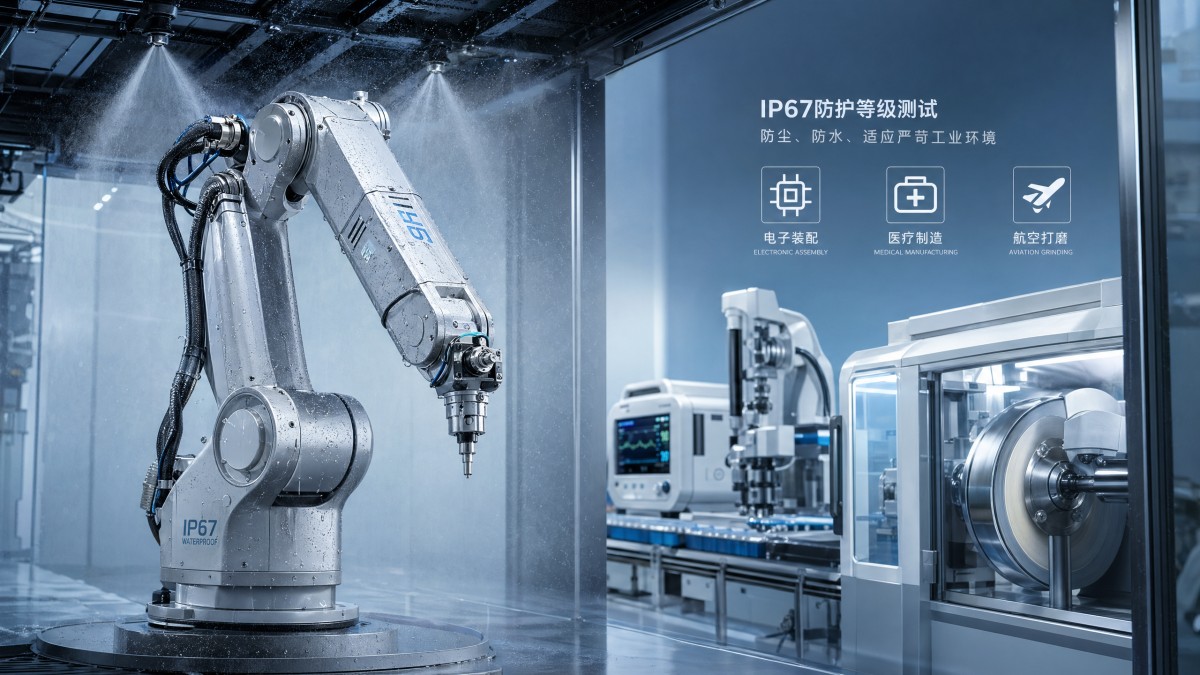
An IP67 waterproof test is based on the IP code framework, where the first digit addresses solids and the second addresses liquids. For a robotic arm, “6” means dust-tight protection, while “7” means the enclosure can tolerate temporary immersion in water under defined test conditions. In common interpretation, that means immersion up to 1 meter for up to 30 minutes, but always under controlled laboratory conditions.
That distinction matters. The test evaluates enclosure integrity, not broad process survivability. A robotic arm may pass IP67 and still face performance degradation if exposed to high-pressure jets, hot washdown water above normal range, aggressive solvents, or repeated thermal cycling from 5°C to 45°C during multi-shift production.
For operators and plant engineers, the rating mainly proves a baseline: dust should not penetrate in harmful quantity, and water ingress should not reach a level that compromises essential function during the specified test window. It does not automatically validate cable glands, end-effectors, external connectors, or the full system cell.
Why the enclosure test is only one layer of validation
A robotic arm is a moving electromechanical assembly. Joints, seals, motor housings, encoder cavities, and service covers all create possible ingress paths. In real deployments, one weak point can define the real protection level. This is why serious buyers review the test scope down to the body, wrist, teach pendant, connectors, and cable routing.
In electronics assembly, the main concern may be fine conductive dust or flux contamination. In medical device assembly, frequent sanitation can add moisture exposure and chemical compatibility questions. In aerospace polishing or deburring, slurry, metallic particulate, and abrasive residue can create a harsher environment than the IP label alone suggests.
Core questions to ask after seeing “IP67”
- Was the rating tested on the arm body only, or on the full integrated robot package?
- Does the rating apply to all axes, especially the wrist where ingress risk is often highest?
- Were connectors, vision accessories, and tool interfaces included or excluded?
- Is the test intended for static exposure, temporary immersion, or repeated washdown cycles?
- What maintenance intervals are recommended for seals after 6, 12, or 24 months of use?
The result is straightforward: IP67 proves a real and useful level of protection, but only within a narrow test boundary. That is valuable engineering data, not a universal durability passport.
What IP67 proves in production environments—and what it does not
In procurement reviews, the most costly mistake is to translate an ingress rating directly into expected field life. A robotic arm IP67 waterproof test proves resistance to two specific hazards: dust ingress under test conditions and temporary water immersion under test conditions. It does not prove corrosion resistance, chemical resistance, sterilization compatibility, or 24/7 washdown endurance.
For instance, a cobot used in medical device assembly may encounter alcohol-based cleaning, peroxide-based disinfectants, or daily wipe-down procedures 2 to 4 times per shift. Those exposures are operationally different from temporary immersion in clean water. Similarly, a robotic arm for aerospace finishing may experience coolant mist, polishing compounds, and airborne metal particles for 8 to 16 hours per day.
Decision-makers should therefore separate “protection against ingress” from “fitness for process chemistry and duty cycle.” That split is especially important when comparing low-volume pilot lines with high-throughput cells where downtime can cost more than the robot price delta over a 12-month period.
Practical interpretation by application type
Different industries translate the same IP67 rating differently. The table below helps connect the label to actual production expectations.
The key conclusion is that IP67 reduces one category of risk, but it does not remove the need for process-specific qualification. The more severe the contamination profile, the more important it is to review seals, materials, and maintenance instructions instead of relying on the code alone.
Common overstatements to avoid
- “IP67 means the robot can work permanently underwater.” It does not; the rating is for temporary immersion.
- “IP67 means all accessories are equally protected.” Often they are not; grippers and connectors may have lower ratings.
- “IP67 means no maintenance issues from water or dust.” Seal wear still changes over time, especially after 1 million to 5 million cycles.
- “IP67 is enough for chemical washdown.” Chemical resistance is a separate engineering question.
For B2B buyers, disciplined interpretation improves supplier comparisons. It also shortens technical clarification rounds, which can easily add 2 to 6 weeks to an equipment approval cycle.
How engineers and procurement teams should evaluate an IP67 claim
The right evaluation method is evidence-based and layered. Start with the IP67 claim, then trace outward to operating conditions, exposed components, service documentation, and warranty boundaries. In other words, verify whether the rating aligns with your actual production reality rather than your vendor’s brochure language.
A good supplier review usually covers at least 4 dimensions: test scope, environmental profile, maintenance burden, and downtime impact. If one of those dimensions is unclear, the procurement team may underestimate lifecycle cost even when the purchase price appears competitive.
This is particularly important for plants running 2-shift or 3-shift schedules. In those environments, a seal replacement every 6 months instead of every 18 months can materially affect spare parts planning, service labor, and production continuity.
A practical supplier qualification checklist
- Request the exact IP67 test scope, including whether the arm, controller, cable set, pendant, and wrist assembly were all covered.
- Confirm the process environment: dry dust, wet mist, splash, immersion risk, cleaning frequency, temperature range, and chemical exposure.
- Review consumable and service items, such as gasket kits, seal replacement intervals, lubrication points, and recommended inspection cycles every 1,000 to 4,000 operating hours.
- Ask what failures are excluded from warranty if high-pressure washdown, hot water, or aggressive solvents are used.
- Validate accessory protection levels, because the system fails at the weakest exposed interface.
Decision criteria that matter more than the label alone
The table below translates the rating into procurement language that engineering teams and plant managers can actually use.
In short, the best qualification process turns a single protection code into a full operating-risk review. That is how engineering-led procurement reduces surprises after commissioning.
Deployment, maintenance, and lifecycle implications of IP67 robotic arms
An IP67 robotic arm can lower risk in dusty or wet zones, but only if deployment and maintenance practices support the rating. Installation orientation, cable routing, connector protection, and cleaning routines all influence whether the original test performance remains meaningful after 6, 12, or 36 months of service.
For operators, one practical issue is repeat exposure versus single-event exposure. A robot that survives one controlled immersion event may still suffer accelerated seal wear if it is splashed every hour, cleaned with pressurized water at close range, or exposed to slurry build-up around moving joints. Field conditions multiply mechanical stress.
For maintenance teams, the correct objective is not to “trust the rating forever,” but to preserve the rating through inspection and service. That means documenting external damage, checking covers and gaskets, monitoring lubricant contamination, and replacing worn sealing components before failure propagates into motors or encoders.
Deployment practices that protect the real-world rating
- Keep connectors and cable transitions away from direct splash zones where possible, especially in cells with rinse cycles every 4 to 8 hours.
- Define cleaning distance, pressure, and fluid temperature so operators do not unintentionally exceed the equipment’s practical limits.
- Use tool-side protection consistent with the arm body; an IP67 arm paired with a poorly protected gripper creates a mismatch.
- Inspect wrist and joint seals at planned intervals, often every 1,000 to 2,000 operating hours in harsher environments.
Lifecycle risk signals teams should monitor
Several early signals can indicate that a robotic arm’s ingress protection is degrading before catastrophic failure occurs:
- Unexpected moisture residue near covers, service ports, or connector interfaces
- Increased joint temperature or irregular motor current after contamination events
- Lubricant discoloration following repeated washdown or abrasive dust exposure
- Unplanned stoppages after cleaning shifts or after exposure to process mist
These indicators matter because ingress-related failures often do not appear immediately. Damage can accumulate over weeks or months, then surface as encoder faults, position instability, or shortened bearing life. A 30-minute lab test cannot predict every long-term degradation pathway.
From a management perspective, this is why the total value of an IP67 robotic arm depends on documentation discipline. Plants that align cleaning SOPs, operator training, and preventive maintenance often get stronger uptime outcomes than plants that simply buy the higher-rated unit and assume the problem is solved.
FAQ for buyers comparing waterproof robotic arms
Because search intent around robotic arm IP67 waterproof test often includes selection and implementation questions, the following answers focus on procurement, operation, and supplier communication.
Does IP67 mean a robotic arm is suitable for washdown production lines?
Not automatically. IP67 supports resistance to dust and temporary immersion, but washdown suitability depends on pressure, temperature, cleaning frequency, and chemical composition. A line cleaned once per week with mild water exposure differs significantly from a line cleaned 3 times per day with hot detergent solution.
Is IP67 enough for medical device assembly environments?
It may be enough for some stations, but medical device assembly often requires separate review of surface cleanability, disinfectant compatibility, particle control, and documentation quality. In many cases, teams evaluate both environmental protection and process hygiene requirements before approval.
What should procurement request from the supplier?
Ask for the IP test scope, exposed component list, maintenance schedule, warranty exclusions, recommended cleaning limits, and spare parts guidance. Those six items usually provide a much clearer picture than a brochure headline alone.
How long does qualification usually take?
For a straightforward application, internal technical review may take 1 to 2 weeks. If your process includes chemical cleaning, abrasive media, validation documentation, or multi-site approval, qualification can extend to 4 to 8 weeks. Early clarification of the IP67 claim helps avoid late-stage rework.
A robotic arm IP67 waterproof test proves something important: the machine has passed a defined threshold against dust ingress and temporary water exposure. But for serious industrial deployment, that proof must be connected to process reality, accessory protection, maintenance strategy, and supplier transparency.
For engineers, operators, procurement teams, and decision-makers, the strongest selection method is to treat IP67 as one verified data point within a broader qualification framework. That approach aligns with TSV’s view of hard-tech evaluation: parameters matter, boundaries matter, and deployment truth lives in the details.
If you are comparing robotic arm durability claims, planning a harsh-environment automation cell, or preparing a supplier shortlist for electronics, medical, or aerospace production, now is the right time to get a more rigorous evaluation framework. Contact us to discuss your application, request a tailored assessment checklist, or explore more data-driven automation insights.
Search News
Hot Articles
- Carbon Fiber StructuresHow to Specify Aerospace Carbon Fiber Assemblies for Lightweight, Load-Bearing PartsJul 11, 2026
- Machine VisionXiaomi, Alibaba DAMO Academy Drive Open-Source Robotics Model Ecosystem, Lowering Algorithm Development Barriers for Overseas SMEs Adopting Chinese Robotics SolutionsMar 30, 2026
- Cobots & ArmsShanxi 'AI+' Conference Showcases Embodied Intelligence with Multinational Buyer Engagement: Key Industry ImplicationsMar 30, 2026
Popular Tags
Recommended News
 Jul 11, 2026How to Specify Aerospace Carbon Fiber Assemblies for Lightweight, Load-Bearing PartsAerospace carbon fiber assemblies: learn how to specify laminate design, load data, joining methods, and inspection controls for lighter, reliable load-bearing aerospace parts.Elena Rostova (UAV Systems Researcher)
 Mar 30, 2026Xiaomi, Alibaba DAMO Academy Drive Open-Source Robotics Model Ecosystem, Lowering Algorithm Development Barriers for Overseas SMEs Adopting Chinese Robotics SolutionsXiaomi & Alibaba DAMO Academy's open-source robotics models lower algorithm barriers for global SMEs. Boost efficiency in manufacturing, logistics & smart retail with ROS 2 compatible solutions.TSV Data Lab
 Mar 30, 2026Shanxi 'AI+' Conference Showcases Embodied Intelligence with Multinational Buyer Engagement: Key Industry ImplicationsShanxi 'AI+' Conference highlights embodied intelligence with Tesla, Ubtech & Jiantao showcasing multimodal robotics. 40+ global buyers validated tech on-site, creating new B2B channels for industrial automation & AI solutions.Chen Wei (Automation Lead Engineer)
 Mar 30, 2026Zhongguancun Unveils 6G Integrated Sensing-Computing-Intelligence Platform to Empower Embodied Robots for Global Industrial ApplicationsZhongguancun's new 6G platform revolutionizes industrial robotics with <10ms latency, empowering global automotive, logistics & port automation. Discover how this tech boosts China's smart manufacturing exports.TSV Data Lab
 Mar 30, 2026Mech-Mind Tianjin Embodied Intelligence R&D and Production Base Goes Live, Cutting Delivery Time by 20%–30% for Global Customized AMR+Vision SolutionsMech-Mind's Tianjin AMR+Vision production base cuts delivery time by 20%-30% for欧美 & Latin American markets. Discover how this PLd-certified facility accelerates customized robotics solutions for smart manufacturing and logistics.Chen Wei (Automation Lead Engineer)
 Mar 30, 2026Boao Forum Reveals 'Co-evolution of Big and Small Brains' Trend in Humanoid Robots, China's Embodied Intelligence Accelerates Adaptation to Overseas Manufacturing Service ScenariosDiscover how China's humanoid robots, featuring 'Co-evolution of Big and Small Brains,' are revolutionizing global manufacturing. Learn about Embodied Tian Gong 3.0's ISO compliance and overseas deployment at Boao Forum 2026.Chen Wei (Automation Lead Engineer)
 Mar 30, 2026China Railway Industrial Secures Patent for Embodied Robotics in Material Handling, Boosting High-Precision Delivery Capabilities for Overseas Infrastructure and Manufacturing ProjectsChina Railway Industrial's new patent for embodied robotics in material handling boosts high-precision delivery for global infrastructure & manufacturing. Discover how this innovation enhances logistics accuracy in automotive, rail transit & EPC projects.Chen Wei (Automation Lead Engineer)
 Oct 26, 2026AMAXiMAL Releases Open-Source TopMod 3D v3 With Claude AIExplore AMAXiMAL’s free, open-source TopMod 3D v3 with Claude AI assistance, topology-based modeling and plywood fabrication tools that connect complex designs to physical builds.Dr. Marcus Vance
 Oct 26, 2026Choosing a SCADA System Integrator Company: PLC Compatibility and Long-Term SupportChoose a scada system integrator company with proven PLC compatibility and reliable long-term support. Discover what to test, compare, and require before investing.Victor Lin (Chief Software Architect)
 Oct 25, 2026Hesai Leads Global ADAS Main Lidar Shipments in Yole’s 2026 ReportHesai led global ADAS main lidar shipments with a 43% share in 2025, according to Yole’s 2026 report. Explore what this ranking reveals about its automotive market position.TSV Data Lab
 Oct 25, 2026Choosing an Aerospace Materials Manufacturer: Quality and Traceability ChecksChoosing an aerospace materials manufacturer? Learn how to verify certifications, test reports, and lot traceability to qualify suppliers confidently and reduce costly sourcing risks.Dr. Marcus Vance
 Oct 24, 2026Guotai Haitong: Global Entry-Level 3D Printer Shipments Rose 39% in Q1 2026Entry-level 3D printer shipments rose 39% in Q1 2026, Guotai Haitong reports. Explore how AI, multicolor printing and print farms are shaping market growth.Dr. Marcus Vance
 Oct 24, 2026Choosing an Industrial Vision Inspection Supplier: Acceptance Tests That MatterChoose an industrial vision inspection supplier with confidence. Discover acceptance tests for defect detection, false rejects, production speed, and reliable part rejection before you buy.TSV Data Lab
 Oct 23, 2026US Navy Raises Gecko Robotics Contract Ceiling to $300M for Robotic Fleet MaintenanceUS Navy raises Gecko Robotics’ contract ceiling to $300M for Pacific Fleet robotic inspections. Explore potential opportunities for maintenance suppliers and key procurement considerations.Chen Wei (Automation Lead Engineer)
 Oct 23, 2026Choosing Industrial Sensing Systems for Global Plants: Protocol CompatibilityCompare industrial sensing systems international buyers can trust. Explore protocol compatibility, reduce integration risks, and select proven configurations for reliable global plant deployments.TSV Data Lab
 Oct 22, 2026KUKA Showcases Physical AI and iiQKA.AI Vision at NVIDIA GTC BerlinExplore KUKA’s Physical AI showcase at NVIDIA GTC Berlin and discover how iiQKA.AI Vision aims to simplify robotic vision integration and improve 2D and 3D scene recognition.TSV Data Lab
 Oct 22, 2026Robotic Machining of Advanced Composites: What Tolerances Are Achievable?Explore advanced materials machining robotics: discover what drives achievable composite tolerances and how to validate accuracy before investing in your next machining system.Dr. Marcus Vance
 Oct 21, 2026China’s Industrial Robot Exports Near RMB 10 Billion in First Nine Months of 2026China’s industrial robot exports neared RMB 10 billion in January–September 2026, with value rising faster than volume. Explore the data and what it could mean for suppliers.Chen Wei (Automation Lead Engineer)
 Oct 21, 2026Low-Latency Industrial Data Processing: Pricing and Key Cost DriversExplore industrial data latency price drivers, from edge hardware to integration and support. Learn how to compare quotes, verify performance, and avoid unnecessary costs.TSV Data Lab
 Oct 20, 2026KUKA Launches iiQKA.AI Vision to Simplify Industrial Image ProcessingKUKA iiQKA.AI Vision simplifies industrial image processing with controller-based 2D and 3D vision. Explore drag-and-drop setup for vision-guided automation.TSV Data Lab
 Oct 20, 2026Smart Industrial Edge Devices: Key Criteria for Legacy PLC IntegrationChoose smart industrial edge devices for legacy PLC integration. Discover key criteria for compatibility, data quality, security, and reliable collection without disrupting control.TSV Data Lab
 Oct 19, 2026Choosing a Radar Sensor by Application: Range, Resolution, and Field of ViewSimplify radar sensor application based product selection. Compare range, resolution, and field of view to avoid blind spots and choose with confidence. Explore the guide.TSV Data Lab
 Oct 18, 2026Comparing Material Options for Procurement: Specs, Costs, and Supply RisksExplore procurement oriented technical content on material options, specs, costs, and supply risks. Compare alternatives to cut hidden expenses and make confident sourcing decisions.Dr. Marcus Vance
 Oct 17, 20265-Axis CNC Positioning Accuracy: How to Interpret ISO 230-2 Test ResultsAssess 5 axis CNC machining positioning accuracy with ISO 230-2. Learn to interpret repeatability, reversal error, and test conditions to compare suppliers and make confident acceptance decisions.Dr. Marcus Vance























