Industrial robots performance benchmarking gets tricky with cycle time claims
Publication Date
author
Industrial robots performance benchmarking should clarify real-world capability, yet cycle time claims often obscure the data technical evaluators actually need. For engineering-led sourcing and validation, the key is not headline speed but test conditions, payload context, repeatability, and duty-cycle transparency. This article examines why benchmark comparisons become unreliable—and how to separate marketing language from engineering truth.
Why scenario differences matter more than headline speed
For technical evaluators, industrial robots performance benchmarking is rarely a single-number exercise. A cycle time that looks impressive in a brochure may be measured with a short move, light payload, ideal acceleration tuning, and no end-effector variation. In a real production line, however, the robot may be handling offset centers of gravity, vision-guided part correction, tool changes, conveyor tracking, or extended dwell periods for process stability.
That is why benchmark interpretation must start with application context. A robot selected for high-speed packaging should not be evaluated the same way as a robot intended for machine tending, palletizing, adhesive dispensing, or precision electronics assembly. Each scenario places different stress on kinematics, control loops, thermal behavior, path consistency, and uptime. When cycle time claims are detached from those conditions, industrial robots performance benchmarking becomes vulnerable to misleading comparisons.
At TechStat Vanguard, the practical question is not “Which robot is fastest on paper?” but “Which benchmark design reveals the truth for this use case?” That framing is especially important for sourcing teams that need to reduce qualification risk, avoid expensive line redesign, and align robot selection with actual throughput goals.
Where cycle time claims usually appear in real business scenarios
In practice, cycle time claims influence buying decisions in several recurring industrial settings. The metric becomes especially visible when procurement teams are under pressure to compare multiple vendors quickly, often before a full pilot cell has been built. The danger is that identical-looking numbers may describe very different test realities.
1) High-volume pick-and-place lines
This scenario prioritizes short repetitive motion, low payload variation, and tight takt time. Here, cycle time can be meaningful, but only if evaluators confirm approach distance, gripper actuation delay, part presentation consistency, and whether acceleration limits were increased beyond sustainable duty conditions.
2) Machine tending and CNC loading
The robot’s total contribution to productivity depends not only on travel speed but also on door opening logic, chuck confirmation, part orientation tolerance, and safety interlocks. A fast dry-cycle benchmark may overstate real output if the robot must pause for machine handshakes or part verification steps.
3) Palletizing and heavy-payload transfer
In this environment, payload percentage, reach, and stability at extended arm positions matter more than a generic cycle number. A robot may complete a benchmark quickly with a nominal payload centered close to the flange, yet slow down significantly when handling long cartons or off-center loads at full stacking height.
4) Precision assembly and electronics handling
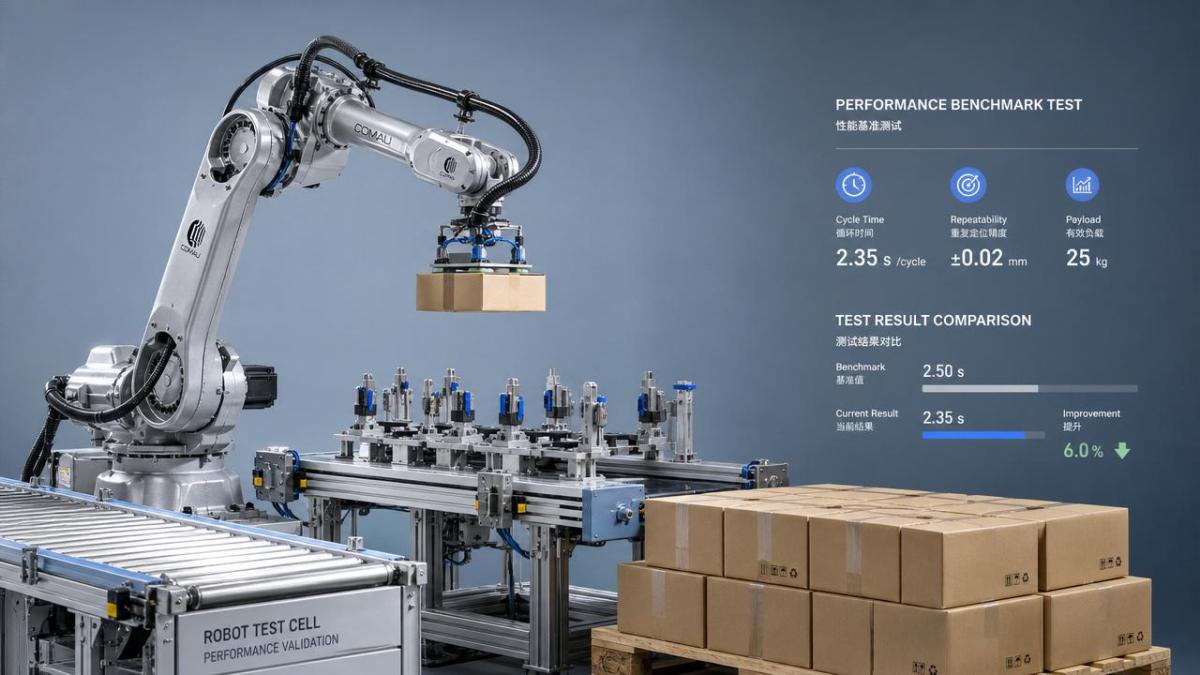
This is the opposite of brochure-driven speed selling. In precision assembly, repeatability under thermal drift, vibration behavior, force-control consistency, and path smoothness can matter more than raw motion time. A slightly slower robot may deliver better yield and less downstream rework.
5) Vision-guided sorting and mixed-SKU handling
When robot motion is linked to camera latency, object localization uncertainty, and dynamic path updates, cycle time becomes a system-level metric rather than a robot-only metric. In such cases, industrial robots performance benchmarking must include sensing, controller communication, and exception recovery behavior.
A scenario comparison table for technical evaluators
The table below shows why industrial robots performance benchmarking should be adjusted to the application instead of relying on universal speed claims.
Why cycle time claims become unreliable in benchmarking practice
Most benchmark distortion happens because cycle time is easy to advertise but difficult to normalize. A vendor may use a favorable path profile, low payload, reduced settling requirement, or selective endpoint definition. Another may include tool-open and tool-close delays, while a third excludes them entirely. On paper, all three publish a “cycle time,” but the engineering meaning is different.
Technical evaluators should pay close attention to at least six variables. First, payload mass and inertia. A 5 kg centered payload does not behave like a 5 kg offset payload. Second, travel path geometry. A short, repeatable arc is not comparable to a long multi-axis move around fixtures. Third, acceleration and jerk tuning. A robot can look faster in short tests but become unstable, hotter, or less accurate across long shifts. Fourth, repeatability criteria. Was the endpoint tolerance strict enough for the target process? Fifth, duty cycle. Continuous production behavior is often very different from demonstration behavior. Sixth, integration conditions. Safety zones, conveyor synchronization, and sensor feedback frequently dominate real takt time.
This is exactly where industrial robots performance benchmarking needs rigor. Without a common benchmark protocol, the evaluator may compare commercial narratives instead of technical evidence.
What different evaluation teams should focus on
Not every stakeholder reads benchmark data the same way. The same cycle time claim can mean one thing to automation engineering and another to procurement leadership. Good evaluation practice separates these viewpoints while keeping them linked to one application scenario.
For automation engineers
Focus on motion profile transparency, payload envelope, path accuracy, controller behavior, and recovery logic. Ask whether the benchmark includes realistic part tolerances and whether the robot remains stable over extended thermal cycles.
For technical sourcing teams
Prioritize benchmark comparability. Require all bidders to use the same workpiece, same tool assumptions, same path definition, and same pass/fail criteria. A slightly slower benchmark with better documentation is often less risky than a faster result with ambiguous conditions.
For plant operations leaders
Look beyond seconds per cycle and ask what happens during stoppages, resets, maintenance windows, and product changeovers. Operational throughput depends on recoverability and consistency as much as peak speed.
For CTOs and capital approval stakeholders
Connect industrial robots performance benchmarking to business outcomes: yield, line balancing, staffing assumptions, spare strategy, and expected payback sensitivity if real takt falls below brochure claims. Capital decisions become stronger when benchmark data is tied to process economics rather than headline motion metrics.
Common scenario mistakes that distort robot selection
One frequent mistake is using demo-cell speed to justify a robot for a high-mix environment. If product geometry varies, gripping changes, and vision corrections are common, pure dry-cycle performance will not predict line behavior. Another mistake is assuming repeatability values guarantee process success. Published repeatability often refers to controlled test conditions and may not reflect fixture compliance, tooling deflection, or thermal drift in the actual cell.
A third mistake is underestimating payload moment. Evaluators may verify rated payload but ignore how part length or eccentric gripping reduces practical speed and stability. A fourth is failing to benchmark failure recovery. In real factories, mispicks, sensor noise, and part jams are normal. The best robot for the scenario is often the one that loses the least time when the process stops being ideal.
Finally, some teams compare robots across incompatible applications. For example, a robot optimized for fast light assembly may not be the right benchmark reference for an abrasive finishing cell or a long-reach palletizer. Industrial robots performance benchmarking only works when the benchmark architecture resembles the intended work.
A practical benchmark framework for application-based decisions
To make benchmarking useful, technical evaluators should define a scenario-led protocol before asking suppliers for results. Start with the actual process sequence, not the vendor datasheet. Document workpiece mass, inertia, grip orientation, path length, dwell requirements, sensor dependencies, and acceptable endpoint tolerance. Then specify whether the benchmark must include full tool actuation, communication delays, and recovery events.
Next, require sustained testing rather than single-run demonstrations. A thirty-second fast cycle may say little about one-shift consistency. Useful industrial robots performance benchmarking should capture repeated operation across enough cycles to expose thermal effects, overshoot, and control variation. If the application is sensitive, request trend data for accuracy drift, missed picks, and recovery duration.
It is also wise to separate three outputs: theoretical motion time, integrated cell cycle time, and achieved throughput under realistic interruptions. When those three numbers are presented together, cycle time claims become much easier to interpret. This is especially effective in cross-functional reviews, where engineering, sourcing, and operations can align around one evidence structure.
FAQ: industrial robots performance benchmarking in real evaluation workflows
Should cycle time be ignored completely?
No. Cycle time remains useful, especially in repetitive high-volume tasks. The problem is not the metric itself, but the lack of context. Treat it as one benchmark layer, not the final decision metric.
What is the minimum data needed for a fair robot comparison?
At minimum: payload and inertia, path definition, endpoint tolerance, acceleration settings, tool timing, duty cycle duration, and whether the test includes sensing and safety interactions. Without these, industrial robots performance benchmarking is incomplete.
Which scenarios need the most caution with speed claims?
Mixed-SKU handling, vision-guided picking, precision assembly, and long-reach heavy-payload applications. These scenarios introduce system complexity that can make brochure cycle figures highly misleading.
Conclusion: benchmark the application, not the slogan
For technical evaluators, the real challenge is not collecting more robot claims but filtering them through scenario logic. Industrial robots performance benchmarking becomes reliable only when cycle time is tied to payload reality, path definition, repeatability thresholds, duty-cycle duration, and integrated cell behavior. Different applications demand different benchmark priorities, and ignoring those differences can lead to poor fit, inflated throughput assumptions, and avoidable supplier qualification delays.
If your team is preparing a sourcing decision, pilot validation, or benchmark request package, define the operating scenario first and require transparent test conditions from every supplier. That is how engineering-led organizations move beyond marketing language and toward decision-grade evidence—the kind of evidence that turns industrial robots performance benchmarking into a tool for trust, not confusion.
Search News
Hot Articles
- Carbon Fiber StructuresHow to Specify Aerospace Carbon Fiber Assemblies for Lightweight, Load-Bearing PartsJul 11, 2026
- Machine VisionXiaomi, Alibaba DAMO Academy Drive Open-Source Robotics Model Ecosystem, Lowering Algorithm Development Barriers for Overseas SMEs Adopting Chinese Robotics SolutionsMar 30, 2026
- Cobots & ArmsShanxi 'AI+' Conference Showcases Embodied Intelligence with Multinational Buyer Engagement: Key Industry ImplicationsMar 30, 2026
Popular Tags
Recommended News
 Jul 11, 2026How to Specify Aerospace Carbon Fiber Assemblies for Lightweight, Load-Bearing PartsAerospace carbon fiber assemblies: learn how to specify laminate design, load data, joining methods, and inspection controls for lighter, reliable load-bearing aerospace parts.Elena Rostova (UAV Systems Researcher)
 Mar 30, 2026Xiaomi, Alibaba DAMO Academy Drive Open-Source Robotics Model Ecosystem, Lowering Algorithm Development Barriers for Overseas SMEs Adopting Chinese Robotics SolutionsXiaomi & Alibaba DAMO Academy's open-source robotics models lower algorithm barriers for global SMEs. Boost efficiency in manufacturing, logistics & smart retail with ROS 2 compatible solutions.TSV Data Lab
 Mar 30, 2026Shanxi 'AI+' Conference Showcases Embodied Intelligence with Multinational Buyer Engagement: Key Industry ImplicationsShanxi 'AI+' Conference highlights embodied intelligence with Tesla, Ubtech & Jiantao showcasing multimodal robotics. 40+ global buyers validated tech on-site, creating new B2B channels for industrial automation & AI solutions.Chen Wei (Automation Lead Engineer)
 Mar 30, 2026Zhongguancun Unveils 6G Integrated Sensing-Computing-Intelligence Platform to Empower Embodied Robots for Global Industrial ApplicationsZhongguancun's new 6G platform revolutionizes industrial robotics with <10ms latency, empowering global automotive, logistics & port automation. Discover how this tech boosts China's smart manufacturing exports.TSV Data Lab
 Mar 30, 2026Mech-Mind Tianjin Embodied Intelligence R&D and Production Base Goes Live, Cutting Delivery Time by 20%–30% for Global Customized AMR+Vision SolutionsMech-Mind's Tianjin AMR+Vision production base cuts delivery time by 20%-30% for欧美 & Latin American markets. Discover how this PLd-certified facility accelerates customized robotics solutions for smart manufacturing and logistics.Chen Wei (Automation Lead Engineer)
 Mar 30, 2026Boao Forum Reveals 'Co-evolution of Big and Small Brains' Trend in Humanoid Robots, China's Embodied Intelligence Accelerates Adaptation to Overseas Manufacturing Service ScenariosDiscover how China's humanoid robots, featuring 'Co-evolution of Big and Small Brains,' are revolutionizing global manufacturing. Learn about Embodied Tian Gong 3.0's ISO compliance and overseas deployment at Boao Forum 2026.Chen Wei (Automation Lead Engineer)
 Mar 30, 2026China Railway Industrial Secures Patent for Embodied Robotics in Material Handling, Boosting High-Precision Delivery Capabilities for Overseas Infrastructure and Manufacturing ProjectsChina Railway Industrial's new patent for embodied robotics in material handling boosts high-precision delivery for global infrastructure & manufacturing. Discover how this innovation enhances logistics accuracy in automotive, rail transit & EPC projects.Chen Wei (Automation Lead Engineer)
 Sep 29, 2026ISO 9283 Repeatability: How to Evaluate Cobot Positioning PerformanceISO 9283 cobot repeatability explained: learn how payload, reach, approach direction, and test conditions affect positioning performance and cell capability.Chen Wei (Automation Lead Engineer)
 Sep 28, 2026Spindle Runout Measurement in Germany: DIN Standards, Methods, and Acceptance LimitsSpindle runout measurement Germany: explore DIN standards, proven methods, acceptance limits, and audit-ready practices for reliable machining quality.Dr. Marcus Vance
 Sep 27, 2026How to Select Wall-Mount Edge Devices for Space-Constrained Factory NetworksWall mount edge devices for space-constrained factories: evaluate workload, thermal design, power resilience, cable access, and network reliability for smarter deployments.TSV Data Lab
 Sep 26, 2026Machining Tolerance Analysis: How to Set Limits That Meet Function and Cost TargetsMachining tolerance analysis: learn how to set functional limits, control tolerance stacks, reduce inspection risk, and balance precision with production cost.Dr. Marcus Vance
 Sep 25, 2026How to Evaluate an Industrial Infrastructure Data Platform for Multi-Site OperationsIndustrial infrastructure data platform evaluation guide for multi-site operations: compare data quality, edge resilience, interoperability, governance, and scalable proof-of-value criteria.Victor Lin (Chief Software Architect)
 Sep 24, 2026How to Select Machine Vision Optics for Accurate Inspection at Different Working DistancesMachine vision optics selection guide for accurate inspection at every working distance. Compare FOV, pixel scale, DOF, distortion, lighting, and telecentric options.TSV Data Lab
 Sep 23, 2026How to Evaluate a Machine Vision System Integrator for High-Speed Inspection LinesChoose a machine vision system integrator with proven expertise in high-speed inspection, reliable reject timing, robust optics, and measurable acceptance criteria.TSV Data Lab
 Sep 28, 2026When is a SCADA API the right choice for connecting plant systems?SCADA API guide: learn when governed plant data integration improves traceability, security, and scalability—without compromising real-time control.Victor Lin (Chief Software Architect)
 Sep 27, 2026How SCADA data integration improves traceability across production linesSCADA data integration connects production-line data to improve traceability, accelerate quality investigations, and strengthen safety decisions.Victor Lin (Chief Software Architect)
 Sep 26, 2026What to define before starting SCADA integration planningSCADA integration planning starts with clear scope, control boundaries, data models, cybersecurity, and testing. Discover the definitions that reduce risk and costly rework.Victor Lin (Chief Software Architect)
 Sep 25, 2026How a smart factory with Industrial IoT reduces production blind spotsDiscover how a smart factory with Industrial IoT turns real-time machine, quality, and workflow data into actionable insights that reduce production blind spots and delivery risks.Victor Lin (Chief Software Architect)
 Sep 24, 2026When does Industrial IoT make smart manufacturing easier to scale?Smart manufacturing Industrial IoT scales when trusted data, interoperable systems, and secure workflows turn connected assets into measurable gains.TSV Data Lab
 Sep 23, 2026What drives ultra-precision machining cost at 1-micron tolerance?Ultra precision machining cost per part at 1 micron tolerance depends on process, material, metrology, and yield. Learn how to compare quotes confidently.Dr. Marcus Vance
 Sep 22, 2026Drone Engine-T550CC Applications: Build the UAV Power System Around the MissionAn application guide for Drone Engine-T550CC integration, covering payload planning, airframe matching, cooling, fuel, vibration, test procedures, documentation, and service preparation.Elena Rostova (UAV Systems Researcher)
 Sep 22, 2026How to Evaluate Industrial Edge Computing Vendors for Factory DeploymentIndustrial edge computing vendor evaluation guide for factories: compare latency, protocol fit, reliability, security, and lifecycle support before deployment.TSV Data Lab
 Sep 21, 2026Drone Payload Integration: Matching Power, Data, and Center of Gravity for Reliable FlightsDrone payload integration made practical: balance power, data, center of gravity, and endurance to build safer, more reliable mission-ready flights.Elena Rostova (UAV Systems Researcher)
 Sep 20, 2026Autonomous Navigation Pricing: Cost Drivers and Budget Benchmarks for AMR ProjectsAutonomous navigation price explained: compare AMR cost drivers, software, sensors, integration, safety, and lifecycle budgets to build a scalable project plan.Chen Wei (Automation Lead Engineer)