Force control in collaborative robots is improving, but not evenly
Publication Date
author
As force control in collaborative robots becomes more capable, the real question is where performance is improving—and where critical gaps remain. For engineers, buyers, and technical researchers, understanding collaborative robots force control technology means looking beyond vendor claims to measurable factors such as sensitivity, stability, repeatability, and safety under real operating conditions.
Why a checklist is the best way to assess progress
For information researchers, the market signal is mixed. Collaborative robot suppliers often report better interaction quality, safer contact behavior, and more refined assembly capability. Yet the improvement is not evenly distributed across robot classes, payload levels, software stacks, and end-use scenarios. That is why a checklist-based review is more useful than a broad trend summary. It helps separate measurable gains from marketing language.
In practice, collaborative robots force control technology should be judged through a structured set of checks: what type of force sensing is used, how stable control remains during contact, how repeatable the system is over long duty cycles, and whether performance holds up when fixtures, tools, and materials change. This approach aligns with TSV’s engineering-first philosophy: parameters, thresholds, and test conditions matter more than generic claims.
Start with these five priority checks
Before comparing brands or platforms, prioritize the following checks. These are the fastest way to identify whether a robot’s force capability is genuinely advancing or only improved in narrow demo conditions.
- Verify the sensing architecture: distinguish between joint torque estimation, built-in wrist force/torque sensors, and external sensing layers. Performance and cost vary substantially.
- Check closed-loop control quality: ask how quickly the robot reacts to contact changes, not just whether it can detect them.
- Review repeatability under force, not only position repeatability. Many systems publish positional numbers while omitting contact consistency.
- Assess stability across materials and tool paths. A robot that performs well on rigid parts may behave differently on flexible, coated, or variable-friction surfaces.
- Confirm safety behavior during unexpected contact, overload, or misalignment. Better force control should improve both process quality and operator protection.
Core evaluation checklist for collaborative robots force control technology
1. Sensor pathway: where the force data comes from
Not all force-aware cobots use the same architecture. Some infer force through motor current and joint torque models, while others integrate dedicated force/torque sensing at the flange or wrist. The first option can be cost-efficient, but it may lose fidelity in delicate insertion, surface finishing, or compliant assembly. The second often improves sensitivity, though integration quality still depends on filtering, calibration, and controller bandwidth.
Priority questions: What is the force resolution? How frequently is the signal sampled? How often must the system be recalibrated? What happens to accuracy after thermal drift or extended operation?
2. Control mode depth: detection is not the same as usable control
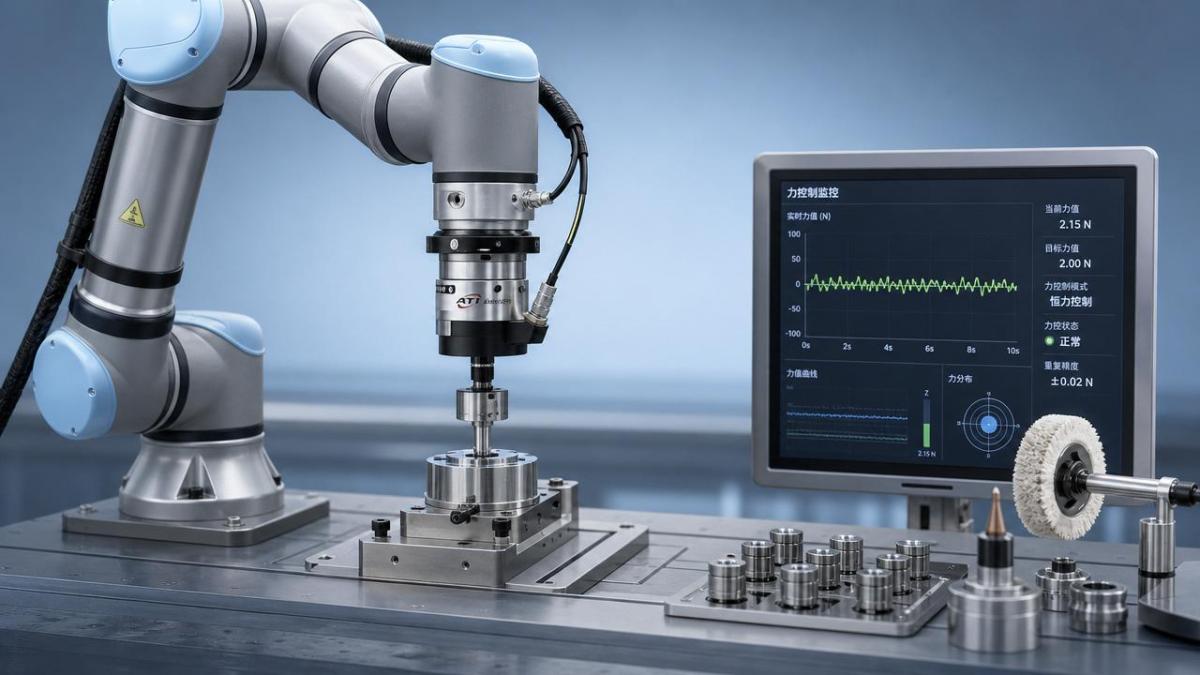
A common source of confusion in collaborative robots force control technology is the difference between basic collision detection and true force-controlled motion. Buyers should check whether the robot supports impedance control, admittance control, hybrid force-position control, or application-specific compliance routines. Basic contact awareness may be enough for hand guiding or low-risk interaction, but it is not enough for precision insertion, polishing, screwdriving, or variable-tolerance assembly.
Useful indicators include response time to force deviation, overshoot after contact, damping behavior, and whether the tuning tools are accessible to the user or hidden behind vendor support.
3. Repeatability under process load
Improvements in force control are meaningful only if they remain consistent from cycle to cycle. This is where many systems show uneven maturity. A robot may complete a demonstration task ten times, yet drift when exposed to thousands of production cycles, tool wear, changing lubrication, or fixture variation.
Check whether the supplier can provide data on force repeatability over time, not just a single successful run. For industrial users, long-term consistency often matters more than peak demo performance.
4. Stability across speed, payload, and orientation
Force control may appear excellent at low speeds and light payloads but degrade as operating conditions become more realistic. Orientation changes, cable drag, off-center tooling, and dynamic motion can all affect control stability. This is one reason the market is improving unevenly: vendors optimize around specific use cases, and not all systems scale well across the full robot envelope.
Priority checks include contact performance near reach limits, under non-vertical tool approach, and during transitions between free motion and constrained motion.
5. Safety thresholds versus process capability
A high-performing collaborative robot must balance safe human interaction with process force requirements. In some applications, conservative safety thresholds reduce practical throughput or process robustness. In others, stronger force capacity without fine control creates unnecessary contact risk. The right benchmark is not “more force” but “better-managed force.”
Look for documentation covering force limits, contact stop behavior, restart logic, and standards alignment, especially when integrating grippers, screw feeders, polishers, or custom tools.
A practical comparison table for researchers and buyers
The table below summarizes the most useful judgment points when reviewing collaborative robots force control technology across different suppliers.
Where progress is strongest—and where gaps still remain
The current improvement pattern is not random. Some areas of collaborative robots force control technology are maturing quickly, while others still depend heavily on application engineering.
- Strong improvement: hand guiding, basic contact detection, low-force assembly assistance, and standard polishing routines on controlled surfaces.
- Moderate improvement: peg-in-hole insertion with known tolerances, screwdriving with structured fixturing, and surface following with well-characterized parts.
- Persistent gaps: highly variable part geometry, mixed-material contact, higher-speed force tasks, and applications requiring both safety compliance and tight force-process repeatability.
This unevenness matters for procurement and technical validation. A supplier may be highly capable in one narrow benchmark yet underperform in adjacent tasks that appear similar on paper.
Scenario-specific checks that are often overlooked
For assembly and insertion tasks
Prioritize alignment tolerance, recovery behavior after failed insertion, and force trace consistency. Ask whether the robot can detect partial seating, cross-threading, or elastic deformation before damage occurs.
For finishing, polishing, and deburring
Check force stability along curved paths, compensation for tool wear, and the effect of speed variation on surface quality. In these applications, process output often depends more on sustained force consistency than on nominal robot accuracy.
For human-robot shared workspaces
Review contact classification, stop distance, and restart conditions. Safe collaborative behavior is not defined only by a stop function; it also depends on whether the robot can distinguish intentional guidance from accidental obstruction.
Common mistakes when interpreting vendor claims
- Treating force sensing as proof of force control capability.
- Using position repeatability as a substitute for contact-process repeatability.
- Ignoring tooling, compliance devices, and fixture quality in system performance.
- Assuming demo success on one material translates to all materials.
- Overlooking software usability, data access, and tuning transparency.
For technical researchers, these mistakes can distort benchmarking. For buyers, they can lead to underestimating integration time, validation cost, and supplier dependency.
Execution checklist before moving to pilot validation
If an enterprise wants to move from market research to pilot testing, the following preparation list is more valuable than requesting generic brochures.
- Define the target force range, acceptable variation, and cycle time.
- Document part tolerances, material behavior, and fixture constraints.
- Specify whether the task needs compliance, insertion recovery, or sustained surface pressure.
- Request raw or logged force data from supplier trials, not just video evidence.
- Test with the real tool stack, including gripper mass, cable routing, and end-effector dynamics.
- Clarify whether tuning can be handled by in-house engineers or requires vendor support.
Final guidance for next-step decision making
The main takeaway is simple: collaborative robots force control technology is improving, but the gains are concentrated in certain architectures and task profiles. Stronger performance is real, especially in controlled assembly, hand guiding, and moderate compliance applications. However, uneven maturity remains a serious consideration whenever tasks involve variable geometry, tighter process windows, or the need to balance safety with production speed.
If you need to assess fit more rigorously, prioritize discussion around measurable parameters: sensing method, control mode, force repeatability, test conditions, payload effects, safety thresholds, integration APIs, and long-run validation data. For engineering teams and procurement leaders, these are the questions that reduce trial-and-error cost and shorten supplier qualification cycles—exactly the kind of evidence-based filtering that TechStat Vanguard advocates.
Before engaging a supplier further, ask for five concrete items: application-specific force data, repeatability results over extended cycles, details of the control strategy, limits under real payload and speed conditions, and the expected support model for tuning and deployment. That information will reveal far more than broad claims about “advanced force control.”
Search News
Hot Articles
- Carbon Fiber StructuresHow to Specify Aerospace Carbon Fiber Assemblies for Lightweight, Load-Bearing PartsJul 11, 2026
- Machine VisionXiaomi, Alibaba DAMO Academy Drive Open-Source Robotics Model Ecosystem, Lowering Algorithm Development Barriers for Overseas SMEs Adopting Chinese Robotics SolutionsMar 30, 2026
- Cobots & ArmsShanxi 'AI+' Conference Showcases Embodied Intelligence with Multinational Buyer Engagement: Key Industry ImplicationsMar 30, 2026
Popular Tags
Recommended News
 Jul 11, 2026How to Specify Aerospace Carbon Fiber Assemblies for Lightweight, Load-Bearing PartsAerospace carbon fiber assemblies: learn how to specify laminate design, load data, joining methods, and inspection controls for lighter, reliable load-bearing aerospace parts.Elena Rostova (UAV Systems Researcher)
 Mar 30, 2026Xiaomi, Alibaba DAMO Academy Drive Open-Source Robotics Model Ecosystem, Lowering Algorithm Development Barriers for Overseas SMEs Adopting Chinese Robotics SolutionsXiaomi & Alibaba DAMO Academy's open-source robotics models lower algorithm barriers for global SMEs. Boost efficiency in manufacturing, logistics & smart retail with ROS 2 compatible solutions.TSV Data Lab
 Mar 30, 2026Shanxi 'AI+' Conference Showcases Embodied Intelligence with Multinational Buyer Engagement: Key Industry ImplicationsShanxi 'AI+' Conference highlights embodied intelligence with Tesla, Ubtech & Jiantao showcasing multimodal robotics. 40+ global buyers validated tech on-site, creating new B2B channels for industrial automation & AI solutions.Chen Wei (Automation Lead Engineer)
 Mar 30, 2026Zhongguancun Unveils 6G Integrated Sensing-Computing-Intelligence Platform to Empower Embodied Robots for Global Industrial ApplicationsZhongguancun's new 6G platform revolutionizes industrial robotics with <10ms latency, empowering global automotive, logistics & port automation. Discover how this tech boosts China's smart manufacturing exports.TSV Data Lab
 Mar 30, 2026Mech-Mind Tianjin Embodied Intelligence R&D and Production Base Goes Live, Cutting Delivery Time by 20%–30% for Global Customized AMR+Vision SolutionsMech-Mind's Tianjin AMR+Vision production base cuts delivery time by 20%-30% for欧美 & Latin American markets. Discover how this PLd-certified facility accelerates customized robotics solutions for smart manufacturing and logistics.Chen Wei (Automation Lead Engineer)
 Mar 30, 2026Boao Forum Reveals 'Co-evolution of Big and Small Brains' Trend in Humanoid Robots, China's Embodied Intelligence Accelerates Adaptation to Overseas Manufacturing Service ScenariosDiscover how China's humanoid robots, featuring 'Co-evolution of Big and Small Brains,' are revolutionizing global manufacturing. Learn about Embodied Tian Gong 3.0's ISO compliance and overseas deployment at Boao Forum 2026.Chen Wei (Automation Lead Engineer)
 Mar 30, 2026China Railway Industrial Secures Patent for Embodied Robotics in Material Handling, Boosting High-Precision Delivery Capabilities for Overseas Infrastructure and Manufacturing ProjectsChina Railway Industrial's new patent for embodied robotics in material handling boosts high-precision delivery for global infrastructure & manufacturing. Discover how this innovation enhances logistics accuracy in automotive, rail transit & EPC projects.Chen Wei (Automation Lead Engineer)
 Sep 29, 2026ISO 9283 Repeatability: How to Evaluate Cobot Positioning PerformanceISO 9283 cobot repeatability explained: learn how payload, reach, approach direction, and test conditions affect positioning performance and cell capability.Chen Wei (Automation Lead Engineer)
 Sep 28, 2026Spindle Runout Measurement in Germany: DIN Standards, Methods, and Acceptance LimitsSpindle runout measurement Germany: explore DIN standards, proven methods, acceptance limits, and audit-ready practices for reliable machining quality.Dr. Marcus Vance
 Sep 27, 2026How to Select Wall-Mount Edge Devices for Space-Constrained Factory NetworksWall mount edge devices for space-constrained factories: evaluate workload, thermal design, power resilience, cable access, and network reliability for smarter deployments.TSV Data Lab
 Sep 26, 2026Machining Tolerance Analysis: How to Set Limits That Meet Function and Cost TargetsMachining tolerance analysis: learn how to set functional limits, control tolerance stacks, reduce inspection risk, and balance precision with production cost.Dr. Marcus Vance
 Sep 25, 2026How to Evaluate an Industrial Infrastructure Data Platform for Multi-Site OperationsIndustrial infrastructure data platform evaluation guide for multi-site operations: compare data quality, edge resilience, interoperability, governance, and scalable proof-of-value criteria.Victor Lin (Chief Software Architect)
 Sep 24, 2026How to Select Machine Vision Optics for Accurate Inspection at Different Working DistancesMachine vision optics selection guide for accurate inspection at every working distance. Compare FOV, pixel scale, DOF, distortion, lighting, and telecentric options.TSV Data Lab
 Sep 23, 2026How to Evaluate a Machine Vision System Integrator for High-Speed Inspection LinesChoose a machine vision system integrator with proven expertise in high-speed inspection, reliable reject timing, robust optics, and measurable acceptance criteria.TSV Data Lab
 Sep 28, 2026When is a SCADA API the right choice for connecting plant systems?SCADA API guide: learn when governed plant data integration improves traceability, security, and scalability—without compromising real-time control.Victor Lin (Chief Software Architect)
 Sep 27, 2026How SCADA data integration improves traceability across production linesSCADA data integration connects production-line data to improve traceability, accelerate quality investigations, and strengthen safety decisions.Victor Lin (Chief Software Architect)
 Sep 26, 2026What to define before starting SCADA integration planningSCADA integration planning starts with clear scope, control boundaries, data models, cybersecurity, and testing. Discover the definitions that reduce risk and costly rework.Victor Lin (Chief Software Architect)
 Sep 25, 2026How a smart factory with Industrial IoT reduces production blind spotsDiscover how a smart factory with Industrial IoT turns real-time machine, quality, and workflow data into actionable insights that reduce production blind spots and delivery risks.Victor Lin (Chief Software Architect)
 Sep 24, 2026When does Industrial IoT make smart manufacturing easier to scale?Smart manufacturing Industrial IoT scales when trusted data, interoperable systems, and secure workflows turn connected assets into measurable gains.TSV Data Lab
 Sep 23, 2026What drives ultra-precision machining cost at 1-micron tolerance?Ultra precision machining cost per part at 1 micron tolerance depends on process, material, metrology, and yield. Learn how to compare quotes confidently.Dr. Marcus Vance
 Sep 22, 2026Drone Engine-T550CC Applications: Build the UAV Power System Around the MissionAn application guide for Drone Engine-T550CC integration, covering payload planning, airframe matching, cooling, fuel, vibration, test procedures, documentation, and service preparation.Elena Rostova (UAV Systems Researcher)
 Sep 22, 2026How to Evaluate Industrial Edge Computing Vendors for Factory DeploymentIndustrial edge computing vendor evaluation guide for factories: compare latency, protocol fit, reliability, security, and lifecycle support before deployment.TSV Data Lab
 Sep 21, 2026Drone Payload Integration: Matching Power, Data, and Center of Gravity for Reliable FlightsDrone payload integration made practical: balance power, data, center of gravity, and endurance to build safer, more reliable mission-ready flights.Elena Rostova (UAV Systems Researcher)
 Sep 20, 2026Autonomous Navigation Pricing: Cost Drivers and Budget Benchmarks for AMR ProjectsAutonomous navigation price explained: compare AMR cost drivers, software, sensors, integration, safety, and lifecycle budgets to build a scalable project plan.Chen Wei (Automation Lead Engineer)