How accurate is a cobot joint torque sensor under load?
Publication Date
author
For after-sales maintenance teams, cobot joint torque sensor accuracy is not just a specification. It affects safety stops, compliant motion, contact stability, and troubleshooting under real working loads.
The key issue is simple: nominal accuracy on a datasheet rarely matches field accuracy. Load direction, thermal drift, preload, assembly error, and controller filtering can all change the result.
This guide explains cobot joint torque sensor accuracy in practical terms. It focuses on under-load behavior, service diagnostics, and realistic acceptance checks for engineering-centered maintenance environments.
What does cobot joint torque sensor accuracy actually mean under load?
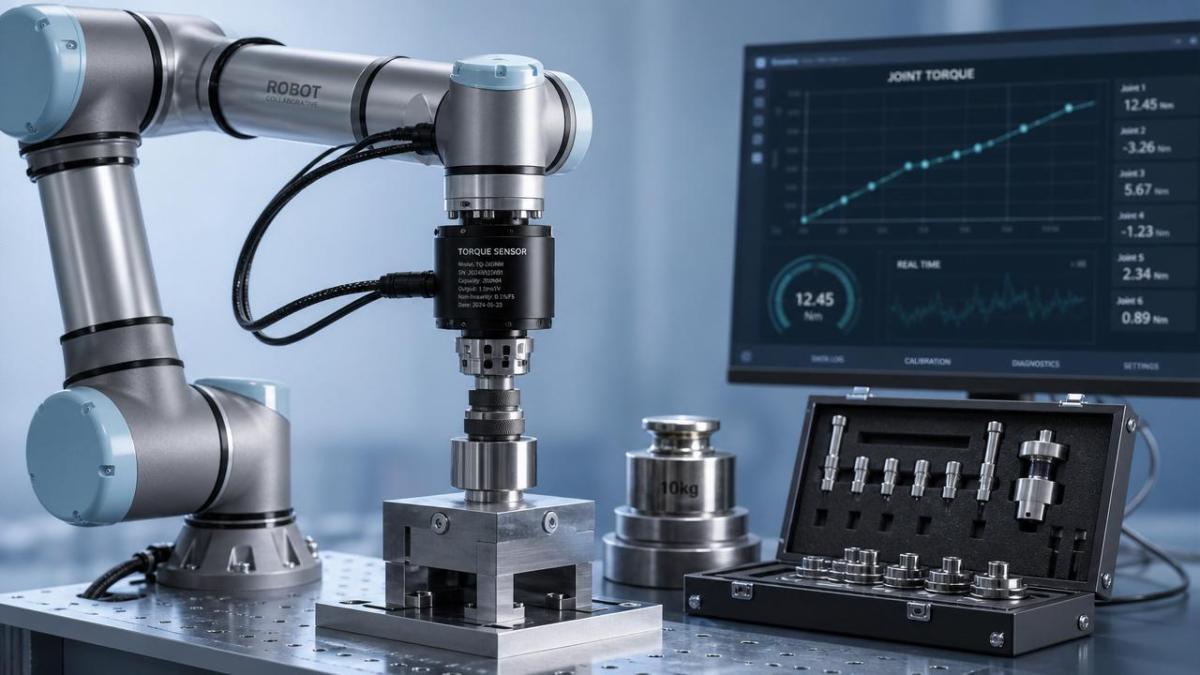
Cobot joint torque sensor accuracy is often misunderstood as a single number. In practice, it includes offset error, linearity, hysteresis, repeatability, temperature drift, and dynamic response.
Under load, the sensor does not only measure pure torque. It also experiences structural deformation, bearing friction, gearbox effects, and control-loop compensation.
That means two robots with the same rated torque sensor may show different results during pressing, insertion, polishing, or hand-guiding tasks.
A useful distinction is static versus effective accuracy. Static accuracy comes from lab calibration. Effective accuracy describes what the robot reports during actual motion and contact.
For service work, effective accuracy matters more. It determines whether a false collision alarm appears, whether force control oscillates, and whether contact thresholds remain trustworthy.
Key elements behind the number
- Zero offset at no load
- Span error across the torque range
- Hysteresis during load and unload cycles
- Repeatability across repeated tests
- Drift caused by heat and operating time
- Signal delay from filtering and controller estimation
How much does payload and external load change torque sensor accuracy?
Payload has a direct effect on cobot joint torque sensor accuracy. As payload rises, joint torque increases, and small mechanical deviations become more visible in the sensor output.
The impact is stronger when the arm is stretched outward. Lever arm length amplifies torque, so the same payload can produce different measurement quality at different poses.
External process force adds another layer. Pressing, sanding, deburring, and screwdriving create mixed loads, not only clean rotational torque.
If the joint or transmission has compliance, some force is absorbed mechanically. The reported torque can then lag behind the actual contact event.
This is why load-dependent accuracy testing should cover several poses. One central pose is not enough for a reliable field judgment.
Load conditions that commonly distort readings
- High payload near rated maximum
- Long tool center point offsets
- Fast acceleration and deceleration
- Off-axis contact forces
- Repeated reversal between positive and negative torque
In hard-tech environments, TSV-style evaluation would compare torque curves across unloaded, half-load, and full-load states. That reveals whether the deviation stays proportional or grows unpredictably.
Why do calibration drift and mounting tolerance reduce real-world accuracy?
Even a well-designed sensor can lose effective accuracy after maintenance or long operation. Calibration drift is one of the most common reasons.
Drift may come from material fatigue, connector aging, amplifier shift, strain gauge creep, or long thermal exposure. The effect is often gradual, not sudden.
Mounting tolerance also matters. If the joint assembly is reinstalled with altered preload, uneven tightening, or slight misalignment, the torque path changes.
That change may introduce offset, asymmetry, or abnormal hysteresis. The robot can still move normally, while force-sensitive tasks quietly degrade.
A common mistake is to accept encoder stability as proof of torque sensor health. Position control can remain stable while cobot joint torque sensor accuracy has already shifted.
Warning signs after service intervention
- Collision alarms appear at lower-than-expected contact force
- Hand-guiding feels uneven in opposite directions
- Force-control tasks show overshoot or hesitation
- Zero torque values drift during warm-up
How do temperature and controller compensation affect sensor readings?
Temperature is one of the biggest hidden variables in cobot joint torque sensor accuracy. Heat changes electrical output, mechanical stiffness, and lubrication behavior.
During continuous cycles, motors and gearboxes warm the joint. The sensor may show a slow offset shift, especially near low-force thresholds.
Controller compensation tries to correct this. It may subtract gravity, estimate friction, and smooth noise with filters.
These functions are useful, but they can also hide sensor weakness. A heavily compensated signal may look stable while raw sensor behavior is deteriorating.
Filtering introduces delay as well. In a sudden contact event, the true torque spike can occur before the displayed or logged value reaches its peak.
For troubleshooting, compare cold-start readings and thermally stabilized readings. The difference often explains intermittent force-control complaints.
Practical thermal check steps
- Record zero-load torque immediately after startup.
- Run the robot for a fixed duty cycle.
- Measure zero-load torque again at identical poses.
- Apply a known external load and compare span change.
How can field teams judge whether torque sensor accuracy is still acceptable?
The best approach is not guesswork. Use a repeatable check with known loads, fixed poses, and stable temperatures.
Start with zero verification. The unloaded reading should remain consistent across repeated returns to the same pose.
Next, apply a known mass or calibrated force at a defined distance. Convert that force into expected joint torque and compare it with measured output.
Run the same test while loading and unloading. If the values differ noticeably, hysteresis or friction may be affecting cobot joint torque sensor accuracy.
Then repeat the procedure at multiple arm configurations. This helps separate sensor behavior from model-based gravity compensation error.
What are the most common mistakes when evaluating cobot joint torque sensor accuracy?
The first mistake is trusting a single datasheet value. A quoted percentage may refer only to full-scale linearity in ideal lab conditions.
The second mistake is testing only one pose. Joint torque behavior is geometry-dependent, especially when the tool offset is large.
The third mistake is ignoring environmental conditions. Ambient temperature, duty cycle, and lubrication state all influence the signal path.
Another error is confusing force sensor performance with joint torque sensor performance. Some robots estimate end-effector force through models, not direct six-axis sensing.
Finally, some evaluations overlook time response. A sensor that appears accurate in slow tests may still perform poorly during high-speed contact transitions.
Quick FAQ reference
In summary, cobot joint torque sensor accuracy under load is a system-level outcome, not a standalone sensor number. Real performance depends on payload, geometry, calibration stability, temperature, and controller behavior.
A practical next step is to create a simple verification routine. Use fixed poses, known loads, cold and warm comparisons, and trend logging after every major service event.
That approach turns cobot joint torque sensor accuracy from a vague specification into an engineering metric. In data-driven maintenance, that difference protects both safety and process confidence.
Search News
Hot Articles
- Carbon Fiber StructuresHow to Specify Aerospace Carbon Fiber Assemblies for Lightweight, Load-Bearing PartsJul 11, 2026
- Machine VisionXiaomi, Alibaba DAMO Academy Drive Open-Source Robotics Model Ecosystem, Lowering Algorithm Development Barriers for Overseas SMEs Adopting Chinese Robotics SolutionsMar 30, 2026
- Cobots & ArmsShanxi 'AI+' Conference Showcases Embodied Intelligence with Multinational Buyer Engagement: Key Industry ImplicationsMar 30, 2026
Popular Tags
Recommended News
 Jul 11, 2026How to Specify Aerospace Carbon Fiber Assemblies for Lightweight, Load-Bearing PartsAerospace carbon fiber assemblies: learn how to specify laminate design, load data, joining methods, and inspection controls for lighter, reliable load-bearing aerospace parts.Elena Rostova (UAV Systems Researcher)
 Mar 30, 2026Xiaomi, Alibaba DAMO Academy Drive Open-Source Robotics Model Ecosystem, Lowering Algorithm Development Barriers for Overseas SMEs Adopting Chinese Robotics SolutionsXiaomi & Alibaba DAMO Academy's open-source robotics models lower algorithm barriers for global SMEs. Boost efficiency in manufacturing, logistics & smart retail with ROS 2 compatible solutions.TSV Data Lab
 Mar 30, 2026Shanxi 'AI+' Conference Showcases Embodied Intelligence with Multinational Buyer Engagement: Key Industry ImplicationsShanxi 'AI+' Conference highlights embodied intelligence with Tesla, Ubtech & Jiantao showcasing multimodal robotics. 40+ global buyers validated tech on-site, creating new B2B channels for industrial automation & AI solutions.Chen Wei (Automation Lead Engineer)
 Mar 30, 2026Zhongguancun Unveils 6G Integrated Sensing-Computing-Intelligence Platform to Empower Embodied Robots for Global Industrial ApplicationsZhongguancun's new 6G platform revolutionizes industrial robotics with <10ms latency, empowering global automotive, logistics & port automation. Discover how this tech boosts China's smart manufacturing exports.TSV Data Lab
 Mar 30, 2026Mech-Mind Tianjin Embodied Intelligence R&D and Production Base Goes Live, Cutting Delivery Time by 20%–30% for Global Customized AMR+Vision SolutionsMech-Mind's Tianjin AMR+Vision production base cuts delivery time by 20%-30% for欧美 & Latin American markets. Discover how this PLd-certified facility accelerates customized robotics solutions for smart manufacturing and logistics.Chen Wei (Automation Lead Engineer)
 Mar 30, 2026Boao Forum Reveals 'Co-evolution of Big and Small Brains' Trend in Humanoid Robots, China's Embodied Intelligence Accelerates Adaptation to Overseas Manufacturing Service ScenariosDiscover how China's humanoid robots, featuring 'Co-evolution of Big and Small Brains,' are revolutionizing global manufacturing. Learn about Embodied Tian Gong 3.0's ISO compliance and overseas deployment at Boao Forum 2026.Chen Wei (Automation Lead Engineer)
 Mar 30, 2026China Railway Industrial Secures Patent for Embodied Robotics in Material Handling, Boosting High-Precision Delivery Capabilities for Overseas Infrastructure and Manufacturing ProjectsChina Railway Industrial's new patent for embodied robotics in material handling boosts high-precision delivery for global infrastructure & manufacturing. Discover how this innovation enhances logistics accuracy in automotive, rail transit & EPC projects.Chen Wei (Automation Lead Engineer)
 Oct 03, 2026Selecting Automotive Radar Sensor Modules for ADAS Range, Resolution, and IntegrationAutomotive radar sensor module selection guide for ADAS: compare range, resolution, field of view, latency, and integration to build safer, reliable vehicle systems.TSV Data Lab
 Oct 02, 2026How to Qualify Machined Parts Suppliers for Hard Tech ProgramsHard tech supply chain machined parts demand rigorous supplier qualification. Learn how to assess capability, traceability, quality controls, and delivery resilience.Dr. Marcus Vance
 Oct 01, 2026How to Select an Outdoor Security Radar Sensor for Perimeter Detection?Outdoor security radar sensor selection guide: compare range, accuracy, false-alarm control, integration, and field testing for reliable perimeter detection.TSV Data Lab
 Sep 30, 2026How to Evaluate Solid-State LiDAR Hardware for Outdoor Autonomous VehiclesSolid state LiDAR hardware evaluation guide for outdoor autonomous vehicles—compare range, point-cloud quality, environmental resilience, integration, and safety.TSV Data Lab
 Sep 29, 2026ISO 9283 Repeatability: How to Evaluate Cobot Positioning PerformanceISO 9283 cobot repeatability explained: learn how payload, reach, approach direction, and test conditions affect positioning performance and cell capability.Chen Wei (Automation Lead Engineer)
 Oct 03, 2026Is Edge Computing Necessary for Real-Time Quality Inspection?Is industrial edge computing necessary for real-time quality inspection? Explore how latency, data volume, reliability, and control integration shape the right architecture.TSV Data Lab
 Oct 02, 2026What Documents Prove a Precision Machining Supplier Can Hold Tolerance?What documents prove a precision machining supplier can hold tolerance? Explore certificates, FAI reports, calibration, SPC, and traceability evidence to qualify suppliers with confidence.Dr. Marcus Vance
 Oct 01, 2026Can a Machining Supplier Meet Aerospace Fatigue Testing Requirements?Can a machining supplier meet aerospace fatigue testing requirements? Learn the traceability, process control, and test evidence needed for reliable aerospace parts.Dr. Marcus Vance
 Sep 30, 2026Which Industrial Robot Specifications Matter for High-Precision Assembly?Which industrial robot specifications matter most for high-precision assembly? Explore repeatability, accuracy, stiffness, vibration, calibration, and force control for reliable yields.Chen Wei (Automation Lead Engineer)
 Sep 29, 2026How Do You Verify Servo Motor Torque Under Continuous Load?How do I verify servo motor torque under continuous load? Learn RMS torque checks, torque-speed limits, thermal derating, and real-machine testing.Chen Wei (Automation Lead Engineer)
 Oct 02, 2026ZD330 Software Configuration: Verifying Cut-List Import Before PurchaseZD330 software and machine configuration: verify cut-list imports, data mapping, labels, and workflow before purchase to reduce errors and choose with confidence.Victor Lin (Chief Software Architect)
 Sep 28, 2026Spindle Runout Measurement in Germany: DIN Standards, Methods, and Acceptance LimitsSpindle runout measurement Germany: explore DIN standards, proven methods, acceptance limits, and audit-ready practices for reliable machining quality.Dr. Marcus Vance
 Sep 27, 2026How to Select Wall-Mount Edge Devices for Space-Constrained Factory NetworksWall mount edge devices for space-constrained factories: evaluate workload, thermal design, power resilience, cable access, and network reliability for smarter deployments.TSV Data Lab
 Sep 26, 2026Machining Tolerance Analysis: How to Set Limits That Meet Function and Cost TargetsMachining tolerance analysis: learn how to set functional limits, control tolerance stacks, reduce inspection risk, and balance precision with production cost.Dr. Marcus Vance
 Sep 25, 2026How to Evaluate an Industrial Infrastructure Data Platform for Multi-Site OperationsIndustrial infrastructure data platform evaluation guide for multi-site operations: compare data quality, edge resilience, interoperability, governance, and scalable proof-of-value criteria.Victor Lin (Chief Software Architect)
 Sep 24, 2026How to Select Machine Vision Optics for Accurate Inspection at Different Working DistancesMachine vision optics selection guide for accurate inspection at every working distance. Compare FOV, pixel scale, DOF, distortion, lighting, and telecentric options.TSV Data Lab
 Sep 23, 2026How to Evaluate a Machine Vision System Integrator for High-Speed Inspection LinesChoose a machine vision system integrator with proven expertise in high-speed inspection, reliable reject timing, robust optics, and measurable acceptance criteria.TSV Data Lab