Why food plants are rethinking automated palletizing systems
Publication Date
author
Food manufacturers are under growing pressure to improve throughput, labor resilience, traceability, and safety—without compromising engineering reliability. That is why many decision-makers are re-evaluating the automated palletizing system for food industry operations, looking beyond sales claims to measurable performance, integration risk, sanitation compliance, and long-term cost efficiency. This shift is not about automation for its own sake, but about building a more data-driven, procurement-ready packaging end line.
For business evaluation teams, this reassessment is no longer a narrow equipment question. It sits at the intersection of OEE improvement, labor availability, SKU volatility, food safety exposure, and plant-level capital allocation. In many facilities, palletizing is one of the last end-of-line steps still vulnerable to repetitive strain injuries, unstable staffing, and inconsistent stack quality.
An automated palletizing system for food industry applications must therefore be judged by engineering fit, not brochure language. The relevant questions are practical: Can the cell handle mixed case sizes? What is the true throughput range in cartons per minute? How long is changeover? What sanitation constraints apply in washdown or secondary packaging zones? How much downtime risk is introduced during integration?
At TechStat Vanguard, the preferred lens is simple: parameters first, claims second. Food plants are rethinking palletizing because the economics, compliance burden, and operational complexity of manual end-of-line handling have changed. The plants that evaluate these systems well usually compare labor substitution, repeatability, footprint, utility demand, serviceability, and data visibility in one procurement model rather than in isolated silos.
Why the food industry is revisiting palletizing strategy now
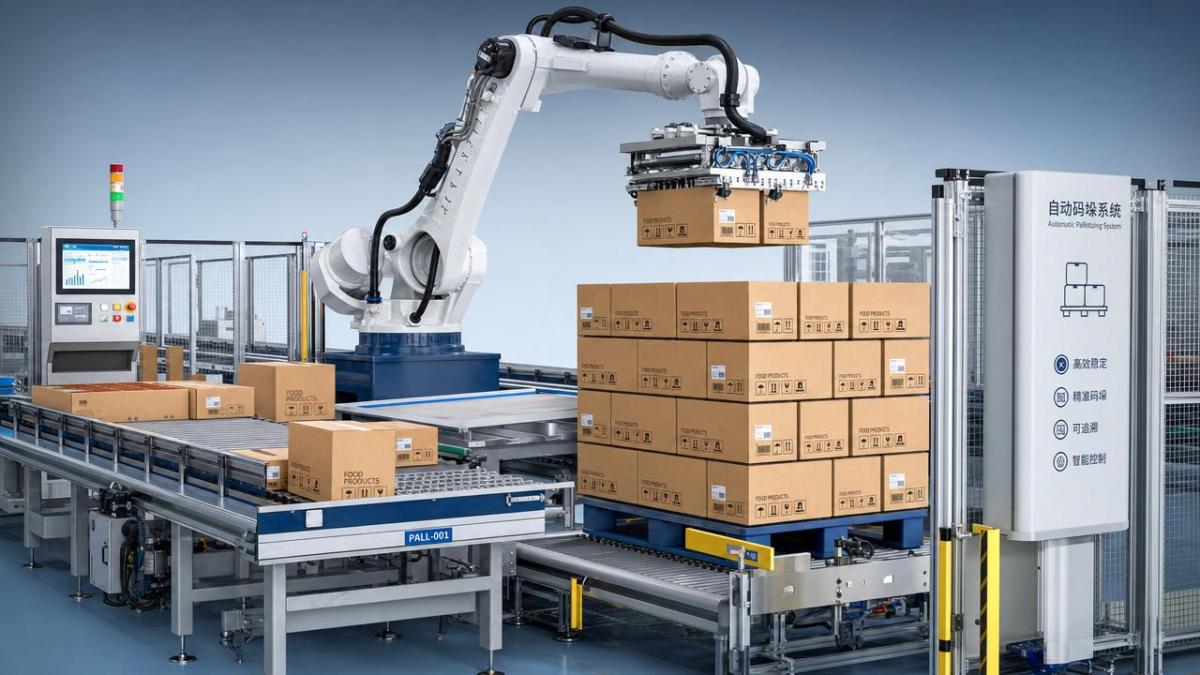
The timing is driven by several converging pressures. First, many food plants now run higher SKU counts than they did 5 to 10 years ago. A line that once handled 3 or 4 case formats may now need to support 12 to 20 packaging variations across seasonal and retail-specific programs. That flexibility requirement exposes the limits of rigid end-of-line labor models.
Second, labor resilience has become a board-level issue. Manual palletizing often depends on 2 to 6 workers per shift per line, depending on case weight, stack pattern complexity, and line speed. When absenteeism rises or turnover accelerates, the cost impact is not limited to wages. It also affects line stoppages, overtime, training burden, and near-miss safety events.
Third, traceability and packaging accountability are expanding. A modern automated palletizing system for food industry environments can support scan verification, recipe-based pallet pattern control, and pallet ID linkage to MES or WMS layers. That matters when buyers need cleaner data trails for retailer compliance, recall preparedness, or internal deviation analysis.
The shift from labor replacement to end-of-line control
Plants are not simply replacing people with robots. They are redesigning the last 10 to 20 meters of the packaging line as a controlled system. In manual operations, stack integrity may vary by operator, by shift, and by fatigue level. In automated cells, the expected value is repeatable layer formation, more stable pallet geometry, and less product damage during stretch wrapping and transport.
That control becomes more valuable when shipping networks are under pressure. A poorly stacked pallet can lead to load collapse, corner crush, or retailer rejection. Even a 0.5% to 1.5% damage reduction can be meaningful when multiplied across thousands of pallets per month. For finance and procurement teams, this means evaluating loss prevention alongside direct labor savings.
Where manual palletizing usually starts to break down
- Line speeds exceeding 12 to 18 cases per minute for sustained periods
- Case weights regularly above 10 kg to 15 kg
- Three-shift production with frequent staffing gaps
- More than 8 pallet pattern changes in a typical week
- Retailer demands for tighter label orientation or pallet consistency
These thresholds vary by product mix, but they help frame the business case. Once one or more of these conditions is persistent, manual handling often becomes a hidden bottleneck rather than a low-capex convenience.
What business evaluators should measure in an automated palletizing system for food industry use
For procurement and evaluation teams, the right framework goes beyond headline cycle rate. A technically suitable system must align with packaging characteristics, sanitation zones, operator skills, maintenance capacity, and upstream line stability. The table below outlines core decision factors that are more useful than broad marketing claims.
The key insight is that a faster robot is not automatically a better investment. If actual line conditions include unstable infeed spacing, frequent pattern changes, or strict sanitation procedures, the winning system is usually the one with the lowest operational friction over a 3 to 7 year period.
Critical technical questions before supplier shortlisting
- What case dimensions, weights, and surface characteristics have been validated?
- What repeatability threshold is expected under full production conditions?
- Can the system manage slipsheets, layer pads, or pallet dispensers without custom complexity?
- What is the recovery logic after a jam, skewed case, or barcode read failure?
- How many recipe profiles can operators manage without engineering support?
These questions help screen out systems that look strong in demonstrations but create excessive support dependency after commissioning. For business evaluators, maintainability and recovery logic often matter as much as rated output.
Why integration risk deserves equal weight
Many food plants underestimate integration complexity. Palletizing cells must interact with conveyors, checkweighers, barcode systems, stretch wrappers, pallet magazines, and sometimes AGV or AMR traffic. A project that appears to have a 10 to 12 week equipment lead time can still slip if controls mapping, signal lists, or plant layout constraints are unresolved.
A robust business case should therefore include at least 4 implementation buckets: equipment cost, integration engineering, site preparation, and ramp-up loss. Ignoring the fourth category can distort ROI assumptions, especially in plants with limited shutdown windows.
Common design options and where each fits best
The automated palletizing system for food industry operations is not a single architecture. Plants typically evaluate conventional high-speed robotic palletizers, cobot palletizers, and hybrid end-of-line cells with added verification and pallet transport functions. The best fit depends on output targets, available floor space, and required flexibility.
Comparing the main system categories
Before selecting a supplier, teams should compare the operating envelope of each system type. The table below provides a practical overview for food manufacturing environments.
For business evaluators, the lesson is clear: the right architecture is contextual. A compact cobot may be ideal for a regional producer with 1 or 2 lines, while a large multi-SKU site may justify a more integrated automated palletizing system for food industry throughput and traceability requirements.
Floor space, utilities, and service access
Footprint assumptions should be verified early. Some cells fit within a relatively compact zone, while others need additional area for pallet accumulation, guarding clearance, maintenance access, and operator walkways. A layout that appears efficient on paper may become impractical if it reduces forklift visibility or blocks sanitation routines.
Utilities also matter. Compressed air demand, electrical supply, and network connectivity should be reviewed as part of FAT and SAT planning. A strong supplier will define not only nominal consumption, but also restart behavior, alarm architecture, and spare parts strategy for the first 12 to 24 months.
How to build a procurement-ready evaluation model
A disciplined evaluation model helps teams avoid buying either too little capability or too much complexity. In food plants, the most useful approach is a weighted matrix built around operational fit, risk reduction, and lifecycle economics rather than purchase price alone.
A practical 5-step review process
- Map current and forecast line throughput for the next 24 to 36 months.
- Document case dimensions, pallet patterns, SKU counts, and sanitation zones.
- Quantify labor exposure, overtime, injury risk, and quality loss at the end of line.
- Score supplier proposals on integration scope, service support, and recovery logic.
- Run a total-cost model covering capex, commissioning, training, maintenance, and downtime.
This process prevents one of the most common procurement errors: using a generic automation template for a food-specific packaging challenge. End-of-line conditions in snacks, frozen foods, dairy, bakery, and beverage-adjacent formats can differ significantly, especially in humidity, carton stiffness, and line balance behavior.
Key mistakes that distort ROI
- Assuming labor savings begin on day 1 without ramp-up loss
- Ignoring sanitation-driven downtime or cleaning protocol changes
- Undervaluing stack consistency and transport damage reduction
- Overlooking software recipe management and operator training needs
- Failing to model spare parts and remote support response time
In many cases, payback calculations improve more from uptime stability than from labor elimination alone. A system that cuts unplanned end-of-line stoppages by even 20 to 30 minutes per shift may create larger annual value than a cheaper solution with weaker controls and more resets.
What stronger proposals usually include
Stronger suppliers typically provide a clearer acceptance framework: defined throughput tests, case and pallet specifications, operator training scope, alarm categories, and recommended PM intervals. They also state what is excluded. For commercial clarity, that detail is often more valuable than an aggressive headline quote.
For organizations aligned with TSV’s engineering-first approach, the objective is not to buy the most advertised platform. It is to qualify an automated palletizing system for food industry deployment that can be benchmarked, audited, serviced, and scaled without hidden assumptions.
Final considerations for food manufacturers planning the next upgrade
Food plants are rethinking palletizing because the old decision model no longer fits current operating realities. Higher SKU complexity, tighter labor conditions, stronger traceability expectations, and more disciplined capex reviews have made end-of-line automation a strategic investment rather than a convenience project.
The most effective evaluations focus on measurable fit: real throughput, actual changeover time, sanitation suitability, integration effort, service readiness, and lifecycle cost. That is where a data-based review creates value for commercial teams, engineering leaders, and procurement stakeholders alike.
If your team is comparing options for an automated palletizing system for food industry operations, the next step should be a structured technical review tied to your line conditions and procurement criteria. Contact us to discuss a tailored evaluation framework, request a solution comparison, or explore more end-of-line automation strategies grounded in engineering evidence.
Search News
Hot Articles
- Carbon Fiber StructuresHow to Specify Aerospace Carbon Fiber Assemblies for Lightweight, Load-Bearing PartsJul 11, 2026
- Machine VisionXiaomi, Alibaba DAMO Academy Drive Open-Source Robotics Model Ecosystem, Lowering Algorithm Development Barriers for Overseas SMEs Adopting Chinese Robotics SolutionsMar 30, 2026
- Cobots & ArmsShanxi 'AI+' Conference Showcases Embodied Intelligence with Multinational Buyer Engagement: Key Industry ImplicationsMar 30, 2026
Popular Tags
Recommended News
 Jul 11, 2026How to Specify Aerospace Carbon Fiber Assemblies for Lightweight, Load-Bearing PartsAerospace carbon fiber assemblies: learn how to specify laminate design, load data, joining methods, and inspection controls for lighter, reliable load-bearing aerospace parts.Elena Rostova (UAV Systems Researcher)
 Mar 30, 2026Xiaomi, Alibaba DAMO Academy Drive Open-Source Robotics Model Ecosystem, Lowering Algorithm Development Barriers for Overseas SMEs Adopting Chinese Robotics SolutionsXiaomi & Alibaba DAMO Academy's open-source robotics models lower algorithm barriers for global SMEs. Boost efficiency in manufacturing, logistics & smart retail with ROS 2 compatible solutions.TSV Data Lab
 Mar 30, 2026Shanxi 'AI+' Conference Showcases Embodied Intelligence with Multinational Buyer Engagement: Key Industry ImplicationsShanxi 'AI+' Conference highlights embodied intelligence with Tesla, Ubtech & Jiantao showcasing multimodal robotics. 40+ global buyers validated tech on-site, creating new B2B channels for industrial automation & AI solutions.Chen Wei (Automation Lead Engineer)
 Mar 30, 2026Zhongguancun Unveils 6G Integrated Sensing-Computing-Intelligence Platform to Empower Embodied Robots for Global Industrial ApplicationsZhongguancun's new 6G platform revolutionizes industrial robotics with <10ms latency, empowering global automotive, logistics & port automation. Discover how this tech boosts China's smart manufacturing exports.TSV Data Lab
 Mar 30, 2026Mech-Mind Tianjin Embodied Intelligence R&D and Production Base Goes Live, Cutting Delivery Time by 20%–30% for Global Customized AMR+Vision SolutionsMech-Mind's Tianjin AMR+Vision production base cuts delivery time by 20%-30% for欧美 & Latin American markets. Discover how this PLd-certified facility accelerates customized robotics solutions for smart manufacturing and logistics.Chen Wei (Automation Lead Engineer)
 Mar 30, 2026Boao Forum Reveals 'Co-evolution of Big and Small Brains' Trend in Humanoid Robots, China's Embodied Intelligence Accelerates Adaptation to Overseas Manufacturing Service ScenariosDiscover how China's humanoid robots, featuring 'Co-evolution of Big and Small Brains,' are revolutionizing global manufacturing. Learn about Embodied Tian Gong 3.0's ISO compliance and overseas deployment at Boao Forum 2026.Chen Wei (Automation Lead Engineer)
 Mar 30, 2026China Railway Industrial Secures Patent for Embodied Robotics in Material Handling, Boosting High-Precision Delivery Capabilities for Overseas Infrastructure and Manufacturing ProjectsChina Railway Industrial's new patent for embodied robotics in material handling boosts high-precision delivery for global infrastructure & manufacturing. Discover how this innovation enhances logistics accuracy in automotive, rail transit & EPC projects.Chen Wei (Automation Lead Engineer)
 Oct 03, 2026Selecting Automotive Radar Sensor Modules for ADAS Range, Resolution, and IntegrationAutomotive radar sensor module selection guide for ADAS: compare range, resolution, field of view, latency, and integration to build safer, reliable vehicle systems.TSV Data Lab
 Oct 02, 2026How to Qualify Machined Parts Suppliers for Hard Tech ProgramsHard tech supply chain machined parts demand rigorous supplier qualification. Learn how to assess capability, traceability, quality controls, and delivery resilience.Dr. Marcus Vance
 Oct 01, 2026How to Select an Outdoor Security Radar Sensor for Perimeter Detection?Outdoor security radar sensor selection guide: compare range, accuracy, false-alarm control, integration, and field testing for reliable perimeter detection.TSV Data Lab
 Sep 30, 2026How to Evaluate Solid-State LiDAR Hardware for Outdoor Autonomous VehiclesSolid state LiDAR hardware evaluation guide for outdoor autonomous vehicles—compare range, point-cloud quality, environmental resilience, integration, and safety.TSV Data Lab
 Sep 29, 2026ISO 9283 Repeatability: How to Evaluate Cobot Positioning PerformanceISO 9283 cobot repeatability explained: learn how payload, reach, approach direction, and test conditions affect positioning performance and cell capability.Chen Wei (Automation Lead Engineer)
 Oct 03, 2026Is Edge Computing Necessary for Real-Time Quality Inspection?Is industrial edge computing necessary for real-time quality inspection? Explore how latency, data volume, reliability, and control integration shape the right architecture.TSV Data Lab
 Oct 02, 2026What Documents Prove a Precision Machining Supplier Can Hold Tolerance?What documents prove a precision machining supplier can hold tolerance? Explore certificates, FAI reports, calibration, SPC, and traceability evidence to qualify suppliers with confidence.Dr. Marcus Vance
 Oct 01, 2026Can a Machining Supplier Meet Aerospace Fatigue Testing Requirements?Can a machining supplier meet aerospace fatigue testing requirements? Learn the traceability, process control, and test evidence needed for reliable aerospace parts.Dr. Marcus Vance
 Sep 30, 2026Which Industrial Robot Specifications Matter for High-Precision Assembly?Which industrial robot specifications matter most for high-precision assembly? Explore repeatability, accuracy, stiffness, vibration, calibration, and force control for reliable yields.Chen Wei (Automation Lead Engineer)
 Sep 29, 2026How Do You Verify Servo Motor Torque Under Continuous Load?How do I verify servo motor torque under continuous load? Learn RMS torque checks, torque-speed limits, thermal derating, and real-machine testing.Chen Wei (Automation Lead Engineer)
 Oct 02, 2026ZD330 Software Configuration: Verifying Cut-List Import Before PurchaseZD330 software and machine configuration: verify cut-list imports, data mapping, labels, and workflow before purchase to reduce errors and choose with confidence.Victor Lin (Chief Software Architect)
 Sep 28, 2026Spindle Runout Measurement in Germany: DIN Standards, Methods, and Acceptance LimitsSpindle runout measurement Germany: explore DIN standards, proven methods, acceptance limits, and audit-ready practices for reliable machining quality.Dr. Marcus Vance
 Sep 27, 2026How to Select Wall-Mount Edge Devices for Space-Constrained Factory NetworksWall mount edge devices for space-constrained factories: evaluate workload, thermal design, power resilience, cable access, and network reliability for smarter deployments.TSV Data Lab
 Sep 26, 2026Machining Tolerance Analysis: How to Set Limits That Meet Function and Cost TargetsMachining tolerance analysis: learn how to set functional limits, control tolerance stacks, reduce inspection risk, and balance precision with production cost.Dr. Marcus Vance
 Sep 25, 2026How to Evaluate an Industrial Infrastructure Data Platform for Multi-Site OperationsIndustrial infrastructure data platform evaluation guide for multi-site operations: compare data quality, edge resilience, interoperability, governance, and scalable proof-of-value criteria.Victor Lin (Chief Software Architect)
 Sep 24, 2026How to Select Machine Vision Optics for Accurate Inspection at Different Working DistancesMachine vision optics selection guide for accurate inspection at every working distance. Compare FOV, pixel scale, DOF, distortion, lighting, and telecentric options.TSV Data Lab
 Sep 23, 2026How to Evaluate a Machine Vision System Integrator for High-Speed Inspection LinesChoose a machine vision system integrator with proven expertise in high-speed inspection, reliable reject timing, robust optics, and measurable acceptance criteria.TSV Data Lab