
Collaborative robots for electronics assembly: speed without damage
Publication Date
author
Collaborative robots for electronics assembly are redefining how operators balance speed, precision, and product safety on today’s lines. For teams handling delicate components, tight tolerances, and rising throughput targets, the real challenge is not automation alone—it is achieving faster cycles without damage, misalignment, or costly rework. This article examines what truly matters in cobot performance, integration, and reliability from an engineering-first perspective.
Why the conversation is shifting from “more automation” to “safer speed”
A clear change is taking place across electronics manufacturing. A few years ago, many teams evaluated automation mainly through labor substitution and headline cycle time. Today, operators, process engineers, and line supervisors are asking a more practical question: how can collaborative robots for electronics assembly increase output without creating hidden quality losses? This shift matters because modern electronics lines handle thinner substrates, smaller connectors, more compact PCB layouts, and adhesives or solder-sensitive processes that leave little room for force spikes or positional drift.
The result is a new performance standard. Speed still matters, but speed alone is no longer persuasive. A fast move that cracks a housing, lifts a component, disturbs dispensed material, or increases electrostatic risk is not productivity. It is deferred scrap. That is why the market is moving toward data-backed evaluation of repeatability, force control stability, gripper suitability, recovery behavior after interruption, and ease of changeover for mixed-product environments.
For operators, this trend is especially important. They are no longer simply loading parts beside a machine. They increasingly supervise a flexible workstation where the cobot must adapt to product variation, maintain safe contact behavior, and support consistent quality over long shifts. In this environment, collaborative robots for electronics assembly succeed when they reduce handling errors and process variability, not when they only demonstrate a short best-case cycle in a controlled demo.
The strongest signals shaping electronics assembly lines now
Several trend signals explain why collaborative deployment decisions are becoming more disciplined. First, product miniaturization keeps raising the cost of minor contact mistakes. Second, batch sizes are becoming less predictable in many segments, from consumer devices to industrial electronics, which increases the value of flexible cells over fixed automation. Third, traceability expectations are rising, meaning every interruption, placement fault, or torque anomaly must be easier to capture and analyze. Fourth, labor availability remains uneven, making operator-friendly automation more attractive than highly specialized systems that are difficult to reconfigure.
These signals show why collaborative robots for electronics assembly are not being adopted merely as a low-cost robot category. They are being considered as flexible process tools that can fit unstable demand patterns while protecting delicate products. That changes both purchasing logic and daily usage expectations.
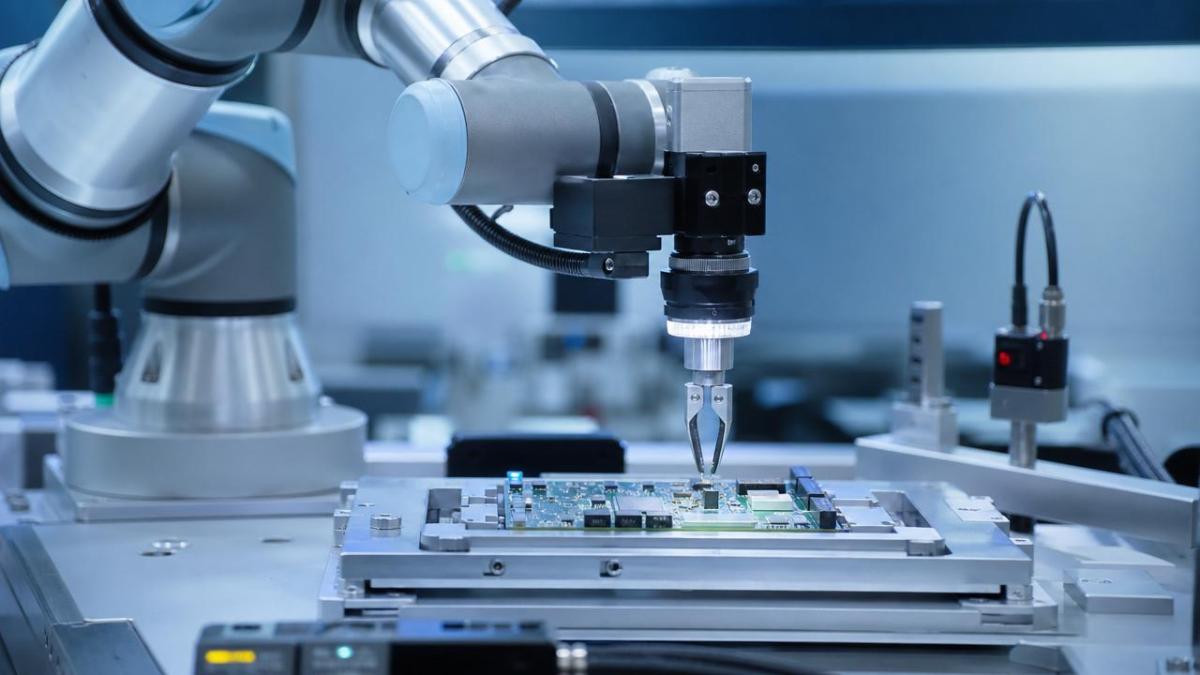
What is driving this change behind the scenes
The first driver is product fragility. Electronics assembly often involves connector insertion, screwdriving into plastic bosses, label placement, dispensing, testing handoff, tray loading, and PCB handling. Each of these tasks can tolerate only limited force error, angle deviation, or vibration. As designs become denser and lighter, acceptable process windows narrow further.
The second driver is integration maturity. Cobots are now easier to pair with machine vision, force sensing, smart screwdrivers, barcode readers, and ESD-aware end effectors than in earlier deployment cycles. This does not eliminate engineering effort, but it does make collaborative robots for electronics assembly more realistic for semi-automated cells where product variation remains high.
The third driver is the economics of downtime and rework. In electronics, one damaged component can be more expensive than a few seconds of slower movement, especially when failure is discovered late in testing or after enclosure closure. That is why many teams now prefer stable, recoverable automation over aggressively tuned motion profiles that raise hidden risk. The real cost comparison is no longer labor versus robot. It is stable yield versus unstable throughput.
The fourth driver is knowledge transfer. Operators are expected to manage more frequent line adjustments without waiting for specialized automation engineers for every minor change. This increases demand for interfaces, task logic, and maintenance workflows that ordinary production teams can understand. A cobot that performs well only when a top integrator is present may look impressive on paper but underperform in actual production.
Where collaborative robots for electronics assembly create the most value
Current adoption patterns suggest that the best use cases are not always the fastest tasks. They are often the tasks where repeatability, ergonomic relief, and damage prevention matter most. Pick-and-place of sensitive parts, test station loading, low-torque screwdriving, adhesive dispensing support, tray handling, and repetitive inspection positioning are strong examples. In these applications, collaborative robots for electronics assembly can reduce inconsistency while still letting operators stay close to the process.
By contrast, some high-speed applications still favor traditional industrial robots, especially where guarding is acceptable and part geometry is highly stable. This is an important market correction. Not every electronics task should become collaborative. The better question is whether human proximity, mixed-model flexibility, and gentler contact behavior create more value than maximum raw speed.
For operators, the practical advantage often appears in reduced fatigue and fewer fine-motor repetitive actions. For line managers, the advantage is easier balancing of takt time during product variation. For quality teams, the advantage is lower handling variation and cleaner event traceability. For procurement, the advantage is broader reuse potential across future workstations if the platform is selected carefully.
The biggest mistakes teams still make when evaluating cobot performance
A common mistake is focusing on nominal repeatability without looking at the full process chain. The arm may repeat well, but if the gripper compliance is poor, the vision calibration drifts, or feeder positioning varies, overall assembly accuracy will still fail. Collaborative robots for electronics assembly should therefore be assessed as part of a complete task system, not as a standalone arm.
Another mistake is underestimating recovery behavior. Electronics lines stop for replenishment, upstream delays, inspection holds, and manual interventions. The real test is not only how fast the cobot runs, but how safely and accurately it returns after interruption. Can the operator restart without complex re-homing? Can the system detect a mispicked part before damage occurs? Can force or torque anomalies trigger useful alarms instead of vague faults?
A third mistake is ignoring ESD, cleanliness, and material interaction. In electronics assembly, end effector material, cable routing, and contact surfaces can influence contamination risk and static management. Fast deployment loses value if these basics are treated as afterthoughts. Engineering-first evaluation means checking the full operating environment, including operator touchpoints and maintenance routines.
What operators and line teams should pay closer attention to
For users on the floor, the key trend is that the role is shifting from manual execution to process supervision. That means successful collaborative robots for electronics assembly must be understandable in daily use. Operators should pay attention to five areas during trials and early deployment:
- Whether part presentation is stable enough for the cobot to avoid edge contact or skewed insertion.
- Whether teaching and changeover can be done without deep programming knowledge.
- Whether fault messages explain the real issue clearly enough for quick recovery.
- Whether gripper force, compliance, and approach path are matched to fragile components.
- Whether cycle time remains stable across a full shift, not only at initial startup.
These are not small details. They determine whether automation becomes a trusted daily tool or an unstable station that operators learn to work around. In electronics environments, workarounds often hide process risk until scrap or field failures reveal the cost.
How selection criteria are evolving across the market
Selection criteria are becoming more operational and less promotional. Buyers and users increasingly want evidence on contact stability, path smoothness around fragile zones, force-limited behavior, downtime recovery logic, and compatibility with inspection and traceability tools. This fits the broader engineering culture promoted by organizations such as TechStat Vanguard, where parameters, tolerances, and measurable behavior matter more than broad marketing claims.
This evolution is healthy. It pushes the market toward honest deployment decisions and away from overgeneralized automation assumptions.
What to watch next in the development of collaborative robots for electronics assembly
Several forward-looking signals deserve attention. One is tighter fusion of vision and force feedback, especially for tasks like connector mating and delicate insertion where positional certainty alone is insufficient. Another is broader use of digital traceability, with cobots logging motion events, task outcomes, and exception states in ways that support root-cause analysis. A third is more modular end-of-arm tooling designed specifically for electronics-safe handling, including ESD-aware surfaces and quick-change grippers for mixed-product lines.
There is also a growing expectation that collaborative robots for electronics assembly must support staged automation. Many factories do not want a large one-time transformation. They want a station that starts with one repetitive task, proves yield stability, then expands to neighboring processes. Vendors and integrators that support this phased logic are likely to align better with real production constraints than those selling all-or-nothing automation narratives.
A practical decision framework for teams planning adoption
If a business is evaluating collaborative robots for electronics assembly now, the most useful next step is not a broad market comparison alone. It is a structured review of process sensitivity and operational readiness. Teams should confirm which stations suffer most from handling variation, where minor contact errors create the most scrap, how often changeovers occur, and whether operators can realistically own daily recovery and adjustment tasks.
A strong pilot candidate usually has measurable quality pain, repetitive manual handling, manageable fixturing complexity, and clear output metrics. It should also allow comparison before and after deployment using yield, interruption frequency, restart time, and defect escape data. This kind of evidence-based approach is more valuable than choosing the station with the highest theoretical automation ratio.
For organizations seeking clearer judgment, the right questions are straightforward: where does damage really occur, what is the true cost of rework, how stable is part presentation, how recoverable is the process after stops, and how much operator intervention remains necessary? If these questions are answered honestly, collaborative robots for electronics assembly can be assessed as production tools rather than trend symbols.
Final takeaway for operators and decision-makers
The most important industry change is not that cobots are becoming more visible. It is that expectations are becoming more exact. Electronics assembly teams now need speed with control, flexibility with traceability, and automation that protects fragile products under real operating conditions. That is why collaborative robots for electronics assembly should be judged by stable yield, safe interaction, recoverability, and engineering transparency.
For companies that want to understand the impact on their own lines, the next step is to identify the stations where precision loss, handling damage, and changeover friction are already limiting performance. From there, evaluate whether a cobot can improve the process window without introducing new instability. In a market full of claims, the best decisions still come from measurable behavior, verified process fit, and a disciplined focus on what operators must manage every day.
Search News
Hot Articles
- Carbon Fiber StructuresHow to Specify Aerospace Carbon Fiber Assemblies for Lightweight, Load-Bearing PartsJul 11, 2026
- Machine VisionXiaomi, Alibaba DAMO Academy Drive Open-Source Robotics Model Ecosystem, Lowering Algorithm Development Barriers for Overseas SMEs Adopting Chinese Robotics SolutionsMar 30, 2026
- Cobots & ArmsShanxi 'AI+' Conference Showcases Embodied Intelligence with Multinational Buyer Engagement: Key Industry ImplicationsMar 30, 2026
Popular Tags
Recommended News
 Jul 11, 2026How to Specify Aerospace Carbon Fiber Assemblies for Lightweight, Load-Bearing PartsAerospace carbon fiber assemblies: learn how to specify laminate design, load data, joining methods, and inspection controls for lighter, reliable load-bearing aerospace parts.Elena Rostova (UAV Systems Researcher)
 Mar 30, 2026Xiaomi, Alibaba DAMO Academy Drive Open-Source Robotics Model Ecosystem, Lowering Algorithm Development Barriers for Overseas SMEs Adopting Chinese Robotics SolutionsXiaomi & Alibaba DAMO Academy's open-source robotics models lower algorithm barriers for global SMEs. Boost efficiency in manufacturing, logistics & smart retail with ROS 2 compatible solutions.TSV Data Lab
 Mar 30, 2026Shanxi 'AI+' Conference Showcases Embodied Intelligence with Multinational Buyer Engagement: Key Industry ImplicationsShanxi 'AI+' Conference highlights embodied intelligence with Tesla, Ubtech & Jiantao showcasing multimodal robotics. 40+ global buyers validated tech on-site, creating new B2B channels for industrial automation & AI solutions.Chen Wei (Automation Lead Engineer)
 Mar 30, 2026Zhongguancun Unveils 6G Integrated Sensing-Computing-Intelligence Platform to Empower Embodied Robots for Global Industrial ApplicationsZhongguancun's new 6G platform revolutionizes industrial robotics with <10ms latency, empowering global automotive, logistics & port automation. Discover how this tech boosts China's smart manufacturing exports.TSV Data Lab
 Mar 30, 2026Mech-Mind Tianjin Embodied Intelligence R&D and Production Base Goes Live, Cutting Delivery Time by 20%–30% for Global Customized AMR+Vision SolutionsMech-Mind's Tianjin AMR+Vision production base cuts delivery time by 20%-30% for欧美 & Latin American markets. Discover how this PLd-certified facility accelerates customized robotics solutions for smart manufacturing and logistics.Chen Wei (Automation Lead Engineer)
 Mar 30, 2026Boao Forum Reveals 'Co-evolution of Big and Small Brains' Trend in Humanoid Robots, China's Embodied Intelligence Accelerates Adaptation to Overseas Manufacturing Service ScenariosDiscover how China's humanoid robots, featuring 'Co-evolution of Big and Small Brains,' are revolutionizing global manufacturing. Learn about Embodied Tian Gong 3.0's ISO compliance and overseas deployment at Boao Forum 2026.Chen Wei (Automation Lead Engineer)
 Mar 30, 2026China Railway Industrial Secures Patent for Embodied Robotics in Material Handling, Boosting High-Precision Delivery Capabilities for Overseas Infrastructure and Manufacturing ProjectsChina Railway Industrial's new patent for embodied robotics in material handling boosts high-precision delivery for global infrastructure & manufacturing. Discover how this innovation enhances logistics accuracy in automotive, rail transit & EPC projects.Chen Wei (Automation Lead Engineer)
 Sep 28, 2026Spindle Runout Measurement in Germany: DIN Standards, Methods, and Acceptance LimitsSpindle runout measurement Germany: explore DIN standards, proven methods, acceptance limits, and audit-ready practices for reliable machining quality.Dr. Marcus Vance
 Sep 27, 2026How to Select Wall-Mount Edge Devices for Space-Constrained Factory NetworksWall mount edge devices for space-constrained factories: evaluate workload, thermal design, power resilience, cable access, and network reliability for smarter deployments.TSV Data Lab
 Sep 26, 2026Machining Tolerance Analysis: How to Set Limits That Meet Function and Cost TargetsMachining tolerance analysis: learn how to set functional limits, control tolerance stacks, reduce inspection risk, and balance precision with production cost.Dr. Marcus Vance
 Sep 25, 2026How to Evaluate an Industrial Infrastructure Data Platform for Multi-Site OperationsIndustrial infrastructure data platform evaluation guide for multi-site operations: compare data quality, edge resilience, interoperability, governance, and scalable proof-of-value criteria.Victor Lin (Chief Software Architect)
 Sep 24, 2026How to Select Machine Vision Optics for Accurate Inspection at Different Working DistancesMachine vision optics selection guide for accurate inspection at every working distance. Compare FOV, pixel scale, DOF, distortion, lighting, and telecentric options.TSV Data Lab
 Sep 23, 2026How to Evaluate a Machine Vision System Integrator for High-Speed Inspection LinesChoose a machine vision system integrator with proven expertise in high-speed inspection, reliable reject timing, robust optics, and measurable acceptance criteria.TSV Data Lab
 Sep 28, 2026When is a SCADA API the right choice for connecting plant systems?SCADA API guide: learn when governed plant data integration improves traceability, security, and scalability—without compromising real-time control.Victor Lin (Chief Software Architect)
 Sep 27, 2026How SCADA data integration improves traceability across production linesSCADA data integration connects production-line data to improve traceability, accelerate quality investigations, and strengthen safety decisions.Victor Lin (Chief Software Architect)
 Sep 26, 2026What to define before starting SCADA integration planningSCADA integration planning starts with clear scope, control boundaries, data models, cybersecurity, and testing. Discover the definitions that reduce risk and costly rework.Victor Lin (Chief Software Architect)
 Sep 25, 2026How a smart factory with Industrial IoT reduces production blind spotsDiscover how a smart factory with Industrial IoT turns real-time machine, quality, and workflow data into actionable insights that reduce production blind spots and delivery risks.Victor Lin (Chief Software Architect)
 Sep 24, 2026When does Industrial IoT make smart manufacturing easier to scale?Smart manufacturing Industrial IoT scales when trusted data, interoperable systems, and secure workflows turn connected assets into measurable gains.TSV Data Lab
 Sep 23, 2026What drives ultra-precision machining cost at 1-micron tolerance?Ultra precision machining cost per part at 1 micron tolerance depends on process, material, metrology, and yield. Learn how to compare quotes confidently.Dr. Marcus Vance
 Sep 22, 2026Drone Engine-T550CC Applications: Build the UAV Power System Around the MissionAn application guide for Drone Engine-T550CC integration, covering payload planning, airframe matching, cooling, fuel, vibration, test procedures, documentation, and service preparation.Elena Rostova (UAV Systems Researcher)
 Sep 22, 2026How to Evaluate Industrial Edge Computing Vendors for Factory DeploymentIndustrial edge computing vendor evaluation guide for factories: compare latency, protocol fit, reliability, security, and lifecycle support before deployment.TSV Data Lab
 Sep 21, 2026Drone Payload Integration: Matching Power, Data, and Center of Gravity for Reliable FlightsDrone payload integration made practical: balance power, data, center of gravity, and endurance to build safer, more reliable mission-ready flights.Elena Rostova (UAV Systems Researcher)
 Sep 20, 2026Autonomous Navigation Pricing: Cost Drivers and Budget Benchmarks for AMR ProjectsAutonomous navigation price explained: compare AMR cost drivers, software, sensors, integration, safety, and lifecycle budgets to build a scalable project plan.Chen Wei (Automation Lead Engineer)
 Sep 19, 2026How to Scope Automation Integration Services for Multi-System Factory ProjectsAutomation integration services: learn how to scope multi-system factory projects with clear workflows, interface contracts, safety boundaries, and acceptance criteria.Victor Lin (Chief Software Architect)























