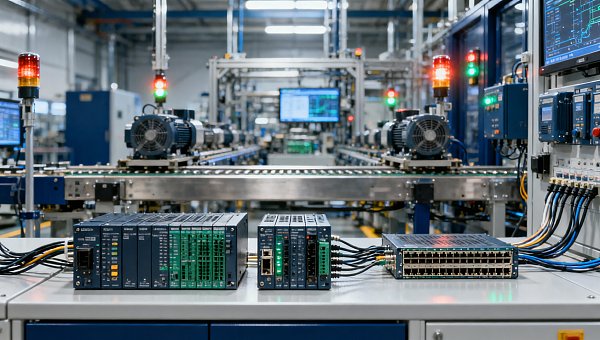
Energy efficiency comparison in robots is changing buying choices
Publication Date
author
For enterprise decision-makers, an industrial robots energy efficiency comparison is no longer a minor technical detail—it is directly shaping capital allocation, total cost of ownership, and supplier selection. As power consumption, duty cycles, and real-world performance become measurable competitive factors, buyers are moving beyond marketing claims to demand verified engineering data that reveals which robotic systems deliver lasting operational value.
What industrial robots energy efficiency comparison really means
At its core, an industrial robots energy efficiency comparison evaluates how effectively different robotic systems convert electrical input into useful work under defined operating conditions. That sounds simple, but in practice it involves far more than checking a nameplate power number. Real efficiency depends on payload, acceleration, idle power draw, control architecture, servo tuning, end-effector mass, path planning, and production rhythm.
For this reason, enterprise buyers increasingly treat energy efficiency as an engineering performance metric rather than a marketing claim. A robot that looks efficient in a brochure may consume significantly more energy in a high-cycle pick-and-place line, a welding cell with frequent stops, or a mixed-load palletizing operation. The value of a sound industrial robots energy efficiency comparison lies in normalizing these variables so decision-makers can compare systems on a like-for-like basis.
This is especially relevant in advanced manufacturing, where energy cost is tied directly to throughput, uptime, thermal management, and sustainability targets. In the TSV view, parameters matter most when they can be traced to real operational conditions. Comparing robots only by peak power or by vague “low-energy design” language is no longer sufficient for serious capital planning.
Why the market is paying closer attention
Several industry trends are pushing industrial robots energy efficiency comparison into the center of buying decisions. First, electricity prices remain volatile across major manufacturing regions. A modest efficiency gap, multiplied across dozens or hundreds of robots and several years of continuous production, can materially change lifecycle cost.
Second, factories are under pressure to increase output without proportionally increasing facility loads. This makes efficient automation attractive not only for cost reasons, but also for power infrastructure planning. Plants with limited transformer capacity, strict utility contracts, or energy reporting requirements cannot ignore how robot fleets affect total consumption.
Third, sustainability reporting has become operational rather than symbolic. Procurement leaders, CTOs, and plant managers are being asked to justify how new equipment supports carbon reduction and resource efficiency. In that environment, an industrial robots energy efficiency comparison becomes a bridge between engineering data and executive accountability.
Finally, the technology itself has matured. Better servo drives, regenerative braking, lighter arms, improved motion algorithms, and edge analytics now allow measurable gains. Because gains are measurable, buyers expect proof. That is why hard-tech evaluation platforms such as TSV emphasize verifiable benchmarks over generic vendor narratives.
Key factors that shape robot energy performance
A reliable industrial robots energy efficiency comparison should account for both hardware and application context. The following factors usually determine whether one robot platform will outperform another in the field:
- Payload-to-arm-mass ratio: lighter structures can reduce required drive energy, but only if stiffness and stability remain adequate.
- Duty cycle profile: continuous motion, intermittent motion, and idle-heavy operation create very different consumption patterns.
- Motion planning efficiency: smoother trajectories, reduced jerk, and optimized acceleration curves often lower power peaks.
- Servo and controller design: motor efficiency, inverter losses, and control responsiveness influence total draw.
- End-of-arm tooling: oversized grippers, vacuum systems, and auxiliary devices can offset gains from the robot arm itself.
- Standby and idle consumption: in many operations, non-productive time is substantial, so low idle power matters.
- Thermal behavior and cooling needs: inefficient systems often create hidden energy costs through extra heat management.
These variables explain why a single power figure tells only part of the story. Enterprise decision-makers should insist on use-case-based data rather than abstract averages.
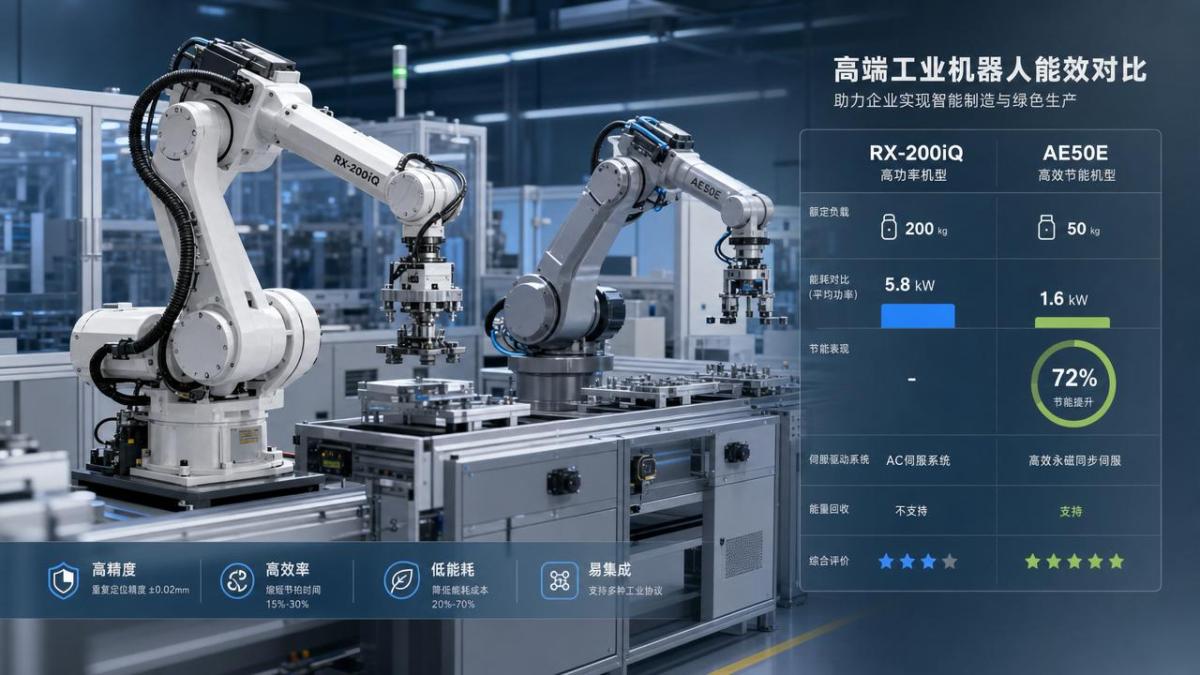
Industry overview: where energy efficiency has the highest business impact
Not every robotic application values energy efficiency in the same way. In some sectors, energy cost is a direct margin issue; in others, it is tied to uptime, regulatory reporting, or facility constraints. The table below provides a practical overview.
How energy efficiency influences buying choices beyond utility bills
The business value of an industrial robots energy efficiency comparison extends beyond electricity expense. For enterprise buyers, efficiency is increasingly a proxy for engineering maturity. A robot platform that performs the same task with lower consumption may also indicate better drive design, lower wear, smarter controls, and improved thermal stability. Those traits can support longer service intervals and more predictable operating conditions.
Efficiency also changes facility economics. Lower average and peak demand can reduce pressure on power distribution systems, simplify expansion planning, and support the integration of additional automation without major infrastructure upgrades. In capital-intensive industries, avoiding electrical retrofits can be as meaningful as reducing operating cost.
There is also a procurement governance dimension. Boards and finance teams increasingly evaluate automation through total cost of ownership, not purchase price alone. In that framework, industrial robots energy efficiency comparison helps procurement teams defend decisions with measurable data. It shifts discussion from “Which robot is cheaper to buy?” to “Which robot creates the strongest cost-performance outcome over five to ten years?”
For multinational operations, consistent energy benchmarking can further support standardization. If a company deploys similar cells across different regions, comparable efficiency data improves vendor selection, operating model consistency, and future line replication.
Common robot categories and what to compare
An industrial robots energy efficiency comparison should be tailored to robot class. Different architectures create different efficiency patterns, so comparison criteria must reflect actual use.
A practical framework for evaluation
To make an industrial robots energy efficiency comparison decision-ready, companies should define a standardized evaluation framework. The most useful approach combines laboratory clarity with production realism.
Start with the intended application envelope: payload, reach, cycle time, motion path, ambient conditions, and annual operating hours. Then request vendor data under those conditions, not under generic test statements. Ask whether figures include controller consumption, peripheral loads, idle time, and braking recovery. If not, the comparison may be incomplete.
Next, compare energy performance alongside other engineering metrics. A robot that saves power but compromises repeatability, fault tolerance, or maintainability may not create net value. TSV’s benchmarking philosophy is relevant here: energy efficiency should be read together with precision, durability, MTBF, and system stability.
Pilot testing is often decisive. Even a short production trial can reveal whether the promised efficiency survives real scheduling, variable loads, and operator behavior. In many factories, software configuration and path optimization unlock a meaningful share of energy savings, so post-installation tuning should be included in the evaluation model.
Mistakes to avoid when interpreting comparison data
Decision-makers should be cautious about simplified claims. One common mistake is comparing robots across different payload classes or task profiles. Another is focusing only on maximum rated power, which says little about average energy use. A third is ignoring peripheral equipment such as vacuum pumps, weld packages, conveyors, or vision systems, all of which affect the real energy footprint of the robotic cell.
It is also risky to assume that the newest model is automatically the most efficient in every scenario. Some designs deliver excellent results in high-speed light-duty applications but perform less efficiently in heavy, intermittent, or multi-tool operations. That is why industrial robots energy efficiency comparison should always be task-specific and evidence-led.
What enterprise leaders should do next
For enterprise decision-makers, the right response is not simply to demand “green robots.” It is to build better technical procurement criteria. Define measurable efficiency thresholds, require transparent test conditions, and connect energy metrics to total cost of ownership models. In supplier reviews, ask for engineering evidence that can be traced to real manufacturing use rather than promotional language.
As industrial automation expands across robotics, sensors, edge AI, and precision manufacturing, the companies that buy best will be those that evaluate best. A disciplined industrial robots energy efficiency comparison helps organizations reduce operating cost, improve infrastructure planning, strengthen sustainability reporting, and choose automation platforms with more durable long-term value.
That is precisely where data-driven analysis matters. In hard-tech procurement, confidence comes from verified parameters, realistic benchmarks, and engineering truth. When buyers align efficiency data with production realities, energy performance stops being a secondary specification and becomes a strategic buying criterion.
Search News
Hot Articles
- Carbon Fiber StructuresHow to Specify Aerospace Carbon Fiber Assemblies for Lightweight, Load-Bearing PartsJul 11, 2026
- Machine VisionXiaomi, Alibaba DAMO Academy Drive Open-Source Robotics Model Ecosystem, Lowering Algorithm Development Barriers for Overseas SMEs Adopting Chinese Robotics SolutionsMar 30, 2026
- Cobots & ArmsShanxi 'AI+' Conference Showcases Embodied Intelligence with Multinational Buyer Engagement: Key Industry ImplicationsMar 30, 2026
Popular Tags
Recommended News
 Jul 11, 2026How to Specify Aerospace Carbon Fiber Assemblies for Lightweight, Load-Bearing PartsAerospace carbon fiber assemblies: learn how to specify laminate design, load data, joining methods, and inspection controls for lighter, reliable load-bearing aerospace parts.Elena Rostova (UAV Systems Researcher)
 Mar 30, 2026Xiaomi, Alibaba DAMO Academy Drive Open-Source Robotics Model Ecosystem, Lowering Algorithm Development Barriers for Overseas SMEs Adopting Chinese Robotics SolutionsXiaomi & Alibaba DAMO Academy's open-source robotics models lower algorithm barriers for global SMEs. Boost efficiency in manufacturing, logistics & smart retail with ROS 2 compatible solutions.TSV Data Lab
 Mar 30, 2026Shanxi 'AI+' Conference Showcases Embodied Intelligence with Multinational Buyer Engagement: Key Industry ImplicationsShanxi 'AI+' Conference highlights embodied intelligence with Tesla, Ubtech & Jiantao showcasing multimodal robotics. 40+ global buyers validated tech on-site, creating new B2B channels for industrial automation & AI solutions.Chen Wei (Automation Lead Engineer)
 Mar 30, 2026Zhongguancun Unveils 6G Integrated Sensing-Computing-Intelligence Platform to Empower Embodied Robots for Global Industrial ApplicationsZhongguancun's new 6G platform revolutionizes industrial robotics with <10ms latency, empowering global automotive, logistics & port automation. Discover how this tech boosts China's smart manufacturing exports.TSV Data Lab
 Mar 30, 2026Mech-Mind Tianjin Embodied Intelligence R&D and Production Base Goes Live, Cutting Delivery Time by 20%–30% for Global Customized AMR+Vision SolutionsMech-Mind's Tianjin AMR+Vision production base cuts delivery time by 20%-30% for欧美 & Latin American markets. Discover how this PLd-certified facility accelerates customized robotics solutions for smart manufacturing and logistics.Chen Wei (Automation Lead Engineer)
 Mar 30, 2026Boao Forum Reveals 'Co-evolution of Big and Small Brains' Trend in Humanoid Robots, China's Embodied Intelligence Accelerates Adaptation to Overseas Manufacturing Service ScenariosDiscover how China's humanoid robots, featuring 'Co-evolution of Big and Small Brains,' are revolutionizing global manufacturing. Learn about Embodied Tian Gong 3.0's ISO compliance and overseas deployment at Boao Forum 2026.Chen Wei (Automation Lead Engineer)
 Mar 30, 2026China Railway Industrial Secures Patent for Embodied Robotics in Material Handling, Boosting High-Precision Delivery Capabilities for Overseas Infrastructure and Manufacturing ProjectsChina Railway Industrial's new patent for embodied robotics in material handling boosts high-precision delivery for global infrastructure & manufacturing. Discover how this innovation enhances logistics accuracy in automotive, rail transit & EPC projects.Chen Wei (Automation Lead Engineer)
 Sep 28, 2026Spindle Runout Measurement in Germany: DIN Standards, Methods, and Acceptance LimitsSpindle runout measurement Germany: explore DIN standards, proven methods, acceptance limits, and audit-ready practices for reliable machining quality.Dr. Marcus Vance
 Sep 27, 2026How to Select Wall-Mount Edge Devices for Space-Constrained Factory NetworksWall mount edge devices for space-constrained factories: evaluate workload, thermal design, power resilience, cable access, and network reliability for smarter deployments.TSV Data Lab
 Sep 26, 2026Machining Tolerance Analysis: How to Set Limits That Meet Function and Cost TargetsMachining tolerance analysis: learn how to set functional limits, control tolerance stacks, reduce inspection risk, and balance precision with production cost.Dr. Marcus Vance
 Sep 25, 2026How to Evaluate an Industrial Infrastructure Data Platform for Multi-Site OperationsIndustrial infrastructure data platform evaluation guide for multi-site operations: compare data quality, edge resilience, interoperability, governance, and scalable proof-of-value criteria.Victor Lin (Chief Software Architect)
 Sep 24, 2026How to Select Machine Vision Optics for Accurate Inspection at Different Working DistancesMachine vision optics selection guide for accurate inspection at every working distance. Compare FOV, pixel scale, DOF, distortion, lighting, and telecentric options.TSV Data Lab
 Sep 23, 2026How to Evaluate a Machine Vision System Integrator for High-Speed Inspection LinesChoose a machine vision system integrator with proven expertise in high-speed inspection, reliable reject timing, robust optics, and measurable acceptance criteria.TSV Data Lab
 Sep 28, 2026When is a SCADA API the right choice for connecting plant systems?SCADA API guide: learn when governed plant data integration improves traceability, security, and scalability—without compromising real-time control.Victor Lin (Chief Software Architect)
 Sep 27, 2026How SCADA data integration improves traceability across production linesSCADA data integration connects production-line data to improve traceability, accelerate quality investigations, and strengthen safety decisions.Victor Lin (Chief Software Architect)
 Sep 26, 2026What to define before starting SCADA integration planningSCADA integration planning starts with clear scope, control boundaries, data models, cybersecurity, and testing. Discover the definitions that reduce risk and costly rework.Victor Lin (Chief Software Architect)
 Sep 25, 2026How a smart factory with Industrial IoT reduces production blind spotsDiscover how a smart factory with Industrial IoT turns real-time machine, quality, and workflow data into actionable insights that reduce production blind spots and delivery risks.Victor Lin (Chief Software Architect)
 Sep 24, 2026When does Industrial IoT make smart manufacturing easier to scale?Smart manufacturing Industrial IoT scales when trusted data, interoperable systems, and secure workflows turn connected assets into measurable gains.TSV Data Lab
 Sep 23, 2026What drives ultra-precision machining cost at 1-micron tolerance?Ultra precision machining cost per part at 1 micron tolerance depends on process, material, metrology, and yield. Learn how to compare quotes confidently.Dr. Marcus Vance
 Sep 22, 2026Drone Engine-T550CC Applications: Build the UAV Power System Around the MissionAn application guide for Drone Engine-T550CC integration, covering payload planning, airframe matching, cooling, fuel, vibration, test procedures, documentation, and service preparation.Elena Rostova (UAV Systems Researcher)
 Sep 22, 2026How to Evaluate Industrial Edge Computing Vendors for Factory DeploymentIndustrial edge computing vendor evaluation guide for factories: compare latency, protocol fit, reliability, security, and lifecycle support before deployment.TSV Data Lab
 Sep 21, 2026Drone Payload Integration: Matching Power, Data, and Center of Gravity for Reliable FlightsDrone payload integration made practical: balance power, data, center of gravity, and endurance to build safer, more reliable mission-ready flights.Elena Rostova (UAV Systems Researcher)
 Sep 20, 2026Autonomous Navigation Pricing: Cost Drivers and Budget Benchmarks for AMR ProjectsAutonomous navigation price explained: compare AMR cost drivers, software, sensors, integration, safety, and lifecycle budgets to build a scalable project plan.Chen Wei (Automation Lead Engineer)
 Sep 19, 2026How to Scope Automation Integration Services for Multi-System Factory ProjectsAutomation integration services: learn how to scope multi-system factory projects with clear workflows, interface contracts, safety boundaries, and acceptance criteria.Victor Lin (Chief Software Architect)