Path Planning Algorithms That Improve AMR Traffic Flow
Publication Date
author
For technical evaluators comparing mobile automation performance, AGV AMR path planning algorithms are more than a software feature—they directly shape congestion risk, throughput stability, and fleet-level efficiency. This article examines how different planning methods influence AMR traffic flow, with a focus on measurable engineering factors such as rerouting speed, collision avoidance logic, and system behavior under dynamic shop-floor conditions.
In high-mix manufacturing, intralogistics bottlenecks rarely come from top speed alone. They emerge when 20, 50, or 100+ vehicles share narrow aisles, dynamic workcells, and shifting task priorities. For teams benchmarking suppliers or defining technical specifications, the question is not whether an AMR can navigate, but how its planning stack behaves when layouts change, traffic density rises by 30%–50%, or localization confidence drops in reflective or cluttered zones.
At TechStat Vanguard, the engineering view is straightforward: traffic flow quality must be assessed through observable parameters. These include route computation latency, deadlock recovery logic, stop-and-go frequency, intersection handling, battery-aware dispatching, and how the system scales from a pilot fleet of 5 units to a production fleet of 60 units or more. That is where AGV AMR path planning algorithms become a decisive procurement and integration criterion.
Why Path Planning Has a Direct Impact on AMR Traffic Flow
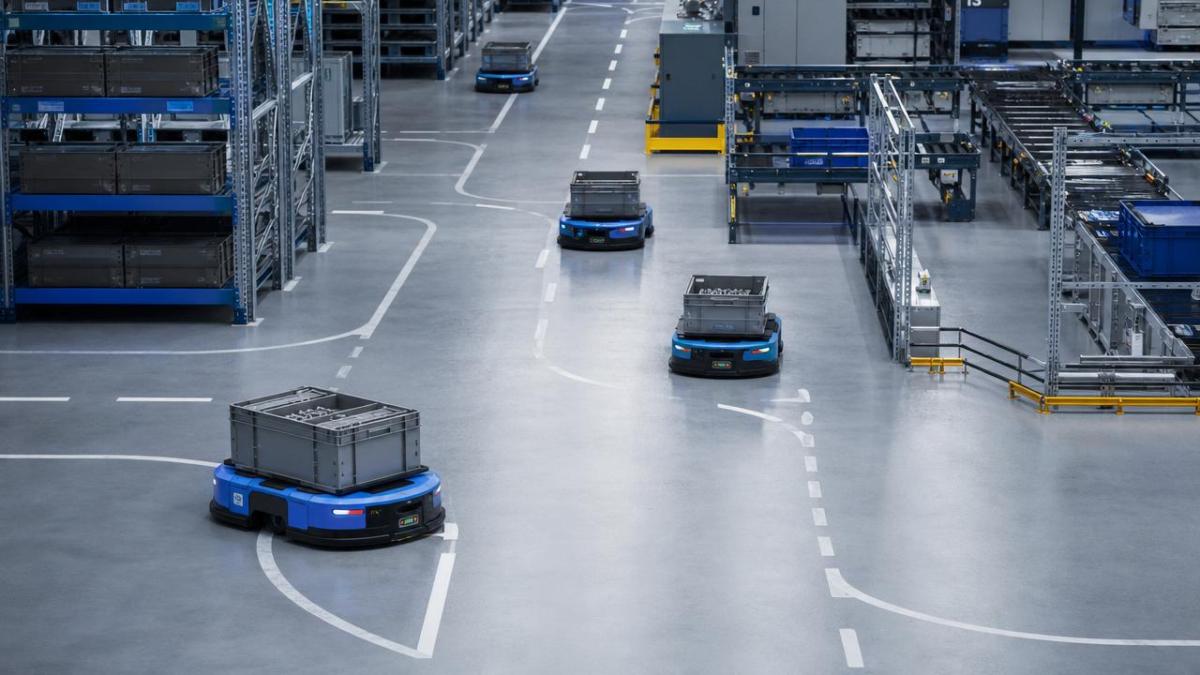
In technical evaluations, traffic flow should be treated as a system-level outcome rather than a navigation feature. A vehicle may demonstrate acceptable waypoint accuracy in isolated testing, yet still perform poorly in production if its path planning cannot manage congestion waves, temporary obstructions, or priority conflicts between transport missions. In most facilities, even a 3–8 second delay at repeated merge points can compound into visible throughput loss over a full shift.
Path planning also influences equipment utilization beyond the robots themselves. When vehicle queues block machine loading points, docking stations, or pallet transfer areas, the effect spreads to upstream and downstream assets. For evaluators in automated manufacturing, electronics assembly, warehousing, aerospace subassembly, or precision machining, this means route logic should be reviewed in relation to takt time, aisle width, and task burst frequency—not in isolation.
Three Levels of Traffic Flow Impact
- Local level: obstacle avoidance, stopping distance, and immediate rerouting within 0.5–3 seconds.
- Fleet level: conflict resolution between multiple AMRs, including crossing, merging, and overtaking logic.
- Operational level: dispatch alignment with production priorities, battery windows, and mission deadlines over 8–24 hour cycles.
What Technical Evaluators Should Measure
A robust review of AGV AMR path planning algorithms should convert software claims into measurable criteria. Useful indicators include average route update time, number of full stops per mission, successful recovery from blocked aisles, and performance under mixed static and dynamic obstacles. In practical factory acceptance tests, a planning system that maintains stable mission completion with 15%–20% route disruption is often more valuable than one optimized only for ideal layouts.
The following comparison helps frame how algorithm classes affect traffic behavior in industrial settings.
The key conclusion is that no single method is universally superior. In low-density environments, graph-based planning may be sufficient. In facilities with 10+ shared intersections, mobile workstations, and changing material call patterns, coordinated or hybrid AGV AMR path planning algorithms usually deliver better traffic outcomes because they optimize both route selection and conflict timing.
Core Algorithm Families and Their Engineering Trade-Offs
When suppliers present navigation capabilities, evaluators should separate marketing language from algorithm behavior. Most industrial systems use a layered architecture: a global planner for mission routes, a local planner for immediate obstacle response, and a fleet controller for traffic governance. The engineering value lies in how these layers interact within 100 ms, 500 ms, or 2 second decision windows.
Global Route Planning for Predictability
Global planning typically relies on maps, semantic zones, and traversability rules. In structured factories, this can support predictable travel times and easier validation. Technical teams should ask whether routing supports one-way aisles, speed zones, keep-out areas, and mission-specific preferences such as avoiding sensitive inspection corridors or prioritizing wide turns for larger payload carts.
A useful benchmark is how the system reacts to a blocked primary route. If the alternative path calculation takes more than 2–5 seconds under live fleet load, congestion may cascade. If rerouting is instantaneous but repeatedly pushes traffic into the same secondary corridor, the algorithm may be fast but not flow-aware.
Common Evaluation Questions
- Does the planner optimize for distance only, or also for congestion probability and mission priority?
- Can the map model support temporary lane closures for maintenance windows of 30 minutes to 8 hours?
- Are route penalties configurable for narrow zones, human-heavy crossings, or low-visibility corners?
Local Planning for Dynamic Obstacle Handling
Local planning governs real-time behavior around forklifts, pallets, and pedestrians. This is where collision avoidance quality becomes visible. A conservative local planner reduces risk, but if thresholds are too cautious, traffic flow deteriorates because vehicles produce unnecessary stops, wide detours, or hesitation loops at intersections.
For mixed environments, evaluators should review sensor fusion latency, obstacle classification logic, and the transition rules between “slow,” “pause,” and “reroute.” In many deployments, reducing unnecessary full stops by even 10%–15% can produce more meaningful throughput gains than increasing nominal travel speed from 1.5 m/s to 1.8 m/s.
Fleet Coordination for Multi-AMR Efficiency
Fleet-level coordination is often the decisive layer for traffic flow. Without it, individually intelligent vehicles may still create deadlocks or queue oscillations. Coordinated planning can reserve critical path segments, assign right-of-way, and stagger arrivals at shared resources such as lifts, docking bays, or narrow transfer stations.
In practical terms, a plant with 25 AMRs and 12 shared intersections needs more than pathfinding. It needs policy logic: which mission gets priority, how long a segment can be reserved, when a waiting vehicle should backtrack, and how battery state affects dispatch. These factors should be visible in simulation and test logs, not hidden behind generic dashboard summaries.
Selection Criteria for Technical Evaluators and Procurement Teams
For R&D engineers, automation architects, and senior sourcing teams, the selection process should tie AGV AMR path planning algorithms to deployment risk and operating economics. A technically credible review normally covers at least four dimensions: traffic stability, integration compatibility, testability, and maintainability. Software sophistication alone is not enough if tuning depends entirely on vendor intervention or if changes require long commissioning cycles.
A Practical Evaluation Matrix
The matrix below can be used during supplier comparison, pilot planning, or specification drafting. It emphasizes measurable checkpoints rather than broad promises.
This type of matrix helps procurement teams avoid a common mistake: selecting for navigation demonstration quality rather than operational flow stability. In many projects, the hidden cost appears 3–6 months after deployment, when layout revisions, product mix changes, or shift-level mission bursts expose weak coordination logic.
Typical Red Flags During Vendor Review
- Traffic control is described only at a conceptual level, with no test logs or scenario definitions.
- Deadlock handling relies mainly on manual operator intervention.
- Performance claims are based on single-robot demos rather than multi-vehicle stress tests.
- Layout changes require extensive remapping, recommissioning, or remote vendor support.
- Simulation outputs do not show queue length, stop frequency, or mission delay distributions.
Questions Worth Adding to an RFQ or Technical Spec Sheet
Engineering-led sourcing benefits from precise questions. Ask suppliers to define the planning architecture, explain how they handle temporary blockages, and provide examples of fleet conflict resolution in dense layouts. It is also useful to require a validation sequence with at least 3 scenarios: nominal flow, obstacle-rich flow, and burst-demand flow during a 20%–30% task increase.
For TSV’s audience, this matters because technical truth is found in parameter boundaries and failure modes. A supplier that can clearly state map refresh dependencies, local planner response thresholds, and expected throughput variation under congestion is usually easier to evaluate than one offering only broad “smart navigation” claims.
Implementation, Validation, and Long-Term Traffic Optimization
Even strong AGV AMR path planning algorithms can underperform if deployment methodology is weak. Traffic flow quality depends on map design, station placement, mission orchestration, and operating rules. In many factories, the first 4–8 weeks after go-live determine whether the system settles into stable flow or enters a cycle of recurring traffic patches.
Four-Step Validation Approach
- Baseline mapping: define one-way lanes, safety zones, and high-conflict nodes before the first pilot run.
- Stress simulation: test blocked corridors, mission bursts, and simultaneous docking requests across at least 2–3 shift patterns.
- Live pilot measurement: record stop frequency, queue duration, reroute count, and mission completion time for 2–4 weeks.
- Iterative tuning: adjust path penalties, priority rules, and station logic using measured bottlenecks rather than assumptions.
Layout and Operations Factors That Algorithms Alone Cannot Fix
Path planning cannot compensate for poor physical design. If aisle widths are marginal, charging stations sit inside active routes, or pickup points force repeated cross-traffic, congestion will persist no matter how advanced the planner appears. Evaluators should therefore review navigation software together with material flow design, buffer placement, and human-robot interaction zones.
A common example is the narrow merge near pallet transfer areas. If three vehicle streams converge within a short 5–10 meter segment, the planner may repeatedly slow or hold vehicles, producing visible wave effects. Sometimes the right solution is algorithm tuning; sometimes it is a revised lane rule or a 2-meter station relocation. Good technical assessment distinguishes between these cases.
Long-Term Maintenance and Optimization Metrics
After commissioning, teams should monitor a focused set of indicators every week or month. These often include average mission time, 95th percentile delay, number of emergency stops, congestion dwell time at critical nodes, and route deviation events caused by temporary obstacles. A dashboard that tracks 5–8 well-defined metrics is usually more valuable than a broad but vague analytics suite.
Over time, the best-performing sites treat path planning as a controllable production parameter. They retune traffic logic when product mix changes, when fleet size increases by another 10–15 units, or when workcell positions shift. This is particularly important in advanced manufacturing environments where process variation and floor reconfiguration are normal rather than exceptional.
Common Misconceptions
“Higher speed means better flow.”
Not necessarily. In dense traffic, smoother conflict resolution and fewer full stops often matter more than peak speed. A system capped at 1.5 m/s can outperform one rated at 2.0 m/s if the latter creates repeated bottlenecks.
“Obstacle avoidance equals intelligent fleet behavior.”
Obstacle avoidance is only one layer. True traffic efficiency depends on how the fleet reserves path segments, resolves contention, and aligns missions with operational priorities.
“A successful demo guarantees production stability.”
A polished demo usually reflects controlled conditions. Production stability must be verified through repeated testing across realistic workloads, variable obstacles, and shift-level demand changes.
For technical evaluators, the real value of AGV AMR path planning algorithms lies in measurable traffic behavior under imperfect conditions. The strongest systems combine global route efficiency, fast local response, and fleet-aware coordination that remains stable as layouts evolve and vehicle counts grow. That is the difference between a navigation feature and a production-ready automation asset.
If your team is benchmarking AMR suppliers, refining a specification sheet, or validating fleet behavior before procurement, a data-driven evaluation framework can reduce trial-and-error costs and shorten qualification cycles. Contact TechStat Vanguard to discuss technical criteria, compare planning architectures, or obtain a more structured assessment approach tailored to your mobile automation environment.
Search News
Hot Articles
- Carbon Fiber StructuresHow to Specify Aerospace Carbon Fiber Assemblies for Lightweight, Load-Bearing PartsJul 11, 2026
- Machine VisionXiaomi, Alibaba DAMO Academy Drive Open-Source Robotics Model Ecosystem, Lowering Algorithm Development Barriers for Overseas SMEs Adopting Chinese Robotics SolutionsMar 30, 2026
- Cobots & ArmsShanxi 'AI+' Conference Showcases Embodied Intelligence with Multinational Buyer Engagement: Key Industry ImplicationsMar 30, 2026
Popular Tags
Recommended News
 Jul 11, 2026How to Specify Aerospace Carbon Fiber Assemblies for Lightweight, Load-Bearing PartsAerospace carbon fiber assemblies: learn how to specify laminate design, load data, joining methods, and inspection controls for lighter, reliable load-bearing aerospace parts.Elena Rostova (UAV Systems Researcher)
 Mar 30, 2026Xiaomi, Alibaba DAMO Academy Drive Open-Source Robotics Model Ecosystem, Lowering Algorithm Development Barriers for Overseas SMEs Adopting Chinese Robotics SolutionsXiaomi & Alibaba DAMO Academy's open-source robotics models lower algorithm barriers for global SMEs. Boost efficiency in manufacturing, logistics & smart retail with ROS 2 compatible solutions.TSV Data Lab
 Mar 30, 2026Shanxi 'AI+' Conference Showcases Embodied Intelligence with Multinational Buyer Engagement: Key Industry ImplicationsShanxi 'AI+' Conference highlights embodied intelligence with Tesla, Ubtech & Jiantao showcasing multimodal robotics. 40+ global buyers validated tech on-site, creating new B2B channels for industrial automation & AI solutions.Chen Wei (Automation Lead Engineer)
 Mar 30, 2026Zhongguancun Unveils 6G Integrated Sensing-Computing-Intelligence Platform to Empower Embodied Robots for Global Industrial ApplicationsZhongguancun's new 6G platform revolutionizes industrial robotics with <10ms latency, empowering global automotive, logistics & port automation. Discover how this tech boosts China's smart manufacturing exports.TSV Data Lab
 Mar 30, 2026Mech-Mind Tianjin Embodied Intelligence R&D and Production Base Goes Live, Cutting Delivery Time by 20%–30% for Global Customized AMR+Vision SolutionsMech-Mind's Tianjin AMR+Vision production base cuts delivery time by 20%-30% for欧美 & Latin American markets. Discover how this PLd-certified facility accelerates customized robotics solutions for smart manufacturing and logistics.Chen Wei (Automation Lead Engineer)
 Mar 30, 2026Boao Forum Reveals 'Co-evolution of Big and Small Brains' Trend in Humanoid Robots, China's Embodied Intelligence Accelerates Adaptation to Overseas Manufacturing Service ScenariosDiscover how China's humanoid robots, featuring 'Co-evolution of Big and Small Brains,' are revolutionizing global manufacturing. Learn about Embodied Tian Gong 3.0's ISO compliance and overseas deployment at Boao Forum 2026.Chen Wei (Automation Lead Engineer)
 Mar 30, 2026China Railway Industrial Secures Patent for Embodied Robotics in Material Handling, Boosting High-Precision Delivery Capabilities for Overseas Infrastructure and Manufacturing ProjectsChina Railway Industrial's new patent for embodied robotics in material handling boosts high-precision delivery for global infrastructure & manufacturing. Discover how this innovation enhances logistics accuracy in automotive, rail transit & EPC projects.Chen Wei (Automation Lead Engineer)
 Sep 28, 2026Spindle Runout Measurement in Germany: DIN Standards, Methods, and Acceptance LimitsSpindle runout measurement Germany: explore DIN standards, proven methods, acceptance limits, and audit-ready practices for reliable machining quality.Dr. Marcus Vance
 Sep 27, 2026How to Select Wall-Mount Edge Devices for Space-Constrained Factory NetworksWall mount edge devices for space-constrained factories: evaluate workload, thermal design, power resilience, cable access, and network reliability for smarter deployments.TSV Data Lab
 Sep 26, 2026Machining Tolerance Analysis: How to Set Limits That Meet Function and Cost TargetsMachining tolerance analysis: learn how to set functional limits, control tolerance stacks, reduce inspection risk, and balance precision with production cost.Dr. Marcus Vance
 Sep 25, 2026How to Evaluate an Industrial Infrastructure Data Platform for Multi-Site OperationsIndustrial infrastructure data platform evaluation guide for multi-site operations: compare data quality, edge resilience, interoperability, governance, and scalable proof-of-value criteria.Victor Lin (Chief Software Architect)
 Sep 24, 2026How to Select Machine Vision Optics for Accurate Inspection at Different Working DistancesMachine vision optics selection guide for accurate inspection at every working distance. Compare FOV, pixel scale, DOF, distortion, lighting, and telecentric options.TSV Data Lab
 Sep 23, 2026How to Evaluate a Machine Vision System Integrator for High-Speed Inspection LinesChoose a machine vision system integrator with proven expertise in high-speed inspection, reliable reject timing, robust optics, and measurable acceptance criteria.TSV Data Lab
 Sep 28, 2026When is a SCADA API the right choice for connecting plant systems?SCADA API guide: learn when governed plant data integration improves traceability, security, and scalability—without compromising real-time control.Victor Lin (Chief Software Architect)
 Sep 27, 2026How SCADA data integration improves traceability across production linesSCADA data integration connects production-line data to improve traceability, accelerate quality investigations, and strengthen safety decisions.Victor Lin (Chief Software Architect)
 Sep 26, 2026What to define before starting SCADA integration planningSCADA integration planning starts with clear scope, control boundaries, data models, cybersecurity, and testing. Discover the definitions that reduce risk and costly rework.Victor Lin (Chief Software Architect)
 Sep 25, 2026How a smart factory with Industrial IoT reduces production blind spotsDiscover how a smart factory with Industrial IoT turns real-time machine, quality, and workflow data into actionable insights that reduce production blind spots and delivery risks.Victor Lin (Chief Software Architect)
 Sep 24, 2026When does Industrial IoT make smart manufacturing easier to scale?Smart manufacturing Industrial IoT scales when trusted data, interoperable systems, and secure workflows turn connected assets into measurable gains.TSV Data Lab
 Sep 23, 2026What drives ultra-precision machining cost at 1-micron tolerance?Ultra precision machining cost per part at 1 micron tolerance depends on process, material, metrology, and yield. Learn how to compare quotes confidently.Dr. Marcus Vance
 Sep 22, 2026Drone Engine-T550CC Applications: Build the UAV Power System Around the MissionAn application guide for Drone Engine-T550CC integration, covering payload planning, airframe matching, cooling, fuel, vibration, test procedures, documentation, and service preparation.Elena Rostova (UAV Systems Researcher)
 Sep 22, 2026How to Evaluate Industrial Edge Computing Vendors for Factory DeploymentIndustrial edge computing vendor evaluation guide for factories: compare latency, protocol fit, reliability, security, and lifecycle support before deployment.TSV Data Lab
 Sep 21, 2026Drone Payload Integration: Matching Power, Data, and Center of Gravity for Reliable FlightsDrone payload integration made practical: balance power, data, center of gravity, and endurance to build safer, more reliable mission-ready flights.Elena Rostova (UAV Systems Researcher)
 Sep 20, 2026Autonomous Navigation Pricing: Cost Drivers and Budget Benchmarks for AMR ProjectsAutonomous navigation price explained: compare AMR cost drivers, software, sensors, integration, safety, and lifecycle budgets to build a scalable project plan.Chen Wei (Automation Lead Engineer)
 Sep 19, 2026How to Scope Automation Integration Services for Multi-System Factory ProjectsAutomation integration services: learn how to scope multi-system factory projects with clear workflows, interface contracts, safety boundaries, and acceptance criteria.Victor Lin (Chief Software Architect)