When AGV and AMR Obstacle Avoidance Looks Good but Performs Poorly
Publication Date
author
On paper, many AGV and AMR obstacle avoidance systems promise smooth navigation, fast reaction, and high safety margins. In real factory and warehouse environments, however, impressive demos often fail under variable lighting, reflective surfaces, dense traffic, and edge-case motion paths. For project managers and engineering leaders, the real question is not how advanced a system looks, but how reliably it performs when operational risk, uptime, and deployment cost are on the line.
The core search intent behind AGV AMR obstacle avoidance systems is practical evaluation. Readers are not looking for a basic definition. They want to understand why systems that appear strong in sales demos underperform on site, how to assess true navigation reliability, and what procurement or deployment criteria can prevent expensive mistakes.
For project managers, the most urgent concerns are predictable throughput, safety risk, commissioning time, maintenance burden, and whether the platform can sustain mixed traffic without creating hidden operational costs. They also need a clear framework to compare vendors beyond marketing claims and simplified lab metrics.
The most useful content, therefore, is not generic discussion about autonomy. What helps is a decision-oriented breakdown of failure modes, evaluation benchmarks, environmental variables, validation methods, and the commercial consequences of poor obstacle avoidance performance. That is where this article will focus.
Why AGV and AMR Obstacle Avoidance Looks Impressive in Demos but Fails in Production
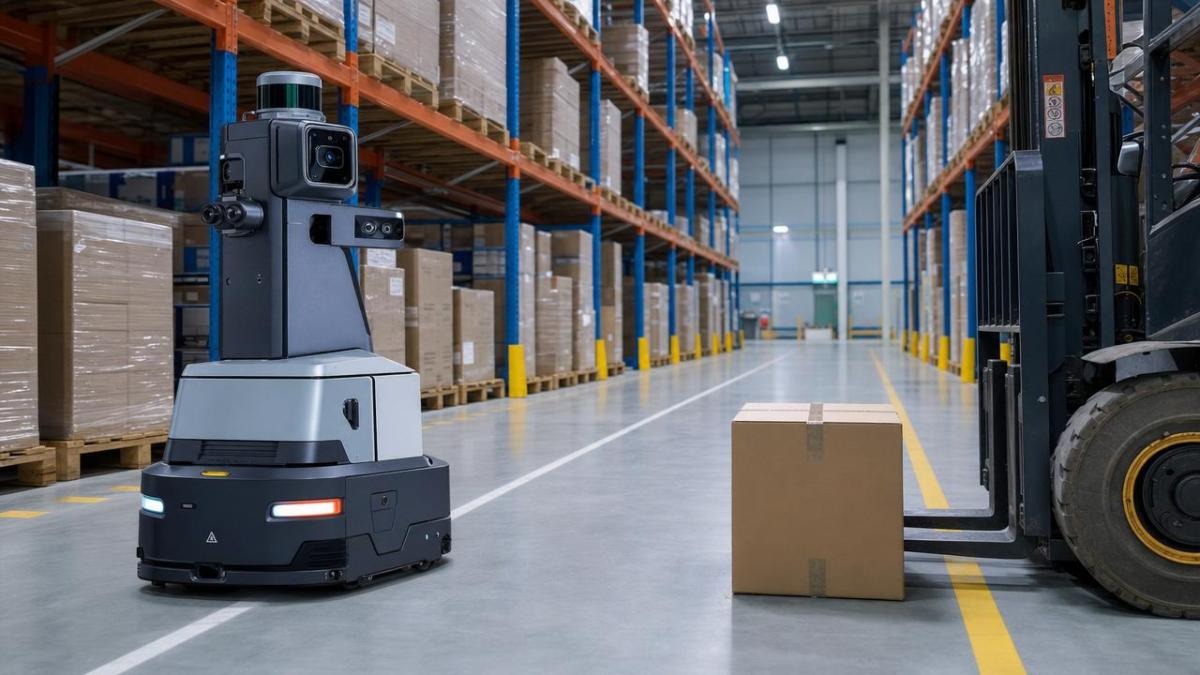
Many AGV AMR obstacle avoidance systems are optimized to look stable in controlled demonstrations. Demo routes are usually clean, well lit, sparsely populated, and designed around predictable object behavior. Production sites are almost never like that.
In live environments, navigation systems must deal with reflective film, shrink wrap, metal racks, narrow aisles, pallet overhang, floor damage, dust, temporary barriers, forklifts cutting across paths, and workers moving unpredictably. Each variable can degrade sensor confidence and path planning quality.
The first problem is that “obstacle avoidance” is often marketed as a single capability. In reality, performance depends on a chain: detection range, classification accuracy, localization stability, path replanning speed, braking consistency, and recovery logic after uncertainty occurs.
If any link in that chain is weak, the vehicle may still be technically safe yet operationally poor. It may stop too often, reroute inefficiently, crawl through critical intersections, or generate frequent manual intervention requests that destroy expected productivity gains.
This is why project leaders should separate safety compliance from usable performance. A system can pass safety requirements and still fail the business case. In many facilities, excessive caution or poor environmental adaptation reduces throughput almost as much as collisions would.
What Project Managers Should Actually Measure Instead of Believing “Advanced” Claims
When vendors describe AGV and AMR obstacle avoidance systems, they often emphasize sensor type, AI capability, or maximum detection distance. Those data points matter, but they do not answer the deployment question that matters most: how does the fleet behave under operational stress?
A stronger evaluation framework starts with measurable operational outcomes. Look at intervention frequency per shift, unexpected stop rate, average speed degradation in mixed traffic, route completion consistency, and recovery time after blocked paths. These metrics reveal whether the system supports real throughput.
Another critical metric is false positive behavior. Some systems detect obstacles aggressively but interpret harmless environmental features as hazards. That may sound conservative, but frequent false stops create congestion, operator frustration, and lower asset utilization across the facility.
False negatives matter too, but for project managers, the hidden cost often comes from false caution. A robot that brakes safely every few meters may satisfy a demonstration narrative, yet become commercially unacceptable once labor planners realize that material flow timing can no longer be trusted.
Ask vendors for performance data tied to environmental conditions, not just best-case averages. You want to see behavior under reflective surfaces, low-light transitions, partially occluded pathways, human cross-traffic, and seasonal layout variation. If the data set is narrow, the risk is high.
The Most Common Reasons Obstacle Avoidance Underperforms on Site
Sensor limitations are one obvious reason, but not the only one. LiDAR, stereo vision, 3D cameras, ultrasonic sensors, and sensor fusion all have strengths and weaknesses. Trouble appears when the selected stack does not match the site’s dominant interference patterns.
Reflective materials can distort LiDAR returns. Transparent barriers can confuse some optical methods. Fast brightness changes can reduce camera reliability. Dust and vibration can gradually shift sensing quality. None of these factors are unusual in logistics and manufacturing operations.
The second major issue is map quality and localization drift. Even if obstacle detection is adequate, poor localization can cause conservative motion behavior. The vehicle becomes uncertain about free space, slows excessively, or hesitates at bottlenecks because it cannot confidently relate sensor input to the map.
Third, path planning logic is often oversimplified for dynamic environments. Avoiding a stationary box is not the same as navigating around a worker, another AMR, and a turning forklift in a narrow aisle. Dynamic prediction quality becomes more important than raw sensor range.
Fourth, the fleet may be deployed before operational rules are mature. Traffic logic, crossing priority, speed zoning, handoff areas, and human-robot interaction standards all affect obstacle avoidance outcomes. Weak site governance is often misdiagnosed as a robot technology failure.
Finally, integration quality matters. Warehouse management systems, manufacturing execution systems, elevator interfaces, door controls, and charging logic all influence navigation flow. What looks like poor obstacle avoidance may actually be a broader orchestration problem in the automation stack.
How to Distinguish Safe Navigation from Productive Navigation
For decision-makers, this distinction is essential. Safe navigation means the vehicle avoids hazardous contact within regulated limits. Productive navigation means it can do so while maintaining predictable cycle times, acceptable route density, and low disruption to surrounding operations.
Many AGV AMR obstacle avoidance systems achieve safety by using highly conservative stopping behavior. That can be appropriate in sensitive environments, but not every site can absorb the throughput penalty. The right question is whether safety logic scales without crippling operational flow.
Look for evidence of graded responses rather than binary behavior. Better systems do not simply stop whenever uncertainty appears. They adapt speed, widen path planning options, predict motion trajectories, and recover gracefully once the obstacle clears or risk confidence improves.
Another sign of productive navigation is stable behavior in mixed fleets and mixed human environments. If robots become erratic around people or other vehicles, operators quickly lose trust. That leads to bypass behavior, manual overrides, and process workarounds that erode ROI.
In practice, the best-performing systems are not always those with the most dramatic autonomy claims. They are usually the ones with robust environmental calibration, predictable edge-case behavior, and transparent tuning tools for site-specific risk balancing.
A Better Vendor Evaluation Checklist for AGV AMR Obstacle Avoidance Systems
Project managers should treat obstacle avoidance as a validation domain, not a feature checkbox. Start by asking what environmental assumptions were built into the system. If the answer stays at a marketing level, the vendor may not understand deployment complexity deeply enough.
Request benchmark data from scenarios that resemble your facility. Ask for results involving narrow aisles, reflective packaging, intersections with human crossing, pallet overhang, floor irregularities, and multi-vehicle congestion. Similarity matters more than polished generic references.
Push for quantitative answers. What is the average slowdown ratio in dynamic traffic? What is the stop frequency per operating hour? How many manual recoveries occur per 100 missions? What is the localization confidence threshold before speed reduction begins?
Also ask about tuning responsibility. Can the vendor adjust obstacle sensitivity, detection zones, and behavior profiles after deployment without destabilizing safety certification or creating endless engineering effort? Systems that require constant manual tweaking often become long-term support burdens.
Another important question concerns failure transparency. When navigation performance degrades, can the system show why? Engineering teams need access to event logs, sensor confidence traces, and route-level diagnostics. Black-box systems make root-cause analysis slow and expensive.
Finally, evaluate support maturity. A strong obstacle avoidance stack still needs disciplined commissioning, retraining, map maintenance, and software updates. Vendor competence in site adaptation is often more valuable than a slightly better lab specification.
How to Run a Realistic Pilot That Exposes Weaknesses Early
A pilot should not be designed to prove success. It should be designed to expose operational failure modes while risk is still manageable. Too many pilots use ideal routes and cooperative conditions, then discover real problems only after broader rollout begins.
Select test windows with genuine traffic complexity. Include peak shift changes, partial congestion, moving pedestrians, and temporary obstructions. If the system only performs well during quiet periods, the pilot does not represent deployment reality.
Define pass-fail criteria before testing begins. These should include throughput consistency, intervention counts, stop causes, average completion time variance, and recovery performance after blocked-path events. Without agreed metrics, every pilot becomes vulnerable to narrative bias.
It is also smart to test environmental drift. Change lighting, add reflective materials, alter aisle contents, and introduce layout variation within reasonable operational bounds. The purpose is to see whether the system is robust or merely calibrated to a narrow snapshot.
Include operators and supervisors in the evaluation process. Their observations often identify friction points earlier than dashboards do. Complaints about hesitation, route unpredictability, or repeated nuisance stops are usually early indicators of scaling issues.
At the end of the pilot, do not ask only whether collisions were avoided. Ask whether the system protected schedule reliability, reduced manual burden, and maintained useful throughput under stress. That is the real deployment threshold.
The Business Impact of Poor Obstacle Avoidance Is Bigger Than It First Appears
Underperforming obstacle avoidance does not just reduce vehicle elegance. It affects labor planning, workstation starvation risk, buffer sizing, SLA performance, and operator trust. Small navigation inefficiencies multiply quickly when fleets grow or routing density increases.
If robots stop unpredictably, planners compensate by adding buffer inventory, keeping manual fallback labor, or widening task windows. Those compensations often hide the automation problem on paper while quietly weakening the project’s economic return.
There is also a governance cost. Frequent exceptions create more supervisor attention, more support tickets, more vendor coordination, and more internal debate about whether the site should change process rules to accommodate the robots. That cost rarely appears in initial ROI models.
In some cases, poor obstacle avoidance creates a reputational problem for automation programs. After one disappointing rollout, future projects face stronger internal skepticism, even if the next use case is technically sound. That makes early validation discipline even more important.
What Good Looks Like in a Reliable Deployment
Strong AGV AMR obstacle avoidance systems do not need to look dramatic. They need to be calm, predictable, and measurable. Good deployments show low intervention rates, consistent mission completion, stable speed profiles, and understandable behavior around people and vehicles.
They also show resilience when conditions change. A reliable system does not collapse when racks shift slightly, traffic thickens, or lighting varies. Instead, it degrades gracefully, keeps operators informed, and returns to normal flow without frequent engineering involvement.
For project managers, the best sign is when obstacle avoidance stops being a discussion topic. If teams no longer talk about nuisance stops, unexplained hesitation, or recurring route failures, the navigation layer is doing its job as infrastructure rather than theater.
Conclusion: Judge Obstacle Avoidance by Operational Truth, Not Demo Theater
When AGV and AMR obstacle avoidance looks good but performs poorly, the issue is rarely one missing feature. It is usually a mismatch between marketing assumptions and operational reality. For engineering leaders, the right response is structured validation, not broader belief.
If you are evaluating AGV AMR obstacle avoidance systems, focus on throughput under uncertainty, false-stop behavior, dynamic traffic handling, recovery logic, and site adaptation maturity. Those factors reveal whether the platform can support business outcomes, not just a showroom narrative.
In hard-tech automation, parameters matter only when they survive real conditions. The systems worth buying are not the ones that appear smartest in a clean demo. They are the ones that remain dependable when layout noise, human motion, and uptime pressure expose the truth.
Search News
Hot Articles
- Carbon Fiber StructuresHow to Specify Aerospace Carbon Fiber Assemblies for Lightweight, Load-Bearing PartsJul 11, 2026
- Machine VisionXiaomi, Alibaba DAMO Academy Drive Open-Source Robotics Model Ecosystem, Lowering Algorithm Development Barriers for Overseas SMEs Adopting Chinese Robotics SolutionsMar 30, 2026
- Cobots & ArmsShanxi 'AI+' Conference Showcases Embodied Intelligence with Multinational Buyer Engagement: Key Industry ImplicationsMar 30, 2026
Popular Tags
Recommended News
 Jul 11, 2026How to Specify Aerospace Carbon Fiber Assemblies for Lightweight, Load-Bearing PartsAerospace carbon fiber assemblies: learn how to specify laminate design, load data, joining methods, and inspection controls for lighter, reliable load-bearing aerospace parts.Elena Rostova (UAV Systems Researcher)
 Mar 30, 2026Xiaomi, Alibaba DAMO Academy Drive Open-Source Robotics Model Ecosystem, Lowering Algorithm Development Barriers for Overseas SMEs Adopting Chinese Robotics SolutionsXiaomi & Alibaba DAMO Academy's open-source robotics models lower algorithm barriers for global SMEs. Boost efficiency in manufacturing, logistics & smart retail with ROS 2 compatible solutions.TSV Data Lab
 Mar 30, 2026Shanxi 'AI+' Conference Showcases Embodied Intelligence with Multinational Buyer Engagement: Key Industry ImplicationsShanxi 'AI+' Conference highlights embodied intelligence with Tesla, Ubtech & Jiantao showcasing multimodal robotics. 40+ global buyers validated tech on-site, creating new B2B channels for industrial automation & AI solutions.Chen Wei (Automation Lead Engineer)
 Mar 30, 2026Zhongguancun Unveils 6G Integrated Sensing-Computing-Intelligence Platform to Empower Embodied Robots for Global Industrial ApplicationsZhongguancun's new 6G platform revolutionizes industrial robotics with <10ms latency, empowering global automotive, logistics & port automation. Discover how this tech boosts China's smart manufacturing exports.TSV Data Lab
 Mar 30, 2026Mech-Mind Tianjin Embodied Intelligence R&D and Production Base Goes Live, Cutting Delivery Time by 20%–30% for Global Customized AMR+Vision SolutionsMech-Mind's Tianjin AMR+Vision production base cuts delivery time by 20%-30% for欧美 & Latin American markets. Discover how this PLd-certified facility accelerates customized robotics solutions for smart manufacturing and logistics.Chen Wei (Automation Lead Engineer)
 Mar 30, 2026Boao Forum Reveals 'Co-evolution of Big and Small Brains' Trend in Humanoid Robots, China's Embodied Intelligence Accelerates Adaptation to Overseas Manufacturing Service ScenariosDiscover how China's humanoid robots, featuring 'Co-evolution of Big and Small Brains,' are revolutionizing global manufacturing. Learn about Embodied Tian Gong 3.0's ISO compliance and overseas deployment at Boao Forum 2026.Chen Wei (Automation Lead Engineer)
 Mar 30, 2026China Railway Industrial Secures Patent for Embodied Robotics in Material Handling, Boosting High-Precision Delivery Capabilities for Overseas Infrastructure and Manufacturing ProjectsChina Railway Industrial's new patent for embodied robotics in material handling boosts high-precision delivery for global infrastructure & manufacturing. Discover how this innovation enhances logistics accuracy in automotive, rail transit & EPC projects.Chen Wei (Automation Lead Engineer)
 Sep 28, 2026Spindle Runout Measurement in Germany: DIN Standards, Methods, and Acceptance LimitsSpindle runout measurement Germany: explore DIN standards, proven methods, acceptance limits, and audit-ready practices for reliable machining quality.Dr. Marcus Vance
 Sep 27, 2026How to Select Wall-Mount Edge Devices for Space-Constrained Factory NetworksWall mount edge devices for space-constrained factories: evaluate workload, thermal design, power resilience, cable access, and network reliability for smarter deployments.TSV Data Lab
 Sep 26, 2026Machining Tolerance Analysis: How to Set Limits That Meet Function and Cost TargetsMachining tolerance analysis: learn how to set functional limits, control tolerance stacks, reduce inspection risk, and balance precision with production cost.Dr. Marcus Vance
 Sep 25, 2026How to Evaluate an Industrial Infrastructure Data Platform for Multi-Site OperationsIndustrial infrastructure data platform evaluation guide for multi-site operations: compare data quality, edge resilience, interoperability, governance, and scalable proof-of-value criteria.Victor Lin (Chief Software Architect)
 Sep 24, 2026How to Select Machine Vision Optics for Accurate Inspection at Different Working DistancesMachine vision optics selection guide for accurate inspection at every working distance. Compare FOV, pixel scale, DOF, distortion, lighting, and telecentric options.TSV Data Lab
 Sep 23, 2026How to Evaluate a Machine Vision System Integrator for High-Speed Inspection LinesChoose a machine vision system integrator with proven expertise in high-speed inspection, reliable reject timing, robust optics, and measurable acceptance criteria.TSV Data Lab
 Sep 28, 2026When is a SCADA API the right choice for connecting plant systems?SCADA API guide: learn when governed plant data integration improves traceability, security, and scalability—without compromising real-time control.Victor Lin (Chief Software Architect)
 Sep 27, 2026How SCADA data integration improves traceability across production linesSCADA data integration connects production-line data to improve traceability, accelerate quality investigations, and strengthen safety decisions.Victor Lin (Chief Software Architect)
 Sep 26, 2026What to define before starting SCADA integration planningSCADA integration planning starts with clear scope, control boundaries, data models, cybersecurity, and testing. Discover the definitions that reduce risk and costly rework.Victor Lin (Chief Software Architect)
 Sep 25, 2026How a smart factory with Industrial IoT reduces production blind spotsDiscover how a smart factory with Industrial IoT turns real-time machine, quality, and workflow data into actionable insights that reduce production blind spots and delivery risks.Victor Lin (Chief Software Architect)
 Sep 24, 2026When does Industrial IoT make smart manufacturing easier to scale?Smart manufacturing Industrial IoT scales when trusted data, interoperable systems, and secure workflows turn connected assets into measurable gains.TSV Data Lab
 Sep 23, 2026What drives ultra-precision machining cost at 1-micron tolerance?Ultra precision machining cost per part at 1 micron tolerance depends on process, material, metrology, and yield. Learn how to compare quotes confidently.Dr. Marcus Vance
 Sep 22, 2026Drone Engine-T550CC Applications: Build the UAV Power System Around the MissionAn application guide for Drone Engine-T550CC integration, covering payload planning, airframe matching, cooling, fuel, vibration, test procedures, documentation, and service preparation.Elena Rostova (UAV Systems Researcher)
 Sep 22, 2026How to Evaluate Industrial Edge Computing Vendors for Factory DeploymentIndustrial edge computing vendor evaluation guide for factories: compare latency, protocol fit, reliability, security, and lifecycle support before deployment.TSV Data Lab
 Sep 21, 2026Drone Payload Integration: Matching Power, Data, and Center of Gravity for Reliable FlightsDrone payload integration made practical: balance power, data, center of gravity, and endurance to build safer, more reliable mission-ready flights.Elena Rostova (UAV Systems Researcher)
 Sep 20, 2026Autonomous Navigation Pricing: Cost Drivers and Budget Benchmarks for AMR ProjectsAutonomous navigation price explained: compare AMR cost drivers, software, sensors, integration, safety, and lifecycle budgets to build a scalable project plan.Chen Wei (Automation Lead Engineer)
 Sep 19, 2026How to Scope Automation Integration Services for Multi-System Factory ProjectsAutomation integration services: learn how to scope multi-system factory projects with clear workflows, interface contracts, safety boundaries, and acceptance criteria.Victor Lin (Chief Software Architect)