UL Expands AGV/AMR Certification Scope for PL e Response Tests
Publication Date
author
On July 9, 2026, UL Solutions announced a new requirement for AGV and AMR products seeking UL 3100 certification in North America. Starting December 1, 2026, applicants will need to add a dynamic response verification report based on ISO/IEC 13849-1 Performance Level e, alongside existing EMC and functional safety testing. For manufacturers, integrators, component suppliers, and project teams planning North American market entry, the update is worth close attention because it directly affects certification preparation, test scope, timing, and cost.
What the new certification requirement includes
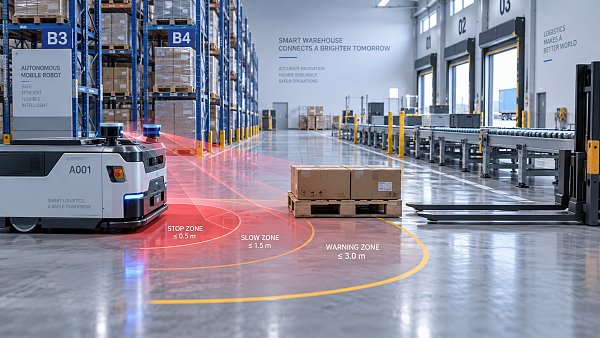
According to the announcement, all AGV/AMR products applying for UL 3100 certification from December 1, 2026 onward must submit an additional dynamic response verification report based on ISO/IEC 13849-1 PL e. The required verification covers end-to-end latency from an emergency stop command to a complete stop, with a threshold of no more than 120 ms. The scope explicitly includes the full stack of the sensor link, controller, and driver. This requirement is in addition to the existing EMC and functional safety testing already associated with the certification process.
Where the pressure is likely to appear first
Product manufacturers will face a broader test boundary
From an industry perspective, AGV and AMR manufacturers are the most directly affected because the new requirement is tied to certification applications themselves. The impact is likely to show up in product validation, documentation readiness, and launch scheduling for North America. What deserves closer attention is that the required latency measurement is defined across the full signal and actuation chain rather than a single subsystem.
System integration and delivery teams may need to revisit project timing
Observably, teams responsible for deployment schedules and market entry planning may need to account for a longer certification path. If certification now requires an added verification report beyond EMC and functional safety testing, the practical effect may appear in delivery sequencing, acceptance planning, and customer-facing timelines for North American projects.
Suppliers in the control and drive chain may face tighter coordination demands
Analysis shows that suppliers involved in sensors, controllers, and drivers may also come under greater scrutiny because the new verification target spans the entire response chain. Even where the certification applicant is the finished AGV/AMR supplier, upstream technical coordination and evidence preparation may become more important in supporting compliance work.
Buyers and end users may see indirect effects in lead time and qualification review
For procurement teams and end-use operators, the immediate issue is less about the test method itself and more about delivery certainty. If the North American access process becomes longer and more expensive, buyers may need to pay closer attention to certification status, expected approval timing, and whether suppliers have already prepared for the added PL e dynamic response requirement.
What companies should watch before the effective date
Track official wording and any implementation clarification
The announced requirement is clear on the effective date, certification scope, and the core latency threshold. Even so, companies should continue watching for any further official clarification around submission expectations, verification boundaries, and document format, because those details can affect internal test preparation and third-party coordination.
Review North America-bound product pipelines now
Businesses with AGV/AMR models intended for UL 3100 applications after December 1, 2026 should review affected product lines and project schedules early. The key practical issue is not only whether a product can meet the requirement, but whether verification evidence can be assembled in time without disrupting commercial delivery plans.
Separate policy language from execution readiness
Analysis shows that the existence of a new rule and the ability to execute against it are not the same thing. A company may understand the requirement in principle yet still face delays if internal validation, supplier data collection, or certification submission materials are not aligned to the new end-to-end response test expectation.
Prepare customer and supplier communication in parallel
Because the announcement points to longer market access cycles and higher testing costs, companies should be ready to communicate these changes across the supply chain. That includes discussions with upstream suppliers on technical evidence and with customers on certification timing, delivery expectations, and possible schedule buffers.
Why this looks like more than a routine test update
Observably, this announcement should not be read only as an added paperwork step. The requirement brings attention to measured system-level stopping performance across sensor, control, and drive functions, which means the compliance focus is extending into how fast the whole safety response chain performs under a PL e framework. Based on the information provided, it is more appropriate to understand this as a concrete near-term compliance change with longer-term signaling value for how AGV/AMR access requirements may be assessed in the North American market.
At the same time, this is still an area that requires continued observation. The confirmed facts establish the new requirement, its effective date, and its likely effect on timing and cost, but they do not by themselves define how individual companies will adjust product design, certification workflows, or supplier coordination.
How to read the significance of this update now
At this stage, the most balanced interpretation is that UL Solutions has introduced a specific compliance threshold that AGV/AMR applicants cannot treat as a minor extension of existing testing. The immediate significance lies in certification preparation and market-entry planning for North America. The broader significance is as a signal that system-level dynamic safety response is drawing sharper attention in certification practice. It is more appropriate to understand this as an actionable short-term change that also warrants longer-term monitoring.
Basis of this article and what still needs verification
This article is based on the user-provided news title, event date, and event summary concerning the UL Solutions announcement issued on July 9, 2026. For developments of this kind, commonly relevant source types include official announcements, company notices, industry association updates, authoritative media coverage, and standard-related documents. A specific official source link was not provided in the input, so the original publication path and any follow-on clarification still need to be continuously verified. Areas worth monitoring next include any additional official interpretation of the requirement, updates to submission expectations, and whether related implementation details are further clarified before the December 1, 2026 effective date.
Search News
Hot Articles
- Carbon Fiber StructuresHow to Specify Aerospace Carbon Fiber Assemblies for Lightweight, Load-Bearing PartsJul 11, 2026
- Machine VisionXiaomi, Alibaba DAMO Academy Drive Open-Source Robotics Model Ecosystem, Lowering Algorithm Development Barriers for Overseas SMEs Adopting Chinese Robotics SolutionsMar 30, 2026
- Cobots & ArmsShanxi 'AI+' Conference Showcases Embodied Intelligence with Multinational Buyer Engagement: Key Industry ImplicationsMar 30, 2026
Popular Tags
Recommended News
 Jul 11, 2026How to Specify Aerospace Carbon Fiber Assemblies for Lightweight, Load-Bearing PartsAerospace carbon fiber assemblies: learn how to specify laminate design, load data, joining methods, and inspection controls for lighter, reliable load-bearing aerospace parts.Elena Rostova (UAV Systems Researcher)
 Mar 30, 2026Xiaomi, Alibaba DAMO Academy Drive Open-Source Robotics Model Ecosystem, Lowering Algorithm Development Barriers for Overseas SMEs Adopting Chinese Robotics SolutionsXiaomi & Alibaba DAMO Academy's open-source robotics models lower algorithm barriers for global SMEs. Boost efficiency in manufacturing, logistics & smart retail with ROS 2 compatible solutions.TSV Data Lab
 Mar 30, 2026Shanxi 'AI+' Conference Showcases Embodied Intelligence with Multinational Buyer Engagement: Key Industry ImplicationsShanxi 'AI+' Conference highlights embodied intelligence with Tesla, Ubtech & Jiantao showcasing multimodal robotics. 40+ global buyers validated tech on-site, creating new B2B channels for industrial automation & AI solutions.Chen Wei (Automation Lead Engineer)
 Mar 30, 2026Zhongguancun Unveils 6G Integrated Sensing-Computing-Intelligence Platform to Empower Embodied Robots for Global Industrial ApplicationsZhongguancun's new 6G platform revolutionizes industrial robotics with <10ms latency, empowering global automotive, logistics & port automation. Discover how this tech boosts China's smart manufacturing exports.TSV Data Lab
 Mar 30, 2026Mech-Mind Tianjin Embodied Intelligence R&D and Production Base Goes Live, Cutting Delivery Time by 20%–30% for Global Customized AMR+Vision SolutionsMech-Mind's Tianjin AMR+Vision production base cuts delivery time by 20%-30% for欧美 & Latin American markets. Discover how this PLd-certified facility accelerates customized robotics solutions for smart manufacturing and logistics.Chen Wei (Automation Lead Engineer)
 Mar 30, 2026Boao Forum Reveals 'Co-evolution of Big and Small Brains' Trend in Humanoid Robots, China's Embodied Intelligence Accelerates Adaptation to Overseas Manufacturing Service ScenariosDiscover how China's humanoid robots, featuring 'Co-evolution of Big and Small Brains,' are revolutionizing global manufacturing. Learn about Embodied Tian Gong 3.0's ISO compliance and overseas deployment at Boao Forum 2026.Chen Wei (Automation Lead Engineer)
 Mar 30, 2026China Railway Industrial Secures Patent for Embodied Robotics in Material Handling, Boosting High-Precision Delivery Capabilities for Overseas Infrastructure and Manufacturing ProjectsChina Railway Industrial's new patent for embodied robotics in material handling boosts high-precision delivery for global infrastructure & manufacturing. Discover how this innovation enhances logistics accuracy in automotive, rail transit & EPC projects.Chen Wei (Automation Lead Engineer)
 Oct 10, 2026How to Select a Machine Performance Monitoring Platform for OEE and Downtime ReductionMachine performance monitoring platform selection guide: validate machine states, OEE data, downtime reasons, integrations, and scalability to reduce losses with confidence.TSV Data Lab
 Oct 08, 2026How to Machine Inconel 625 Blades Without Heat Cracks or Edge ChippingInconel 625 blade machining guide: prevent heat cracks, edge chipping, chatter, and work hardening with proven tooling, cooling, fixturing, and inspection strategies.Dr. Marcus Vance
 Oct 07, 2026How to Evaluate an HMI Panel Distributor for Industrial Automation ProjectsHMI panel distributor evaluation guide: verify technical compatibility, traceability, supply reliability, lifecycle support, and total cost for automation projects.Victor Lin (Chief Software Architect)
 Oct 06, 2026Navigation Fault Tolerance Standards for AMRs: What Safety Teams Must VerifyNavigation fault tolerance standards: learn what AMR safety teams must verify, from localization loss and sensor faults to stopping distance, safe restart, and site-specific validation.Chen Wei (Automation Lead Engineer)
 Oct 05, 2026Calculating Edge Computing Total Cost of Ownership Across Distributed SitesEdge computing ownership cost explained: calculate deployment, energy, connectivity, security, remote support, and refresh costs across distributed sites.TSV Data Lab
 Oct 04, 2026CAD/CAM Benchmarking in the GCC: What Manufacturers Should Ask a ConsultantCAD CAM benchmark consultant GCC guide: learn the key questions manufacturers should ask to validate post-processors, workflows, machine performance, and production risk.Victor Lin (Chief Software Architect)
 Oct 03, 2026Selecting Automotive Radar Sensor Modules for ADAS Range, Resolution, and IntegrationAutomotive radar sensor module selection guide for ADAS: compare range, resolution, field of view, latency, and integration to build safer, reliable vehicle systems.TSV Data Lab
 Oct 02, 2026How to Qualify Machined Parts Suppliers for Hard Tech ProgramsHard tech supply chain machined parts demand rigorous supplier qualification. Learn how to assess capability, traceability, quality controls, and delivery resilience.Dr. Marcus Vance
 Oct 01, 2026How to Select an Outdoor Security Radar Sensor for Perimeter Detection?Outdoor security radar sensor selection guide: compare range, accuracy, false-alarm control, integration, and field testing for reliable perimeter detection.TSV Data Lab
 Sep 30, 2026How to Evaluate Solid-State LiDAR Hardware for Outdoor Autonomous VehiclesSolid state LiDAR hardware evaluation guide for outdoor autonomous vehicles—compare range, point-cloud quality, environmental resilience, integration, and safety.TSV Data Lab
 Sep 29, 2026ISO 9283 Repeatability: How to Evaluate Cobot Positioning PerformanceISO 9283 cobot repeatability explained: learn how payload, reach, approach direction, and test conditions affect positioning performance and cell capability.Chen Wei (Automation Lead Engineer)
 Oct 09, 2026What does a manufacturing robot really cost beyond the purchase price?Manufacturing robot cost goes far beyond the purchase price. Explore integration, tooling, safety, uptime, and total ownership factors for smarter automation investments.Chen Wei (Automation Lead Engineer)
 Oct 08, 2026AGV vs. AMR: Which Is Better for Frequently Changing Routes?Which is better for changing routes? Compare AGVs and AMRs for flexible navigation, docking precision, traffic control, and faster facility reconfiguration.Chen Wei (Automation Lead Engineer)
 Oct 07, 2026How Much Does an Automated Guided Vehicle Cost in 2026?How much does an automated guided vehicle cost in 2026? Explore AGV price ranges, hidden deployment costs, and smart buying factors for stronger ROI.Chen Wei (Automation Lead Engineer)
 Oct 06, 2026Are Collaborative Robots Safe Enough to Operate Without Fencing?Are collaborative robots safe enough to work without fencing? Explore risk assessment, safeguarding options, and practical guidance for safer, productive cobot cells.Chen Wei (Automation Lead Engineer)
 Oct 05, 2026What Causes Machine Vision Systems to Miss Small Defects?What causes machine vision systems to miss small defects? Discover how lighting, optics, motion, and AI thresholds affect detection—and prevent costly escapes.TSV Data Lab
 Oct 04, 2026How Should You Compare 5-Axis CNC Machine Accuracy Claims?How do I compare 5-axis CNC machine accuracy claims? Learn how to assess standards, thermal stability, TCP accuracy, and real-world test evidence.Dr. Marcus Vance