Is AGV or AMR Better for Warehouse Automation in 2026?
Publication Date
author
As warehouses face tighter labor markets, higher throughput targets, and stricter ROI scrutiny in 2026, choosing the right mobile automation strategy has become a boardroom priority. This guide examines AGV AMR for warehouse automation through an engineering-first lens, helping enterprise decision-makers cut through vendor hype and compare navigation flexibility, deployment complexity, safety performance, and long-term scalability with greater precision.
Why a checklist beats vendor claims in AGV AMR for warehouse automation
For most enterprise buyers, the real question is not whether automated mobile robots are valuable. It is whether a specific system fits the facility, process, and financial model. In 2026, AGV AMR for warehouse automation decisions are increasingly shaped by multi-site deployment plans, ERP and WMS integration pressure, and rising expectations for uptime. That means a checklist-based evaluation is more useful than abstract comparisons.
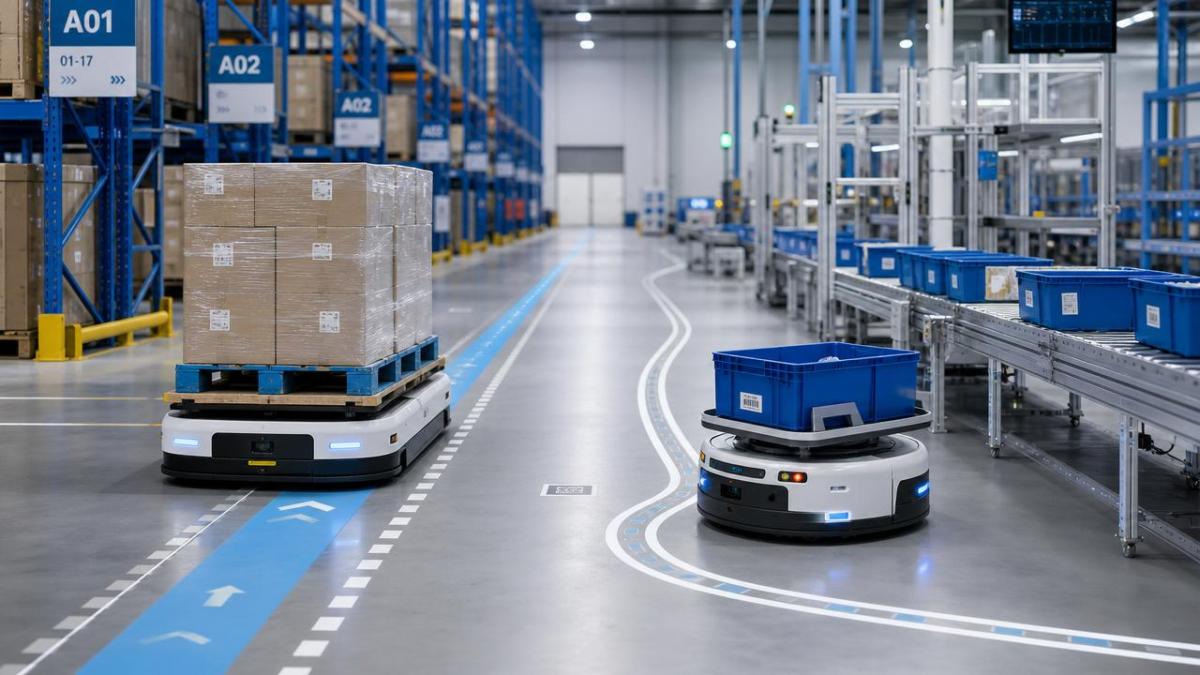
AGVs and AMRs can both improve internal logistics, but they solve different operating constraints. AGVs usually excel where routes are stable, traffic is controlled, and process repeatability matters most. AMRs tend to outperform in variable environments where workflows, aisle congestion, and task priorities shift frequently. The wrong choice often comes from evaluating marketing language instead of measurable fit.
First decision screen: the 8 checks to confirm before comparing suppliers
- Map stability: Are pick paths, replenishment routes, and dock-to-storage movements mostly fixed or frequently changing?
- Traffic complexity: Do forklifts, pedestrians, carts, and mobile assets regularly share the same space?
- Layout change frequency: Will racking, workcells, or temporary staging zones be reconfigured more than once or twice per year?
- Payload and towing profile: Are you moving light totes, mixed pallets, or heavy trailers with strict acceleration and braking needs?
- Integration depth: Does the solution need basic dispatching only, or real-time orchestration with WMS, MES, and inventory logic?
- Safety envelope: What stopping distance, obstacle detection, and mixed-traffic compliance level is required?
- Uptime target: Is 95% acceptable, or does the operation require near-continuous availability with rapid service response?
- Expansion path: Are you starting with one workflow or planning a multi-building automation roadmap?
If most answers point to stable routes, predictable flow, and low layout change, AGV economics may be stronger. If most answers point to dynamic routing, exception handling, and future flexibility, AMR value usually increases despite higher software and integration complexity.
Core comparison checklist: where AGV and AMR differ most
1. Navigation and route adaptability
AGVs often rely on defined guidance methods or tightly controlled paths. Their strength is repeatability. In contrast, AMRs use onboard sensing and software to localize, reroute, and avoid obstacles with greater autonomy. For AGV AMR for warehouse automation comparisons, decision-makers should ask for navigation fault tolerance data, not just “smart” or “flexible” claims. Key metrics include localization recovery time, reroute success rate, and behavior under blocked aisles.
2. Deployment effort and site preparation
AGVs may require more route engineering and physical preparation but can be simpler to govern once installed. AMRs can reduce hard infrastructure dependence, yet they often demand stronger digital readiness, including map creation, fleet tuning, wireless coverage validation, and workflow orchestration logic. A fast pilot does not always mean a fast enterprise rollout. Ask each supplier for time-to-steady-state, not only time-to-install.
3. Safety performance in mixed environments
In mixed traffic, safety is not a brochure feature; it is a productivity variable. AGVs may operate very effectively in controlled lanes, while AMRs are generally better suited to dynamic interaction. However, AMR performance varies significantly depending on sensor quality, tuning, and environmental conditions. Request stopping distance by speed band, nuisance stop rate, obstacle classification logic, and performance under reflective surfaces, dust, and low-light conditions.
4. Throughput consistency versus situational flexibility
AGVs are often selected for highly repetitive material flows because they support stable takt-based execution. AMRs may be more adaptable when task queues change throughout the day. The practical question is whether your operation values maximum consistency or dynamic responsiveness. For warehouse automation, the better option is the one that protects service level during peak variability, not just average daily volume.
5. Scalability of software and fleet control
Adding five robots is easy on paper. Scaling from one workflow to a site-wide fleet is where many projects fail. The AGV AMR for warehouse automation evaluation should include dispatch logic, congestion management, battery charging strategy, API openness, and multi-vendor interoperability. If the software stack becomes a closed island, future expansion costs can rise sharply.
Practical decision table for enterprise buyers
Scenario-based guidance: which environments favor which approach?
High-volume pallet movement
If pallet transport follows regular routes between receiving, storage, and shipping, AGV systems often deliver strong cost discipline and predictable performance. This is especially true when aisle rules and right-of-way can be standardized.
E-commerce and multi-SKU fulfillment
AMRs usually gain an advantage in environments with short order cycles, fluctuating priorities, and frequent path conflicts. Their ability to adapt to congestion and support evolving workflows can protect throughput during seasonal peaks.
Brownfield facilities
Brownfield sites demand careful analysis. If the building has narrow aisles, inconsistent floor conditions, and high human traffic, AMRs may appear attractive, but only if sensor performance and digital infrastructure are robust. In some brownfield cases, a structured AGV zone around the most repetitive flows is the safer first step.
Hybrid strategies
For large enterprises, the answer to AGV AMR for warehouse automation may be “both.” AGVs can handle repetitive backbone transport, while AMRs manage dynamic feeder tasks. Hybrid architecture works best when orchestration rules, charging policy, and traffic priorities are designed early rather than added later.
The most overlooked risks in AGV AMR for warehouse automation projects
- Overreliance on pilot results from a low-complexity area that does not represent full-site traffic or exception rates.
- Ignoring wireless reliability, map maintenance, and software governance while focusing only on robot hardware cost.
- Underestimating charging strategy, battery swap policy, and how energy management affects fleet availability.
- Failing to define manual override procedures, recovery steps after blockage, and escalation rules for human operators.
- Assuming safety compliance automatically equals operational efficiency; excessive caution tuning can reduce real throughput.
- Not validating service support capacity, spare parts lead time, and remote diagnostics responsiveness for multi-shift operations.
How to build an evaluation process that stands up to ROI scrutiny
Enterprise teams should use a staged decision process. First, document transport tasks by distance, payload, frequency, and exception rate. Second, classify operating zones by traffic complexity and layout volatility. Third, align technical requirements with business goals: labor reduction, throughput gain, inventory accuracy, safety improvement, or lead-time compression. Fourth, request supplier data in a comparable format.
At minimum, your request for proposal should ask for fleet sizing assumptions, utilization model, expected throughput at peak, obstacle recovery logic, software integration scope, commissioning timeline, and post-launch support SLAs. For AGV AMR for warehouse automation, a useful supplier comparison is built on tested parameters, not generic capability claims.
FAQ: key questions leaders ask before approving a mobile automation program
Is AMR always more advanced than AGV?
No. AMR technology is often more adaptive, but “more advanced” does not automatically mean “better fit.” AGVs can be the superior engineering choice when process discipline and route consistency matter more than autonomy.
Which option usually delivers faster ROI?
That depends on site conditions. AGVs may achieve faster ROI in stable repetitive flows because modeling is simpler. AMRs may deliver stronger long-term ROI when process variability would otherwise require repeated re-engineering.
Can one platform scale across multiple warehouses?
Only if software architecture, support model, and data standards are mature. Scalability in AGV AMR for warehouse automation is not just about adding vehicles; it is about replicating performance across facilities without excessive tuning effort.
Final decision guide: what to prepare before speaking with vendors
Before moving into solution design, prepare six inputs: current transport volumes by task, peak-hour demand, facility map with traffic constraints, required payload profile, target KPIs, and integration architecture. With that foundation, you can quickly determine whether AGV, AMR, or a hybrid model deserves deeper investment.
For enterprise decision-makers, the best AGV AMR for warehouse automation choice in 2026 will be the one that matches workflow volatility, safety requirements, digital maturity, and scale ambitions with measurable discipline. If you need to validate parameters, deployment fit, project timeline, budget range, or supplier capability, prioritize discussions around route stability, exception handling, uptime assumptions, integration ownership, and support commitments before comparing purchase price.
Search News
Hot Articles
- Carbon Fiber StructuresHow to Specify Aerospace Carbon Fiber Assemblies for Lightweight, Load-Bearing PartsJul 11, 2026
- Machine VisionXiaomi, Alibaba DAMO Academy Drive Open-Source Robotics Model Ecosystem, Lowering Algorithm Development Barriers for Overseas SMEs Adopting Chinese Robotics SolutionsMar 30, 2026
- Cobots & ArmsShanxi 'AI+' Conference Showcases Embodied Intelligence with Multinational Buyer Engagement: Key Industry ImplicationsMar 30, 2026
Popular Tags
Recommended News
 Jul 11, 2026How to Specify Aerospace Carbon Fiber Assemblies for Lightweight, Load-Bearing PartsAerospace carbon fiber assemblies: learn how to specify laminate design, load data, joining methods, and inspection controls for lighter, reliable load-bearing aerospace parts.Elena Rostova (UAV Systems Researcher)
 Mar 30, 2026Xiaomi, Alibaba DAMO Academy Drive Open-Source Robotics Model Ecosystem, Lowering Algorithm Development Barriers for Overseas SMEs Adopting Chinese Robotics SolutionsXiaomi & Alibaba DAMO Academy's open-source robotics models lower algorithm barriers for global SMEs. Boost efficiency in manufacturing, logistics & smart retail with ROS 2 compatible solutions.TSV Data Lab
 Mar 30, 2026Shanxi 'AI+' Conference Showcases Embodied Intelligence with Multinational Buyer Engagement: Key Industry ImplicationsShanxi 'AI+' Conference highlights embodied intelligence with Tesla, Ubtech & Jiantao showcasing multimodal robotics. 40+ global buyers validated tech on-site, creating new B2B channels for industrial automation & AI solutions.Chen Wei (Automation Lead Engineer)
 Mar 30, 2026Zhongguancun Unveils 6G Integrated Sensing-Computing-Intelligence Platform to Empower Embodied Robots for Global Industrial ApplicationsZhongguancun's new 6G platform revolutionizes industrial robotics with <10ms latency, empowering global automotive, logistics & port automation. Discover how this tech boosts China's smart manufacturing exports.TSV Data Lab
 Mar 30, 2026Mech-Mind Tianjin Embodied Intelligence R&D and Production Base Goes Live, Cutting Delivery Time by 20%–30% for Global Customized AMR+Vision SolutionsMech-Mind's Tianjin AMR+Vision production base cuts delivery time by 20%-30% for欧美 & Latin American markets. Discover how this PLd-certified facility accelerates customized robotics solutions for smart manufacturing and logistics.Chen Wei (Automation Lead Engineer)
 Mar 30, 2026Boao Forum Reveals 'Co-evolution of Big and Small Brains' Trend in Humanoid Robots, China's Embodied Intelligence Accelerates Adaptation to Overseas Manufacturing Service ScenariosDiscover how China's humanoid robots, featuring 'Co-evolution of Big and Small Brains,' are revolutionizing global manufacturing. Learn about Embodied Tian Gong 3.0's ISO compliance and overseas deployment at Boao Forum 2026.Chen Wei (Automation Lead Engineer)
 Mar 30, 2026China Railway Industrial Secures Patent for Embodied Robotics in Material Handling, Boosting High-Precision Delivery Capabilities for Overseas Infrastructure and Manufacturing ProjectsChina Railway Industrial's new patent for embodied robotics in material handling boosts high-precision delivery for global infrastructure & manufacturing. Discover how this innovation enhances logistics accuracy in automotive, rail transit & EPC projects.Chen Wei (Automation Lead Engineer)
 Sep 28, 2026Spindle Runout Measurement in Germany: DIN Standards, Methods, and Acceptance LimitsSpindle runout measurement Germany: explore DIN standards, proven methods, acceptance limits, and audit-ready practices for reliable machining quality.Dr. Marcus Vance
 Sep 27, 2026How to Select Wall-Mount Edge Devices for Space-Constrained Factory NetworksWall mount edge devices for space-constrained factories: evaluate workload, thermal design, power resilience, cable access, and network reliability for smarter deployments.TSV Data Lab
 Sep 26, 2026Machining Tolerance Analysis: How to Set Limits That Meet Function and Cost TargetsMachining tolerance analysis: learn how to set functional limits, control tolerance stacks, reduce inspection risk, and balance precision with production cost.Dr. Marcus Vance
 Sep 25, 2026How to Evaluate an Industrial Infrastructure Data Platform for Multi-Site OperationsIndustrial infrastructure data platform evaluation guide for multi-site operations: compare data quality, edge resilience, interoperability, governance, and scalable proof-of-value criteria.Victor Lin (Chief Software Architect)
 Sep 24, 2026How to Select Machine Vision Optics for Accurate Inspection at Different Working DistancesMachine vision optics selection guide for accurate inspection at every working distance. Compare FOV, pixel scale, DOF, distortion, lighting, and telecentric options.TSV Data Lab
 Sep 23, 2026How to Evaluate a Machine Vision System Integrator for High-Speed Inspection LinesChoose a machine vision system integrator with proven expertise in high-speed inspection, reliable reject timing, robust optics, and measurable acceptance criteria.TSV Data Lab
 Sep 28, 2026When is a SCADA API the right choice for connecting plant systems?SCADA API guide: learn when governed plant data integration improves traceability, security, and scalability—without compromising real-time control.Victor Lin (Chief Software Architect)
 Sep 27, 2026How SCADA data integration improves traceability across production linesSCADA data integration connects production-line data to improve traceability, accelerate quality investigations, and strengthen safety decisions.Victor Lin (Chief Software Architect)
 Sep 26, 2026What to define before starting SCADA integration planningSCADA integration planning starts with clear scope, control boundaries, data models, cybersecurity, and testing. Discover the definitions that reduce risk and costly rework.Victor Lin (Chief Software Architect)
 Sep 25, 2026How a smart factory with Industrial IoT reduces production blind spotsDiscover how a smart factory with Industrial IoT turns real-time machine, quality, and workflow data into actionable insights that reduce production blind spots and delivery risks.Victor Lin (Chief Software Architect)
 Sep 24, 2026When does Industrial IoT make smart manufacturing easier to scale?Smart manufacturing Industrial IoT scales when trusted data, interoperable systems, and secure workflows turn connected assets into measurable gains.TSV Data Lab
 Sep 23, 2026What drives ultra-precision machining cost at 1-micron tolerance?Ultra precision machining cost per part at 1 micron tolerance depends on process, material, metrology, and yield. Learn how to compare quotes confidently.Dr. Marcus Vance
 Sep 22, 2026Drone Engine-T550CC Applications: Build the UAV Power System Around the MissionAn application guide for Drone Engine-T550CC integration, covering payload planning, airframe matching, cooling, fuel, vibration, test procedures, documentation, and service preparation.Elena Rostova (UAV Systems Researcher)
 Sep 22, 2026How to Evaluate Industrial Edge Computing Vendors for Factory DeploymentIndustrial edge computing vendor evaluation guide for factories: compare latency, protocol fit, reliability, security, and lifecycle support before deployment.TSV Data Lab
 Sep 21, 2026Drone Payload Integration: Matching Power, Data, and Center of Gravity for Reliable FlightsDrone payload integration made practical: balance power, data, center of gravity, and endurance to build safer, more reliable mission-ready flights.Elena Rostova (UAV Systems Researcher)
 Sep 20, 2026Autonomous Navigation Pricing: Cost Drivers and Budget Benchmarks for AMR ProjectsAutonomous navigation price explained: compare AMR cost drivers, software, sensors, integration, safety, and lifecycle budgets to build a scalable project plan.Chen Wei (Automation Lead Engineer)
 Sep 19, 2026How to Scope Automation Integration Services for Multi-System Factory ProjectsAutomation integration services: learn how to scope multi-system factory projects with clear workflows, interface contracts, safety boundaries, and acceptance criteria.Victor Lin (Chief Software Architect)