Heavy Duty AGV Manufacturer and Floor Load Assumptions
Publication Date
author
Selecting a heavy duty AGV manufacturer is not just about payload ratings—it starts with verified floor load assumptions, traffic patterns, and long-term structural safety. For automation upgrades, the real engineering question is whether the building slab, joints, reinforcement, and dynamic wheel loads can support continuous autonomous transport without hidden failure modes. A reliable supplier should provide more than brochure numbers. The right evaluation process connects AGV wheel pressure, travel frequency, turning behavior, rack interface loads, charging strategy, and future throughput expansion to the actual floor conditions inside the facility.
This matters across general industry environments, from steel processing and paper mills to aerospace component logistics, battery production, heavy assembly, and large-format warehousing. In each case, a heavy duty AGV manufacturer should be assessed through engineering evidence: floor bearing assumptions, point-load calculations, finite element validation where needed, and clear acceptance criteria for slab flatness, cracks, drainage, and joint transitions. When those basics are ignored, AGV projects often suffer from premature wheel wear, navigation instability, floor damage, poor uptime, and expensive retrofit work.
Why floor load assumptions should come before payload comparisons
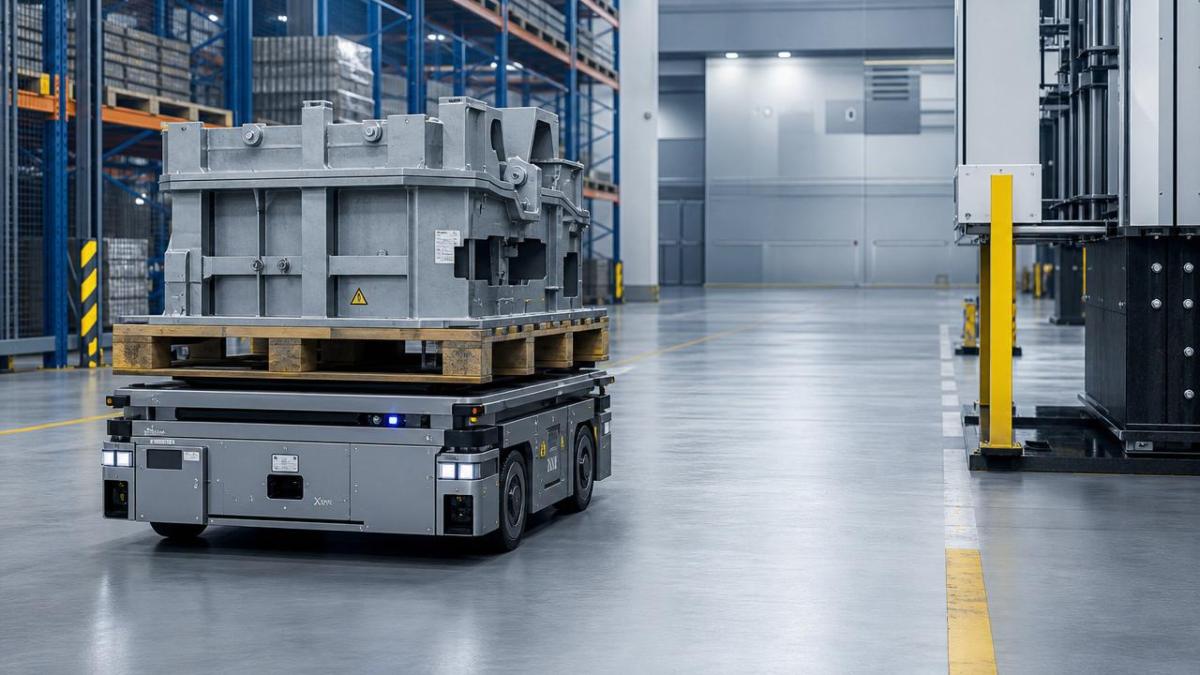
A payload figure alone does not describe the real floor demand created by an AGV. Two vehicles with the same nominal carrying capacity can produce very different contact pressures depending on wheel material, wheel diameter, axle count, suspension design, load distribution, and turning radius. This is why any credible heavy duty AGV manufacturer should discuss static load, dynamic load, shock load, emergency stop transfer, and concentrated wheel load rather than repeating a single maximum payload number.
Floor systems are also rarely uniform. Slab-on-grade areas, elevated mezzanines, embedded utility trenches, expansion joints, machine foundations, and repaired sections all behave differently under repeated autonomous traffic. If a heavy duty AGV manufacturer does not ask for floor drawings, concrete grade, slab thickness, reinforcement details, and traffic maps, the design review is incomplete. Good AGV engineering begins with facility truth, not catalog simplifications.
Core technical checks when evaluating a heavy duty AGV manufacturer
The following points help separate a technically grounded heavy duty AGV manufacturer from a marketing-led vendor. Each item should be confirmed with drawings, calculations, test data, or acceptance documentation rather than verbal assurance.
- Request wheel load calculations for fully loaded, partially loaded, and off-center load cases, including turning, braking, and docking conditions.
- Verify floor assumptions: slab thickness, concrete compressive strength, reinforcement type, subgrade quality, and any elevated structure limitations.
- Check maximum contact pressure at each wheel and compare it against floor design limits and local repaired-area restrictions.
- Review joint-crossing strategy, including wheel material, speed reduction logic, suspension compliance, and allowable joint gap tolerance.
- Confirm axle layout and load equalization method so one wheel does not carry excessive force on uneven or worn floor sections.
- Evaluate turning behavior because pivot turns can create high shear stress and accelerated floor damage in coated or polished zones.
- Ask for route-based traffic modeling that shows trips per hour, peak congestion, queue zones, and cumulative floor fatigue exposure.
- Review floor flatness and levelness requirements for navigation stability, load security, mast alignment, and repeatable docking performance.
- Verify battery weight, charger location, and energy strategy because these affect dead load, axle distribution, and traffic concentration points.
- Confirm how the AGV handles ramps, trench covers, embedded rails, and drainage transitions without wheel overload or chassis interference.
- Request maintenance assumptions for wheels, bearings, and brakes, since wear changes contact patch behavior and floor interaction over time.
- Check documentation quality: layout approval drawings, load maps, risk assessments, FAT/SAT criteria, and floor acceptance records.
A qualified heavy duty AGV manufacturer should be comfortable sharing not only nominal specifications but also design assumptions, test boundaries, and conditions under which performance claims are valid. That transparency is often the clearest predictor of project stability.
A practical comparison table for supplier review
How requirements change across common industrial scenarios
Heavy manufacturing and metal processing
In heavy manufacturing, a heavy duty AGV manufacturer often faces concentrated loads, elevated temperatures, scale debris, and frequent route crossings near production equipment. The floor may include patched zones, embedded rails, or heat-affected sections that perform differently from the surrounding slab. Here, wheel material and route design matter as much as payload. Steel wheels may increase durability in some environments but can raise contact stress and noise; polyurethane may lower impact but wear faster under harsh contamination.
Extra attention should go to shock loading during pickup and drop-off. If the AGV engages fixtures, rollers, or transfer stations, the floor sees not only travel loads but also localized transient forces during alignment and load handover. A strong heavy duty AGV manufacturer will model these events and define interface tolerances clearly.
Warehousing and large-format intralogistics
Warehouse projects may appear easier because floor surfaces are often smoother, but the risk shifts toward traffic density and repetitive fatigue. A heavy duty AGV manufacturer should analyze recurring paths near inbound lanes, pick modules, charging zones, and dispatch bottlenecks. Even if floor stress is acceptable on day one, repeated high-frequency wheel passage can accelerate joint edge damage and coating breakdown.
This environment also demands careful turning analysis. Tighter aisle geometry can increase scrubbing forces, especially for large platform AGVs carrying oversized pallets or custom frames. Route smoothing, turning radius control, and distributed charging can significantly reduce floor wear concentration.
Aerospace, energy, and high-value assembly
In aerospace or energy equipment assembly, floor loading is only one part of the decision. The heavy duty AGV manufacturer must also account for vibration sensitivity, precision docking, and load stability for expensive components with strict handling requirements. Slab deflection, micro-unevenness, and joint impact can affect not just the vehicle but the product being transported.
For this reason, the evaluation should include acceleration profiles, deceleration rates, mast or frame stiffness, and tolerance stack-up at stations. A floor that is structurally safe may still be operationally unsuitable if it introduces unacceptable positional variation or transport vibration.
Commonly overlooked risks that create expensive surprises
Ignoring local weak zones. A facility can have a generally adequate floor while still containing isolated weak points above pits, utility channels, old repairs, or poorly compacted subgrade. One route segment can become the failure origin for the whole AGV system.
Using static payload instead of dynamic wheel force. A brochure payload does not capture turning, emergency stops, uneven load placement, or transfer impacts. These conditions often define the real peak stress and should be central in any heavy duty AGV manufacturer review.
Underestimating future expansion. A route designed for six vehicles may become a fatigue hotspot when the fleet doubles. Floor assumptions should reflect long-term traffic growth, not just initial commissioning volumes.
Overlooking battery and charging effects. Charging areas attract repeated stopping, turning, and dwell time. Concentrated use can damage coatings and joints faster than travel lanes, particularly with high-mass vehicles.
Accepting generic floor statements. If a heavy duty AGV manufacturer says the system is “suitable for standard concrete floors” without quantified assumptions, the statement has limited engineering value. Concrete performance is highly dependent on thickness, reinforcement, curing, subbase, and condition.
Practical steps for a more defensible AGV selection process
- Collect floor drawings, repair history, slab data, and any known restrictions before discussing final AGV configuration.
- Provide route maps with estimated trip counts, peak hours, loading logic, and future throughput targets.
- Ask each heavy duty AGV manufacturer for wheel load calculations tied to your exact load case, not a generic machine family.
- Require defined floor acceptance criteria covering cracks, joints, flatness, contamination, and allowable elevation change.
- Validate critical path areas through field inspection and, where justified, structural review or localized load verification.
- Include expansion assumptions in the bid stage so future payload or fleet growth does not invalidate the original floor analysis.
This process improves not only supplier comparison but also internal project alignment. It creates a common technical baseline for civil, operations, automation, and maintenance teams. That baseline is where a trustworthy heavy duty AGV manufacturer should operate—through explicit assumptions, measurable parameters, and documented constraints.
FAQ: technical questions worth asking early
How do I compare two AGVs with the same payload?
Compare per-wheel load, contact pressure, turning behavior, axle distribution, and route traffic frequency. Those factors often matter more than headline payload.
Can an existing floor usually support a heavy-duty AGV?
Sometimes, but not safely by assumption alone. Floor age, reinforcement, joints, repairs, and traffic concentration all influence real suitability.
What is the biggest warning sign in supplier discussions?
A heavy duty AGV manufacturer that avoids quantified floor assumptions or does not request route and slab data is a major caution signal.
Are dynamic loads always important?
Yes. Braking, acceleration, turning, docking, and crossing joints can produce localized stresses beyond simple static calculations.
Final direction for a safer and more scalable decision
Choosing a heavy duty AGV manufacturer should begin with engineering discipline: define the floor, map the traffic, quantify the wheel loads, and challenge every assumption that affects structural safety and operational uptime. The strongest AGV solutions are not the ones with the loudest payload claims. They are the ones supported by transparent calculations, realistic floor criteria, and a route-specific understanding of long-term facility behavior.
The next practical step is simple: build a technical comparison file for each heavy duty AGV manufacturer that includes floor assumptions, per-wheel load data, route traffic analysis, joint-crossing limits, and future scaling logic. When these elements are documented early, AGV selection becomes far more defensible, infrastructure risk drops sharply, and the system is better positioned to perform reliably over its full service life.
Search News
Hot Articles
- Carbon Fiber StructuresHow to Specify Aerospace Carbon Fiber Assemblies for Lightweight, Load-Bearing PartsJul 11, 2026
- Machine VisionXiaomi, Alibaba DAMO Academy Drive Open-Source Robotics Model Ecosystem, Lowering Algorithm Development Barriers for Overseas SMEs Adopting Chinese Robotics SolutionsMar 30, 2026
- Cobots & ArmsShanxi 'AI+' Conference Showcases Embodied Intelligence with Multinational Buyer Engagement: Key Industry ImplicationsMar 30, 2026
Popular Tags
Recommended News
 Jul 11, 2026How to Specify Aerospace Carbon Fiber Assemblies for Lightweight, Load-Bearing PartsAerospace carbon fiber assemblies: learn how to specify laminate design, load data, joining methods, and inspection controls for lighter, reliable load-bearing aerospace parts.Elena Rostova (UAV Systems Researcher)
 Mar 30, 2026Xiaomi, Alibaba DAMO Academy Drive Open-Source Robotics Model Ecosystem, Lowering Algorithm Development Barriers for Overseas SMEs Adopting Chinese Robotics SolutionsXiaomi & Alibaba DAMO Academy's open-source robotics models lower algorithm barriers for global SMEs. Boost efficiency in manufacturing, logistics & smart retail with ROS 2 compatible solutions.TSV Data Lab
 Mar 30, 2026Shanxi 'AI+' Conference Showcases Embodied Intelligence with Multinational Buyer Engagement: Key Industry ImplicationsShanxi 'AI+' Conference highlights embodied intelligence with Tesla, Ubtech & Jiantao showcasing multimodal robotics. 40+ global buyers validated tech on-site, creating new B2B channels for industrial automation & AI solutions.Chen Wei (Automation Lead Engineer)
 Mar 30, 2026Zhongguancun Unveils 6G Integrated Sensing-Computing-Intelligence Platform to Empower Embodied Robots for Global Industrial ApplicationsZhongguancun's new 6G platform revolutionizes industrial robotics with <10ms latency, empowering global automotive, logistics & port automation. Discover how this tech boosts China's smart manufacturing exports.TSV Data Lab
 Mar 30, 2026Mech-Mind Tianjin Embodied Intelligence R&D and Production Base Goes Live, Cutting Delivery Time by 20%–30% for Global Customized AMR+Vision SolutionsMech-Mind's Tianjin AMR+Vision production base cuts delivery time by 20%-30% for欧美 & Latin American markets. Discover how this PLd-certified facility accelerates customized robotics solutions for smart manufacturing and logistics.Chen Wei (Automation Lead Engineer)
 Mar 30, 2026Boao Forum Reveals 'Co-evolution of Big and Small Brains' Trend in Humanoid Robots, China's Embodied Intelligence Accelerates Adaptation to Overseas Manufacturing Service ScenariosDiscover how China's humanoid robots, featuring 'Co-evolution of Big and Small Brains,' are revolutionizing global manufacturing. Learn about Embodied Tian Gong 3.0's ISO compliance and overseas deployment at Boao Forum 2026.Chen Wei (Automation Lead Engineer)
 Mar 30, 2026China Railway Industrial Secures Patent for Embodied Robotics in Material Handling, Boosting High-Precision Delivery Capabilities for Overseas Infrastructure and Manufacturing ProjectsChina Railway Industrial's new patent for embodied robotics in material handling boosts high-precision delivery for global infrastructure & manufacturing. Discover how this innovation enhances logistics accuracy in automotive, rail transit & EPC projects.Chen Wei (Automation Lead Engineer)
 Sep 29, 2026ISO 9283 Repeatability: How to Evaluate Cobot Positioning PerformanceISO 9283 cobot repeatability explained: learn how payload, reach, approach direction, and test conditions affect positioning performance and cell capability.Chen Wei (Automation Lead Engineer)
 Sep 29, 2026How Do You Verify Servo Motor Torque Under Continuous Load?How do I verify servo motor torque under continuous load? Learn RMS torque checks, torque-speed limits, thermal derating, and real-machine testing.Chen Wei (Automation Lead Engineer)
 Sep 28, 2026Spindle Runout Measurement in Germany: DIN Standards, Methods, and Acceptance LimitsSpindle runout measurement Germany: explore DIN standards, proven methods, acceptance limits, and audit-ready practices for reliable machining quality.Dr. Marcus Vance
 Sep 27, 2026How to Select Wall-Mount Edge Devices for Space-Constrained Factory NetworksWall mount edge devices for space-constrained factories: evaluate workload, thermal design, power resilience, cable access, and network reliability for smarter deployments.TSV Data Lab
 Sep 26, 2026Machining Tolerance Analysis: How to Set Limits That Meet Function and Cost TargetsMachining tolerance analysis: learn how to set functional limits, control tolerance stacks, reduce inspection risk, and balance precision with production cost.Dr. Marcus Vance
 Sep 25, 2026How to Evaluate an Industrial Infrastructure Data Platform for Multi-Site OperationsIndustrial infrastructure data platform evaluation guide for multi-site operations: compare data quality, edge resilience, interoperability, governance, and scalable proof-of-value criteria.Victor Lin (Chief Software Architect)
 Sep 24, 2026How to Select Machine Vision Optics for Accurate Inspection at Different Working DistancesMachine vision optics selection guide for accurate inspection at every working distance. Compare FOV, pixel scale, DOF, distortion, lighting, and telecentric options.TSV Data Lab
 Sep 23, 2026How to Evaluate a Machine Vision System Integrator for High-Speed Inspection LinesChoose a machine vision system integrator with proven expertise in high-speed inspection, reliable reject timing, robust optics, and measurable acceptance criteria.TSV Data Lab
 Sep 29, 2026How MES and OEE work together to identify production lossesMES and OEE work together to uncover hidden production losses, connect downtime, speed, and quality data, and drive smarter shop-floor improvements.Victor Lin (Chief Software Architect)
 Sep 28, 2026When is a SCADA API the right choice for connecting plant systems?SCADA API guide: learn when governed plant data integration improves traceability, security, and scalability—without compromising real-time control.Victor Lin (Chief Software Architect)
 Sep 27, 2026How SCADA data integration improves traceability across production linesSCADA data integration connects production-line data to improve traceability, accelerate quality investigations, and strengthen safety decisions.Victor Lin (Chief Software Architect)
 Sep 26, 2026What to define before starting SCADA integration planningSCADA integration planning starts with clear scope, control boundaries, data models, cybersecurity, and testing. Discover the definitions that reduce risk and costly rework.Victor Lin (Chief Software Architect)
 Sep 25, 2026How a smart factory with Industrial IoT reduces production blind spotsDiscover how a smart factory with Industrial IoT turns real-time machine, quality, and workflow data into actionable insights that reduce production blind spots and delivery risks.Victor Lin (Chief Software Architect)
 Sep 24, 2026When does Industrial IoT make smart manufacturing easier to scale?Smart manufacturing Industrial IoT scales when trusted data, interoperable systems, and secure workflows turn connected assets into measurable gains.TSV Data Lab
 Sep 23, 2026What drives ultra-precision machining cost at 1-micron tolerance?Ultra precision machining cost per part at 1 micron tolerance depends on process, material, metrology, and yield. Learn how to compare quotes confidently.Dr. Marcus Vance
 Sep 22, 2026Drone Engine-T550CC Applications: Build the UAV Power System Around the MissionAn application guide for Drone Engine-T550CC integration, covering payload planning, airframe matching, cooling, fuel, vibration, test procedures, documentation, and service preparation.Elena Rostova (UAV Systems Researcher)
 Sep 22, 2026How to Evaluate Industrial Edge Computing Vendors for Factory DeploymentIndustrial edge computing vendor evaluation guide for factories: compare latency, protocol fit, reliability, security, and lifecycle support before deployment.TSV Data Lab