AGV or AMR for warehouse automation? The real tradeoffs
Publication Date
author
Choosing AGV AMR for warehouse automation is no longer a simple technology preference—it is a capital, risk, and scalability decision that directly affects throughput, labor efficiency, and long-term integration costs. For enterprise decision-makers, the real question is not which system sounds more advanced, but which one delivers measurable operational value under actual warehouse constraints.
What decision-makers really compare in AGV AMR for warehouse automation
In procurement meetings, AGV and AMR are often reduced to a false binary: AGV is old, AMR is smart. That framing is too shallow for serious investment. In practice, AGV AMR for warehouse automation decisions are shaped by route predictability, change frequency, safety zoning, WMS or MES integration burden, labor substitution goals, and the cost of operational disruption during deployment.
TechStat Vanguard approaches this topic from an engineering-first viewpoint. Parameters matter more than slogans. A warehouse director does not buy “innovation.” They buy cycle stability, fault recovery logic, navigation tolerance, maintainability, and a realistic payback path under real facility conditions such as narrow aisles, mixed manual traffic, and uneven floor quality.
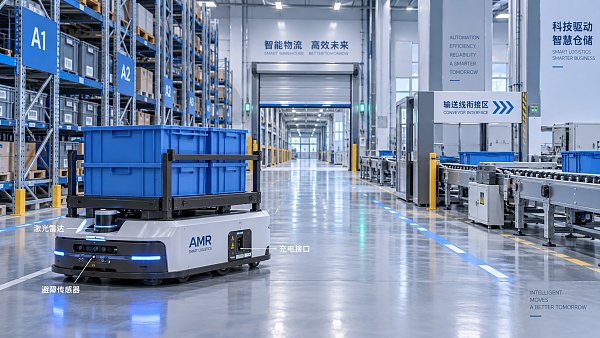
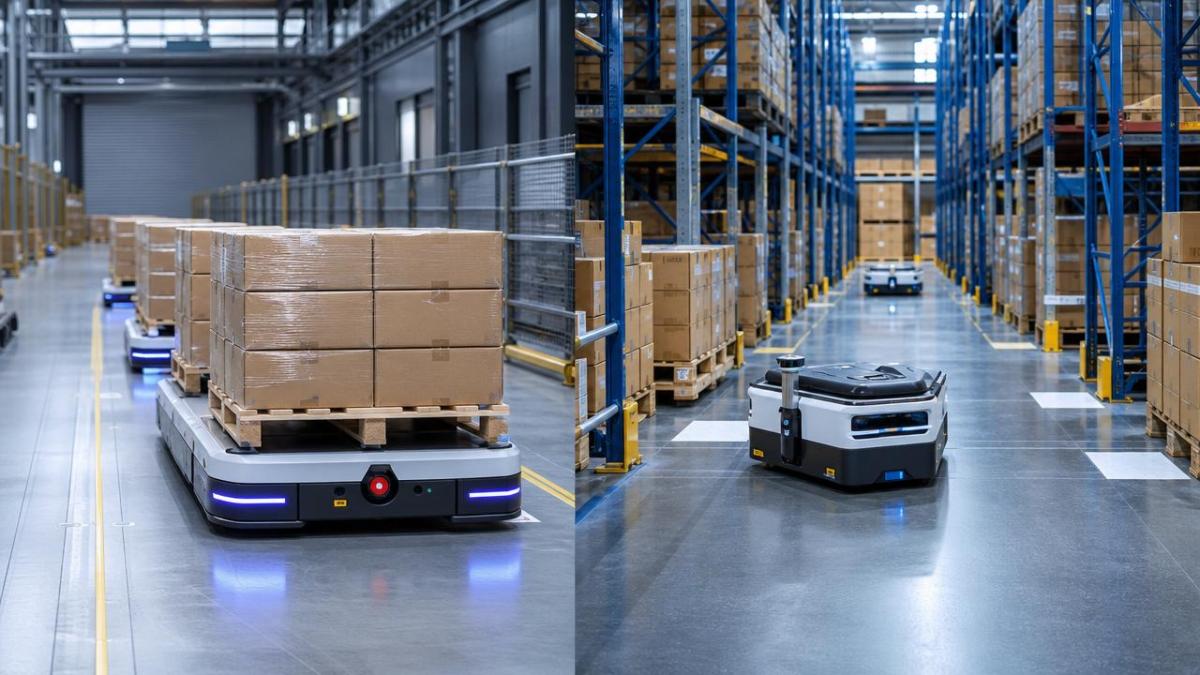
At a basic level, Automated Guided Vehicles usually follow fixed or semi-fixed routes using magnetic tape, QR markers, reflectors, or predefined guidance infrastructure. Autonomous Mobile Robots use onboard sensing and software-driven navigation to localize, reroute, and avoid obstacles with less dependence on physical route markers.
- If your flows are repetitive and stable, AGV may outperform on predictability and cost discipline.
- If your layout changes often or traffic is dynamic, AMR may reduce changeover friction and engineering rework.
- If your leadership team wants scalable automation, the right answer depends less on labels and more on material flow architecture.
The strategic question is not “Which is better?”
The better question is: which platform best fits your SKU variability, facility constraints, and integration roadmap over the next three to five years? In many warehouses, the highest-cost mistake is not choosing the cheaper or more expensive robot. It is choosing a mobility architecture that mismatches process reality and then forces expensive redesign later.
AGV vs AMR: where the real tradeoffs appear
The table below summarizes the main technical and operational tradeoffs that enterprise buyers should evaluate when assessing AGV AMR for warehouse automation. These criteria are more decision-relevant than generic claims about intelligence or modernization.
The practical conclusion is clear: AGV usually wins where process standardization is already high, while AMR usually wins where operational agility has measurable value. Neither system is universally superior. The wrong match can create hidden costs in congestion, low utilization, or recurring engineering intervention.
Why many comparisons go wrong
Many vendor comparisons focus on top speed, battery claims, or fleet size headlines. Those numbers matter, but they are incomplete. Real throughput depends on task dispatching, charging strategy, crossing priority rules, idle recovery, exception handling, and the percentage of time the vehicle can actually move under site conditions. This is why TSV emphasizes benchmarking under realistic warehouse constraints rather than brochure-level specifications.
Which warehouse scenarios favor AGV, and which favor AMR?
Before selecting AGV AMR for warehouse automation, map your operation by flow type, not by technology trend. A single site may even justify a hybrid architecture if inbound pallet transport is stable but picking replenishment is variable.
The following scenario matrix helps identify which mobility logic usually aligns better with the operating environment.
This scenario view is especially important for enterprise buyers managing multiple facilities. Standardizing on one technology across every site may look attractive from a procurement perspective, but operational fit should come first. A network-wide decision should be based on process families, not on a single pilot result.
Common mixed-use environments
- Manufacturing logistics often favors AGV for line feeding and AMR for exception transport or warehouse replenishment.
- Retail distribution centers may use AMR in pick-intensive zones and more structured automated transport in pallet corridors.
- Third-party logistics providers usually value AMR flexibility when customer profiles and SKU velocity change frequently.
What technical parameters should buyers verify before purchase?
When reviewing AGV AMR for warehouse automation proposals, decision-makers should ask for measurable operating parameters instead of generic capability claims. A strong proposal explains conditions, limitations, integration assumptions, and recovery behavior when reality deviates from the ideal flow model.
Key specification areas to verify
- Navigation accuracy and localization stability under your actual lighting, floor reflectivity, and aisle geometry.
- Payload range, lift interface, pallet compatibility, and load center constraints for every material type.
- Traffic management logic, including cross-aisle behavior, queuing, right-of-way rules, and congestion recovery.
- Battery charging model, charging dwell time, and fleet availability during peak shifts.
- Interface capability with WMS, WES, MES, ERP, elevators, automatic doors, and conveyor controls.
- Safety architecture, speed zoning, emergency stop behavior, and compliance with applicable industrial safety practices.
- Maintainability metrics such as spare parts lead time, diagnostic depth, remote support model, and software update process.
Questions that expose hidden risk
Ask how the fleet behaves when a rack location is blocked, when Wi-Fi quality drops, when floor markings degrade, or when a lift station is delayed. Ask for the assumptions behind cycle-time simulations. Ask whether quoted throughput is based on ideal route occupancy or real mixed-traffic conditions. These questions often reveal more than headline specifications.
How to evaluate total cost, not just purchase price
Budget pressure pushes many teams to compare only hardware price. That is understandable, but incomplete. The cost of AGV AMR for warehouse automation is shaped by route engineering, software integration, safety modifications, charging layout, operator training, support agreements, and process downtime during commissioning. A lower unit price can still lead to a higher total cost of ownership.
Use the table below to structure cost evaluation beyond the initial quotation.
For CFOs and operations leaders, the right comparison unit is not only cost per vehicle. It is cost per stable move, cost per recovered labor hour, and cost per avoided process disruption over the useful life of the system. That lens often changes the final decision.
What implementation risks do enterprises often underestimate?
The biggest failures in warehouse automation rarely come from the robot alone. They come from weak process definition, poor data inputs, or unrealistic assumptions during the pilot stage. AGV AMR for warehouse automation works best when flow logic, exception handling, and ownership responsibilities are defined before rollout.
Typical underestimated risks
- Under-specifying traffic interactions with forklifts, pedestrians, manual carts, and temporary staging areas.
- Assuming map-based navigation solves poor housekeeping, damaged floors, or aisle encroachment.
- Ignoring the quality of upstream master data, task creation logic, and location coding in WMS or ERP.
- Running a small pilot in a clean zone and then extrapolating results to the most congested part of the facility.
- Treating change management as an afterthought, especially for supervisors and operators who must handle exceptions.
A safer procurement sequence
A disciplined selection process typically starts with a flow audit, then a constraint map, then a simulation or pilot with defined success criteria, and only then a phased deployment. TSV’s perspective is that benchmarking should include failure modes, not just nominal performance. Decision-makers need to know how the system behaves on bad days, not only on presentation day.
Standards, safety, and integration: what should be on the checklist?
Compliance and integration quality are central to risk control. While exact requirements depend on region and application, enterprise buyers should verify that the vendor can clearly explain applicable machinery safety practices, electrical compliance, functional safety logic, and interface responsibilities across the automation stack.
- Request a documented safety concept for human-robot interaction zones, emergency stop propagation, and speed reduction areas.
- Confirm ownership of integration across WMS, PLC, door controls, conveyor signals, and charging infrastructure.
- Verify cybersecurity expectations for fleet software, user permissions, remote access, and update control.
- Ask how software revisions are validated so that future updates do not destabilize validated workflows.
This is where data-driven evaluation matters. A credible partner should be able to discuss not only system capability, but also integration boundaries, test plans, exception ownership, and performance acceptance criteria. That level of specificity reduces supplier qualification cycles and avoids expensive ambiguity later.
FAQ: practical questions about AGV AMR for warehouse automation
How should we choose between AGV and AMR for a brownfield warehouse?
Start with obstruction frequency, layout stability, and integration maturity. Brownfield sites usually have more variability, temporary storage, and mixed traffic, which often favors AMR. However, if the flow is repetitive and routes are disciplined, AGV can still be the better investment. The deciding factor is not building age; it is process variability and the cost of change.
Is AMR always more expensive than AGV?
Not necessarily. Hardware pricing alone does not answer that question. AMR may reduce physical route infrastructure and future reconfiguration cost, while AGV may offer simpler economics in stable flows. Compare total ownership cost, engineering change cost, and expected scaling cost over several years rather than judging by purchase price alone.
What KPIs should be included in a vendor evaluation?
Use KPIs tied to operation: completed moves per hour under real traffic, mission success rate, mean recovery time after blockage, charging availability, integration downtime, and labor hours displaced without throughput loss. If possible, ask vendors to define test conditions behind each KPI.
Can one enterprise deploy both AGV and AMR?
Yes, and in many cases that is the most rational design. Fixed, high-volume corridors may justify AGV logic, while dynamic pick zones or overflow routes may benefit from AMR flexibility. The key is orchestration: task assignment, traffic segmentation, charging planning, and interface governance must be designed as one system, not as disconnected pilots.
Why decision-makers turn to TSV before final vendor selection
For enterprise leaders, the hardest part of AGV AMR for warehouse automation is often not finding suppliers. It is filtering noise from evidence. TechStat Vanguard was built for exactly this problem. Our approach is independent, parameter-driven, and aligned with the needs of CTOs, procurement directors, and engineering teams who need engineering truth rather than inflated marketing language.
We focus on the variables that actually change project outcomes: navigation fault tolerance, integration boundaries, maintainability assumptions, and realistic performance interpretation under operating constraints. That helps organizations reduce trial-and-error cost, shorten supplier evaluation cycles, and draft stronger technical specifications before capital is committed.
What you can contact us about
- Parameter confirmation for AGV or AMR proposals, including navigation logic, payload assumptions, and fleet sizing inputs.
- Selection support for warehouse automation scenarios such as pallet transport, replenishment, picking assistance, and mixed-traffic workflows.
- Review of delivery timelines, deployment sequencing, and commissioning risk for multi-site or phased rollouts.
- Guidance on customized solution scope, system integration boundaries, and compliance-related checklist items.
- Benchmark-oriented support for quotation review, supplier comparison, and technical whitepaper interpretation.
If your team is evaluating AGV AMR for warehouse automation and needs a clearer basis for selection, TSV can help you turn ambiguous claims into comparable engineering criteria. That is the fastest way to make a scalable automation decision with fewer surprises after purchase.
Search News
Hot Articles
- Carbon Fiber StructuresHow to Specify Aerospace Carbon Fiber Assemblies for Lightweight, Load-Bearing PartsJul 11, 2026
- Machine VisionXiaomi, Alibaba DAMO Academy Drive Open-Source Robotics Model Ecosystem, Lowering Algorithm Development Barriers for Overseas SMEs Adopting Chinese Robotics SolutionsMar 30, 2026
- Cobots & ArmsShanxi 'AI+' Conference Showcases Embodied Intelligence with Multinational Buyer Engagement: Key Industry ImplicationsMar 30, 2026
Popular Tags
Recommended News
 Jul 11, 2026How to Specify Aerospace Carbon Fiber Assemblies for Lightweight, Load-Bearing PartsAerospace carbon fiber assemblies: learn how to specify laminate design, load data, joining methods, and inspection controls for lighter, reliable load-bearing aerospace parts.Elena Rostova (UAV Systems Researcher)
 Mar 30, 2026Xiaomi, Alibaba DAMO Academy Drive Open-Source Robotics Model Ecosystem, Lowering Algorithm Development Barriers for Overseas SMEs Adopting Chinese Robotics SolutionsXiaomi & Alibaba DAMO Academy's open-source robotics models lower algorithm barriers for global SMEs. Boost efficiency in manufacturing, logistics & smart retail with ROS 2 compatible solutions.TSV Data Lab
 Mar 30, 2026Shanxi 'AI+' Conference Showcases Embodied Intelligence with Multinational Buyer Engagement: Key Industry ImplicationsShanxi 'AI+' Conference highlights embodied intelligence with Tesla, Ubtech & Jiantao showcasing multimodal robotics. 40+ global buyers validated tech on-site, creating new B2B channels for industrial automation & AI solutions.Chen Wei (Automation Lead Engineer)
 Mar 30, 2026Zhongguancun Unveils 6G Integrated Sensing-Computing-Intelligence Platform to Empower Embodied Robots for Global Industrial ApplicationsZhongguancun's new 6G platform revolutionizes industrial robotics with <10ms latency, empowering global automotive, logistics & port automation. Discover how this tech boosts China's smart manufacturing exports.TSV Data Lab
 Mar 30, 2026Mech-Mind Tianjin Embodied Intelligence R&D and Production Base Goes Live, Cutting Delivery Time by 20%–30% for Global Customized AMR+Vision SolutionsMech-Mind's Tianjin AMR+Vision production base cuts delivery time by 20%-30% for欧美 & Latin American markets. Discover how this PLd-certified facility accelerates customized robotics solutions for smart manufacturing and logistics.Chen Wei (Automation Lead Engineer)
 Mar 30, 2026Boao Forum Reveals 'Co-evolution of Big and Small Brains' Trend in Humanoid Robots, China's Embodied Intelligence Accelerates Adaptation to Overseas Manufacturing Service ScenariosDiscover how China's humanoid robots, featuring 'Co-evolution of Big and Small Brains,' are revolutionizing global manufacturing. Learn about Embodied Tian Gong 3.0's ISO compliance and overseas deployment at Boao Forum 2026.Chen Wei (Automation Lead Engineer)
 Mar 30, 2026China Railway Industrial Secures Patent for Embodied Robotics in Material Handling, Boosting High-Precision Delivery Capabilities for Overseas Infrastructure and Manufacturing ProjectsChina Railway Industrial's new patent for embodied robotics in material handling boosts high-precision delivery for global infrastructure & manufacturing. Discover how this innovation enhances logistics accuracy in automotive, rail transit & EPC projects.Chen Wei (Automation Lead Engineer)
 Sep 28, 2026Spindle Runout Measurement in Germany: DIN Standards, Methods, and Acceptance LimitsSpindle runout measurement Germany: explore DIN standards, proven methods, acceptance limits, and audit-ready practices for reliable machining quality.Dr. Marcus Vance
 Sep 27, 2026How to Select Wall-Mount Edge Devices for Space-Constrained Factory NetworksWall mount edge devices for space-constrained factories: evaluate workload, thermal design, power resilience, cable access, and network reliability for smarter deployments.TSV Data Lab
 Sep 26, 2026Machining Tolerance Analysis: How to Set Limits That Meet Function and Cost TargetsMachining tolerance analysis: learn how to set functional limits, control tolerance stacks, reduce inspection risk, and balance precision with production cost.Dr. Marcus Vance
 Sep 25, 2026How to Evaluate an Industrial Infrastructure Data Platform for Multi-Site OperationsIndustrial infrastructure data platform evaluation guide for multi-site operations: compare data quality, edge resilience, interoperability, governance, and scalable proof-of-value criteria.Victor Lin (Chief Software Architect)
 Sep 24, 2026How to Select Machine Vision Optics for Accurate Inspection at Different Working DistancesMachine vision optics selection guide for accurate inspection at every working distance. Compare FOV, pixel scale, DOF, distortion, lighting, and telecentric options.TSV Data Lab
 Sep 23, 2026How to Evaluate a Machine Vision System Integrator for High-Speed Inspection LinesChoose a machine vision system integrator with proven expertise in high-speed inspection, reliable reject timing, robust optics, and measurable acceptance criteria.TSV Data Lab
 Sep 28, 2026When is a SCADA API the right choice for connecting plant systems?SCADA API guide: learn when governed plant data integration improves traceability, security, and scalability—without compromising real-time control.Victor Lin (Chief Software Architect)
 Sep 27, 2026How SCADA data integration improves traceability across production linesSCADA data integration connects production-line data to improve traceability, accelerate quality investigations, and strengthen safety decisions.Victor Lin (Chief Software Architect)
 Sep 26, 2026What to define before starting SCADA integration planningSCADA integration planning starts with clear scope, control boundaries, data models, cybersecurity, and testing. Discover the definitions that reduce risk and costly rework.Victor Lin (Chief Software Architect)
 Sep 25, 2026How a smart factory with Industrial IoT reduces production blind spotsDiscover how a smart factory with Industrial IoT turns real-time machine, quality, and workflow data into actionable insights that reduce production blind spots and delivery risks.Victor Lin (Chief Software Architect)
 Sep 24, 2026When does Industrial IoT make smart manufacturing easier to scale?Smart manufacturing Industrial IoT scales when trusted data, interoperable systems, and secure workflows turn connected assets into measurable gains.TSV Data Lab
 Sep 23, 2026What drives ultra-precision machining cost at 1-micron tolerance?Ultra precision machining cost per part at 1 micron tolerance depends on process, material, metrology, and yield. Learn how to compare quotes confidently.Dr. Marcus Vance
 Sep 22, 2026Drone Engine-T550CC Applications: Build the UAV Power System Around the MissionAn application guide for Drone Engine-T550CC integration, covering payload planning, airframe matching, cooling, fuel, vibration, test procedures, documentation, and service preparation.Elena Rostova (UAV Systems Researcher)
 Sep 22, 2026How to Evaluate Industrial Edge Computing Vendors for Factory DeploymentIndustrial edge computing vendor evaluation guide for factories: compare latency, protocol fit, reliability, security, and lifecycle support before deployment.TSV Data Lab
 Sep 21, 2026Drone Payload Integration: Matching Power, Data, and Center of Gravity for Reliable FlightsDrone payload integration made practical: balance power, data, center of gravity, and endurance to build safer, more reliable mission-ready flights.Elena Rostova (UAV Systems Researcher)
 Sep 20, 2026Autonomous Navigation Pricing: Cost Drivers and Budget Benchmarks for AMR ProjectsAutonomous navigation price explained: compare AMR cost drivers, software, sensors, integration, safety, and lifecycle budgets to build a scalable project plan.Chen Wei (Automation Lead Engineer)
 Sep 19, 2026How to Scope Automation Integration Services for Multi-System Factory ProjectsAutomation integration services: learn how to scope multi-system factory projects with clear workflows, interface contracts, safety boundaries, and acceptance criteria.Victor Lin (Chief Software Architect)