AGV LiDAR Navigation in Germany: What to Check for Indoor Accuracy and Compliance
Publication Date
author
Indoor navigation has become a decisive factor in automated material flow, especially where aisle density, machine proximity, and uptime targets leave little tolerance for localization drift. In agv lidar navigation Germany projects, the real question is not whether a system can move, but whether it can maintain repeatable positioning under reflective surfaces, changing pallet loads, mixed traffic, and strict compliance expectations. For technical review, accuracy must be read together with sensor stability, software behavior, and the regulatory context that governs deployment inside German industrial sites.
Why indoor LiDAR navigation now deserves closer scrutiny
Germany remains a demanding environment for AGV and AMR deployment because production sites are highly structured, safety-sensitive, and often retrofit rather than greenfield.
That matters because retrofit sites introduce navigation friction. Floor layouts evolve, metal racks create reflections, and legacy machinery can generate electromagnetic and operational noise.

From a TSV perspective, this is exactly where technical evaluation must separate verified engineering performance from broad marketing claims.
A navigation stack that looks stable in a controlled demo may degrade quickly in a warehouse with glossy wrapping film, narrow crossings, and repeated forklift interference.
That is why agv lidar navigation Germany has become a data problem as much as an automation problem.
What indoor accuracy really means
Indoor accuracy is often reduced to a headline figure, usually in millimeters. That figure matters, but by itself it is incomplete.
A more useful reading includes four layers: absolute position accuracy, repeatability, heading stability, and recovery behavior after partial signal degradation.
Absolute accuracy describes how closely the vehicle matches a mapped position.
Repeatability is often more important in production. A vehicle that consistently stops within a tight tolerance may outperform one with better nominal accuracy but unstable repeat cycles.
Heading stability affects docking, conveyor transfer, and line-side delivery. Small angular errors can become major process errors at forks, lifts, or handoff stations.
Recovery behavior reveals how the system responds when scans are partially blocked, the map changes, or point-cloud quality drops for several seconds.
In agv lidar navigation Germany, these four dimensions usually matter more than a single brochure number.
The sensor checks that expose real performance
LiDAR quality is not only about range. Indoor deployments depend heavily on how the sensor handles texture-poor environments and difficult surface behavior.
Point-cloud stability
Look for frame-to-frame consistency in static zones. If identical surroundings produce unstable point density, localization confidence will fluctuate.
Reflective and transparent materials
Wrapped pallets, polished floors, stainless housings, mesh fencing, and glass partitions can distort returns or create false gaps.
The right check is not whether the sensor detects them once. It is whether the navigation stack classifies and filters them consistently over time.
Occlusion tolerance
Temporary blocking from people, trolleys, or stacked goods should not trigger avoidable re-localization failures.
Multi-sensor synchronization
When LiDAR is fused with odometry, IMU, or vision, timing drift becomes critical. Bad synchronization can look like map error when it is actually data alignment error.
Mapping and repeatability in operational settings
A reliable map is not simply a digital floor plan. It is a controlled representation of features the vehicle can identify repeatedly under operating load.
In practice, repeatability should be tested in full routes, not isolated stations. Straight travel, tight turns, shelf approach, and docking all stress navigation differently.
A useful benchmark for agv lidar navigation Germany is route-to-route consistency during shift changes, when traffic density and obstacle patterns vary most.
It is also worth checking map maintenance overhead. If every layout update requires heavy manual remapping, the operating cost can rise faster than expected.
This is where TSV-style evaluation is valuable: parameters only matter when they hold after environment drift, not just during commissioning week.
Compliance is part of navigation performance
For indoor AGV projects in Germany, compliance should never be separated from technical accuracy. Safety and legal fit directly shape usable navigation behavior.
The relevant framework may include the EU Machinery Regulation transition context, CE marking requirements, ISO 3691-4 for driverless industrial trucks, and functional safety expectations tied to the application.
There may also be site-specific requirements involving pedestrian zones, emergency routes, cybersecurity governance, and integration with factory safety systems.
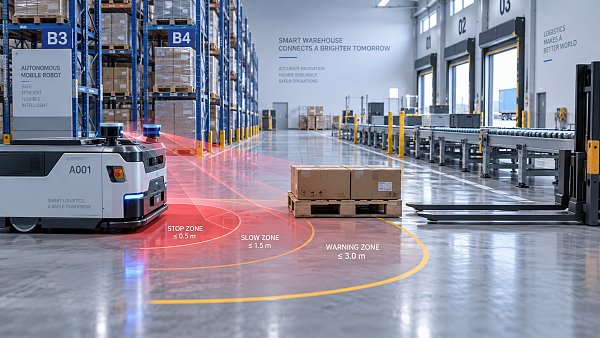
In agv lidar navigation Germany, a technically capable platform can still become a poor fit if the safety case depends on unrealistic speed limits or over-conservative restricted zones.
The practical question is whether the navigation system remains productive after compliance controls are activated.
What to verify in documentation
- Declared standards and the exact scope they cover
- Safety scanner configuration logic and field switching behavior
- Validation records for stopping distance and obstacle detection
- Change-control process for software, maps, and route edits
- Evidence that the certified configuration matches the delivered system
Where evaluation usually goes wrong
One common mistake is testing only under ideal lighting, low traffic, and newly cleaned floors. That does not reflect a normal industrial week.
Another is accepting broad claims about millimeter accuracy without asking whether that figure applies during motion, docking, or recovery after interruption.
A third issue is comparing systems with different map maturity. One vendor may demonstrate on a highly optimized route while another uses a first-pass site map.
For agv lidar navigation Germany, fair comparison requires the same route logic, the same obstacle profile, and the same acceptance criteria.
A practical framework for side-by-side assessment
The strongest evaluations combine navigation metrics, environmental stress tests, and compliance evidence in one review sheet.
- Measure stop accuracy across repeated docking cycles with varied payload states
- Run routes near reflective wrapping, metal racks, and transparent barriers
- Record drift during acceleration, braking, and sharp directional change
- Check recovery time after forced occlusion or partial map obstruction
- Review standards declarations together with real operating constraints
- Estimate map update effort after typical layout change events
This approach aligns well with the TSV principle that engineering truth sits in measurable tolerances, not promotional phrasing.
What to do next before qualification
A sound next step is to define acceptance criteria before any live demo. That prevents the evaluation from being shaped by whichever vendor controls the narrative best.
For agv lidar navigation Germany, the most useful checklist links route accuracy, repeatability, re-localization speed, reflective-surface tolerance, and compliance documentation to one decision matrix.
Once those checks are structured, comparison becomes much clearer. Some systems will prove strong in clean mapping but weak in recovery. Others will be compliant but operationally restrictive.
That is the point of disciplined review: reduce qualification risk early, build a spec around verified behavior, and move forward with data that can survive real plant conditions.
Search News
Hot Articles
- Carbon Fiber StructuresHow to Specify Aerospace Carbon Fiber Assemblies for Lightweight, Load-Bearing PartsJul 11, 2026
- Machine VisionXiaomi, Alibaba DAMO Academy Drive Open-Source Robotics Model Ecosystem, Lowering Algorithm Development Barriers for Overseas SMEs Adopting Chinese Robotics SolutionsMar 30, 2026
- Cobots & ArmsShanxi 'AI+' Conference Showcases Embodied Intelligence with Multinational Buyer Engagement: Key Industry ImplicationsMar 30, 2026
Popular Tags
Recommended News
 Jul 11, 2026How to Specify Aerospace Carbon Fiber Assemblies for Lightweight, Load-Bearing PartsAerospace carbon fiber assemblies: learn how to specify laminate design, load data, joining methods, and inspection controls for lighter, reliable load-bearing aerospace parts.Elena Rostova (UAV Systems Researcher)
 Mar 30, 2026Xiaomi, Alibaba DAMO Academy Drive Open-Source Robotics Model Ecosystem, Lowering Algorithm Development Barriers for Overseas SMEs Adopting Chinese Robotics SolutionsXiaomi & Alibaba DAMO Academy's open-source robotics models lower algorithm barriers for global SMEs. Boost efficiency in manufacturing, logistics & smart retail with ROS 2 compatible solutions.TSV Data Lab
 Mar 30, 2026Shanxi 'AI+' Conference Showcases Embodied Intelligence with Multinational Buyer Engagement: Key Industry ImplicationsShanxi 'AI+' Conference highlights embodied intelligence with Tesla, Ubtech & Jiantao showcasing multimodal robotics. 40+ global buyers validated tech on-site, creating new B2B channels for industrial automation & AI solutions.Chen Wei (Automation Lead Engineer)
 Mar 30, 2026Zhongguancun Unveils 6G Integrated Sensing-Computing-Intelligence Platform to Empower Embodied Robots for Global Industrial ApplicationsZhongguancun's new 6G platform revolutionizes industrial robotics with <10ms latency, empowering global automotive, logistics & port automation. Discover how this tech boosts China's smart manufacturing exports.TSV Data Lab
 Mar 30, 2026Mech-Mind Tianjin Embodied Intelligence R&D and Production Base Goes Live, Cutting Delivery Time by 20%–30% for Global Customized AMR+Vision SolutionsMech-Mind's Tianjin AMR+Vision production base cuts delivery time by 20%-30% for欧美 & Latin American markets. Discover how this PLd-certified facility accelerates customized robotics solutions for smart manufacturing and logistics.Chen Wei (Automation Lead Engineer)
 Mar 30, 2026Boao Forum Reveals 'Co-evolution of Big and Small Brains' Trend in Humanoid Robots, China's Embodied Intelligence Accelerates Adaptation to Overseas Manufacturing Service ScenariosDiscover how China's humanoid robots, featuring 'Co-evolution of Big and Small Brains,' are revolutionizing global manufacturing. Learn about Embodied Tian Gong 3.0's ISO compliance and overseas deployment at Boao Forum 2026.Chen Wei (Automation Lead Engineer)
 Mar 30, 2026China Railway Industrial Secures Patent for Embodied Robotics in Material Handling, Boosting High-Precision Delivery Capabilities for Overseas Infrastructure and Manufacturing ProjectsChina Railway Industrial's new patent for embodied robotics in material handling boosts high-precision delivery for global infrastructure & manufacturing. Discover how this innovation enhances logistics accuracy in automotive, rail transit & EPC projects.Chen Wei (Automation Lead Engineer)
 Oct 11, 2026How Procurement-Oriented Content Taxonomy Improves B2B Buying JourneysProcurement-oriented content taxonomy streamlines B2B buying journeys with clearer evidence, supplier comparisons, risk visibility, and faster approvals.TSV Data Lab
 Oct 10, 2026How to Select a Machine Performance Monitoring Platform for OEE and Downtime ReductionMachine performance monitoring platform selection guide: validate machine states, OEE data, downtime reasons, integrations, and scalability to reduce losses with confidence.TSV Data Lab
 Oct 08, 2026How to Machine Inconel 625 Blades Without Heat Cracks or Edge ChippingInconel 625 blade machining guide: prevent heat cracks, edge chipping, chatter, and work hardening with proven tooling, cooling, fixturing, and inspection strategies.Dr. Marcus Vance
 Oct 07, 2026How to Evaluate an HMI Panel Distributor for Industrial Automation ProjectsHMI panel distributor evaluation guide: verify technical compatibility, traceability, supply reliability, lifecycle support, and total cost for automation projects.Victor Lin (Chief Software Architect)
 Oct 06, 2026Navigation Fault Tolerance Standards for AMRs: What Safety Teams Must VerifyNavigation fault tolerance standards: learn what AMR safety teams must verify, from localization loss and sensor faults to stopping distance, safe restart, and site-specific validation.Chen Wei (Automation Lead Engineer)
 Oct 05, 2026Calculating Edge Computing Total Cost of Ownership Across Distributed SitesEdge computing ownership cost explained: calculate deployment, energy, connectivity, security, remote support, and refresh costs across distributed sites.TSV Data Lab
 Oct 04, 2026CAD/CAM Benchmarking in the GCC: What Manufacturers Should Ask a ConsultantCAD CAM benchmark consultant GCC guide: learn the key questions manufacturers should ask to validate post-processors, workflows, machine performance, and production risk.Victor Lin (Chief Software Architect)
 Oct 03, 2026Selecting Automotive Radar Sensor Modules for ADAS Range, Resolution, and IntegrationAutomotive radar sensor module selection guide for ADAS: compare range, resolution, field of view, latency, and integration to build safer, reliable vehicle systems.TSV Data Lab
 Oct 02, 2026How to Qualify Machined Parts Suppliers for Hard Tech ProgramsHard tech supply chain machined parts demand rigorous supplier qualification. Learn how to assess capability, traceability, quality controls, and delivery resilience.Dr. Marcus Vance
 Oct 01, 2026How to Select an Outdoor Security Radar Sensor for Perimeter Detection?Outdoor security radar sensor selection guide: compare range, accuracy, false-alarm control, integration, and field testing for reliable perimeter detection.TSV Data Lab
 Sep 30, 2026How to Evaluate Solid-State LiDAR Hardware for Outdoor Autonomous VehiclesSolid state LiDAR hardware evaluation guide for outdoor autonomous vehicles—compare range, point-cloud quality, environmental resilience, integration, and safety.TSV Data Lab
 Sep 29, 2026ISO 9283 Repeatability: How to Evaluate Cobot Positioning PerformanceISO 9283 cobot repeatability explained: learn how payload, reach, approach direction, and test conditions affect positioning performance and cell capability.Chen Wei (Automation Lead Engineer)
 Oct 11, 2026How payload and reach change the cost of an industrial robotCost of industrial robot systems depends heavily on payload and reach. Learn how sizing, torque, tooling, safety, and lifecycle factors shape smarter automation investments.Chen Wei (Automation Lead Engineer)
 Oct 10, 2026When does the cost of industrial robots pay back in high-volume production?Cost of industrial robots: discover how high-volume manufacturers calculate payback through uptime, cycle time, labor, quality, and integration before investing.Chen Wei (Automation Lead Engineer)
 Oct 09, 2026What does a manufacturing robot really cost beyond the purchase price?Manufacturing robot cost goes far beyond the purchase price. Explore integration, tooling, safety, uptime, and total ownership factors for smarter automation investments.Chen Wei (Automation Lead Engineer)
 Oct 08, 2026AGV vs. AMR: Which Is Better for Frequently Changing Routes?Which is better for changing routes? Compare AGVs and AMRs for flexible navigation, docking precision, traffic control, and faster facility reconfiguration.Chen Wei (Automation Lead Engineer)
 Oct 07, 2026How Much Does an Automated Guided Vehicle Cost in 2026?How much does an automated guided vehicle cost in 2026? Explore AGV price ranges, hidden deployment costs, and smart buying factors for stronger ROI.Chen Wei (Automation Lead Engineer)