What to Check Before Downloading an Aerospace Machining Whitepaper
Publication Date
author
Before downloading an aerospace machining technical whitepaper, the first task is simple: verify whether it contains engineering evidence.
In aerospace sourcing and design validation, vague promises create risk, delay, and expensive rework.
A useful document should explain tolerances, materials, process limits, certifications, inspection methods, and repeatability.
This guide shows what to check before trusting any aerospace machining technical whitepaper.
What makes an aerospace machining technical whitepaper credible?
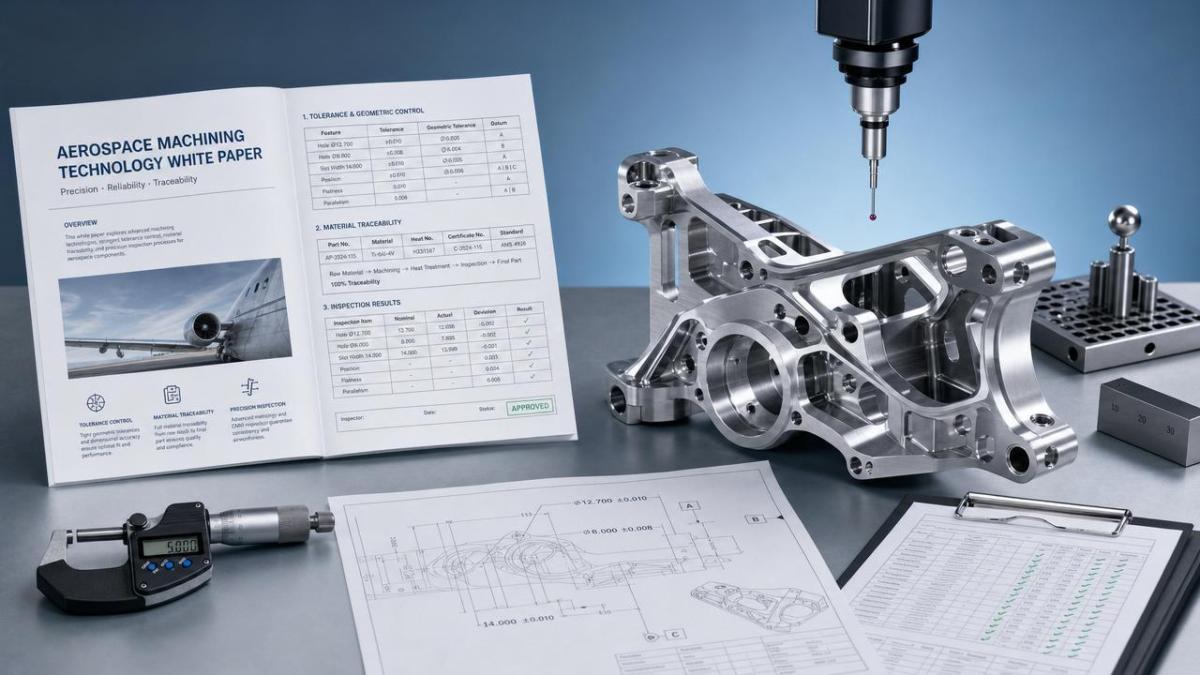
A credible aerospace machining technical whitepaper starts with traceable facts, not polished language.
Look for exact numbers instead of claims like “advanced precision” or “premium aerospace quality.”
Strong papers usually include dimensional tolerance windows, surface finish values, and geometric control requirements.
They also define how those numbers were measured.
A reliable aerospace machining technical whitepaper should mention test standards, metrology tools, and sampling conditions.
That means CMM protocols, inspection frequency, and whether results reflect prototypes or production batches.
Certification context matters too.
A paper referencing AS9100, NADCAP-related processes, or documented traceability usually offers better technical discipline.
Still, logos alone are not enough.
The document should connect certifications to process capability, inspection control, and nonconformance handling.
Quick credibility signals
- Specific tolerance data with units
- Material grades and condition states
- Inspection methods and equipment references
- Revision dates and test scope
- Clear limits, assumptions, and exclusions
Which technical data points should you verify first?
The best aerospace machining technical whitepaper helps evaluate whether a process can meet actual flight-critical requirements.
Start with tolerance capability.
Check linear tolerances, positional accuracy, flatness, concentricity, and repeatability across multiple runs.
Next, review material information carefully.
A useful paper should identify alloys such as titanium, Inconel, aluminum aerospace grades, or stainless variants.
It should also explain machinability challenges, heat generation, burr behavior, and stress management.
Surface integrity is another major checkpoint.
For aerospace parts, roughness alone is not enough.
Look for notes on microcracking, tool marks, recast layers, residual stress, and edge condition control.
Then review fatigue-related discussion.
Even if a whitepaper is not a full fatigue study, it should explain how machining affects part life.
This is especially important for brackets, housings, structural connectors, and rotating assemblies.
Priority data checklist
- Tolerance range under real production conditions
- Material specification and heat treatment condition
- Surface finish and surface integrity data
- Fatigue or durability implications
- Inspection, traceability, and lot consistency
How can you tell whether the whitepaper is educational or promotional?
This question matters because many documents are styled like engineering resources but behave like brochures.
A promotional piece often uses broad claims without defining boundary conditions.
For example, it may say “tight-tolerance aerospace machining” without stating achievable values or part size limits.
It may highlight machine brands but ignore process capability studies.
An educational aerospace machining technical whitepaper explains tradeoffs.
It may compare 3-axis and 5-axis strategies, discuss fixture distortion, or describe why thin-wall geometries are difficult.
It should also acknowledge limitations.
Documents become more trustworthy when they state what was not tested, what assumptions were used, and where uncertainty remains.
Another sign is the use of visuals.
Charts, tolerance tables, capability snapshots, and inspection images add value when clearly labeled and interpreted.
Decorative graphics without technical meaning usually signal weak substance.
Why do standards, traceability, and revision history matter so much?
Aerospace decisions depend on controlled information.
An aerospace machining technical whitepaper without revision history can become misleading very quickly.
Machine upgrades, tooling changes, and inspection updates can alter capability.
That is why publication dates and revision notes deserve attention.
Traceability is equally important.
A strong whitepaper should show how material lots, process steps, and quality records connect to final part performance.
This reduces ambiguity during supplier screening and technical benchmarking.
Standards references should also be meaningful.
If AS9100 is mentioned, ask whether the paper links that standard to documented process control.
If special processing appears, check whether the chain of responsibility is explained.
Organizations that value data discipline often publish more dependable aerospace machining technical whitepaper content.
This aligns with the broader need for engineering truth over marketing noise, a principle central to TSV’s global vision.
What common red flags should stop a download decision?
Some warning signs appear before the first page is finished.
If the aerospace machining technical whitepaper hides basic authorship, technical sources, or publication date, be cautious.
If every paragraph sounds like sales copy, its technical value is probably limited.
Watch for unsupported superlatives.
Terms like “world-class,” “ultra-precise,” and “best-in-class” should trigger questions unless tied to measurable evidence.
Be careful with isolated success stories too.
One sample part does not prove stable capability across alloys, geometries, or batch volumes.
Another red flag is missing application context.
A paper discussing titanium milling may still be irrelevant if it ignores thin sections, hole quality, or thermal distortion.
Finally, avoid documents that present no decision value.
A useful aerospace machining technical whitepaper should help compare processes, qualify risks, or narrow technical options.
Stop-and-check red flags
- No date, author, or revision control
- No units, tolerances, or test methods
- Only machine marketing, no capability evidence
- No discussion of part complexity or material behavior
- No link between standards and actual process controls
How should you use the whitepaper after downloading it?
Downloading is only the start.
The real value of an aerospace machining technical whitepaper appears when its data is converted into evaluation questions.
Use it to build a checklist for tolerances, materials, inspection needs, and process limitations.
Compare the paper’s claims against part drawings, RFQ language, and internal validation requirements.
If a whitepaper discusses titanium part stability, ask whether the same logic applies to your geometry and wall thickness.
If it presents capability data, ask whether that capability was sustained over volume.
Technical teams often move faster when they treat whitepapers as screening tools, not final proof.
This approach shortens qualification cycles and reduces avoidable trial-and-error.
That is the larger purpose behind data-first analysis platforms such as TechStat Vanguard.
Measured information creates better decisions than polished messaging.
A strong aerospace machining technical whitepaper should reduce uncertainty, not add more interpretation work.
Before downloading, check whether the document promises measurable engineering insight.
After downloading, test every claim against tolerances, materials, fatigue relevance, traceability, and inspection logic.
When data is clear, technical evaluation becomes faster and more reliable.
Use each aerospace machining technical whitepaper as a structured filter for smarter manufacturing decisions.
Search News
Hot Articles
- Carbon Fiber StructuresHow to Specify Aerospace Carbon Fiber Assemblies for Lightweight, Load-Bearing PartsJul 11, 2026
- Machine VisionXiaomi, Alibaba DAMO Academy Drive Open-Source Robotics Model Ecosystem, Lowering Algorithm Development Barriers for Overseas SMEs Adopting Chinese Robotics SolutionsMar 30, 2026
- Cobots & ArmsShanxi 'AI+' Conference Showcases Embodied Intelligence with Multinational Buyer Engagement: Key Industry ImplicationsMar 30, 2026
Popular Tags
Recommended News
 Jul 11, 2026How to Specify Aerospace Carbon Fiber Assemblies for Lightweight, Load-Bearing PartsAerospace carbon fiber assemblies: learn how to specify laminate design, load data, joining methods, and inspection controls for lighter, reliable load-bearing aerospace parts.Elena Rostova (UAV Systems Researcher)
 Mar 30, 2026Xiaomi, Alibaba DAMO Academy Drive Open-Source Robotics Model Ecosystem, Lowering Algorithm Development Barriers for Overseas SMEs Adopting Chinese Robotics SolutionsXiaomi & Alibaba DAMO Academy's open-source robotics models lower algorithm barriers for global SMEs. Boost efficiency in manufacturing, logistics & smart retail with ROS 2 compatible solutions.TSV Data Lab
 Mar 30, 2026Shanxi 'AI+' Conference Showcases Embodied Intelligence with Multinational Buyer Engagement: Key Industry ImplicationsShanxi 'AI+' Conference highlights embodied intelligence with Tesla, Ubtech & Jiantao showcasing multimodal robotics. 40+ global buyers validated tech on-site, creating new B2B channels for industrial automation & AI solutions.Chen Wei (Automation Lead Engineer)
 Mar 30, 2026Zhongguancun Unveils 6G Integrated Sensing-Computing-Intelligence Platform to Empower Embodied Robots for Global Industrial ApplicationsZhongguancun's new 6G platform revolutionizes industrial robotics with <10ms latency, empowering global automotive, logistics & port automation. Discover how this tech boosts China's smart manufacturing exports.TSV Data Lab
 Mar 30, 2026Mech-Mind Tianjin Embodied Intelligence R&D and Production Base Goes Live, Cutting Delivery Time by 20%–30% for Global Customized AMR+Vision SolutionsMech-Mind's Tianjin AMR+Vision production base cuts delivery time by 20%-30% for欧美 & Latin American markets. Discover how this PLd-certified facility accelerates customized robotics solutions for smart manufacturing and logistics.Chen Wei (Automation Lead Engineer)
 Mar 30, 2026Boao Forum Reveals 'Co-evolution of Big and Small Brains' Trend in Humanoid Robots, China's Embodied Intelligence Accelerates Adaptation to Overseas Manufacturing Service ScenariosDiscover how China's humanoid robots, featuring 'Co-evolution of Big and Small Brains,' are revolutionizing global manufacturing. Learn about Embodied Tian Gong 3.0's ISO compliance and overseas deployment at Boao Forum 2026.Chen Wei (Automation Lead Engineer)
 Mar 30, 2026China Railway Industrial Secures Patent for Embodied Robotics in Material Handling, Boosting High-Precision Delivery Capabilities for Overseas Infrastructure and Manufacturing ProjectsChina Railway Industrial's new patent for embodied robotics in material handling boosts high-precision delivery for global infrastructure & manufacturing. Discover how this innovation enhances logistics accuracy in automotive, rail transit & EPC projects.Chen Wei (Automation Lead Engineer)
 Sep 28, 2026Spindle Runout Measurement in Germany: DIN Standards, Methods, and Acceptance LimitsSpindle runout measurement Germany: explore DIN standards, proven methods, acceptance limits, and audit-ready practices for reliable machining quality.Dr. Marcus Vance
 Sep 27, 2026How to Select Wall-Mount Edge Devices for Space-Constrained Factory NetworksWall mount edge devices for space-constrained factories: evaluate workload, thermal design, power resilience, cable access, and network reliability for smarter deployments.TSV Data Lab
 Sep 26, 2026Machining Tolerance Analysis: How to Set Limits That Meet Function and Cost TargetsMachining tolerance analysis: learn how to set functional limits, control tolerance stacks, reduce inspection risk, and balance precision with production cost.Dr. Marcus Vance
 Sep 25, 2026How to Evaluate an Industrial Infrastructure Data Platform for Multi-Site OperationsIndustrial infrastructure data platform evaluation guide for multi-site operations: compare data quality, edge resilience, interoperability, governance, and scalable proof-of-value criteria.Victor Lin (Chief Software Architect)
 Sep 24, 2026How to Select Machine Vision Optics for Accurate Inspection at Different Working DistancesMachine vision optics selection guide for accurate inspection at every working distance. Compare FOV, pixel scale, DOF, distortion, lighting, and telecentric options.TSV Data Lab
 Sep 23, 2026How to Evaluate a Machine Vision System Integrator for High-Speed Inspection LinesChoose a machine vision system integrator with proven expertise in high-speed inspection, reliable reject timing, robust optics, and measurable acceptance criteria.TSV Data Lab
 Sep 28, 2026When is a SCADA API the right choice for connecting plant systems?SCADA API guide: learn when governed plant data integration improves traceability, security, and scalability—without compromising real-time control.Victor Lin (Chief Software Architect)
 Sep 27, 2026How SCADA data integration improves traceability across production linesSCADA data integration connects production-line data to improve traceability, accelerate quality investigations, and strengthen safety decisions.Victor Lin (Chief Software Architect)
 Sep 26, 2026What to define before starting SCADA integration planningSCADA integration planning starts with clear scope, control boundaries, data models, cybersecurity, and testing. Discover the definitions that reduce risk and costly rework.Victor Lin (Chief Software Architect)
 Sep 25, 2026How a smart factory with Industrial IoT reduces production blind spotsDiscover how a smart factory with Industrial IoT turns real-time machine, quality, and workflow data into actionable insights that reduce production blind spots and delivery risks.Victor Lin (Chief Software Architect)
 Sep 24, 2026When does Industrial IoT make smart manufacturing easier to scale?Smart manufacturing Industrial IoT scales when trusted data, interoperable systems, and secure workflows turn connected assets into measurable gains.TSV Data Lab
 Sep 23, 2026What drives ultra-precision machining cost at 1-micron tolerance?Ultra precision machining cost per part at 1 micron tolerance depends on process, material, metrology, and yield. Learn how to compare quotes confidently.Dr. Marcus Vance
 Sep 22, 2026Drone Engine-T550CC Applications: Build the UAV Power System Around the MissionAn application guide for Drone Engine-T550CC integration, covering payload planning, airframe matching, cooling, fuel, vibration, test procedures, documentation, and service preparation.Elena Rostova (UAV Systems Researcher)
 Sep 22, 2026How to Evaluate Industrial Edge Computing Vendors for Factory DeploymentIndustrial edge computing vendor evaluation guide for factories: compare latency, protocol fit, reliability, security, and lifecycle support before deployment.TSV Data Lab
 Sep 21, 2026Drone Payload Integration: Matching Power, Data, and Center of Gravity for Reliable FlightsDrone payload integration made practical: balance power, data, center of gravity, and endurance to build safer, more reliable mission-ready flights.Elena Rostova (UAV Systems Researcher)
 Sep 20, 2026Autonomous Navigation Pricing: Cost Drivers and Budget Benchmarks for AMR ProjectsAutonomous navigation price explained: compare AMR cost drivers, software, sensors, integration, safety, and lifecycle budgets to build a scalable project plan.Chen Wei (Automation Lead Engineer)
 Sep 19, 2026How to Scope Automation Integration Services for Multi-System Factory ProjectsAutomation integration services: learn how to scope multi-system factory projects with clear workflows, interface contracts, safety boundaries, and acceptance criteria.Victor Lin (Chief Software Architect)