Is 3D Metal Printing Ready for Rocket Nozzle Production Runs?
Publication Date
author
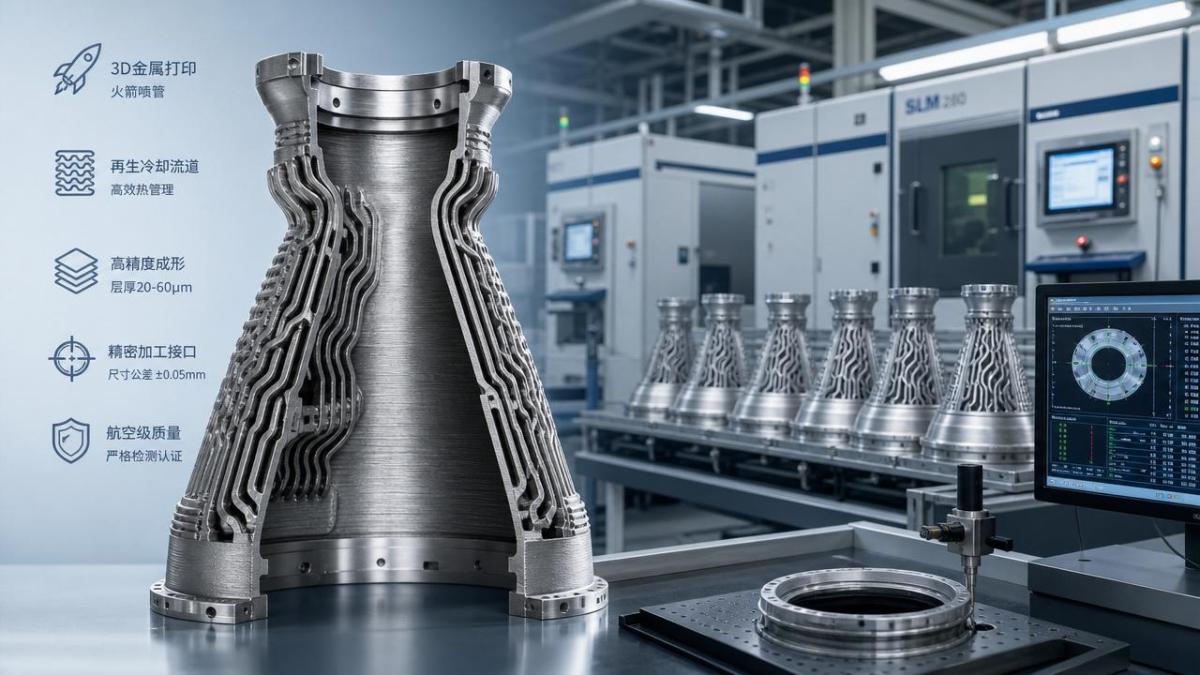
As launch programs scale from prototypes to repeatable manufacturing, decision-makers are asking a tougher question: is 3d metal printing for rocket nozzles truly ready for production runs? Beyond design freedom, the real issue is whether additive processes can deliver repeatable tolerances, thermal durability, material consistency, and cost efficiency at aerospace procurement standards.
The answer is no longer binary. In several nozzle categories, 3d metal printing for rocket nozzles has moved past demonstration and into controlled industrial use. Yet production readiness depends on geometry, alloy, inspection discipline, post-processing stability, and batch-level quality control.
For a data-driven engineering view, readiness should be judged by measurable outputs. These include dimensional capability, porosity control, build repeatability, surface integrity, lead time compression, and traceable performance under thermal cycling and hot-fire conditions.
Why the conversation around 3d metal printing for rocket nozzles has changed
The market signal is clear. Rocket development has shifted from occasional custom hardware to repeatable low-volume and mid-volume manufacturing. That change raises the bar from “can it be printed” to “can it be printed repeatedly.”
Five years ago, additive nozzle discussions centered on impossible cooling channels and part count reduction. Today, the discussion is more practical. Teams want lower rework, shorter qualification cycles, and fewer supply chain bottlenecks.
This shift matters because rocket nozzles are unforgiving components. They combine steep thermal gradients, vibration, combustion instability exposure, and complex internal flow paths. A process that works once is not enough for production runs.
The strongest trend signals point toward selective readiness, not universal maturity
Current evidence suggests that 3d metal printing for rocket nozzles is most mature in smaller engines, development programs, and nozzle designs where integrated cooling or consolidation creates major value.
Readiness drops when programs require very high annual volumes, extremely large nozzle formats, or material systems with narrow processing windows. In those cases, additive may still be strategic, but not automatically optimal.
A useful industry view is to separate “printability” from “production capability.” Many nozzles are printable. Far fewer are manufacturable at stable cost, stable yield, and stable inspection outcomes across multiple lots.
What is driving adoption right now
The real readiness test is repeatability across the full manufacturing chain
Production readiness for 3d metal printing for rocket nozzles is not determined by the printer alone. It is determined by the chain from feedstock to final inspection.
Powder quality is a major variable. Particle size distribution, oxygen pickup, flowability, and lot consistency directly affect density, melt behavior, and defect risk. Weak powder control can erase any design advantage.
Build strategy matters just as much. Scan path, support design, orientation, laser settings, and thermal management influence distortion, residual stress, and microstructure. A nozzle can pass one build and drift in the next.
Post-processing is often the hidden bottleneck. Heat treatment, HIP, machining, surface finishing, and internal channel cleaning determine whether printed geometry becomes flight-worthy hardware or expensive scrap.
Key process checkpoints that separate prototypes from production runs
- Stable feedstock specifications with incoming inspection data
- Locked build parameters for each alloy and nozzle family
- Validated distortion compensation and machining allowance strategy
- HIP and heat treatment windows linked to mechanical test results
- CT, dimensional, and surface inspection standards tied to acceptance criteria
- Hot-fire correlation between as-built data and engine performance
Material and thermal demands remain the biggest gatekeepers
Not every alloy behaves equally well in additive manufacturing. Some nickel superalloys, copper alloys, and refractory-related systems present tradeoffs in print stability, crack sensitivity, conductivity, and post-build processing.
For rocket nozzles, thermal behavior is central. High heat flux, oxidation exposure, chamber pressure variation, and repeated startup cycles punish weak interfaces and marginal microstructures.
This is why 3d metal printing for rocket nozzles must be assessed through application-specific testing. Tensile data alone is insufficient. Thermal fatigue, creep behavior, channel wall integrity, and combustion-facing erosion all matter.
Where 3d metal printing for rocket nozzles creates the clearest business impact
The strongest impact appears when nozzle geometry is complex, design changes are frequent, and conventional fabrication requires many joins. In these scenarios, additive reduces schedule risk more than it reduces simple unit price.
It also changes qualification economics. A digitally controlled process with strong records can shorten root-cause investigation, especially when defects can be traced to a parameter window, powder lot, or thermal history.
However, the cost story is nuanced. 3d metal printing for rocket nozzles may lower total program cost while raising some direct manufacturing costs. That happens when faster iteration and fewer assemblies offset printer, HIP, and inspection expenses.
Operational areas most affected by this shift
- Engineering validation cycles become shorter and more data-rich
- Supplier qualification focuses more on process control than brochure claims
- Inventory planning shifts toward digital files and controlled powder stock
- Inspection teams require stronger CT and metallurgical review capability
- Program risk moves from assembly variation to process discipline
What deserves close attention before declaring production readiness
A common mistake is to evaluate 3d metal printing for rocket nozzles using a successful prototype campaign alone. True readiness requires evidence across multiple builds, operators, machine states, and post-processing batches.
Another mistake is focusing only on external dimensions. Internal channels, wall thickness transitions, trapped powder removal, and local surface condition often determine whether a nozzle survives service.
Core checkpoints worth tracking
- Batch-to-batch density and porosity consistency
- Dimensional repeatability after stress relief, HIP, and machining
- Internal passage cleanliness and measurable flow uniformity
- Thermal cycle durability under representative duty profiles
- Scrap rate, rework rate, and final yield over several lots
- Inspection throughput relative to delivery schedule targets
A practical judgment framework for the next 12 to 24 months
The near-term outlook is favorable but selective. 3d metal printing for rocket nozzles is ready for production runs when the nozzle family is well-bounded, the alloy is qualified, and process controls are statistically stable.
It is less ready when builds remain highly customized, post-processing routes are immature, or acceptance criteria are still evolving from test campaign to test campaign.
The most reliable next step is evidence-based benchmarking. Compare additive nozzles and conventional nozzles using the same metrics: leak integrity, hot-fire cycles, turnaround time, yield, and full landed cost.
For organizations aligning with the TSV approach, the key is simple: remove the hype, interrogate the parameters, and let validated data decide. In that framework, 3d metal printing for rocket nozzles is not a universal answer, but it is increasingly a production-grade answer for the right nozzle architectures.
The most effective action now is to define a qualification matrix, map process risk by nozzle type, and require traceable evidence from powder lot to hot-fire result. That is where production confidence is built.
Search News
Hot Articles
- Carbon Fiber StructuresHow to Specify Aerospace Carbon Fiber Assemblies for Lightweight, Load-Bearing PartsJul 11, 2026
- Machine VisionXiaomi, Alibaba DAMO Academy Drive Open-Source Robotics Model Ecosystem, Lowering Algorithm Development Barriers for Overseas SMEs Adopting Chinese Robotics SolutionsMar 30, 2026
- Cobots & ArmsShanxi 'AI+' Conference Showcases Embodied Intelligence with Multinational Buyer Engagement: Key Industry ImplicationsMar 30, 2026
Popular Tags
Recommended News
 Jul 11, 2026How to Specify Aerospace Carbon Fiber Assemblies for Lightweight, Load-Bearing PartsAerospace carbon fiber assemblies: learn how to specify laminate design, load data, joining methods, and inspection controls for lighter, reliable load-bearing aerospace parts.Elena Rostova (UAV Systems Researcher)
 Mar 30, 2026Xiaomi, Alibaba DAMO Academy Drive Open-Source Robotics Model Ecosystem, Lowering Algorithm Development Barriers for Overseas SMEs Adopting Chinese Robotics SolutionsXiaomi & Alibaba DAMO Academy's open-source robotics models lower algorithm barriers for global SMEs. Boost efficiency in manufacturing, logistics & smart retail with ROS 2 compatible solutions.TSV Data Lab
 Mar 30, 2026Shanxi 'AI+' Conference Showcases Embodied Intelligence with Multinational Buyer Engagement: Key Industry ImplicationsShanxi 'AI+' Conference highlights embodied intelligence with Tesla, Ubtech & Jiantao showcasing multimodal robotics. 40+ global buyers validated tech on-site, creating new B2B channels for industrial automation & AI solutions.Chen Wei (Automation Lead Engineer)
 Mar 30, 2026Zhongguancun Unveils 6G Integrated Sensing-Computing-Intelligence Platform to Empower Embodied Robots for Global Industrial ApplicationsZhongguancun's new 6G platform revolutionizes industrial robotics with <10ms latency, empowering global automotive, logistics & port automation. Discover how this tech boosts China's smart manufacturing exports.TSV Data Lab
 Mar 30, 2026Mech-Mind Tianjin Embodied Intelligence R&D and Production Base Goes Live, Cutting Delivery Time by 20%–30% for Global Customized AMR+Vision SolutionsMech-Mind's Tianjin AMR+Vision production base cuts delivery time by 20%-30% for欧美 & Latin American markets. Discover how this PLd-certified facility accelerates customized robotics solutions for smart manufacturing and logistics.Chen Wei (Automation Lead Engineer)
 Mar 30, 2026Boao Forum Reveals 'Co-evolution of Big and Small Brains' Trend in Humanoid Robots, China's Embodied Intelligence Accelerates Adaptation to Overseas Manufacturing Service ScenariosDiscover how China's humanoid robots, featuring 'Co-evolution of Big and Small Brains,' are revolutionizing global manufacturing. Learn about Embodied Tian Gong 3.0's ISO compliance and overseas deployment at Boao Forum 2026.Chen Wei (Automation Lead Engineer)
 Mar 30, 2026China Railway Industrial Secures Patent for Embodied Robotics in Material Handling, Boosting High-Precision Delivery Capabilities for Overseas Infrastructure and Manufacturing ProjectsChina Railway Industrial's new patent for embodied robotics in material handling boosts high-precision delivery for global infrastructure & manufacturing. Discover how this innovation enhances logistics accuracy in automotive, rail transit & EPC projects.Chen Wei (Automation Lead Engineer)
 Sep 28, 2026Spindle Runout Measurement in Germany: DIN Standards, Methods, and Acceptance LimitsSpindle runout measurement Germany: explore DIN standards, proven methods, acceptance limits, and audit-ready practices for reliable machining quality.Dr. Marcus Vance
 Sep 27, 2026How to Select Wall-Mount Edge Devices for Space-Constrained Factory NetworksWall mount edge devices for space-constrained factories: evaluate workload, thermal design, power resilience, cable access, and network reliability for smarter deployments.TSV Data Lab
 Sep 26, 2026Machining Tolerance Analysis: How to Set Limits That Meet Function and Cost TargetsMachining tolerance analysis: learn how to set functional limits, control tolerance stacks, reduce inspection risk, and balance precision with production cost.Dr. Marcus Vance
 Sep 25, 2026How to Evaluate an Industrial Infrastructure Data Platform for Multi-Site OperationsIndustrial infrastructure data platform evaluation guide for multi-site operations: compare data quality, edge resilience, interoperability, governance, and scalable proof-of-value criteria.Victor Lin (Chief Software Architect)
 Sep 24, 2026How to Select Machine Vision Optics for Accurate Inspection at Different Working DistancesMachine vision optics selection guide for accurate inspection at every working distance. Compare FOV, pixel scale, DOF, distortion, lighting, and telecentric options.TSV Data Lab
 Sep 23, 2026How to Evaluate a Machine Vision System Integrator for High-Speed Inspection LinesChoose a machine vision system integrator with proven expertise in high-speed inspection, reliable reject timing, robust optics, and measurable acceptance criteria.TSV Data Lab
 Sep 28, 2026When is a SCADA API the right choice for connecting plant systems?SCADA API guide: learn when governed plant data integration improves traceability, security, and scalability—without compromising real-time control.Victor Lin (Chief Software Architect)
 Sep 27, 2026How SCADA data integration improves traceability across production linesSCADA data integration connects production-line data to improve traceability, accelerate quality investigations, and strengthen safety decisions.Victor Lin (Chief Software Architect)
 Sep 26, 2026What to define before starting SCADA integration planningSCADA integration planning starts with clear scope, control boundaries, data models, cybersecurity, and testing. Discover the definitions that reduce risk and costly rework.Victor Lin (Chief Software Architect)
 Sep 25, 2026How a smart factory with Industrial IoT reduces production blind spotsDiscover how a smart factory with Industrial IoT turns real-time machine, quality, and workflow data into actionable insights that reduce production blind spots and delivery risks.Victor Lin (Chief Software Architect)
 Sep 24, 2026When does Industrial IoT make smart manufacturing easier to scale?Smart manufacturing Industrial IoT scales when trusted data, interoperable systems, and secure workflows turn connected assets into measurable gains.TSV Data Lab
 Sep 23, 2026What drives ultra-precision machining cost at 1-micron tolerance?Ultra precision machining cost per part at 1 micron tolerance depends on process, material, metrology, and yield. Learn how to compare quotes confidently.Dr. Marcus Vance
 Sep 22, 2026Drone Engine-T550CC Applications: Build the UAV Power System Around the MissionAn application guide for Drone Engine-T550CC integration, covering payload planning, airframe matching, cooling, fuel, vibration, test procedures, documentation, and service preparation.Elena Rostova (UAV Systems Researcher)
 Sep 22, 2026How to Evaluate Industrial Edge Computing Vendors for Factory DeploymentIndustrial edge computing vendor evaluation guide for factories: compare latency, protocol fit, reliability, security, and lifecycle support before deployment.TSV Data Lab
 Sep 21, 2026Drone Payload Integration: Matching Power, Data, and Center of Gravity for Reliable FlightsDrone payload integration made practical: balance power, data, center of gravity, and endurance to build safer, more reliable mission-ready flights.Elena Rostova (UAV Systems Researcher)
 Sep 20, 2026Autonomous Navigation Pricing: Cost Drivers and Budget Benchmarks for AMR ProjectsAutonomous navigation price explained: compare AMR cost drivers, software, sensors, integration, safety, and lifecycle budgets to build a scalable project plan.Chen Wei (Automation Lead Engineer)
 Sep 19, 2026How to Scope Automation Integration Services for Multi-System Factory ProjectsAutomation integration services: learn how to scope multi-system factory projects with clear workflows, interface contracts, safety boundaries, and acceptance criteria.Victor Lin (Chief Software Architect)