
Medical implant machining wholesale: traceability is the hidden filter
Publication Date
author
In medical implant machining wholesale, price and capacity may open the conversation, but traceability is what qualifies a supplier for serious procurement. For buyers facing strict compliance, material verification, and long-term risk control, every machining record, batch link, and inspection trail matters. This article examines why traceability has become the hidden filter behind reliable implant sourcing.
The market signal is changing: procurement is moving from quote comparison to evidence comparison
A clear shift is happening across medical device sourcing. In the past, many buyers in medical implant machining wholesale started with familiar variables: unit cost, lead time, machine count, and available materials. Those factors still matter, but they no longer decide supplier fitness on their own. Procurement teams now face stronger regulatory scrutiny, tighter internal audit standards, and higher expectations from quality, legal, and product teams. As a result, supplier evaluation is moving away from claims and toward verifiable records.
This change is especially visible in implant components because the risk profile is different from general precision parts. A machining deviation does not only affect assembly efficiency; it can affect patient safety, product approval, recall exposure, and brand credibility. In that environment, traceability becomes more than a quality-system term. It acts as a commercial filter, separating suppliers that can document reality from those that can only describe capability in broad language.
For procurement professionals, the implication is practical: in medical implant machining wholesale, the supplier that answers faster is not always the supplier that reduces future risk. The stronger candidate is often the one that can connect raw material certificates, process parameters, in-process inspection, final measurement, operator accountability, and batch release history into one auditable chain.
Why traceability is rising from a quality issue to a sourcing priority
Several forces are driving this change. First, medical device compliance expectations have become less tolerant of documentation gaps. Buyers are under pressure not only to select a capable machining partner, but also to prove why that partner was selected and how risk was controlled. Second, implant programs increasingly involve complex alloys, tight tolerances, and multi-step finishing or validation requirements. The more process steps a part passes through, the more important traceable control becomes.
Third, globalized supply chains have added distance between design ownership and manufacturing execution. Engineering teams may sit in one region, procurement in another, and machining in a third. Without disciplined traceability, information degrades as it moves. Fourth, post-market accountability is shaping supplier decisions earlier in the procurement cycle. Buyers know that if a field issue appears months later, the ability to isolate affected lots quickly can determine the scale of containment, investigation cost, and regulatory response.
These shifts explain why medical implant machining wholesale is no longer judged purely by machining capability. The market is rewarding manufacturing partners that can provide evidence continuity from incoming material to finished implant component.
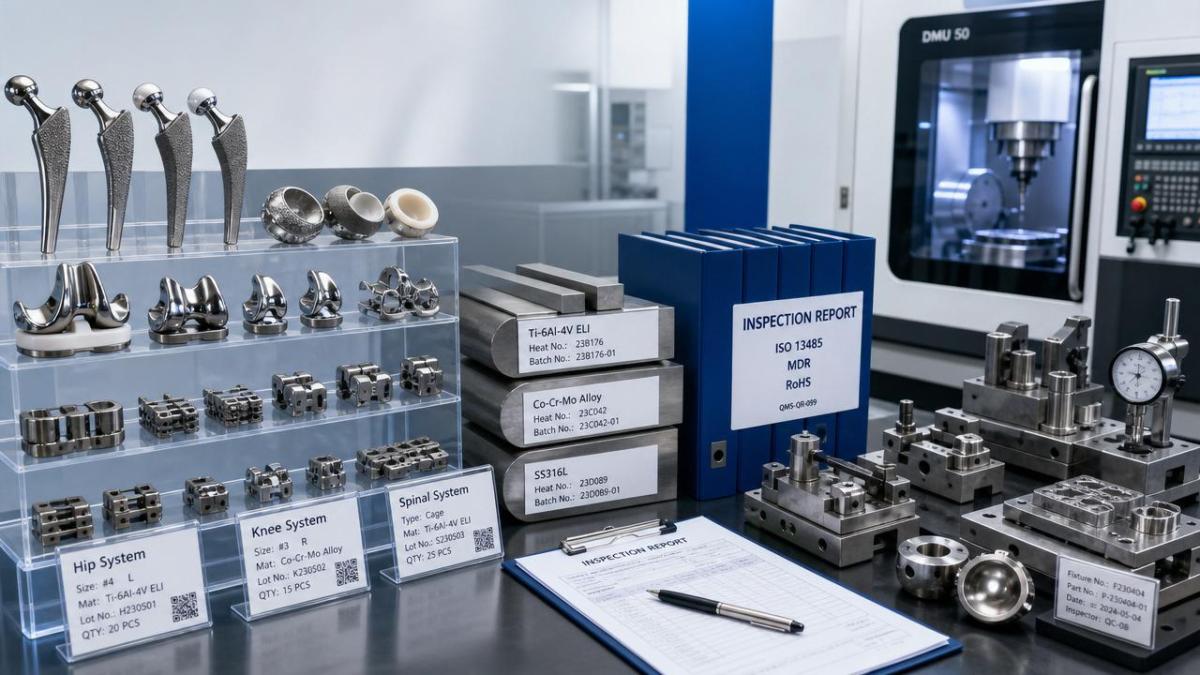
The hidden filter: what buyers are really testing when they ask about traceability
When procurement teams ask traceability questions, they are usually testing several deeper issues at once. They want to know whether a supplier controls process variation, whether records are generated in real time or rebuilt after the fact, whether subcontracted steps are visible, and whether a nonconformance can be investigated without delay. In other words, traceability is often a proxy for operational maturity.
A supplier in medical implant machining wholesale may present advanced 5-axis equipment and broad material coverage, but if lot history is fragmented across paper logs, spreadsheets, and individual operator habits, the practical risk remains high. Conversely, a supplier with slightly less marketing polish but stronger process discipline may be the safer long-term choice. This is one reason experienced buyers increasingly include record review during supplier selection, even before first production orders scale up.
The strongest traceability systems usually show consistency in five linked areas: material identity, machine and program history, inspection data, personnel accountability, and change control. Missing one of these links can weaken the entire chain. For implant sourcing, that weakness becomes visible exactly when pressure is highest: an audit, a complaint, a deviation, or a field investigation.
How the change affects procurement, engineering, quality, and supplier management
The rise of traceability in medical implant machining wholesale does not affect procurement alone. It changes how multiple functions cooperate. Buyers now need deeper technical conversations earlier in the sourcing cycle. Engineering teams must define which process attributes require documentation, not just which dimensions require inspection. Quality teams need supplier records that support internal controls and external audit defense. Supplier managers must monitor whether traceability performance stays stable after approval, not only during onboarding.
This cross-functional effect matters because many sourcing delays come from internal disagreement. Procurement may prefer a lower-cost option, while quality questions documentation depth and engineering questions repeatability. Strong traceability reduces that conflict by giving all functions a shared factual basis for evaluation.
Why digitalization is raising the bar in medical implant machining wholesale
Another trend worth watching is the quiet digital upgrade of supplier expectations. Buyers increasingly assume that critical records can be retrieved quickly, linked accurately, and reviewed without manual searching across disconnected systems. This does not mean every supplier needs the same software stack. It does mean that digital discipline is becoming a competitive signal.
In medical implant machining wholesale, digital traceability can improve control over revision history, machine setup records, inspection output, tool life tracking, and material lot correlation. More importantly, it reduces dependence on memory and informal communication. A supplier that can answer record requests in hours instead of days is often demonstrating more than administrative efficiency; it is showing that process knowledge is structured and retained.
For buyers, this means future-ready sourcing should evaluate the usability of traceability data, not only its existence. Records that technically exist but cannot be searched, correlated, or explained under pressure offer limited protection. As a result, medical implant machining wholesale is likely to reward suppliers that combine machining precision with accessible, disciplined data architecture.
What buyers should examine before approving a supplier
As traceability becomes a stronger market filter, procurement teams need more targeted evaluation criteria. A useful starting point is to test not whether a supplier says it has traceability, but how that traceability behaves in real scenarios. Ask for a sample document chain from raw material receipt to shipment release. Review how process changes are logged. Verify whether rework, deviations, and subcontract operations remain visible in the same history. Check how quickly a supplier can isolate affected batches from a hypothetical issue.
In medical implant machining wholesale, buyers should also distinguish between certificate collection and true traceability. A folder full of documents may look complete, but if material lot numbers do not connect clearly to machine runs, inspection files, and final packaged quantities, the control chain is weak. The real question is whether each finished part or batch can be traced backward and forward without ambiguity.
- Can the supplier map material lots to each manufacturing batch?
- Are setup changes, tool replacements, and program revisions recorded and linked?
- Does inspection data connect directly to the lot and process stage?
- Are outside processes fully visible within the same traceability chain?
- How fast can the supplier produce evidence during an audit or complaint?
These checks help buyers compare suppliers on practical risk control instead of surface presentation. They are especially useful in dual sourcing, new product introduction, and supplier transfer decisions.
The next phase: traceability will shape supplier rankings more than many expect
Looking ahead, the competitive landscape in medical implant machining wholesale is likely to split more clearly. One group of suppliers will continue competing mainly on price, machine availability, and generic quality claims. Another group will position itself around measurable control, transparent records, and lower lifecycle risk. For serious implant programs, the second group will gain an advantage, even when unit pricing is not the lowest.
This does not mean buyers should ignore cost pressure. It means cost should be interpreted in context. A lower piece price can become expensive if poor traceability expands the scope of investigation, delays product release, or complicates supplier accountability. In contrast, stronger traceability can shorten qualification cycles, support faster issue containment, and improve confidence in long-term supply planning.
The broader direction is clear: in medical implant machining wholesale, procurement maturity is shifting from “Who can machine this part?” to “Who can prove control of this part over time?” That is a more strategic question, and it better matches the risk profile of implant manufacturing.
Practical judgment signals for procurement teams
If your team is evaluating suppliers now, focus on a few signals that indicate whether the traceability foundation is strong enough for future demand. First, watch how specific the supplier is when discussing records. Precision usually reflects system discipline. Second, examine whether documentation flow is routine or reactive. Third, assess how well traceability survives complexity, such as multi-step machining, finishing, cleaning, inspection, and outsourced operations. Finally, look for consistency between technical claims and documentary evidence.
For organizations influenced by data-driven engineering thinking, this approach aligns with a broader truth: reliable supply chains are built on parameters, records, and verification, not promotional language. In that sense, traceability is not administrative overhead. It is a practical bridge between machining capability and procurement trust.
Final takeaway for implant sourcing decisions
The current direction of medical implant machining wholesale is not defined only by tighter tolerances or faster production. It is defined by the demand for evidence-backed manufacturing. Traceability has become the hidden filter because it reveals whether a supplier can support compliance, manage risk, and sustain quality under scrutiny. For procurement teams, that makes it one of the most valuable early indicators in supplier selection.
If your business wants to judge how this trend affects current sourcing, start by confirming a few questions: Can your suppliers trace every batch clearly across all steps? Can they retrieve audit-ready records quickly? Can they isolate a problem without widening business disruption? And can they prove process control with the same confidence they use to quote capacity? In medical implant machining wholesale, those answers increasingly determine which suppliers remain acceptable and which suppliers become strategic.
Search News
Hot Articles
- Carbon Fiber StructuresHow to Specify Aerospace Carbon Fiber Assemblies for Lightweight, Load-Bearing PartsJul 11, 2026
- Machine VisionXiaomi, Alibaba DAMO Academy Drive Open-Source Robotics Model Ecosystem, Lowering Algorithm Development Barriers for Overseas SMEs Adopting Chinese Robotics SolutionsMar 30, 2026
- Cobots & ArmsShanxi 'AI+' Conference Showcases Embodied Intelligence with Multinational Buyer Engagement: Key Industry ImplicationsMar 30, 2026
Popular Tags
Recommended News
 Jul 11, 2026How to Specify Aerospace Carbon Fiber Assemblies for Lightweight, Load-Bearing PartsAerospace carbon fiber assemblies: learn how to specify laminate design, load data, joining methods, and inspection controls for lighter, reliable load-bearing aerospace parts.Elena Rostova (UAV Systems Researcher)
 Mar 30, 2026Xiaomi, Alibaba DAMO Academy Drive Open-Source Robotics Model Ecosystem, Lowering Algorithm Development Barriers for Overseas SMEs Adopting Chinese Robotics SolutionsXiaomi & Alibaba DAMO Academy's open-source robotics models lower algorithm barriers for global SMEs. Boost efficiency in manufacturing, logistics & smart retail with ROS 2 compatible solutions.TSV Data Lab
 Mar 30, 2026Shanxi 'AI+' Conference Showcases Embodied Intelligence with Multinational Buyer Engagement: Key Industry ImplicationsShanxi 'AI+' Conference highlights embodied intelligence with Tesla, Ubtech & Jiantao showcasing multimodal robotics. 40+ global buyers validated tech on-site, creating new B2B channels for industrial automation & AI solutions.Chen Wei (Automation Lead Engineer)
 Mar 30, 2026Zhongguancun Unveils 6G Integrated Sensing-Computing-Intelligence Platform to Empower Embodied Robots for Global Industrial ApplicationsZhongguancun's new 6G platform revolutionizes industrial robotics with <10ms latency, empowering global automotive, logistics & port automation. Discover how this tech boosts China's smart manufacturing exports.TSV Data Lab
 Mar 30, 2026Mech-Mind Tianjin Embodied Intelligence R&D and Production Base Goes Live, Cutting Delivery Time by 20%–30% for Global Customized AMR+Vision SolutionsMech-Mind's Tianjin AMR+Vision production base cuts delivery time by 20%-30% for欧美 & Latin American markets. Discover how this PLd-certified facility accelerates customized robotics solutions for smart manufacturing and logistics.Chen Wei (Automation Lead Engineer)
 Mar 30, 2026Boao Forum Reveals 'Co-evolution of Big and Small Brains' Trend in Humanoid Robots, China's Embodied Intelligence Accelerates Adaptation to Overseas Manufacturing Service ScenariosDiscover how China's humanoid robots, featuring 'Co-evolution of Big and Small Brains,' are revolutionizing global manufacturing. Learn about Embodied Tian Gong 3.0's ISO compliance and overseas deployment at Boao Forum 2026.Chen Wei (Automation Lead Engineer)
 Mar 30, 2026China Railway Industrial Secures Patent for Embodied Robotics in Material Handling, Boosting High-Precision Delivery Capabilities for Overseas Infrastructure and Manufacturing ProjectsChina Railway Industrial's new patent for embodied robotics in material handling boosts high-precision delivery for global infrastructure & manufacturing. Discover how this innovation enhances logistics accuracy in automotive, rail transit & EPC projects.Chen Wei (Automation Lead Engineer)
 Sep 28, 2026Spindle Runout Measurement in Germany: DIN Standards, Methods, and Acceptance LimitsSpindle runout measurement Germany: explore DIN standards, proven methods, acceptance limits, and audit-ready practices for reliable machining quality.Dr. Marcus Vance
 Sep 27, 2026How to Select Wall-Mount Edge Devices for Space-Constrained Factory NetworksWall mount edge devices for space-constrained factories: evaluate workload, thermal design, power resilience, cable access, and network reliability for smarter deployments.TSV Data Lab
 Sep 26, 2026Machining Tolerance Analysis: How to Set Limits That Meet Function and Cost TargetsMachining tolerance analysis: learn how to set functional limits, control tolerance stacks, reduce inspection risk, and balance precision with production cost.Dr. Marcus Vance
 Sep 25, 2026How to Evaluate an Industrial Infrastructure Data Platform for Multi-Site OperationsIndustrial infrastructure data platform evaluation guide for multi-site operations: compare data quality, edge resilience, interoperability, governance, and scalable proof-of-value criteria.Victor Lin (Chief Software Architect)
 Sep 24, 2026How to Select Machine Vision Optics for Accurate Inspection at Different Working DistancesMachine vision optics selection guide for accurate inspection at every working distance. Compare FOV, pixel scale, DOF, distortion, lighting, and telecentric options.TSV Data Lab
 Sep 23, 2026How to Evaluate a Machine Vision System Integrator for High-Speed Inspection LinesChoose a machine vision system integrator with proven expertise in high-speed inspection, reliable reject timing, robust optics, and measurable acceptance criteria.TSV Data Lab
 Sep 28, 2026When is a SCADA API the right choice for connecting plant systems?SCADA API guide: learn when governed plant data integration improves traceability, security, and scalability—without compromising real-time control.Victor Lin (Chief Software Architect)
 Sep 27, 2026How SCADA data integration improves traceability across production linesSCADA data integration connects production-line data to improve traceability, accelerate quality investigations, and strengthen safety decisions.Victor Lin (Chief Software Architect)
 Sep 26, 2026What to define before starting SCADA integration planningSCADA integration planning starts with clear scope, control boundaries, data models, cybersecurity, and testing. Discover the definitions that reduce risk and costly rework.Victor Lin (Chief Software Architect)
 Sep 25, 2026How a smart factory with Industrial IoT reduces production blind spotsDiscover how a smart factory with Industrial IoT turns real-time machine, quality, and workflow data into actionable insights that reduce production blind spots and delivery risks.Victor Lin (Chief Software Architect)
 Sep 24, 2026When does Industrial IoT make smart manufacturing easier to scale?Smart manufacturing Industrial IoT scales when trusted data, interoperable systems, and secure workflows turn connected assets into measurable gains.TSV Data Lab
 Sep 23, 2026What drives ultra-precision machining cost at 1-micron tolerance?Ultra precision machining cost per part at 1 micron tolerance depends on process, material, metrology, and yield. Learn how to compare quotes confidently.Dr. Marcus Vance
 Sep 22, 2026Drone Engine-T550CC Applications: Build the UAV Power System Around the MissionAn application guide for Drone Engine-T550CC integration, covering payload planning, airframe matching, cooling, fuel, vibration, test procedures, documentation, and service preparation.Elena Rostova (UAV Systems Researcher)
 Sep 22, 2026How to Evaluate Industrial Edge Computing Vendors for Factory DeploymentIndustrial edge computing vendor evaluation guide for factories: compare latency, protocol fit, reliability, security, and lifecycle support before deployment.TSV Data Lab
 Sep 21, 2026Drone Payload Integration: Matching Power, Data, and Center of Gravity for Reliable FlightsDrone payload integration made practical: balance power, data, center of gravity, and endurance to build safer, more reliable mission-ready flights.Elena Rostova (UAV Systems Researcher)
 Sep 20, 2026Autonomous Navigation Pricing: Cost Drivers and Budget Benchmarks for AMR ProjectsAutonomous navigation price explained: compare AMR cost drivers, software, sensors, integration, safety, and lifecycle budgets to build a scalable project plan.Chen Wei (Automation Lead Engineer)
 Sep 19, 2026How to Scope Automation Integration Services for Multi-System Factory ProjectsAutomation integration services: learn how to scope multi-system factory projects with clear workflows, interface contracts, safety boundaries, and acceptance criteria.Victor Lin (Chief Software Architect)























