
What to check in 5-axis fatigue test reports before approval
Publication Date
author
Before signing off on expensive aerospace, medical, or industrial parts, finance approvers should treat a 5-axis CNC machining fatigue test report as a risk document, not a technical attachment. A “pass” result alone is not enough. The report must show that the tested sample matches the quoted part, the loading conditions reflect real use, the failure criteria are defined, and the data quality is strong enough to support commercial approval.
For non-technical approvers, the practical question is simple: does this report reduce financial risk, or does it only create the appearance of technical validation? The answer depends on a small set of checkpoints. If those checkpoints are weak, the cost exposure can be significant: field failures, warranty claims, supplier disputes, production delays, emergency redesigns, and write-offs on nonconforming inventory.
This article explains what to check in 5-axis fatigue test reports before approval, with a focus on what matters most to finance reviewers: traceability, realism of the test setup, statistical credibility, hidden exclusions, and whether the durability claim actually supports the purchase decision. The goal is not to turn finance teams into fatigue analysts. It is to help them ask the right questions before money is committed.
What finance approvers should verify first in 5-axis CNC machining fatigue test reports
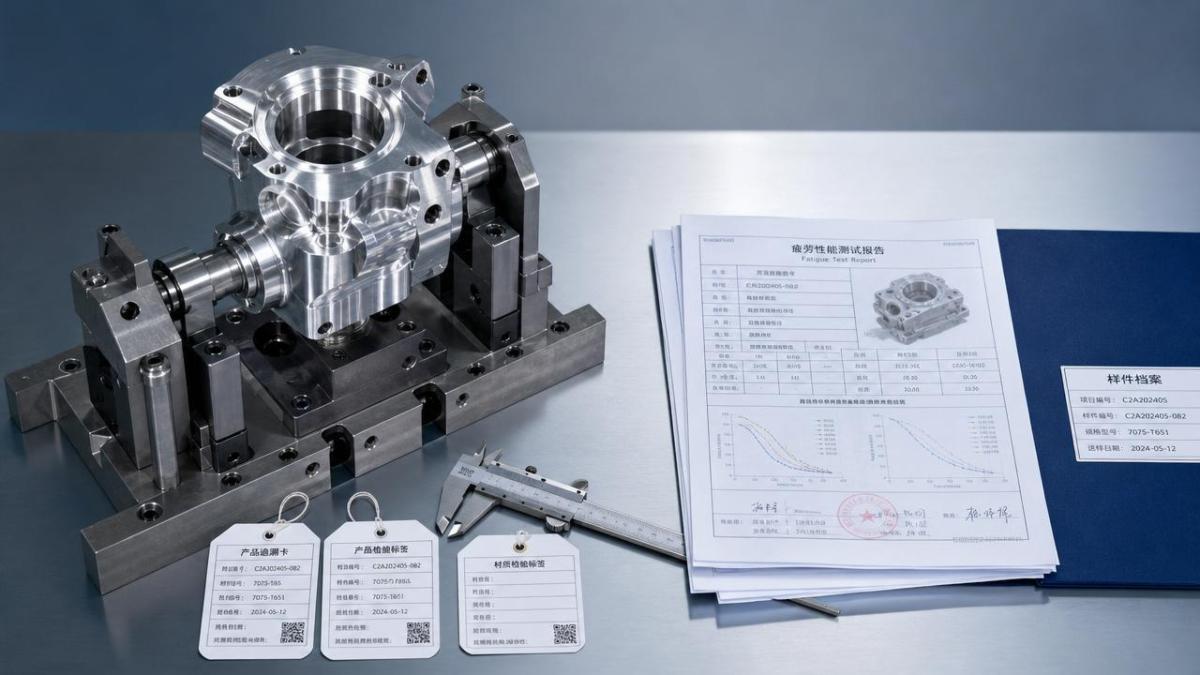
The first review step is not the S-N curve, cycle count, or laboratory logo. It is identity matching. You need to confirm that the fatigue test report refers to the same part, process route, material condition, and revision level that appear in the quote, drawing package, and purchase order. If the tested specimen differs in geometry, tolerances, heat treatment, surface finish, or post-machining process, the report may have little approval value.
This is especially important in 5-axis CNC machining because fatigue performance is highly sensitive to process details. Toolpath strategy, cutter engagement, residual stress, burr removal, edge condition, and blended surfaces can all affect crack initiation. A report tied to an earlier revision or a simplified coupon may not represent the production part you are paying for.
For a finance approver, this means looking for clear traceability fields: part number, drawing revision, material batch, machining process description, surface treatment, and test specimen ID. If these are missing or vague, the report should not be treated as full evidence for commercial approval. A report that cannot be tied to a billable deliverable creates an audit gap as well as an engineering risk.
A useful first-screen question is: “Can we prove this exact report supports this exact invoice?” If the answer is no, the approval process should pause until the supplier or testing lab closes the traceability gap in writing.
Does the tested sample actually represent the purchased component?
Many approval mistakes happen because decision-makers assume any fatigue test is better than no fatigue test. In practice, representativeness matters more than mere existence. A polished test coupon, a thicker cross-section, or a reduced-feature geometry can perform much better than the actual 5-axis machined component used in service.
Ask whether the specimen was a full part, a subscale part, or a standard coupon. Full-part testing generally provides stronger commercial confidence, especially for complex geometries where multi-axis machining influences local stress concentrations. If the report is based on coupons, the supplier should explain why coupon data is a valid proxy for the actual component.
Also check whether the tested part includes the same stress risers found in production: holes, fillets, threaded regions, pockets, scalloped surfaces, corner transitions, and blended 5-axis contours. Fatigue failures often begin at exactly these details. If the specimen excludes them, the reported durability may overstate field performance.
From a finance standpoint, this is a value-for-money issue. If the supplier’s pricing reflects a premium for durability, then the supporting report should demonstrate durability in the configuration you are buying, not in an easier-to-pass specimen. Otherwise, the report does not justify the commercial claim behind the price.
Are the testing conditions close to real operating conditions?
A technically valid test can still be commercially misleading if the load case is unrealistic. Fatigue results depend on load magnitude, load ratio, frequency, temperature, environment, fixture rigidity, and direction of applied force. Finance approvers do not need to master each variable, but they should verify that the report states them clearly and that they are reasonably aligned with actual use.
Start with the loading profile. Was the part tested under axial, bending, torsional, or multiaxial loading? If the field application involves combined stresses but the report uses a single simplified load mode, the result may understate risk. This matters a lot for parts produced through 5-axis CNC machining, because these components often serve in high-performance assemblies where load paths are not simple.
Next, check the stress level and cycle target. A report may declare success at one million cycles, but your application may require ten million or infinite-life assumptions below a certain stress threshold. A “pass” is meaningful only in relation to the actual service expectation.
Environmental conditions are another common blind spot. Corrosion, humidity, temperature extremes, lubricants, and vibration can materially reduce fatigue life. If the part will work in an aggressive environment and the report covers only room-temperature dry testing, approval should be conditional, not automatic.
Look for fixture details too. Poor fixturing can either create artificial failure points or shield the part from realistic stress. If the report does not explain how the specimen was mounted and how loading was transferred, there is reason to question whether the setup reflects real-world behavior.
Is the pass/fail criterion defined clearly enough for approval?
One of the most dangerous phrases in approval workflows is “tested successfully” without a precise definition of success. In fatigue testing, pass/fail can mean different things: no complete fracture, no visible crack above a threshold size, no stiffness degradation beyond a limit, or survival to a target cycle count at a specified load. These are not interchangeable standards.
Before approving a part or supplier invoice, confirm that the fatigue test report defines failure criteria in measurable terms. Did the part fail by crack initiation, crack propagation, permanent deformation, or final fracture? Was non-destructive inspection used during testing? Were there run-outs, and how were they treated in the analysis?
This matters commercially because ambiguous pass criteria allow suppliers to market marginal performance as acceptable performance. For example, surviving a short test without catastrophic fracture is not the same as demonstrating safe durability for long-term service. If the report does not define the threshold that separates pass from fail, you cannot reliably compare test outcomes to contract requirements.
A practical finance question is: “Would this wording hold up in a dispute over warranty or nonperformance?” If not, the approval basis is too weak.
How many samples were tested, and is the data statistically credible?
A fatigue report based on one specimen can be useful for preliminary engineering insight, but it is often weak evidence for financial approval, especially when the part is expensive, safety-relevant, or intended for repeat production. Fatigue life naturally varies between samples due to material scatter, machining marks, microstructure, and local geometry variation. That is why sample size matters.
Check how many specimens were tested at each stress level and whether the report presents a statistical method, not just isolated outcomes. If only the best-performing sample is highlighted, the commercial risk is high. More credible reports include multiple specimens, scatter bands, confidence levels, or at least a transparent explanation of variability.
For finance teams, statistical weakness translates directly into budget uncertainty. If durability claims are based on thin data, future failure rates may exceed assumptions, raising quality cost, replacement cost, and service liabilities. This is particularly relevant when approving new suppliers, first-article lots, or premium-priced parts sold on the strength of performance claims.
You do not need to reject every small-sample report. But you should classify it correctly. Limited sample data may support conditional approval, pilot procurement, or staged release. It should not be treated the same as a robust validation program with repeatable results.
Do surface finish, toolpath, and post-processing details support the fatigue claim?
For 5-axis CNC machining fatigue test reports, process-specific details are not minor technical notes. They are central to fatigue performance. Surface roughness, cutter marks, feed direction, recast layers from secondary processes, edge break quality, polishing, shot peening, anodizing, and coating preparation can all change crack initiation behavior.
Finance approvers should therefore check whether the report states the manufacturing condition of the tested sample. Was it tested “as machined,” polished, coated, anodized, bead blasted, or heat treated? Were these steps identical to the quoted production route? If the tested sample received extra finishing that is not included in the supplier’s commercial offer, the reported life may not be achievable at the approved price.
There is also a margin-risk issue. Suppliers sometimes validate a part under tightly controlled prototype conditions, then move to faster or lower-cost production settings. Even small changes in tooling wear management or surface finishing can reduce fatigue life. If the report does not describe process controls, finance teams should ask whether the tested condition is locked into the production quality plan.
In short, durability is not just a material property. It is a manufacturing outcome. If the process behind the report differs from the process behind the invoice, the approval logic breaks down.
Are there exclusions, assumptions, or report gaps that create hidden liability?
Most fatigue test reports contain limitations. The problem is not that limitations exist; the problem is when they are buried in footnotes and ignored during approval. A report may exclude corrosion effects, thermal cycling, impact loads, overload events, assembly preload, or interaction with mating parts. Each exclusion narrows the meaning of the reported result.
Read the scope statement carefully. Does the report test the standalone component only, or the assembled condition? Was the part tested after all relevant manufacturing steps, including welding, fastening, or press-fit installation if applicable? Was the analysis limited to one principal load direction? Were outlier failures removed from the dataset, and if so, why?
These details matter because finance often approves not just a part, but an expected business outcome: service life, warranty exposure, and supplier accountability. If the report’s assumptions are narrower than the application assumptions used in budgeting or customer commitments, the organization may be absorbing risk without realizing it.
A strong review habit is to ask for a one-page limitation summary before approval. If a supplier or lab cannot clearly state what the 5-axis CNC machining fatigue test reports do and do not prove, caution is justified.
Does the report come from a credible source with enough traceability for audits and disputes?
Even well-presented data loses value if source credibility is uncertain. Before approval, confirm who performed the testing, what standard or internal protocol was used, and whether calibration and document control are evident. Independent third-party testing often carries more weight than internal supplier testing, especially for high-value or high-risk parts.
That does not mean internal reports are automatically invalid. It means they should be reviewed with stronger scrutiny. Look for test dates, equipment identification, operator or reviewer sign-off, revision control, and links to raw data or appendices. A polished PDF without underlying traceability may be persuasive in sales discussions but weak in a claim investigation.
For finance teams, document credibility is also a governance issue. If a quality dispute arises, can your organization demonstrate that approval was based on controlled evidence? If not, the cost is not only technical. It may involve compliance exposure, delayed customer reimbursement, or internal control findings.
When approval authority sits outside engineering, source credibility becomes even more important. A trustworthy report reduces the need for repeated technical escalation and helps keep procurement cycles efficient without lowering standards.
How to make an approval decision without becoming a fatigue expert
The smartest approach for finance approvers is not to interpret every graph personally. It is to use a structured decision filter. First, verify identity and revision match. Second, check whether the sample and process represent the purchased part. Third, confirm that loading conditions, environment, and cycle targets align with service reality. Fourth, review sample size and statistical strength. Fifth, identify limitations, exclusions, and unresolved assumptions.
If all five areas are strong, the report likely supports approval. If one or two areas are unclear, approval can still proceed with conditions: engineering sign-off, supplier clarification, incoming inspection reinforcement, or limited-volume release. If several areas are weak, the fatigue report should not be used as the main justification for payment or supplier qualification.
This framework is especially useful when reviewing 5-axis CNC machining fatigue test reports tied to premium pricing, first-time supplier onboarding, or parts used in regulated or safety-sensitive systems. In such cases, the cost of approving weak evidence is usually far higher than the cost of asking a few more questions upfront.
Good approval practice is not about slowing business down. It is about preventing avoidable downstream costs that begin with an unchecked technical assumption and end as a financial loss.
Conclusion: approve the risk, not just the report
A fatigue test report should help you answer one commercial question: does the evidence justify the payment, supplier claim, or sourcing decision with an acceptable level of risk? For finance approvers, the most important checkpoints are traceability, representativeness, realistic test conditions, clear failure definitions, statistical credibility, process consistency, and transparent limitations.
When these elements are present, 5-axis CNC machining fatigue test reports become useful decision tools rather than technical decorations. When they are missing, a pass/fail summary can create false confidence and hide future cost exposure. The right approval mindset is simple: do not approve because the report exists; approve because the report proves what the business needs it to prove.
That discipline protects budgets, shortens dispute cycles, and supports better supplier decisions across advanced manufacturing programs. In a market where durability claims often influence price, the ability to read fatigue evidence with commercial clarity is not just helpful. It is a strategic control.
Search News
Hot Articles
- Carbon Fiber StructuresHow to Specify Aerospace Carbon Fiber Assemblies for Lightweight, Load-Bearing PartsJul 11, 2026
- Machine VisionXiaomi, Alibaba DAMO Academy Drive Open-Source Robotics Model Ecosystem, Lowering Algorithm Development Barriers for Overseas SMEs Adopting Chinese Robotics SolutionsMar 30, 2026
- Cobots & ArmsShanxi 'AI+' Conference Showcases Embodied Intelligence with Multinational Buyer Engagement: Key Industry ImplicationsMar 30, 2026
Popular Tags
Recommended News
 Jul 11, 2026How to Specify Aerospace Carbon Fiber Assemblies for Lightweight, Load-Bearing PartsAerospace carbon fiber assemblies: learn how to specify laminate design, load data, joining methods, and inspection controls for lighter, reliable load-bearing aerospace parts.Elena Rostova (UAV Systems Researcher)
 Mar 30, 2026Xiaomi, Alibaba DAMO Academy Drive Open-Source Robotics Model Ecosystem, Lowering Algorithm Development Barriers for Overseas SMEs Adopting Chinese Robotics SolutionsXiaomi & Alibaba DAMO Academy's open-source robotics models lower algorithm barriers for global SMEs. Boost efficiency in manufacturing, logistics & smart retail with ROS 2 compatible solutions.TSV Data Lab
 Mar 30, 2026Shanxi 'AI+' Conference Showcases Embodied Intelligence with Multinational Buyer Engagement: Key Industry ImplicationsShanxi 'AI+' Conference highlights embodied intelligence with Tesla, Ubtech & Jiantao showcasing multimodal robotics. 40+ global buyers validated tech on-site, creating new B2B channels for industrial automation & AI solutions.Chen Wei (Automation Lead Engineer)
 Mar 30, 2026Zhongguancun Unveils 6G Integrated Sensing-Computing-Intelligence Platform to Empower Embodied Robots for Global Industrial ApplicationsZhongguancun's new 6G platform revolutionizes industrial robotics with <10ms latency, empowering global automotive, logistics & port automation. Discover how this tech boosts China's smart manufacturing exports.TSV Data Lab
 Mar 30, 2026Mech-Mind Tianjin Embodied Intelligence R&D and Production Base Goes Live, Cutting Delivery Time by 20%–30% for Global Customized AMR+Vision SolutionsMech-Mind's Tianjin AMR+Vision production base cuts delivery time by 20%-30% for欧美 & Latin American markets. Discover how this PLd-certified facility accelerates customized robotics solutions for smart manufacturing and logistics.Chen Wei (Automation Lead Engineer)
 Mar 30, 2026Boao Forum Reveals 'Co-evolution of Big and Small Brains' Trend in Humanoid Robots, China's Embodied Intelligence Accelerates Adaptation to Overseas Manufacturing Service ScenariosDiscover how China's humanoid robots, featuring 'Co-evolution of Big and Small Brains,' are revolutionizing global manufacturing. Learn about Embodied Tian Gong 3.0's ISO compliance and overseas deployment at Boao Forum 2026.Chen Wei (Automation Lead Engineer)
 Mar 30, 2026China Railway Industrial Secures Patent for Embodied Robotics in Material Handling, Boosting High-Precision Delivery Capabilities for Overseas Infrastructure and Manufacturing ProjectsChina Railway Industrial's new patent for embodied robotics in material handling boosts high-precision delivery for global infrastructure & manufacturing. Discover how this innovation enhances logistics accuracy in automotive, rail transit & EPC projects.Chen Wei (Automation Lead Engineer)
 Sep 28, 2026Spindle Runout Measurement in Germany: DIN Standards, Methods, and Acceptance LimitsSpindle runout measurement Germany: explore DIN standards, proven methods, acceptance limits, and audit-ready practices for reliable machining quality.Dr. Marcus Vance
 Sep 27, 2026How to Select Wall-Mount Edge Devices for Space-Constrained Factory NetworksWall mount edge devices for space-constrained factories: evaluate workload, thermal design, power resilience, cable access, and network reliability for smarter deployments.TSV Data Lab
 Sep 26, 2026Machining Tolerance Analysis: How to Set Limits That Meet Function and Cost TargetsMachining tolerance analysis: learn how to set functional limits, control tolerance stacks, reduce inspection risk, and balance precision with production cost.Dr. Marcus Vance
 Sep 25, 2026How to Evaluate an Industrial Infrastructure Data Platform for Multi-Site OperationsIndustrial infrastructure data platform evaluation guide for multi-site operations: compare data quality, edge resilience, interoperability, governance, and scalable proof-of-value criteria.Victor Lin (Chief Software Architect)
 Sep 24, 2026How to Select Machine Vision Optics for Accurate Inspection at Different Working DistancesMachine vision optics selection guide for accurate inspection at every working distance. Compare FOV, pixel scale, DOF, distortion, lighting, and telecentric options.TSV Data Lab
 Sep 23, 2026How to Evaluate a Machine Vision System Integrator for High-Speed Inspection LinesChoose a machine vision system integrator with proven expertise in high-speed inspection, reliable reject timing, robust optics, and measurable acceptance criteria.TSV Data Lab
 Sep 28, 2026When is a SCADA API the right choice for connecting plant systems?SCADA API guide: learn when governed plant data integration improves traceability, security, and scalability—without compromising real-time control.Victor Lin (Chief Software Architect)
 Sep 27, 2026How SCADA data integration improves traceability across production linesSCADA data integration connects production-line data to improve traceability, accelerate quality investigations, and strengthen safety decisions.Victor Lin (Chief Software Architect)
 Sep 26, 2026What to define before starting SCADA integration planningSCADA integration planning starts with clear scope, control boundaries, data models, cybersecurity, and testing. Discover the definitions that reduce risk and costly rework.Victor Lin (Chief Software Architect)
 Sep 25, 2026How a smart factory with Industrial IoT reduces production blind spotsDiscover how a smart factory with Industrial IoT turns real-time machine, quality, and workflow data into actionable insights that reduce production blind spots and delivery risks.Victor Lin (Chief Software Architect)
 Sep 24, 2026When does Industrial IoT make smart manufacturing easier to scale?Smart manufacturing Industrial IoT scales when trusted data, interoperable systems, and secure workflows turn connected assets into measurable gains.TSV Data Lab
 Sep 23, 2026What drives ultra-precision machining cost at 1-micron tolerance?Ultra precision machining cost per part at 1 micron tolerance depends on process, material, metrology, and yield. Learn how to compare quotes confidently.Dr. Marcus Vance
 Sep 22, 2026Drone Engine-T550CC Applications: Build the UAV Power System Around the MissionAn application guide for Drone Engine-T550CC integration, covering payload planning, airframe matching, cooling, fuel, vibration, test procedures, documentation, and service preparation.Elena Rostova (UAV Systems Researcher)
 Sep 22, 2026How to Evaluate Industrial Edge Computing Vendors for Factory DeploymentIndustrial edge computing vendor evaluation guide for factories: compare latency, protocol fit, reliability, security, and lifecycle support before deployment.TSV Data Lab
 Sep 21, 2026Drone Payload Integration: Matching Power, Data, and Center of Gravity for Reliable FlightsDrone payload integration made practical: balance power, data, center of gravity, and endurance to build safer, more reliable mission-ready flights.Elena Rostova (UAV Systems Researcher)
 Sep 20, 2026Autonomous Navigation Pricing: Cost Drivers and Budget Benchmarks for AMR ProjectsAutonomous navigation price explained: compare AMR cost drivers, software, sensors, integration, safety, and lifecycle budgets to build a scalable project plan.Chen Wei (Automation Lead Engineer)
 Sep 19, 2026How to Scope Automation Integration Services for Multi-System Factory ProjectsAutomation integration services: learn how to scope multi-system factory projects with clear workflows, interface contracts, safety boundaries, and acceptance criteria.Victor Lin (Chief Software Architect)























