Aerospace machining precision tolerance standards that change quoting
Publication Date
author
For business evaluators comparing aerospace suppliers, aerospace machining precision tolerance standards are not just engineering details—they directly reshape quoting, risk exposure, and supplier selection. This article explains how tolerance bands, material behavior, certification requirements, and inspection depth influence cost structures, lead times, and confidence in procurement decisions, helping you assess machining quotes with greater technical clarity and commercial accuracy.
Why do aerospace machining precision tolerance standards change quoting so much?
In most industrial sourcing categories, price moves with material cost, machining time, and volume. In aerospace, that is only the surface. Aerospace machining precision tolerance standards often determine whether a part can be produced on a stable process window or requires repeated offsets, slower cutting strategies, thermal control, specialized tooling, enhanced inspection, and tighter documentation. Those factors can change a quote dramatically even when the geometry appears nearly identical.
For a business evaluator, the commercial meaning is simple: tighter tolerances do not increase cost in a straight line. A shift from a practical tolerance to a highly restrictive one may trigger a different manufacturing route altogether. A shop may move from standard 3-axis machining to 5-axis finishing, from in-process sampling to 100% inspection, or from conventional fixtures to custom workholding. That is why two suppliers can quote the same drawing very differently while both remain technically credible.
This is especially important in a data-driven procurement environment such as aerospace structures, UAV subsystems, sensor housings, brackets, manifolds, and flight-critical interfaces. When evaluators understand aerospace machining precision tolerance standards, they can separate justified cost from defensive pricing and identify which quote reflects real process capability.
What exactly should a business evaluator look for on a drawing or RFQ?
The first step is to stop treating tolerance as a single number. In aerospace machining precision tolerance standards, quoting risk comes from the combined stack of dimensional tolerance, geometric tolerancing, surface finish, material condition, and inspection traceability. A generous profile tolerance on a non-critical outer face may be easy. A tight true position requirement tied to multiple datum surfaces in a thin-wall titanium component is not.
Business evaluators should review at least five RFQ elements:
- General tolerance notes versus explicitly critical dimensions
- GD&T controls such as flatness, perpendicularity, concentricity, and true position
- Material type, heat treatment state, and machinability behavior
- Surface finish, burr limits, edge-break requirements, and cosmetic criteria
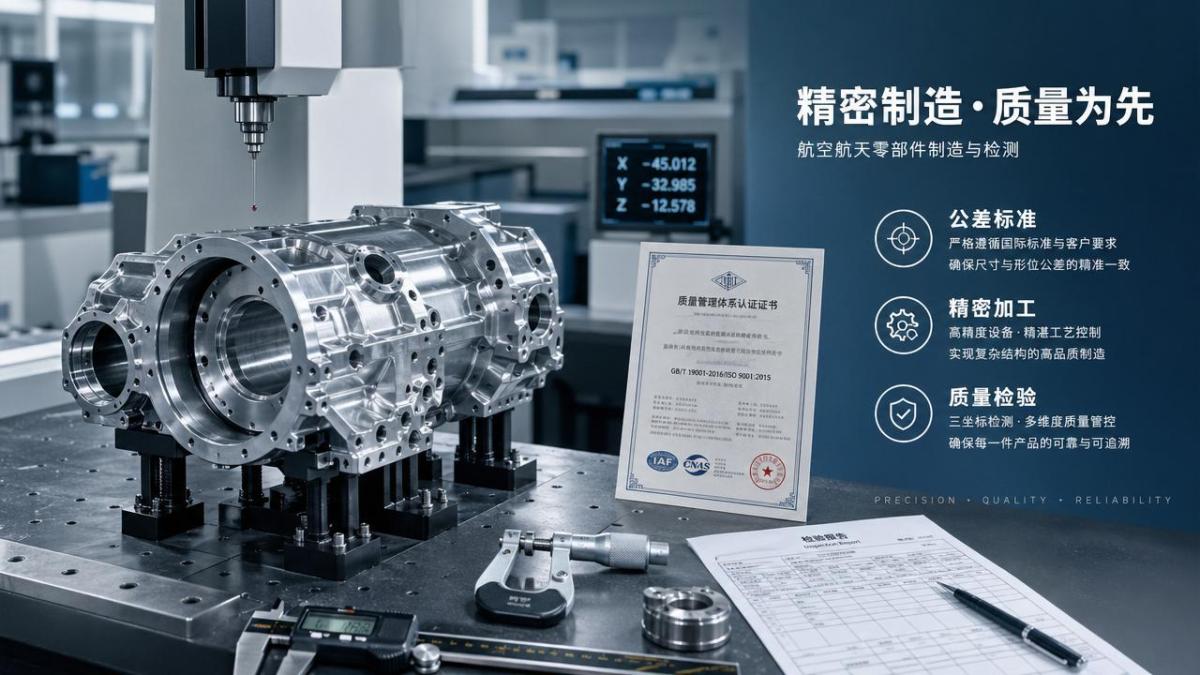
- Inspection deliverables such as FAI, CMM reports, SPC evidence, and material certs
These details define how suppliers interpret aerospace machining precision tolerance standards in practice. A quote based only on model geometry without full tolerance context is incomplete. In many cases, the hidden cost is not machining volume but proof of compliance.
Which tolerance-related factors most strongly affect cost and lead time?
Several factors consistently move both price and delivery. Understanding them helps evaluators compare quotes on a like-for-like basis.
1. Tighter dimensional bands
As tolerances narrow, machine stability, tool wear control, temperature management, and operator intervention become more critical. Shops may reduce feed rates, add spring passes, or schedule machining in controlled conditions. The result is more machine hours and less scheduling flexibility.
2. Complex GD&T requirements
A dimension may look simple, but if it references multiple datums with positional or profile constraints, inspection complexity increases sharply. Aerospace machining precision tolerance standards often require the supplier to validate not only size but spatial relationship. That typically means more advanced CMM programming and more setup discipline.
3. Material behavior
Aluminum, stainless steel, Inconel, and titanium do not respond the same way under machining load. Titanium and nickel alloys often create greater heat, tool wear, and deflection challenges. Thin-wall parts in these materials may distort after roughing or after stress relief. Suppliers quote this risk differently depending on their experience and process controls.
4. Inspection depth and documentation
In aerospace procurement, traceability matters. Full first article inspection, serialized lot control, calibrated inspection records, and certificate packages add labor that is easy to overlook. A low quote may exclude some of these deliverables unless the RFQ defines them clearly.
5. Process yield and scrap exposure
When tolerances approach the supplier’s capability limit, scrap risk rises. Some shops price aggressively and absorb the risk. Others build in a risk premium. Neither approach is automatically wrong, but business evaluators should understand which model is being used.
How do certifications and compliance standards influence the quote?
Aerospace machining precision tolerance standards rarely stand alone. They are usually supported by quality system requirements such as AS9100, customer-specific flow-down clauses, and inspection documentation practices. Certification does not guarantee perfect machining, but it affects how a supplier controls nonconformance, revision management, traceability, and verification.
For business evaluators, the key question is not just “Is the supplier certified?” but “Does the certification align with the risk level of the part?” A structural bracket for a prototype drone may not need the same compliance burden as a flight-critical aerospace actuator component. However, when the drawing demands strict aerospace machining precision tolerance standards, the absence of mature process control can create hidden downstream cost through delays, rework, or qualification failure.
This is where TSV’s data-first approach is useful: the most credible suppliers do not sell with adjectives. They show process capability, documented inspection methods, material traceability, and historical consistency against critical tolerances.
How can you compare quotes when one supplier is cheaper but claims the same tolerance capability?
A lower quote is not automatically a warning sign, but it should trigger better questions. The right comparison method is to test whether both suppliers are pricing the same technical obligation. In aerospace machining precision tolerance standards, commercial gaps often come from different assumptions rather than different hourly rates.
Use the following comparison framework before making a sourcing decision:
If one quote excludes these items, it is not a true apples-to-apples comparison. Business evaluators should request a quote assumption sheet or compliance matrix. That often reveals why pricing differs.
What are the most common mistakes buyers make with aerospace machining precision tolerance standards?
The first mistake is assuming every tight tolerance is necessary. Many drawings carry legacy tolerances copied from earlier programs. If a tolerance does not support fit, load path, sealing, alignment, or safety, relaxing it may lower cost and improve supplier options without harming function.
The second mistake is ignoring datum strategy. Features can be individually within size limits but fail assembly intent if the datum scheme is difficult to control. Suppliers that recognize this early may quote higher because they anticipate fixture and inspection complexity. That is not overpricing; it may be more technically honest.
The third mistake is undervaluing inspection and reporting. In aerospace machining precision tolerance standards, acceptance is not based only on making the part. It is based on proving the part. Evaluators who focus only on unit price may miss expensive documentation gaps until PPAP-like or first article stages.
The fourth mistake is treating prototype and production quoting the same way. A supplier may meet tolerance on ten parts through heavy manual attention, but that does not mean the process scales economically to hundreds of units. Ask whether the quoted method is development-oriented or production-capable.
When should you challenge a tolerance, and when should you accept the higher quote?
Challenge the tolerance when the supplier explains that cost is driven by a feature with unclear functional value. This often happens on non-mating cosmetic surfaces, excessive flatness callouts on flexible parts, or unnecessarily broad 100% inspection requirements. A design-for-manufacturability review can reveal where aerospace machining precision tolerance standards are being applied more strictly than needed.
Accept the higher quote when the feature is clearly tied to assembly precision, fatigue life, pressure integrity, aerodynamic fit, sensor alignment, or safety-critical performance. In such cases, cost reduction attempts may simply move risk downstream into rework, integration delays, or field reliability issues.
A practical rule for business evaluators is this: challenge cost that comes from ambiguity; accept cost that comes from validated functional necessity.
What questions should you ask suppliers before finalizing a sourcing decision?
The best supplier conversations are specific. Instead of asking whether they can “hold tight tolerances,” ask how they will control the exact tolerance stack on your part. Before awarding business, confirm the following:
- Which features are considered highest risk under the aerospace machining precision tolerance standards on this drawing?
- What machine platform, fixture strategy, and inspection method will be used?
- Is the quote based on prototype handling or repeatable production process capability?
- What documentation is included, and what is priced separately?
- What assumptions were made about material condition, finish stock, and post-processing?
- What dimensions or GD&T controls would they recommend reviewing for cost optimization?
These questions help business evaluators translate technical risk into sourcing clarity. They also make it easier to identify suppliers who understand not just machining, but the commercial consequences of aerospace compliance.
Final takeaway: how should business evaluators use this information?
Aerospace machining precision tolerance standards should be treated as quoting drivers, not background notes. They affect machine time, inspection effort, documentation burden, scrap probability, and schedule confidence. The smartest procurement decisions come from understanding which tolerances are truly functional, which are legacy or excessive, and which suppliers can demonstrate stable capability rather than simply promise it.
If you need to confirm a specific sourcing path, parameter set, lead-time expectation, or quote rationale, start by aligning on critical features, material condition, inspection depth, certification scope, and repeatability evidence. Those are the questions that turn aerospace machining precision tolerance standards from a source of confusion into a reliable basis for commercial judgment.
Search News
Hot Articles
- Carbon Fiber StructuresHow to Specify Aerospace Carbon Fiber Assemblies for Lightweight, Load-Bearing PartsJul 11, 2026
- Machine VisionXiaomi, Alibaba DAMO Academy Drive Open-Source Robotics Model Ecosystem, Lowering Algorithm Development Barriers for Overseas SMEs Adopting Chinese Robotics SolutionsMar 30, 2026
- Cobots & ArmsShanxi 'AI+' Conference Showcases Embodied Intelligence with Multinational Buyer Engagement: Key Industry ImplicationsMar 30, 2026
Popular Tags
Recommended News
 Jul 11, 2026How to Specify Aerospace Carbon Fiber Assemblies for Lightweight, Load-Bearing PartsAerospace carbon fiber assemblies: learn how to specify laminate design, load data, joining methods, and inspection controls for lighter, reliable load-bearing aerospace parts.Elena Rostova (UAV Systems Researcher)
 Mar 30, 2026Xiaomi, Alibaba DAMO Academy Drive Open-Source Robotics Model Ecosystem, Lowering Algorithm Development Barriers for Overseas SMEs Adopting Chinese Robotics SolutionsXiaomi & Alibaba DAMO Academy's open-source robotics models lower algorithm barriers for global SMEs. Boost efficiency in manufacturing, logistics & smart retail with ROS 2 compatible solutions.TSV Data Lab
 Mar 30, 2026Shanxi 'AI+' Conference Showcases Embodied Intelligence with Multinational Buyer Engagement: Key Industry ImplicationsShanxi 'AI+' Conference highlights embodied intelligence with Tesla, Ubtech & Jiantao showcasing multimodal robotics. 40+ global buyers validated tech on-site, creating new B2B channels for industrial automation & AI solutions.Chen Wei (Automation Lead Engineer)
 Mar 30, 2026Zhongguancun Unveils 6G Integrated Sensing-Computing-Intelligence Platform to Empower Embodied Robots for Global Industrial ApplicationsZhongguancun's new 6G platform revolutionizes industrial robotics with <10ms latency, empowering global automotive, logistics & port automation. Discover how this tech boosts China's smart manufacturing exports.TSV Data Lab
 Mar 30, 2026Mech-Mind Tianjin Embodied Intelligence R&D and Production Base Goes Live, Cutting Delivery Time by 20%–30% for Global Customized AMR+Vision SolutionsMech-Mind's Tianjin AMR+Vision production base cuts delivery time by 20%-30% for欧美 & Latin American markets. Discover how this PLd-certified facility accelerates customized robotics solutions for smart manufacturing and logistics.Chen Wei (Automation Lead Engineer)
 Mar 30, 2026Boao Forum Reveals 'Co-evolution of Big and Small Brains' Trend in Humanoid Robots, China's Embodied Intelligence Accelerates Adaptation to Overseas Manufacturing Service ScenariosDiscover how China's humanoid robots, featuring 'Co-evolution of Big and Small Brains,' are revolutionizing global manufacturing. Learn about Embodied Tian Gong 3.0's ISO compliance and overseas deployment at Boao Forum 2026.Chen Wei (Automation Lead Engineer)
 Mar 30, 2026China Railway Industrial Secures Patent for Embodied Robotics in Material Handling, Boosting High-Precision Delivery Capabilities for Overseas Infrastructure and Manufacturing ProjectsChina Railway Industrial's new patent for embodied robotics in material handling boosts high-precision delivery for global infrastructure & manufacturing. Discover how this innovation enhances logistics accuracy in automotive, rail transit & EPC projects.Chen Wei (Automation Lead Engineer)
 Sep 28, 2026Spindle Runout Measurement in Germany: DIN Standards, Methods, and Acceptance LimitsSpindle runout measurement Germany: explore DIN standards, proven methods, acceptance limits, and audit-ready practices for reliable machining quality.Dr. Marcus Vance
 Sep 27, 2026How to Select Wall-Mount Edge Devices for Space-Constrained Factory NetworksWall mount edge devices for space-constrained factories: evaluate workload, thermal design, power resilience, cable access, and network reliability for smarter deployments.TSV Data Lab
 Sep 26, 2026Machining Tolerance Analysis: How to Set Limits That Meet Function and Cost TargetsMachining tolerance analysis: learn how to set functional limits, control tolerance stacks, reduce inspection risk, and balance precision with production cost.Dr. Marcus Vance
 Sep 25, 2026How to Evaluate an Industrial Infrastructure Data Platform for Multi-Site OperationsIndustrial infrastructure data platform evaluation guide for multi-site operations: compare data quality, edge resilience, interoperability, governance, and scalable proof-of-value criteria.Victor Lin (Chief Software Architect)
 Sep 24, 2026How to Select Machine Vision Optics for Accurate Inspection at Different Working DistancesMachine vision optics selection guide for accurate inspection at every working distance. Compare FOV, pixel scale, DOF, distortion, lighting, and telecentric options.TSV Data Lab
 Sep 23, 2026How to Evaluate a Machine Vision System Integrator for High-Speed Inspection LinesChoose a machine vision system integrator with proven expertise in high-speed inspection, reliable reject timing, robust optics, and measurable acceptance criteria.TSV Data Lab
 Sep 28, 2026When is a SCADA API the right choice for connecting plant systems?SCADA API guide: learn when governed plant data integration improves traceability, security, and scalability—without compromising real-time control.Victor Lin (Chief Software Architect)
 Sep 27, 2026How SCADA data integration improves traceability across production linesSCADA data integration connects production-line data to improve traceability, accelerate quality investigations, and strengthen safety decisions.Victor Lin (Chief Software Architect)
 Sep 26, 2026What to define before starting SCADA integration planningSCADA integration planning starts with clear scope, control boundaries, data models, cybersecurity, and testing. Discover the definitions that reduce risk and costly rework.Victor Lin (Chief Software Architect)
 Sep 25, 2026How a smart factory with Industrial IoT reduces production blind spotsDiscover how a smart factory with Industrial IoT turns real-time machine, quality, and workflow data into actionable insights that reduce production blind spots and delivery risks.Victor Lin (Chief Software Architect)
 Sep 24, 2026When does Industrial IoT make smart manufacturing easier to scale?Smart manufacturing Industrial IoT scales when trusted data, interoperable systems, and secure workflows turn connected assets into measurable gains.TSV Data Lab
 Sep 23, 2026What drives ultra-precision machining cost at 1-micron tolerance?Ultra precision machining cost per part at 1 micron tolerance depends on process, material, metrology, and yield. Learn how to compare quotes confidently.Dr. Marcus Vance
 Sep 22, 2026Drone Engine-T550CC Applications: Build the UAV Power System Around the MissionAn application guide for Drone Engine-T550CC integration, covering payload planning, airframe matching, cooling, fuel, vibration, test procedures, documentation, and service preparation.Elena Rostova (UAV Systems Researcher)
 Sep 22, 2026How to Evaluate Industrial Edge Computing Vendors for Factory DeploymentIndustrial edge computing vendor evaluation guide for factories: compare latency, protocol fit, reliability, security, and lifecycle support before deployment.TSV Data Lab
 Sep 21, 2026Drone Payload Integration: Matching Power, Data, and Center of Gravity for Reliable FlightsDrone payload integration made practical: balance power, data, center of gravity, and endurance to build safer, more reliable mission-ready flights.Elena Rostova (UAV Systems Researcher)
 Sep 20, 2026Autonomous Navigation Pricing: Cost Drivers and Budget Benchmarks for AMR ProjectsAutonomous navigation price explained: compare AMR cost drivers, software, sensors, integration, safety, and lifecycle budgets to build a scalable project plan.Chen Wei (Automation Lead Engineer)
 Sep 19, 2026How to Scope Automation Integration Services for Multi-System Factory ProjectsAutomation integration services: learn how to scope multi-system factory projects with clear workflows, interface contracts, safety boundaries, and acceptance criteria.Victor Lin (Chief Software Architect)