Aerospace Precision Tolerance Standards That Drive Machining Cost
Publication Date
author
For finance approvers, aerospace machining precision tolerance standards are not just technical details—they are direct cost drivers that shape scrap rates, inspection time, supplier risk, and program profitability. This article explains how tighter tolerances influence machining economics, where specification discipline prevents overspending, and how data-based decisions help teams balance compliance, performance, and total procurement value.
When buyers search for aerospace machining precision tolerance standards, the real question is usually not “what is a tolerance?” It is “which tolerances are truly necessary, what do they cost, and how can we avoid paying for precision that adds no measurable program value?” For financial decision-makers, that is the right question. In aerospace, small dimensional limits can create large swings in setup complexity, machine time, inspection burden, supplier qualification difficulty, and rejection exposure.
The practical conclusion is straightforward: tighter tolerance standards do not automatically mean better value. In many programs, the cost curve becomes steep long before the functional benefit does. The organizations that manage this well are not the ones that chase the most aggressive numbers on every drawing. They are the ones that align aerospace machining precision tolerance standards with actual fit, fatigue, safety, and certification needs.
Why finance approvers should treat tolerance standards as a cost control lever

For engineering teams, tolerance is about functional control. For finance teams, it is also a pricing engine. Every time a dimension is tightened, the supplier may need slower cutting parameters, more stable fixturing, additional in-process checks, higher-skill operators, more expensive machines, or expanded final inspection. In extreme cases, the part may require temperature-controlled measurement environments, special tooling, or iterative process capability studies before volume production can even begin.
This is why tolerance decisions belong in cost reviews much earlier than many companies assume. A part quoted at an attractive unit price can become expensive once first-article inspection delays, scrap during process tuning, and ongoing nonconformance management are included. If the drawing applies close tolerances broadly rather than selectively, the quoted price may only reflect the beginning of the financial impact.
Finance approvers should therefore view aerospace machining precision tolerance standards as one of the strongest hidden variables in total acquisition cost. Material grade matters. Surface treatment matters. Certification paperwork matters. But tolerance discipline often determines whether those other costs remain manageable or escalate across the life of the program.
What tighter tolerances actually do to machining cost
The most direct effect is longer cycle time. To hold tighter dimensional windows, machinists often reduce feed rates, use lighter cuts, and add intermediate checks. This slows production and lowers spindle utilization. A component that appears simple on paper may become difficult to produce repeatedly when geometric tolerances, positional tolerances, or tight profile requirements stack across multiple features.
The second cost driver is setup complexity. Loose-tolerance work can often be held with standard workholding and routine machine alignment. Tight-tolerance aerospace work may require custom fixtures, more advanced probing routines, extra datum verification, or multiple machining setups to control distortion. These preparations increase non-recurring engineering cost and make low-volume production especially expensive.
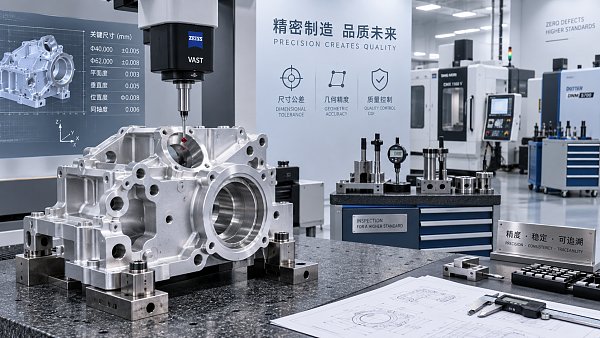
The third effect is inspection expansion. In aerospace, measuring a part is not just an administrative step. It can involve CMM programming, gauge repeatability checks, manual validation, and complete traceability records. The tighter the specification, the more often the supplier must measure, document, and prove conformance. Inspection is a real cost center, not just a quality checkbox.
The fourth and most financially sensitive effect is scrap and rework risk. Some parts become impossible to recover once a critical feature drifts outside tolerance. Others can be reworked, but at the cost of additional machine time, new inspection cycles, and potential delivery delays. Tighter standards reduce process margin. When process margin shrinks, financial exposure rises.
Where aerospace standards create necessary cost—and where overspecification destroys value
Not all tight tolerances are wasteful. In aerospace assemblies, certain dimensions directly affect load paths, bearing fits, sealing performance, aerodynamic alignment, vibration behavior, or fatigue life. These are legitimate places where strict tolerance control supports safety, reliability, and certification. Finance teams should not interpret cost pressure as a reason to loosen every challenging feature.
The problem is overspecification. This happens when drawing limits are copied from legacy programs, inherited from internal templates, or applied conservatively without confirming their effect on performance. For example, a non-critical bracket may receive the same dimensional expectations as a flight-critical interface simply because both passed through the same release workflow. That is where machining cost rises without a corresponding increase in product value.
One common sign of overspecification is uniform tightness across an entire print. Real functional parts usually have a mix of critical and non-critical characteristics. If nearly every feature carries a premium tolerance, that often suggests insufficient design-for-manufacturing review. Another warning sign is when suppliers repeatedly request clarifications, exceptions, or cost adders tied to dimensions that engineering cannot clearly justify in functional terms.
For finance approvers, the important distinction is this: necessary precision protects the program; unjustified precision taxes it. A disciplined sourcing organization learns to ask which dimensions drive fit, performance, compliance, and long-term reliability—and which simply drive quote inflation.
How tolerance choices affect supplier pricing, risk, and negotiating power
Suppliers do not price aerospace parts only by shape and material. They price by risk. A part with demanding aerospace machining precision tolerance standards is riskier to quote because the supplier must estimate process capability, hold contingency for scrap, allocate inspection resources, and protect itself against delivery penalties. Even if two parts have similar geometry, the one with tighter control bands can produce a meaningfully higher quote.
Tolerance intensity also narrows the supplier pool. Many shops can machine aerospace metals. Fewer can repeatedly hold demanding tolerances with traceable inspection and documentation under AS9100-aligned quality systems. As the eligible supplier base shrinks, the buyer loses price competition and capacity flexibility. That can translate into higher unit pricing, weaker lead-time resilience, and greater dependence on a small group of approved vendors.
This matters in negotiations. If a supplier sees broad or ambiguous tight tolerances, it will usually protect itself with conservative pricing. If the buyer can clearly classify critical-to-function features and relax non-critical dimensions, the supplier has room to sharpen the quote. Good specification discipline therefore improves not just manufacturability but commercial leverage.
Finance teams should also watch how tolerance requirements interact with supplier maturity. A premium shop may deliver high precision with stable yields, while a less capable supplier may initially offer lower pricing but generate downstream cost through escapes, delayed first articles, and recurring nonconformance. Lowest quoted price is rarely the same as lowest tolerance-adjusted cost.
What finance teams should ask before approving a high-precision machining budget
The first question is functional necessity: which dimensions are truly critical, and what happens if they are relaxed slightly? The answer should be based on assembly behavior, safety, fatigue, thermal expansion, sealing, vibration, or certification logic—not preference or habit. If no one can connect a tight number to a defined performance consequence, the team may be paying for unnecessary precision.
The second question is process capability: has the chosen supplier demonstrated repeatable control at the specified levels in similar materials and geometries? Aerospace alloys, thin-wall structures, and complex 5-axis parts often behave differently from simpler benchmark samples. Finance approvers do not need to run technical reviews themselves, but they should expect evidence of capability, not confidence language.
The third question is cost concentration: which features are creating the majority of the machining and inspection premium? Often, only a small number of dimensions are driving a large share of the quote delta. When those cost-intensive features are visible, leadership can make more informed trade-offs between design intent and budget impact.
The fourth question is failure economics: if the supplier misses the tolerance, what is the actual business consequence? Is the part scrapped, reworked, concessioned, or downgraded to internal use? Does the miss delay a flight test schedule or merely trigger a local correction? Financial approval improves when tolerance risk is linked to realistic cost scenarios instead of abstract quality language.
How to evaluate total procurement value instead of just piece price
A sound approval process looks beyond the quoted unit cost and examines total procurement value. That includes non-recurring engineering, fixture design, first-article inspection effort, metrology burden, expected yield loss, delivery reliability, and supplier responsiveness when deviations occur. A part that costs 8% more per unit from a highly capable supplier may be significantly cheaper at the program level than a lower-priced alternative with unstable quality performance.
One useful approach is to map tolerance-driven costs into three buckets: upfront, recurring, and risk-based. Upfront costs include process development, tooling, and qualification. Recurring costs include machine time, operator labor, inspection, and documentation. Risk-based costs include scrap, rework, schedule slippage, corrective action administration, and dual-sourcing pressure if the initial supplier struggles.
This framework helps finance teams compare options more rationally. For example, a tighter tolerance may look acceptable when viewed only through engineering intent, but less attractive when paired with a longer first-article timeline and lower expected yield. Conversely, a demanding specification may be justified if it prevents field failures, assembly delays, or expensive downstream adjustments. The key is to force visibility into both sides of the equation.
In practice, the best sourcing decisions are often made when procurement, engineering, quality, and finance review tolerance-sensitive parts together before final release. That cross-functional discipline turns aerospace machining precision tolerance standards from a hidden cost source into an explicit planning variable.
Practical signals that a drawing may be costing more than it should
There are several warning patterns finance approvers can learn to recognize. One is a quote with unusually high inspection line items relative to the complexity of the part. Another is a supplier note that certain dimensions require special setups, custom gauging, or low-yield process windows. Repeated requests for engineering deviation review are another sign that the print may be tighter than the application realistically requires.
Large price gaps between qualified suppliers can also be informative. Sometimes the difference reflects capability. But it may also indicate that one supplier interprets the risk as much higher because of ambiguous or aggressively controlled dimensions. In such cases, the right response is not automatically to choose the cheaper quote. It is to investigate whether specification clarity and tolerance rationalization could improve pricing confidence across the board.
Another red flag is when prototype and production pricing diverge sharply. Early runs may be manageable with manual intervention, expert machinists, and extra inspection time. Production scaling is where unjustified tolerances become expensive. If scale-up economics deteriorate quickly, the tolerance structure may be too dependent on heroic process control rather than robust manufacturability.
A decision framework for balancing compliance, performance, and cost
The most effective organizations use a hierarchy. First, identify safety-critical and certification-critical features that must not be compromised. Second, define function-critical dimensions that affect fit, fatigue, sealing, or dynamic performance. Third, separate cosmetic, convenience, or low-impact features that can tolerate wider bands without harming mission outcomes. This ranking allows cost to be concentrated where value is highest.
Next, tie each high-cost tolerance to evidence. That evidence may come from test data, simulation, assembly history, field reliability, or regulatory needs. If the evidence is weak, the cost premium deserves challenge. This does not mean forcing looser standards recklessly. It means requiring the same level of rigor for dimensional tightness that aerospace teams already expect for material and process choices.
Finally, make supplier capability part of the approval logic. A realistic tolerance standard is one that can be repeatedly achieved by qualified suppliers with acceptable yield, stable lead times, and verifiable inspection. A specification that only works in theory, or only under ideal shop conditions, may satisfy a drawing review while damaging the business case.
Conclusion: precision should be purchased intentionally, not symbolically
For finance approvers, the business lesson is clear. Aerospace machining precision tolerance standards are among the most powerful hidden drivers of part cost, sourcing flexibility, quality risk, and schedule confidence. Tighter numbers can absolutely be necessary—but they should be bought for demonstrated functional reasons, not inherited assumptions.
The strongest approval decisions come from asking disciplined questions: Which tolerances protect mission performance? Which ones mainly add machining and inspection burden? How much supplier risk is embedded in the quote? And what is the total cost of holding these standards across qualification, production, and delivery?
When organizations answer those questions with data, they spend more intelligently. They protect compliance where it matters, avoid overspecification where it does not, and create better alignment between engineering truth and procurement value. In aerospace, that is not just good technical governance. It is better financial governance too.
Search News
Hot Articles
- Carbon Fiber StructuresHow to Specify Aerospace Carbon Fiber Assemblies for Lightweight, Load-Bearing PartsJul 11, 2026
- Machine VisionXiaomi, Alibaba DAMO Academy Drive Open-Source Robotics Model Ecosystem, Lowering Algorithm Development Barriers for Overseas SMEs Adopting Chinese Robotics SolutionsMar 30, 2026
- Cobots & ArmsShanxi 'AI+' Conference Showcases Embodied Intelligence with Multinational Buyer Engagement: Key Industry ImplicationsMar 30, 2026
Popular Tags
Recommended News
 Jul 11, 2026How to Specify Aerospace Carbon Fiber Assemblies for Lightweight, Load-Bearing PartsAerospace carbon fiber assemblies: learn how to specify laminate design, load data, joining methods, and inspection controls for lighter, reliable load-bearing aerospace parts.Elena Rostova (UAV Systems Researcher)
 Mar 30, 2026Xiaomi, Alibaba DAMO Academy Drive Open-Source Robotics Model Ecosystem, Lowering Algorithm Development Barriers for Overseas SMEs Adopting Chinese Robotics SolutionsXiaomi & Alibaba DAMO Academy's open-source robotics models lower algorithm barriers for global SMEs. Boost efficiency in manufacturing, logistics & smart retail with ROS 2 compatible solutions.TSV Data Lab
 Mar 30, 2026Shanxi 'AI+' Conference Showcases Embodied Intelligence with Multinational Buyer Engagement: Key Industry ImplicationsShanxi 'AI+' Conference highlights embodied intelligence with Tesla, Ubtech & Jiantao showcasing multimodal robotics. 40+ global buyers validated tech on-site, creating new B2B channels for industrial automation & AI solutions.Chen Wei (Automation Lead Engineer)
 Mar 30, 2026Zhongguancun Unveils 6G Integrated Sensing-Computing-Intelligence Platform to Empower Embodied Robots for Global Industrial ApplicationsZhongguancun's new 6G platform revolutionizes industrial robotics with <10ms latency, empowering global automotive, logistics & port automation. Discover how this tech boosts China's smart manufacturing exports.TSV Data Lab
 Mar 30, 2026Mech-Mind Tianjin Embodied Intelligence R&D and Production Base Goes Live, Cutting Delivery Time by 20%–30% for Global Customized AMR+Vision SolutionsMech-Mind's Tianjin AMR+Vision production base cuts delivery time by 20%-30% for欧美 & Latin American markets. Discover how this PLd-certified facility accelerates customized robotics solutions for smart manufacturing and logistics.Chen Wei (Automation Lead Engineer)
 Mar 30, 2026Boao Forum Reveals 'Co-evolution of Big and Small Brains' Trend in Humanoid Robots, China's Embodied Intelligence Accelerates Adaptation to Overseas Manufacturing Service ScenariosDiscover how China's humanoid robots, featuring 'Co-evolution of Big and Small Brains,' are revolutionizing global manufacturing. Learn about Embodied Tian Gong 3.0's ISO compliance and overseas deployment at Boao Forum 2026.Chen Wei (Automation Lead Engineer)
 Mar 30, 2026China Railway Industrial Secures Patent for Embodied Robotics in Material Handling, Boosting High-Precision Delivery Capabilities for Overseas Infrastructure and Manufacturing ProjectsChina Railway Industrial's new patent for embodied robotics in material handling boosts high-precision delivery for global infrastructure & manufacturing. Discover how this innovation enhances logistics accuracy in automotive, rail transit & EPC projects.Chen Wei (Automation Lead Engineer)
 Sep 28, 2026Spindle Runout Measurement in Germany: DIN Standards, Methods, and Acceptance LimitsSpindle runout measurement Germany: explore DIN standards, proven methods, acceptance limits, and audit-ready practices for reliable machining quality.Dr. Marcus Vance
 Sep 27, 2026How to Select Wall-Mount Edge Devices for Space-Constrained Factory NetworksWall mount edge devices for space-constrained factories: evaluate workload, thermal design, power resilience, cable access, and network reliability for smarter deployments.TSV Data Lab
 Sep 26, 2026Machining Tolerance Analysis: How to Set Limits That Meet Function and Cost TargetsMachining tolerance analysis: learn how to set functional limits, control tolerance stacks, reduce inspection risk, and balance precision with production cost.Dr. Marcus Vance
 Sep 25, 2026How to Evaluate an Industrial Infrastructure Data Platform for Multi-Site OperationsIndustrial infrastructure data platform evaluation guide for multi-site operations: compare data quality, edge resilience, interoperability, governance, and scalable proof-of-value criteria.Victor Lin (Chief Software Architect)
 Sep 24, 2026How to Select Machine Vision Optics for Accurate Inspection at Different Working DistancesMachine vision optics selection guide for accurate inspection at every working distance. Compare FOV, pixel scale, DOF, distortion, lighting, and telecentric options.TSV Data Lab
 Sep 23, 2026How to Evaluate a Machine Vision System Integrator for High-Speed Inspection LinesChoose a machine vision system integrator with proven expertise in high-speed inspection, reliable reject timing, robust optics, and measurable acceptance criteria.TSV Data Lab
 Sep 28, 2026When is a SCADA API the right choice for connecting plant systems?SCADA API guide: learn when governed plant data integration improves traceability, security, and scalability—without compromising real-time control.Victor Lin (Chief Software Architect)
 Sep 27, 2026How SCADA data integration improves traceability across production linesSCADA data integration connects production-line data to improve traceability, accelerate quality investigations, and strengthen safety decisions.Victor Lin (Chief Software Architect)
 Sep 26, 2026What to define before starting SCADA integration planningSCADA integration planning starts with clear scope, control boundaries, data models, cybersecurity, and testing. Discover the definitions that reduce risk and costly rework.Victor Lin (Chief Software Architect)
 Sep 25, 2026How a smart factory with Industrial IoT reduces production blind spotsDiscover how a smart factory with Industrial IoT turns real-time machine, quality, and workflow data into actionable insights that reduce production blind spots and delivery risks.Victor Lin (Chief Software Architect)
 Sep 24, 2026When does Industrial IoT make smart manufacturing easier to scale?Smart manufacturing Industrial IoT scales when trusted data, interoperable systems, and secure workflows turn connected assets into measurable gains.TSV Data Lab
 Sep 23, 2026What drives ultra-precision machining cost at 1-micron tolerance?Ultra precision machining cost per part at 1 micron tolerance depends on process, material, metrology, and yield. Learn how to compare quotes confidently.Dr. Marcus Vance
 Sep 22, 2026Drone Engine-T550CC Applications: Build the UAV Power System Around the MissionAn application guide for Drone Engine-T550CC integration, covering payload planning, airframe matching, cooling, fuel, vibration, test procedures, documentation, and service preparation.Elena Rostova (UAV Systems Researcher)
 Sep 22, 2026How to Evaluate Industrial Edge Computing Vendors for Factory DeploymentIndustrial edge computing vendor evaluation guide for factories: compare latency, protocol fit, reliability, security, and lifecycle support before deployment.TSV Data Lab
 Sep 21, 2026Drone Payload Integration: Matching Power, Data, and Center of Gravity for Reliable FlightsDrone payload integration made practical: balance power, data, center of gravity, and endurance to build safer, more reliable mission-ready flights.Elena Rostova (UAV Systems Researcher)
 Sep 20, 2026Autonomous Navigation Pricing: Cost Drivers and Budget Benchmarks for AMR ProjectsAutonomous navigation price explained: compare AMR cost drivers, software, sensors, integration, safety, and lifecycle budgets to build a scalable project plan.Chen Wei (Automation Lead Engineer)
 Sep 19, 2026How to Scope Automation Integration Services for Multi-System Factory ProjectsAutomation integration services: learn how to scope multi-system factory projects with clear workflows, interface contracts, safety boundaries, and acceptance criteria.Victor Lin (Chief Software Architect)