
Why do hvac systems for hotels fail peak demand tests?
Publication Date
author
When hvac systems for hotels fail peak demand tests, the root cause is rarely a single undersized chiller or faulty control loop.
More often, failure emerges from mismatched load assumptions, poor diversity modeling, weak commissioning data, or equipment behaving differently under real occupancy, humidity, and ventilation stress.
For complex hospitality assets, peak testing is not a formality. It is a measurable proof that comfort, resilience, and operating cost assumptions survive real conditions.
Why Peak Demand Failure Matters in Hotel Operating Scenarios
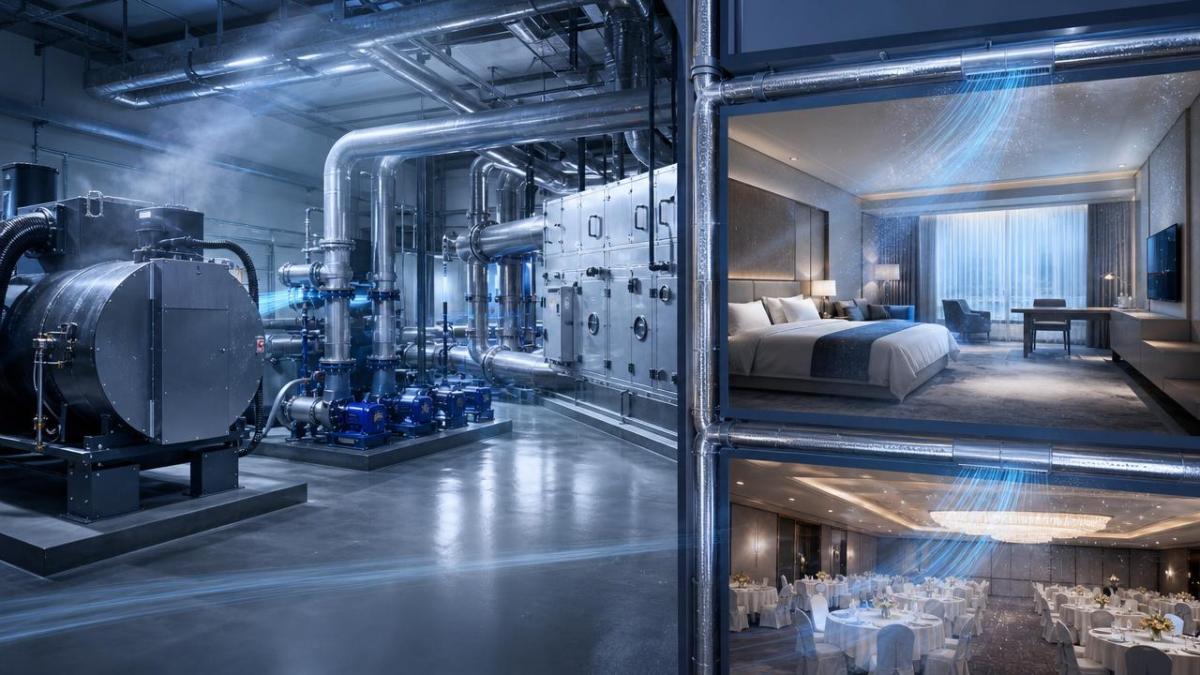
Hotels are not static buildings. Occupancy, kitchens, laundries, meeting rooms, pools, and outdoor air loads can collide within the same hour.
That collision is why hvac systems for hotels need scenario-based validation, not only design-day calculations or factory performance certificates.
A system may pass individual equipment checks but fail when guest rooms recover, banquet halls fill, and humidity spikes after door traffic.
Peak demand testing exposes whether design assumptions, controls, hydronics, ventilation, and operational sequencing work as one integrated system.
Scenario Background: Hotel Loads Are Diverse, Not Uniform
The most common mistake is treating a hotel as a predictable block load. In reality, demand moves across zones and time periods.
Guest rooms may peak during afternoon recovery. Restaurants may peak during meal service. Ballrooms may peak during dense events.
Spa, pool, and laundry areas add latent loads. These loads stress dehumidification and ventilation more than sensible cooling capacity.
Because of this variation, hvac systems for hotels often fail when diversity factors are copied from generic commercial templates.
A realistic test must connect the building schedule, local weather, guest behavior, and operating procedures into one demand profile.
Application Scenario 1: Guest Room Recovery After Check-In Peaks
Guest rooms create a unique recovery challenge. Rooms may sit in setback mode before many occupants arrive within a narrow window.
If fan coils, VRF terminals, or air handlers cannot recover quickly, comfort complaints appear before central plant alarms appear.
For hvac systems for hotels, the key judgment point is not only peak capacity. It is recovery time under occupied ventilation conditions.
Testing should record room temperature drift, valve position, supply air temperature, condensation risk, and fan speed response.
Core judgment points
- Can rooms recover within the promised guest comfort window?
- Does recovery overload risers, pumps, or chilled water distribution?
- Do controls prioritize occupied rooms without destabilizing adjacent zones?
Application Scenario 2: Banquet, Conference, and Event Load Surges
Event spaces can convert quickly from empty halls to dense internal heat and ventilation loads.
This is where hvac systems for hotels frequently fail peak demand tests despite acceptable average daily performance.
The failure often begins with ventilation. Outdoor air dampers open, coil loads rise, and chilled water demand jumps sharply.
If demand-controlled ventilation is poorly tuned, carbon dioxide levels, humidity, and comfort can move outside acceptable limits.
A reliable test should simulate pre-cooling, staged occupancy, door opening, lighting loads, and kitchen adjacency.
Core judgment points
- Does pre-cooling reduce peak load without causing overcooling?
- Can air handling units maintain ventilation and humidity together?
- Do chilled water valves avoid simultaneous full-open instability?
Application Scenario 3: Kitchens, Laundry, and Back-of-House Heat
Back-of-house areas create intense and uneven thermal demand. Exhaust, makeup air, hot water, and equipment heat interact continuously.
In these areas, hvac systems for hotels fail when makeup air is treated as a secondary detail rather than a primary load source.
Kitchen exhaust can pull conditioned air from surrounding zones. Laundry moisture can overwhelm dehumidification during high linen turnover.
Peak demand tests should include meal preparation periods, exhaust fan operation, dryer cycles, and pressure relationship checks.
The practical goal is not a perfect temperature everywhere. It is stable pressure, safe ventilation, and no spillover into guest areas.
Application Scenario 4: Humid Climates and Outdoor Air Stress
Humidity is a frequent hidden reason hvac systems for hotels underperform during peak tests.
A design may satisfy dry-bulb temperature but still fail because latent load control is insufficient.
Humid climates expose weak coil selection, insufficient reheat strategy, poor envelope sealing, and incorrect ventilation scheduling.
The test should measure dew point, relative humidity, coil leaving conditions, condensate behavior, and door infiltration effects.
For resorts, lobbies, pools, and open entrances, latent load testing can be more important than sensible cooling verification.
Application Scenario 5: Retrofit Hotels With Legacy Infrastructure
Retrofitted hotels often combine new chillers or heat pumps with older pipes, ducts, dampers, and terminal units.
This hybrid condition creates a major risk for hvac systems for hotels during peak validation.
New equipment may be capable, but distribution restrictions prevent capacity from reaching the actual zones.
Testing should compare plant output against zone-level delivery. Flow, pressure drop, air balance, and valve authority must be verified.
A retrofit peak test should also check whether legacy controls override or conflict with new automation logic.
Different Hotel Scenarios Demand Different Test Criteria
This comparison shows why one generic test cannot prove all hvac systems for hotels are ready for actual operation.
Why Failures Appear Late in Commissioning
Peak demand failures often appear late because early commissioning checks isolate equipment rather than test interacting scenarios.
A chiller can meet rated output. A pump can meet design flow. An air handler can pass static pressure checks.
Yet the whole system may still fail when all zones request capacity at the same time.
For hvac systems for hotels, integration risk is often greater than component risk.
The strongest evidence comes from trend logs, temporary sensors, occupancy simulations, and controlled stress sequences.
Scenario-Based Adaptation Recommendations
Reliable validation begins with a load narrative. It should describe when, where, and why demand peaks occur.
That narrative then becomes the basis for test scripts, sensor placement, control sequences, and acceptance thresholds.
- Build separate peak profiles for rooms, events, kitchens, laundry, and public areas.
- Verify sensible and latent capacity, not temperature alone.
- Trend system behavior at five-minute intervals or faster during stress periods.
- Test recovery after setback, not only steady-state full-load operation.
- Compare central plant output with zone-level delivery.
- Confirm override logic for demand limiting, emergency mode, and night operation.
These actions turn hvac systems for hotels from estimated designs into measurable operating assets.
Common Misjudgments That Cause Peak Test Failure
Misjudgment 1: Assuming nameplate capacity equals usable capacity
Rated capacity is not always available under local water temperatures, fouled coils, restricted ducts, or high outdoor air fractions.
Misjudgment 2: Ignoring humidity until guests complain
Comfort depends on moisture control. Dry-bulb compliance alone does not prove hvac systems for hotels are performing correctly.
Misjudgment 3: Treating controls as a final software task
Control sequences define how capacity is distributed. Late tuning can expose hardware limitations that should have been identified earlier.
Misjudgment 4: Testing without operational realism
Empty-building tests cannot represent check-in waves, banquet schedules, kitchen exhaust, pool humidity, or open lobby doors.
Data Quality: The Missing Link in Hotel HVAC Validation
A failed test is only useful when the data explains the failure mechanism.
For hvac systems for hotels, the most valuable data includes temperatures, humidity, flow, pressure, valve position, damper position, and occupancy events.
Data should be timestamped and aligned across the building automation system, temporary meters, and field observations.
This prevents inaccurate conclusions, such as blaming a chiller when the real issue is airside distribution or control sequencing.
Engineering truth requires evidence. Parameters, thresholds, and tolerance bands make failure analysis actionable.
Practical Acceptance Benchmarks for Peak Demand Tests
Acceptance criteria should be written before testing begins. Otherwise, pass-or-fail decisions become subjective.
- Guest rooms recover within the specified comfort window after setback.
- Event spaces maintain ventilation without humidity excursions.
- Central plant sequencing avoids short cycling during staged demand.
- Pumps and fans maintain stable flow without hunting.
- Critical areas remain within agreed dew point and pressure limits.
These benchmarks make hvac systems for hotels easier to compare, troubleshoot, and improve across different property types.
Action Guide: Turning Failure Risk Into Engineering Proof
The next step is to replace checklist commissioning with scenario-driven verification.
Start by mapping each hotel function to its peak load trigger, operating schedule, and comfort tolerance.
Then define the test sequence, required instruments, acceptance limits, and corrective decision path before peak testing begins.
For new projects, this process reduces redesign risk before opening. For existing properties, it reveals where energy and comfort losses originate.
When hvac systems for hotels are validated through real scenarios, peak demand tests become more than compliance exercises.
They become engineering benchmarks that protect comfort, operating cost, brand reliability, and long-term asset performance.
Search News
Hot Articles
- Carbon Fiber StructuresHow to Specify Aerospace Carbon Fiber Assemblies for Lightweight, Load-Bearing PartsJul 11, 2026
- Machine VisionXiaomi, Alibaba DAMO Academy Drive Open-Source Robotics Model Ecosystem, Lowering Algorithm Development Barriers for Overseas SMEs Adopting Chinese Robotics SolutionsMar 30, 2026
- Cobots & ArmsShanxi 'AI+' Conference Showcases Embodied Intelligence with Multinational Buyer Engagement: Key Industry ImplicationsMar 30, 2026
Popular Tags
Recommended News
 Jul 11, 2026How to Specify Aerospace Carbon Fiber Assemblies for Lightweight, Load-Bearing PartsAerospace carbon fiber assemblies: learn how to specify laminate design, load data, joining methods, and inspection controls for lighter, reliable load-bearing aerospace parts.Elena Rostova (UAV Systems Researcher)
 Mar 30, 2026Xiaomi, Alibaba DAMO Academy Drive Open-Source Robotics Model Ecosystem, Lowering Algorithm Development Barriers for Overseas SMEs Adopting Chinese Robotics SolutionsXiaomi & Alibaba DAMO Academy's open-source robotics models lower algorithm barriers for global SMEs. Boost efficiency in manufacturing, logistics & smart retail with ROS 2 compatible solutions.TSV Data Lab
 Mar 30, 2026Shanxi 'AI+' Conference Showcases Embodied Intelligence with Multinational Buyer Engagement: Key Industry ImplicationsShanxi 'AI+' Conference highlights embodied intelligence with Tesla, Ubtech & Jiantao showcasing multimodal robotics. 40+ global buyers validated tech on-site, creating new B2B channels for industrial automation & AI solutions.Chen Wei (Automation Lead Engineer)
 Mar 30, 2026Zhongguancun Unveils 6G Integrated Sensing-Computing-Intelligence Platform to Empower Embodied Robots for Global Industrial ApplicationsZhongguancun's new 6G platform revolutionizes industrial robotics with <10ms latency, empowering global automotive, logistics & port automation. Discover how this tech boosts China's smart manufacturing exports.TSV Data Lab
 Mar 30, 2026Mech-Mind Tianjin Embodied Intelligence R&D and Production Base Goes Live, Cutting Delivery Time by 20%–30% for Global Customized AMR+Vision SolutionsMech-Mind's Tianjin AMR+Vision production base cuts delivery time by 20%-30% for欧美 & Latin American markets. Discover how this PLd-certified facility accelerates customized robotics solutions for smart manufacturing and logistics.Chen Wei (Automation Lead Engineer)
 Mar 30, 2026Boao Forum Reveals 'Co-evolution of Big and Small Brains' Trend in Humanoid Robots, China's Embodied Intelligence Accelerates Adaptation to Overseas Manufacturing Service ScenariosDiscover how China's humanoid robots, featuring 'Co-evolution of Big and Small Brains,' are revolutionizing global manufacturing. Learn about Embodied Tian Gong 3.0's ISO compliance and overseas deployment at Boao Forum 2026.Chen Wei (Automation Lead Engineer)
 Mar 30, 2026China Railway Industrial Secures Patent for Embodied Robotics in Material Handling, Boosting High-Precision Delivery Capabilities for Overseas Infrastructure and Manufacturing ProjectsChina Railway Industrial's new patent for embodied robotics in material handling boosts high-precision delivery for global infrastructure & manufacturing. Discover how this innovation enhances logistics accuracy in automotive, rail transit & EPC projects.Chen Wei (Automation Lead Engineer)
 Oct 15, 2026R&D Cost Reduction Services: How to Evaluate Fees, Savings, and ROIEvaluate R&D cost reduction services with confidence. Compare fees, verify savings, and calculate ROI without compromising performance. Discover how to choose a provider that delivers real value.Chen Wei (Automation Lead Engineer)
 Oct 14, 2026Drone Frame Composites: Carbon Fiber vs. Fiberglass for Weight and StiffnessExplore drone structural materials composites: compare carbon fiber and fiberglass for weight, stiffness, cost, and antenna compatibility. Find the right material for your drone frame.Elena Rostova (UAV Systems Researcher)
 Oct 13, 2026Smart Cameras vs. PC-Based Machine Vision: Which Fits High-Speed Inspection?This industrial product comparison for machine vision weighs smart cameras vs. PC-based systems on latency, throughput, and cost. Discover your best fit for high-speed inspection.TSV Data Lab
 Oct 12, 2026How to Verify RoHS Compliance in Industrial Sensing Systems Before DeploymentRoHS compliant sensing systems: learn how to verify materials, supplier declarations, testing, and configuration controls before industrial deployment.TSV Data Lab
 Oct 11, 2026How Procurement-Oriented Content Taxonomy Improves B2B Buying JourneysProcurement-oriented content taxonomy streamlines B2B buying journeys with clearer evidence, supplier comparisons, risk visibility, and faster approvals.TSV Data Lab
 Oct 10, 2026How to Select a Machine Performance Monitoring Platform for OEE and Downtime ReductionMachine performance monitoring platform selection guide: validate machine states, OEE data, downtime reasons, integrations, and scalability to reduce losses with confidence.TSV Data Lab
 Oct 08, 2026How to Machine Inconel 625 Blades Without Heat Cracks or Edge ChippingInconel 625 blade machining guide: prevent heat cracks, edge chipping, chatter, and work hardening with proven tooling, cooling, fixturing, and inspection strategies.Dr. Marcus Vance
 Oct 07, 2026How to Evaluate an HMI Panel Distributor for Industrial Automation ProjectsHMI panel distributor evaluation guide: verify technical compatibility, traceability, supply reliability, lifecycle support, and total cost for automation projects.Victor Lin (Chief Software Architect)
 Oct 06, 2026Navigation Fault Tolerance Standards for AMRs: What Safety Teams Must VerifyNavigation fault tolerance standards: learn what AMR safety teams must verify, from localization loss and sensor faults to stopping distance, safe restart, and site-specific validation.Chen Wei (Automation Lead Engineer)
 Oct 05, 2026Calculating Edge Computing Total Cost of Ownership Across Distributed SitesEdge computing ownership cost explained: calculate deployment, energy, connectivity, security, remote support, and refresh costs across distributed sites.TSV Data Lab
 Oct 04, 2026CAD/CAM Benchmarking in the GCC: What Manufacturers Should Ask a ConsultantCAD CAM benchmark consultant GCC guide: learn the key questions manufacturers should ask to validate post-processors, workflows, machine performance, and production risk.Victor Lin (Chief Software Architect)
 Oct 03, 2026Selecting Automotive Radar Sensor Modules for ADAS Range, Resolution, and IntegrationAutomotive radar sensor module selection guide for ADAS: compare range, resolution, field of view, latency, and integration to build safer, reliable vehicle systems.TSV Data Lab
 Oct 02, 2026How to Qualify Machined Parts Suppliers for Hard Tech ProgramsHard tech supply chain machined parts demand rigorous supplier qualification. Learn how to assess capability, traceability, quality controls, and delivery resilience.Dr. Marcus Vance
 Oct 01, 2026How to Select an Outdoor Security Radar Sensor for Perimeter Detection?Outdoor security radar sensor selection guide: compare range, accuracy, false-alarm control, integration, and field testing for reliable perimeter detection.TSV Data Lab
 Sep 30, 2026How to Evaluate Solid-State LiDAR Hardware for Outdoor Autonomous VehiclesSolid state LiDAR hardware evaluation guide for outdoor autonomous vehicles—compare range, point-cloud quality, environmental resilience, integration, and safety.TSV Data Lab
 Sep 29, 2026ISO 9283 Repeatability: How to Evaluate Cobot Positioning PerformanceISO 9283 cobot repeatability explained: learn how payload, reach, approach direction, and test conditions affect positioning performance and cell capability.Chen Wei (Automation Lead Engineer)
 Oct 14, 2026How tight can micro machining aerospace tolerances be in production?Micro machining aerospace tolerances can reach low-micron levels in production. Learn what controls repeatability, inspection confidence, and flight-critical quality.Dr. Marcus Vance























