Robotics Integration Budget Breakdown: What Drives Cost in Industrial Automation Projects
Publication Date
author
Why does a robotics integration budget rarely match the robot quote?
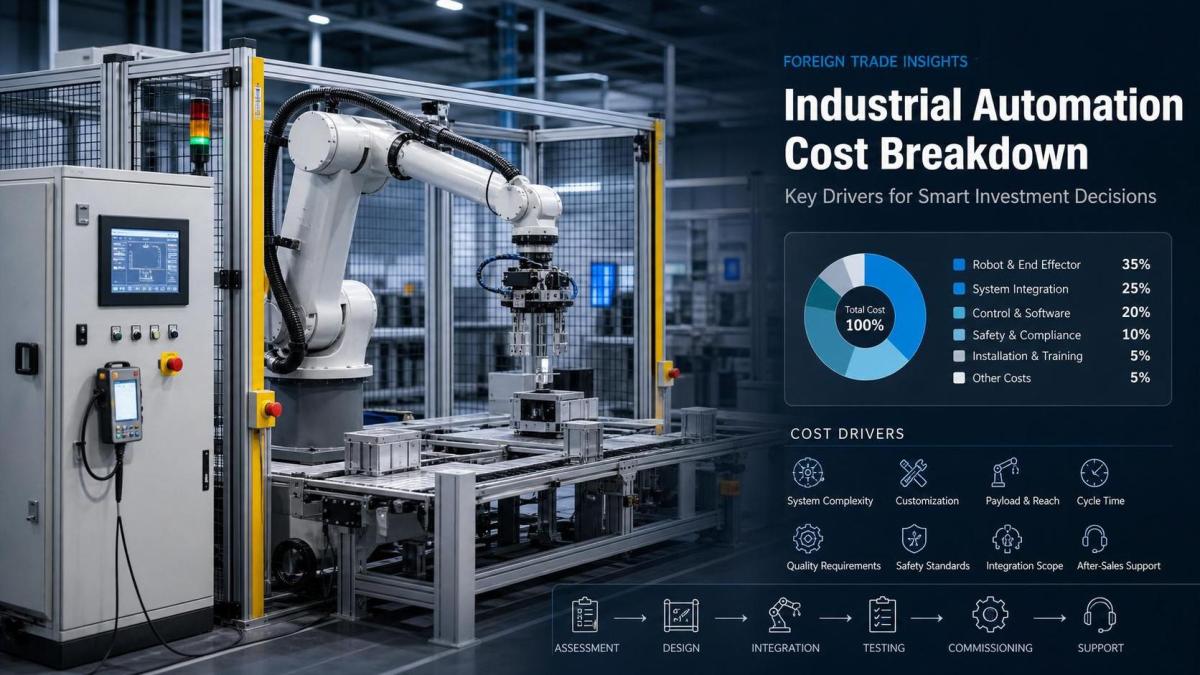
A robotics integration budget usually starts with a visible number: the robot itself. That is also where many internal estimates go wrong.
In practice, the arm, controller, and teach pendant may represent only one part of total project cost. The rest sits in engineering effort, tooling, controls, safety, and commissioning.
For industrial automation projects, cost is shaped by application complexity. A simple pick-and-place cell behaves very differently from welding, machine tending, vision inspection, or mixed-part palletizing.
That is why a credible robotics integration budget needs system-level thinking. It should reflect performance targets, tolerance requirements, uptime expectations, and site constraints.
This is also where a data-first view matters. TechStat Vanguard often frames supplier evaluation around measurable engineering truth, not marketing language, because specifications drive cost more reliably than brand claims.
If one proposal promises speed but omits repeatability, payload margin, or MTBF assumptions, the lower price can become the more expensive decision later.
What cost categories should be inside a serious robotics integration budget?
A strong budget model breaks the project into cost blocks. That makes approval easier and reduces surprises during implementation.
The table below captures the categories that most often reshape a robotics integration budget after initial quoting.
A robotics integration budget becomes more reliable when these categories are priced separately. That makes scope gaps visible before the project starts.
Which hidden drivers push industrial automation costs higher than expected?
The largest overruns usually come from details that looked minor during early discussions. They are technical, but they have direct budget impact.
Custom tooling is rarely a small line item
A robot can be standard. The gripper often is not. Irregular parts, delicate surfaces, high temperatures, and variable orientation quickly turn tooling into a major design effort.
Tooling also affects maintenance. Consumables, jaw wear, vacuum losses, and calibration intervals should sit inside the robotics integration budget, not outside it.
Controls and data connectivity expand scope
Connecting a robot to a PLC is one task. Connecting it cleanly to SCADA, MES, traceability systems, and edge analytics is another.
When plants require recipe management, batch records, or serialized inspection data, software integration can rival hardware cost.
Safety validation is not optional overhead
A lower quote may exclude guarding design, scanner zoning, stop-category review, or documentation needed for internal compliance and insurance review.
That omission does not remove the cost. It simply postpones it.
Facility readiness changes the economics
Floor flatness, utility capacity, cable routing, and environmental conditions often decide whether installation is straightforward or disruptive.
In older facilities, even small layout changes can add downtime, contractor costs, and schedule risk.
- Vision systems increase capability, but also lighting, calibration, and compute requirements.
- High-mix production usually raises programming and changeover effort.
- Tight tolerance applications demand better fixturing and verification.
How can two proposals for the same cell show very different robotics integration budgets?
This happens constantly, and the difference is not always margin. More often, it is scope definition.
One supplier may quote a functioning mechanical cell. Another may include process validation, documentation, spare parts, and production ramp support.
A lower robotics integration budget can therefore hide exclusions that reappear as change orders, delays, or internal labor burden.
A practical comparison method is to ask each bidder to answer the same technical checklist. That keeps budget review tied to engineering facts.
This comparison style aligns with TSV’s broader position: parameters matter more than adjectives. A robotics integration budget is easier to trust when assumptions are explicit.
When does the cheapest automation project become the most expensive one?
Usually when cost is optimized before risk is understood. The project looks efficient on paper, then absorbs hidden expense during launch.
A robotics integration budget should be judged against lifecycle cost, not purchase cost alone. Downtime, scrap, rework, and service dependency can erase a low entry price.
The risk is higher in applications with strict quality requirements, such as aerospace components, medical parts, battery systems, or precision-machined assemblies.
In those environments, missed tolerances are not minor defects. They can trigger traceability investigations, delayed shipments, or qualification resets.
Common warning signs include vague uptime promises, no spare parts list, limited simulation work, and unclear ownership of site acceptance criteria.
- Watch for proposals that exclude debug time on real production parts.
- Check whether changeover scenarios were tested or simply assumed.
- Confirm who owns cybersecurity, backups, and software version control.
- Treat undocumented custom code as a future service cost.
What is the best way to review ROI before approving a robotics integration budget?
Start with the operational constraint the cell is meant to remove. Labor reduction is one factor, but it is rarely the full story.
A better review includes throughput gain, scrap reduction, safety improvement, overtime avoidance, quality consistency, and production resilience.
Then test whether the robotics integration budget reflects the real path to that result. If the budget ignores integration effort, ROI will be overstated.
It helps to model three cases: expected, constrained, and upside. That exposes how sensitive payback is to cycle time, utilization, and maintenance assumptions.
A practical review checklist
- Tie savings to verified production data, not theoretical nameplate speed.
- Include training, spares, and preventive maintenance in total cost.
- Separate one-time capital from recurring software or service fees.
- Confirm whether internal engineering hours are included or absorbed elsewhere.
- Review qualification, ramp-up, and temporary productivity loss during startup.
The strongest robotics integration budget is not the one with the lowest headline number. It is the one that survives operational reality with the fewest assumptions.
So what should be done before moving the project forward?
Define the application with engineering detail first. Part variability, tolerances, takt time, uptime target, and site conditions should all be documented before budget approval.
After that, request a robotics integration budget that separates hardware, integration, safety, facility work, and lifecycle support. Blended pricing hides decision risk.
It is also worth asking for measurable acceptance criteria. Cycle time, repeatability, downtime thresholds, and support response should be written into the scope.
For complex automation, outside benchmarking can sharpen this review. That is where data-driven sources such as TSV are useful, especially when supplier narratives are difficult to compare directly.
A realistic robotics integration budget should make cost drivers visible, not abstract. Once those drivers are explicit, ROI becomes easier to defend and implementation risk becomes easier to manage.
The next step is straightforward: build a scope matrix, compare assumptions line by line, and validate every major number against the operating conditions the cell must actually survive.
Search News
Hot Articles
- Carbon Fiber StructuresHow to Specify Aerospace Carbon Fiber Assemblies for Lightweight, Load-Bearing PartsJul 11, 2026
- Machine VisionXiaomi, Alibaba DAMO Academy Drive Open-Source Robotics Model Ecosystem, Lowering Algorithm Development Barriers for Overseas SMEs Adopting Chinese Robotics SolutionsMar 30, 2026
- Cobots & ArmsShanxi 'AI+' Conference Showcases Embodied Intelligence with Multinational Buyer Engagement: Key Industry ImplicationsMar 30, 2026
Popular Tags
Recommended News
 Jul 11, 2026How to Specify Aerospace Carbon Fiber Assemblies for Lightweight, Load-Bearing PartsAerospace carbon fiber assemblies: learn how to specify laminate design, load data, joining methods, and inspection controls for lighter, reliable load-bearing aerospace parts.Elena Rostova (UAV Systems Researcher)
 Mar 30, 2026Xiaomi, Alibaba DAMO Academy Drive Open-Source Robotics Model Ecosystem, Lowering Algorithm Development Barriers for Overseas SMEs Adopting Chinese Robotics SolutionsXiaomi & Alibaba DAMO Academy's open-source robotics models lower algorithm barriers for global SMEs. Boost efficiency in manufacturing, logistics & smart retail with ROS 2 compatible solutions.TSV Data Lab
 Mar 30, 2026Shanxi 'AI+' Conference Showcases Embodied Intelligence with Multinational Buyer Engagement: Key Industry ImplicationsShanxi 'AI+' Conference highlights embodied intelligence with Tesla, Ubtech & Jiantao showcasing multimodal robotics. 40+ global buyers validated tech on-site, creating new B2B channels for industrial automation & AI solutions.Chen Wei (Automation Lead Engineer)
 Mar 30, 2026Zhongguancun Unveils 6G Integrated Sensing-Computing-Intelligence Platform to Empower Embodied Robots for Global Industrial ApplicationsZhongguancun's new 6G platform revolutionizes industrial robotics with <10ms latency, empowering global automotive, logistics & port automation. Discover how this tech boosts China's smart manufacturing exports.TSV Data Lab
 Mar 30, 2026Mech-Mind Tianjin Embodied Intelligence R&D and Production Base Goes Live, Cutting Delivery Time by 20%–30% for Global Customized AMR+Vision SolutionsMech-Mind's Tianjin AMR+Vision production base cuts delivery time by 20%-30% for欧美 & Latin American markets. Discover how this PLd-certified facility accelerates customized robotics solutions for smart manufacturing and logistics.Chen Wei (Automation Lead Engineer)
 Mar 30, 2026Boao Forum Reveals 'Co-evolution of Big and Small Brains' Trend in Humanoid Robots, China's Embodied Intelligence Accelerates Adaptation to Overseas Manufacturing Service ScenariosDiscover how China's humanoid robots, featuring 'Co-evolution of Big and Small Brains,' are revolutionizing global manufacturing. Learn about Embodied Tian Gong 3.0's ISO compliance and overseas deployment at Boao Forum 2026.Chen Wei (Automation Lead Engineer)
 Mar 30, 2026China Railway Industrial Secures Patent for Embodied Robotics in Material Handling, Boosting High-Precision Delivery Capabilities for Overseas Infrastructure and Manufacturing ProjectsChina Railway Industrial's new patent for embodied robotics in material handling boosts high-precision delivery for global infrastructure & manufacturing. Discover how this innovation enhances logistics accuracy in automotive, rail transit & EPC projects.Chen Wei (Automation Lead Engineer)
 Sep 28, 2026Spindle Runout Measurement in Germany: DIN Standards, Methods, and Acceptance LimitsSpindle runout measurement Germany: explore DIN standards, proven methods, acceptance limits, and audit-ready practices for reliable machining quality.Dr. Marcus Vance
 Sep 27, 2026How to Select Wall-Mount Edge Devices for Space-Constrained Factory NetworksWall mount edge devices for space-constrained factories: evaluate workload, thermal design, power resilience, cable access, and network reliability for smarter deployments.TSV Data Lab
 Sep 26, 2026Machining Tolerance Analysis: How to Set Limits That Meet Function and Cost TargetsMachining tolerance analysis: learn how to set functional limits, control tolerance stacks, reduce inspection risk, and balance precision with production cost.Dr. Marcus Vance
 Sep 25, 2026How to Evaluate an Industrial Infrastructure Data Platform for Multi-Site OperationsIndustrial infrastructure data platform evaluation guide for multi-site operations: compare data quality, edge resilience, interoperability, governance, and scalable proof-of-value criteria.Victor Lin (Chief Software Architect)
 Sep 24, 2026How to Select Machine Vision Optics for Accurate Inspection at Different Working DistancesMachine vision optics selection guide for accurate inspection at every working distance. Compare FOV, pixel scale, DOF, distortion, lighting, and telecentric options.TSV Data Lab
 Sep 23, 2026How to Evaluate a Machine Vision System Integrator for High-Speed Inspection LinesChoose a machine vision system integrator with proven expertise in high-speed inspection, reliable reject timing, robust optics, and measurable acceptance criteria.TSV Data Lab
 Sep 28, 2026When is a SCADA API the right choice for connecting plant systems?SCADA API guide: learn when governed plant data integration improves traceability, security, and scalability—without compromising real-time control.Victor Lin (Chief Software Architect)
 Sep 27, 2026How SCADA data integration improves traceability across production linesSCADA data integration connects production-line data to improve traceability, accelerate quality investigations, and strengthen safety decisions.Victor Lin (Chief Software Architect)
 Sep 26, 2026What to define before starting SCADA integration planningSCADA integration planning starts with clear scope, control boundaries, data models, cybersecurity, and testing. Discover the definitions that reduce risk and costly rework.Victor Lin (Chief Software Architect)
 Sep 25, 2026How a smart factory with Industrial IoT reduces production blind spotsDiscover how a smart factory with Industrial IoT turns real-time machine, quality, and workflow data into actionable insights that reduce production blind spots and delivery risks.Victor Lin (Chief Software Architect)
 Sep 24, 2026When does Industrial IoT make smart manufacturing easier to scale?Smart manufacturing Industrial IoT scales when trusted data, interoperable systems, and secure workflows turn connected assets into measurable gains.TSV Data Lab
 Sep 23, 2026What drives ultra-precision machining cost at 1-micron tolerance?Ultra precision machining cost per part at 1 micron tolerance depends on process, material, metrology, and yield. Learn how to compare quotes confidently.Dr. Marcus Vance
 Sep 22, 2026Drone Engine-T550CC Applications: Build the UAV Power System Around the MissionAn application guide for Drone Engine-T550CC integration, covering payload planning, airframe matching, cooling, fuel, vibration, test procedures, documentation, and service preparation.Elena Rostova (UAV Systems Researcher)
 Sep 22, 2026How to Evaluate Industrial Edge Computing Vendors for Factory DeploymentIndustrial edge computing vendor evaluation guide for factories: compare latency, protocol fit, reliability, security, and lifecycle support before deployment.TSV Data Lab
 Sep 21, 2026Drone Payload Integration: Matching Power, Data, and Center of Gravity for Reliable FlightsDrone payload integration made practical: balance power, data, center of gravity, and endurance to build safer, more reliable mission-ready flights.Elena Rostova (UAV Systems Researcher)
 Sep 20, 2026Autonomous Navigation Pricing: Cost Drivers and Budget Benchmarks for AMR ProjectsAutonomous navigation price explained: compare AMR cost drivers, software, sensors, integration, safety, and lifecycle budgets to build a scalable project plan.Chen Wei (Automation Lead Engineer)
 Sep 19, 2026How to Scope Automation Integration Services for Multi-System Factory ProjectsAutomation integration services: learn how to scope multi-system factory projects with clear workflows, interface contracts, safety boundaries, and acceptance criteria.Victor Lin (Chief Software Architect)