HVAC automation control logic breaks down at handover stage
Publication Date
author
When hvac automation control logic fails at the handover stage, project managers are rarely dealing with a minor controls issue. They are usually facing a chain of commercial, operational, and technical risks at the exact moment the project is supposed to become stable. What should have been a clean transition from design and installation into operation instead turns into alarm floods, unexplained overrides, comfort complaints, unresolved commissioning items, and disputes about whether the system was ever delivered as specified.
The core problem is not that control logic is inherently unreliable. It is that the logic often changes form several times between concept design, consultant sequences, subcontractor programming, site modification, and final testing. By the time handover begins, the “installed logic” may no longer match the “intended logic,” and nobody has a fully traceable record of where the deviation occurred. For project leaders, this is where risk becomes expensive.
For engineering-focused organizations, the solution is not more generic coordination meetings or broader statements about “smart buildings.” The solution is disciplined definition, verification, and acceptance of control sequences using measurable criteria. If project teams treat the control layer with the same rigor they apply to mechanical capacity, electrical load, or life-safety systems, most handover-stage failures can be detected much earlier and corrected with less friction.
This article focuses on what project managers and engineering leads actually need to know: why handover failures happen, what warning signs matter, how to assess whether a controls package is truly ready, and what acceptance structure reduces the gap between design intent and operational reality.
Why HVAC automation control logic often breaks down at handover
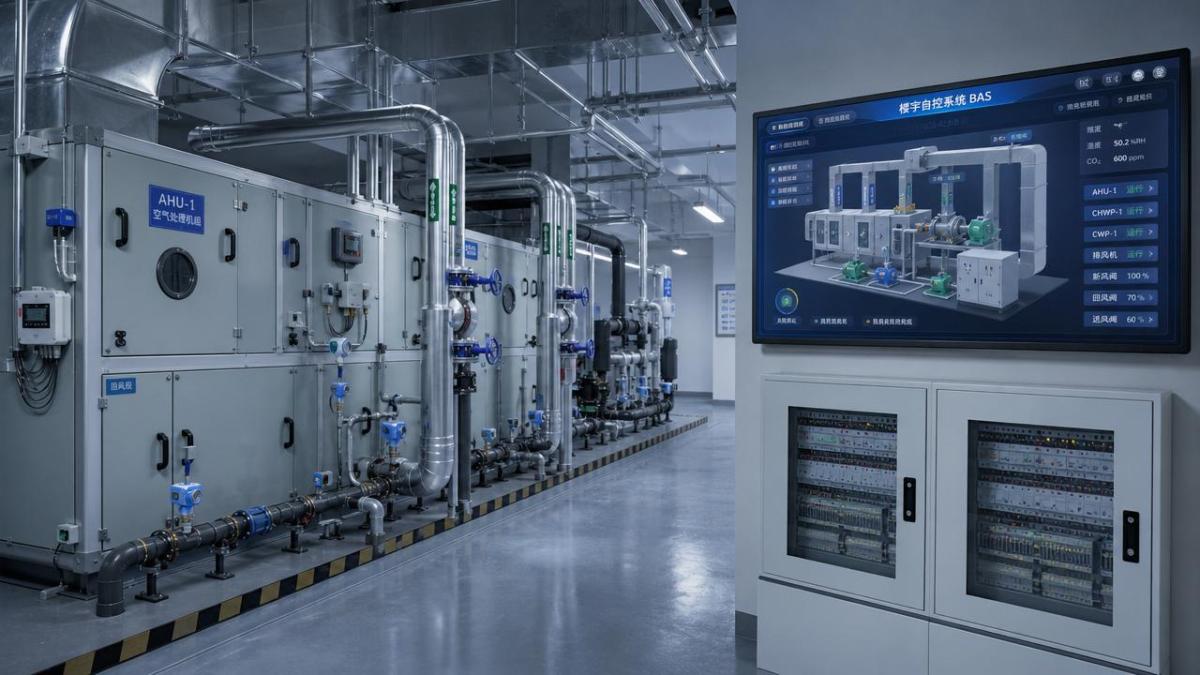
At handover, the project is under time pressure, multiple trades are finishing in parallel, and the owner expects a usable system rather than a theoretical one. This is exactly why weaknesses in hvac automation control logic become visible. During earlier phases, many issues remain hidden because systems are not yet running in fully integrated conditions. At handover, however, occupancy patterns, equipment interlocks, alarms, schedules, trending, and fail-safe behavior are expected to work together.
In many projects, the original control narrative is too generic to support reliable programming. Sequence documents may describe high-level intent such as “optimize energy efficiency” or “stage equipment based on demand” without defining thresholds, timing delays, reset strategies, alarm priorities, sensor validation rules, or mode transitions. Controls contractors then interpret the gaps differently, often under schedule pressure.
A second cause is fragmented responsibility. The consultant may produce sequences, the controls integrator may program them, the mechanical contractor may modify field devices, and the commissioning team may discover behavioral faults late in the process. If no one owns the end-to-end logic validation path, handover becomes the first true integration test, which is far too late.
There is also a documentation problem. Redlined sequences, temporary overrides, field adjustments, and software revisions are frequently not reconciled into a final, controlled baseline. As a result, the owner receives an operating system that may function partially but cannot be confidently maintained. The risk is not only immediate performance instability but also long-term dependence on tribal knowledge from individuals who may leave after project closeout.
For project managers, the key judgment is simple: handover-stage logic breakdown is usually a process failure before it is a programming failure. If the chain from design intent to tested implementation is weak, the building automation system will expose that weakness when real operating conditions begin.
What project managers should care about most at this stage
From a management perspective, the most important question is not whether every line of code is elegant. It is whether the delivered control logic creates predictable system behavior, defensible acceptance outcomes, and manageable operational risk. That means focusing on the issues that directly affect schedule, claims exposure, energy performance, occupant outcomes, and post-handover support burden.
First, project managers should care about whether the sequence of operation is testable. A sequence that cannot be tested objectively will become a commercial problem. Vague wording allows different parties to argue different interpretations of “compliance.” If acceptance criteria are not measurable, disputes multiply during commissioning and substantial completion.
Second, they should focus on mode-based behavior. Many failures happen not in normal cooling or heating operation, but during transitions: startup, shutdown, occupancy change, economizer enable, low-load conditions, freeze protection, smoke events, power recovery, network interruption, sensor failure, and manual override release. If these transitions are not explicitly defined, the system can appear functional in demonstrations while still failing under realistic building conditions.
Third, alarm strategy matters more than many teams assume. A building with poor logic may technically run, but if alarm thresholds, suppression rules, and prioritization are poorly configured, operators are overwhelmed. Alarm fatigue leads to ignored faults, slower response, and a hidden decline in system reliability. At handover, this becomes the owner’s problem almost immediately.
Fourth, managers must care about maintainability. A controls package that only the original programmer understands is not truly handed over. Naming conventions, point lists, trend setup, graphics logic, override registers, and software version control all affect whether facility teams can operate and troubleshoot the system without excessive vendor dependence.
Where the gap opens between design intent and site delivery
The handover failure rarely starts at handover. It usually starts months earlier when design documents leave ambiguity unresolved. Many sequence specifications are copied from previous projects, adjusted only partially, and never fully aligned with the actual plant configuration, control architecture, or operating philosophy of the building. This creates a structural mismatch from the beginning.
Another common gap appears during submittal review. Teams often verify hardware and network architecture more rigorously than software logic. Point counts, controller locations, and device compatibility receive attention, while control flow, state logic, and fallback conditions remain under-reviewed. Yet the latter are what determine how the system behaves under pressure.
Field conditions then widen the gap. Valve authority may differ from design assumptions, sensor placement may be compromised, variable-speed drive settings may be altered for startup convenience, and mechanical balancing may lag behind control tuning. Programmers then introduce local fixes to stabilize behavior. These fixes may solve immediate symptoms while silently diverging from the original sequence.
Integration between systems adds another layer of risk. HVAC logic increasingly depends on data from fire alarm interfaces, access control, occupancy inputs, power monitoring, weather data, chiller plant optimization layers, and supervisory analytics. If signal ownership, refresh timing, or fail-state logic is unclear, the HVAC sequence may not fail completely, but it will behave inconsistently enough to undermine operator trust.
This is why data-driven organizations insist on traceability. The project team should be able to answer: What was the design intent? What was programmed? What was changed in the field? What was tested? What passed? What remains conditional? Without that chain, handover becomes guesswork dressed as completion.
How to identify that the control logic is not truly ready for handover
Project managers do not need to read source code to recognize when hvac automation control logic is not ready. They need a practical set of indicators that reveal whether the system is stable, testable, and transferable. Several signs are especially important.
One warning sign is repeated dependence on manual overrides. If systems only perform as expected while technicians are forcing points, holding dampers, locking valves, or suppressing alarms, the underlying logic is not complete. Temporary stability achieved through overrides is not operational readiness.
A second sign is that trend data does not support the narrative of successful testing. If a contractor reports that discharge air control, pressure reset, or plant staging is functioning correctly, trend logs should show stable response, reasonable deadbands, expected time delays, and sensible mode transitions. When no trend evidence exists, or when trends are too short or poorly sampled to prove behavior, acceptance is weak.
A third sign is unresolved inconsistency between graphics, point names, and field behavior. If operators see one thing on the front end while devices respond differently in reality, the system is not ready. Mismatched labels, inverted statuses, incorrect units, and ambiguous alarm texts are not cosmetic issues; they interfere directly with troubleshooting and risk management.
Another sign is that testing remains scenario-light. If the controls package has only been demonstrated under ideal daytime conditions, it has not been proven. Robust handover requires testing under low load, high load, occupancy transitions, network interruptions, sensor failures, and recovery conditions. A sequence that passes only in one state is not a handed-over sequence.
Finally, if the as-built documents and final sequence revisions are lagging behind field reality, handover should be treated as incomplete. The owner cannot accept reliable operation from an undocumented logic environment.
What a stronger verification approach looks like
The most effective projects move beyond generic functional testing and adopt structured verification tied to specific sequence outcomes. This starts with breaking each major HVAC sequence into defined modes, triggers, expected actions, lockouts, alarms, and proof points. Instead of saying “the AHU shall optimize temperature control,” define exactly how supply air temperature resets, what inputs are used, what minimum and maximum limits apply, how quickly the reset can change, and what happens when a critical sensor fails.
For project managers, this creates a better basis for planning and risk control. Verification can then be staged before handover rather than compressed into the final weeks. Factory review of logic architecture, submittal-level sequence crosswalks, point-to-sequence traceability, pre-functional device validation, integrated scenario tests, and trend-based review should be built into the project timeline.
A strong process also separates three things that are often mixed together: installation completeness, control responsiveness, and operational optimization. A system can be fully installed but poorly controlled. It can be responsive in local loops but unstable at system level. It can also be stable while still not optimized for energy. These should be evaluated as separate acceptance layers so that teams do not mistake basic operation for finished performance.
Trend-based verification is especially valuable. Instead of relying only on witness tests, require evidence over time. For example, verify that static pressure reset behaves within expected bounds across different occupancy levels; that chilled water valve authority does not create hunting; that simultaneous heating and cooling stays within defined thresholds; and that alarm rates remain manageable after occupancy begins. Time-series data reduces subjectivity and reveals instability that short demonstrations miss.
This is consistent with TSV’s engineering-led philosophy: parameters matter because they make acceptance real. If a control strategy cannot be evaluated with data, it is too vulnerable to interpretation.
How to write acceptance standards that reduce disputes
Many handover disputes happen because contract language and sequence narratives do not establish measurable acceptance standards. To reduce ambiguity, project teams should convert key control expectations into objective criteria before commissioning intensifies.
For example, instead of accepting “stable zone control,” define allowable control band, recovery time after setpoint change, and maximum oscillation frequency under normal load. Instead of accepting “economizer operation,” define outdoor air conditions for enable, disable, minimum damper position, mixed air low-limit response, and proof through trend logs. Instead of accepting “alarm reporting,” define priority classes, annunciation delays, suppression rules, and operator response visibility.
Acceptance standards should also address data quality. Trend intervals, naming conventions, unit consistency, time synchronization, point status reliability, and archive retention affect whether the owner can diagnose issues after handover. A building automation system without usable data is difficult to govern, no matter how advanced its feature list appears.
It is equally important to define documentation deliverables as part of acceptance. Final sequences, software backups, controller databases, network architecture, points lists, graphics libraries, cause-and-effect logic, alarm matrices, and override logs should be treated as operational assets, not administrative afterthoughts. If these are missing, the owner inherits uncertainty.
Project leaders should remember that a tighter acceptance framework does not slow projects by definition. In practice, it often accelerates completion because it reduces late-stage argument about what “working” means.
Practical steps project leaders can take before the next handover
If you are managing an active project, the best time to strengthen controls governance is before handover pressure peaks. Start by asking for a sequence-to-points crosswalk on critical systems: air handling units, chilled water plants, heating hot water systems, VAV control, smoke interfaces, and central plant staging. This reveals whether the intended logic is fully represented in the implemented points structure.
Next, require a mode-and-failure review for each major system. Teams should walk through normal operation, setback, warm-up, cooldown, equipment failover, sensor fault, communication loss, and power recovery. This can be done without waiting for every final condition on site, and it exposes logic gaps early.
Then insist on trend-backed pre-handover reviews. Do not rely only on screenshots or demonstrations. Ask for several days of representative data on critical loops, resets, starts, stops, alarms, and plant transitions. Review not just whether the system reaches setpoint, but how it gets there, how often it overshoots, and how it behaves when conditions change.
Also, bring operations personnel into review earlier. Facility teams often identify maintainability concerns that project teams overlook, such as confusing graphics, unclear alarm text, poor scheduling logic, and missing operator visibility into automatic resets. Handover is stronger when the eventual users can understand and trust the automation behavior.
Finally, treat unresolved logic items as business risks, not just technical snags. If key sequences are still provisional, document the exposure explicitly: energy risk, comfort risk, seasonal testing risk, staffing dependency, or claims risk. This changes the conversation from “minor controls cleanup” to accountable project governance.
Conclusion: handover succeeds when control logic is treated as engineered scope, not a late-stage detail
When hvac automation control logic breaks down at handover, the visible symptoms may be unstable temperatures, nuisance alarms, or delayed closeout. But the deeper issue is that the project has allowed a critical engineering layer to remain insufficiently defined, verified, or documented until the last possible moment.
For project managers and engineering leads, the most effective response is not more general coordination or more optimistic assumptions. It is a disciplined framework: precise sequences, mode-based testing, trend-backed verification, documented revisions, and measurable acceptance standards. This approach reduces commissioning friction, protects project outcomes, and gives owners a system they can actually operate with confidence.
In practical terms, successful handover depends on one principle: the installed automation logic must be traceable to design intent and provable through data. When that standard is met, disputes shrink, operational risk drops, and the building begins its life with a control foundation that supports performance rather than undermines it.
Search News
Hot Articles
- Carbon Fiber StructuresHow to Specify Aerospace Carbon Fiber Assemblies for Lightweight, Load-Bearing PartsJul 11, 2026
- Machine VisionXiaomi, Alibaba DAMO Academy Drive Open-Source Robotics Model Ecosystem, Lowering Algorithm Development Barriers for Overseas SMEs Adopting Chinese Robotics SolutionsMar 30, 2026
- Cobots & ArmsShanxi 'AI+' Conference Showcases Embodied Intelligence with Multinational Buyer Engagement: Key Industry ImplicationsMar 30, 2026
Popular Tags
Recommended News
 Jul 11, 2026How to Specify Aerospace Carbon Fiber Assemblies for Lightweight, Load-Bearing PartsAerospace carbon fiber assemblies: learn how to specify laminate design, load data, joining methods, and inspection controls for lighter, reliable load-bearing aerospace parts.Elena Rostova (UAV Systems Researcher)
 Mar 30, 2026Xiaomi, Alibaba DAMO Academy Drive Open-Source Robotics Model Ecosystem, Lowering Algorithm Development Barriers for Overseas SMEs Adopting Chinese Robotics SolutionsXiaomi & Alibaba DAMO Academy's open-source robotics models lower algorithm barriers for global SMEs. Boost efficiency in manufacturing, logistics & smart retail with ROS 2 compatible solutions.TSV Data Lab
 Mar 30, 2026Shanxi 'AI+' Conference Showcases Embodied Intelligence with Multinational Buyer Engagement: Key Industry ImplicationsShanxi 'AI+' Conference highlights embodied intelligence with Tesla, Ubtech & Jiantao showcasing multimodal robotics. 40+ global buyers validated tech on-site, creating new B2B channels for industrial automation & AI solutions.Chen Wei (Automation Lead Engineer)
 Mar 30, 2026Zhongguancun Unveils 6G Integrated Sensing-Computing-Intelligence Platform to Empower Embodied Robots for Global Industrial ApplicationsZhongguancun's new 6G platform revolutionizes industrial robotics with <10ms latency, empowering global automotive, logistics & port automation. Discover how this tech boosts China's smart manufacturing exports.TSV Data Lab
 Mar 30, 2026Mech-Mind Tianjin Embodied Intelligence R&D and Production Base Goes Live, Cutting Delivery Time by 20%–30% for Global Customized AMR+Vision SolutionsMech-Mind's Tianjin AMR+Vision production base cuts delivery time by 20%-30% for欧美 & Latin American markets. Discover how this PLd-certified facility accelerates customized robotics solutions for smart manufacturing and logistics.Chen Wei (Automation Lead Engineer)
 Mar 30, 2026Boao Forum Reveals 'Co-evolution of Big and Small Brains' Trend in Humanoid Robots, China's Embodied Intelligence Accelerates Adaptation to Overseas Manufacturing Service ScenariosDiscover how China's humanoid robots, featuring 'Co-evolution of Big and Small Brains,' are revolutionizing global manufacturing. Learn about Embodied Tian Gong 3.0's ISO compliance and overseas deployment at Boao Forum 2026.Chen Wei (Automation Lead Engineer)
 Mar 30, 2026China Railway Industrial Secures Patent for Embodied Robotics in Material Handling, Boosting High-Precision Delivery Capabilities for Overseas Infrastructure and Manufacturing ProjectsChina Railway Industrial's new patent for embodied robotics in material handling boosts high-precision delivery for global infrastructure & manufacturing. Discover how this innovation enhances logistics accuracy in automotive, rail transit & EPC projects.Chen Wei (Automation Lead Engineer)
 Sep 28, 2026Spindle Runout Measurement in Germany: DIN Standards, Methods, and Acceptance LimitsSpindle runout measurement Germany: explore DIN standards, proven methods, acceptance limits, and audit-ready practices for reliable machining quality.Dr. Marcus Vance
 Sep 27, 2026How to Select Wall-Mount Edge Devices for Space-Constrained Factory NetworksWall mount edge devices for space-constrained factories: evaluate workload, thermal design, power resilience, cable access, and network reliability for smarter deployments.TSV Data Lab
 Sep 26, 2026Machining Tolerance Analysis: How to Set Limits That Meet Function and Cost TargetsMachining tolerance analysis: learn how to set functional limits, control tolerance stacks, reduce inspection risk, and balance precision with production cost.Dr. Marcus Vance
 Sep 25, 2026How to Evaluate an Industrial Infrastructure Data Platform for Multi-Site OperationsIndustrial infrastructure data platform evaluation guide for multi-site operations: compare data quality, edge resilience, interoperability, governance, and scalable proof-of-value criteria.Victor Lin (Chief Software Architect)
 Sep 24, 2026How to Select Machine Vision Optics for Accurate Inspection at Different Working DistancesMachine vision optics selection guide for accurate inspection at every working distance. Compare FOV, pixel scale, DOF, distortion, lighting, and telecentric options.TSV Data Lab
 Sep 23, 2026How to Evaluate a Machine Vision System Integrator for High-Speed Inspection LinesChoose a machine vision system integrator with proven expertise in high-speed inspection, reliable reject timing, robust optics, and measurable acceptance criteria.TSV Data Lab
 Sep 28, 2026When is a SCADA API the right choice for connecting plant systems?SCADA API guide: learn when governed plant data integration improves traceability, security, and scalability—without compromising real-time control.Victor Lin (Chief Software Architect)
 Sep 27, 2026How SCADA data integration improves traceability across production linesSCADA data integration connects production-line data to improve traceability, accelerate quality investigations, and strengthen safety decisions.Victor Lin (Chief Software Architect)
 Sep 26, 2026What to define before starting SCADA integration planningSCADA integration planning starts with clear scope, control boundaries, data models, cybersecurity, and testing. Discover the definitions that reduce risk and costly rework.Victor Lin (Chief Software Architect)
 Sep 25, 2026How a smart factory with Industrial IoT reduces production blind spotsDiscover how a smart factory with Industrial IoT turns real-time machine, quality, and workflow data into actionable insights that reduce production blind spots and delivery risks.Victor Lin (Chief Software Architect)
 Sep 24, 2026When does Industrial IoT make smart manufacturing easier to scale?Smart manufacturing Industrial IoT scales when trusted data, interoperable systems, and secure workflows turn connected assets into measurable gains.TSV Data Lab
 Sep 23, 2026What drives ultra-precision machining cost at 1-micron tolerance?Ultra precision machining cost per part at 1 micron tolerance depends on process, material, metrology, and yield. Learn how to compare quotes confidently.Dr. Marcus Vance
 Sep 22, 2026Drone Engine-T550CC Applications: Build the UAV Power System Around the MissionAn application guide for Drone Engine-T550CC integration, covering payload planning, airframe matching, cooling, fuel, vibration, test procedures, documentation, and service preparation.Elena Rostova (UAV Systems Researcher)
 Sep 22, 2026How to Evaluate Industrial Edge Computing Vendors for Factory DeploymentIndustrial edge computing vendor evaluation guide for factories: compare latency, protocol fit, reliability, security, and lifecycle support before deployment.TSV Data Lab
 Sep 21, 2026Drone Payload Integration: Matching Power, Data, and Center of Gravity for Reliable FlightsDrone payload integration made practical: balance power, data, center of gravity, and endurance to build safer, more reliable mission-ready flights.Elena Rostova (UAV Systems Researcher)
 Sep 20, 2026Autonomous Navigation Pricing: Cost Drivers and Budget Benchmarks for AMR ProjectsAutonomous navigation price explained: compare AMR cost drivers, software, sensors, integration, safety, and lifecycle budgets to build a scalable project plan.Chen Wei (Automation Lead Engineer)
 Sep 19, 2026How to Scope Automation Integration Services for Multi-System Factory ProjectsAutomation integration services: learn how to scope multi-system factory projects with clear workflows, interface contracts, safety boundaries, and acceptance criteria.Victor Lin (Chief Software Architect)