White Label ERP for Manufacturing Can Cut Launch Time but Add Limits
Publication Date
author
For distributors, resellers, and agents serving industrial buyers, white label ERP for manufacturing can look like the fastest route to market. Yet speed often comes with trade-offs in customization, data transparency, and long-term scalability. This article examines where white-label deployment creates momentum, where it introduces operational limits, and how to evaluate the balance with the precision today’s manufacturing supply chain demands.
In manufacturing channels, speed matters because buyers often expect a working demo in 2–4 weeks, not 4–6 months. But in hard-tech environments shaped by tolerance control, traceability, supplier qualification, and multi-site production planning, software decisions cannot be made on branding alone.
That is why the discussion around white label ERP for manufacturing deserves a more technical lens. For channel partners aligned with data-first industrial decision-making, the key question is not whether white-label ERP is fast, but whether it can support real manufacturing complexity without creating hidden operational constraints later.
Why White Label ERP for Manufacturing Gains Fast Traction in Channel Sales
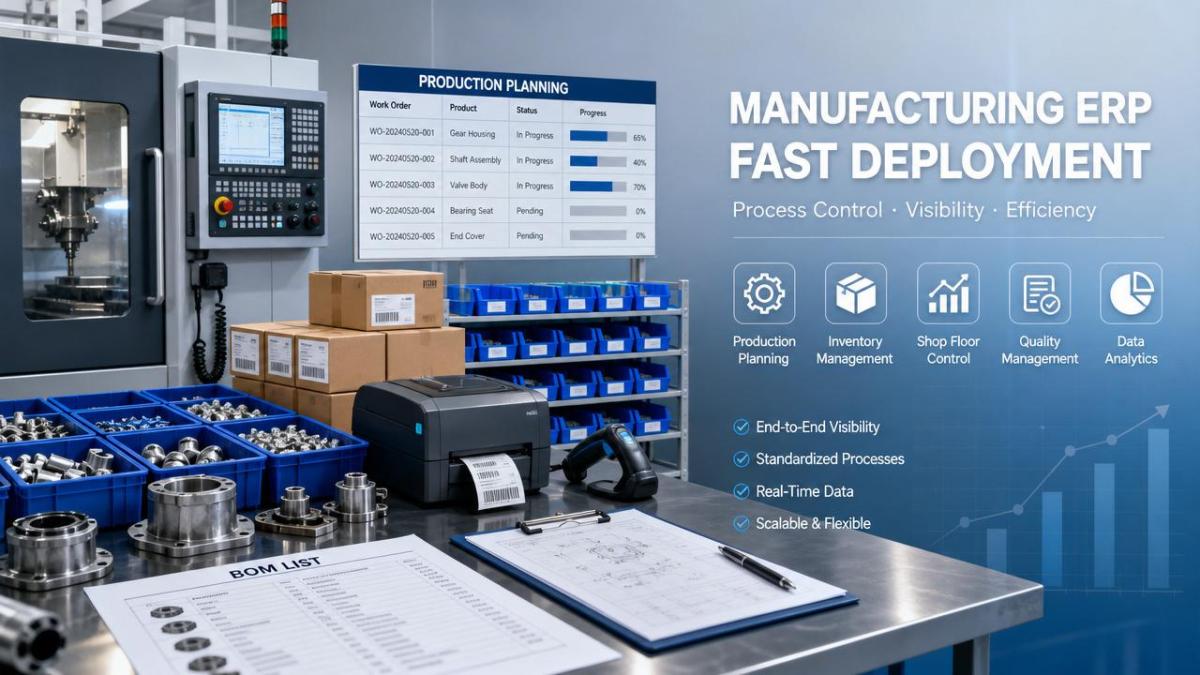
A white label ERP model gives distributors and agents a practical shortcut. Instead of funding a full product build, they can rebrand an existing platform, launch under their own commercial identity, and begin prospecting within 30–90 days in many standard deployments.
For manufacturing-focused channel partners, this speed is especially attractive when the target market includes small and mid-sized factories, contract manufacturers, CNC workshops, component assemblers, or industrial trading firms that need basic planning, purchasing, and inventory visibility quickly.
Where the launch advantage comes from
Most white label ERP for manufacturing offerings already include a functional core: bill of materials management, purchase order workflows, stock control, shop-floor routing, invoicing, and standard reporting. That reduces implementation friction across the first 3 stages of pre-sale, pilot, and go-live.
- Lower initial software development cost than building from scratch
- Shorter sales enablement cycle for distributors, often 2–6 weeks
- Faster product packaging for vertical offers such as metalworking, electronics assembly, or industrial components
- Prebuilt user roles for procurement, planning, warehouse, and finance teams
Commercial value for resellers
For agents and resellers, the white-label structure can create a cleaner route to recurring revenue. Instead of earning only one-time hardware margins, they can add subscription billing, implementation fees, data migration support, and first-line support contracts with service windows such as 8x5 or 24x7.
This is particularly relevant in industrial markets where buyers prefer one accountable supplier. If a distributor already handles machines, sensors, spare parts, or automation integration, adding ERP under the same brand can improve account stickiness over a 12–36 month relationship.
The table below shows where white label ERP for manufacturing tends to deliver real channel momentum, and where that advantage is more limited depending on factory complexity.
The main takeaway is clear: white label ERP for manufacturing can accelerate channel growth when the sales motion targets standardized needs. The launch benefit is strongest in repeatable segments, not in highly customized, engineering-heavy production environments.
Where White Label ERP Creates Limits for Manufacturing Operations
The same structure that shortens launch time can also create structural constraints. In manufacturing, those limits usually appear in 4 areas: workflow depth, data transparency, integration flexibility, and roadmap dependence on the upstream software owner.
Customization can stop at the surface layer
Many white-label platforms allow visible changes such as logo, color scheme, user portal domain, and sales collateral. But deeper manufacturing logic often remains fixed. That becomes a problem when a buyer needs multi-level BOM revision control, serialized traceability, or plant-specific routing rules.
A distributor may promise flexibility, yet the backend system may only support limited workflow changes without custom code from the original vendor. In practical terms, the difference between changing a dashboard and changing scheduling logic can be measured in 2 days versus 8–12 weeks.
Data visibility may not match industrial procurement standards
TSV’s data-first perspective matters here. Manufacturing buyers increasingly ask for exact audit trails: who changed a supplier record, when a batch lot was received, how a nonconformance was logged, and whether a production order can be tied to a machine, operator, and incoming material lot.
If white label ERP for manufacturing only provides summary dashboards without line-level traceability, the channel partner may win the initial deal but lose credibility during qualification. This is critical in sectors where acceptance can depend on tolerance ranges, revision history, and document retention periods of 3–7 years or more.
Common operational limits buyers discover after deployment
- Limited API access for MES, WMS, PLC, or CRM integration
- Restricted custom fields for engineering change orders and QA checkpoints
- Basic reporting that cannot break down scrap, rework, or downtime by cell or shift
- Weak support for dual-unit inventory, subcontracting, or multi-plant transfers
- Upgrade delays when all roadmap decisions sit with the upstream platform owner
The comparison below helps channel partners evaluate whether a white-label offer fits the customer’s real production environment or only the sales presentation.
The pattern is consistent. White label ERP for manufacturing works best where process variation is controlled. As process depth, compliance burden, and cross-system integration rise, hidden restrictions become more expensive than the original time saved.
How Distributors and Resellers Should Evaluate Fit Before Signing
Industrial buyers do not buy ERP only for transactions. They buy it to reduce planning errors, shorten supplier response cycles, improve inventory accuracy, and create measurable control over production data. A channel partner should therefore qualify fit using a technical checklist before focusing on brand packaging.
The 6-point qualification framework
- Map the buyer’s production mode: make-to-stock, make-to-order, assemble-to-order, or engineer-to-order.
- Verify data granularity: lot, serial, revision, operation, and supplier trace records.
- Test integration needs across at least 3 systems, such as accounting, CRM, MES, or barcode scanning.
- Confirm customization boundaries in writing, including lead time, cost band, and ownership of changes.
- Review support SLA targets, such as first response within 2–8 hours and critical issue resolution paths.
- Check export and migration rights so the customer is not trapped if requirements outgrow the platform.
Questions that reveal backend risk
Ask whether custom workflow logic survives major version upgrades. Ask whether API rate limits apply. Ask whether historical data can be exported in structured format. Ask whether quality records can be retained by plant, supplier, and batch over a multi-year compliance cycle.
These questions matter because channel partners often inherit the support burden. If the customer’s production scheduler fails during a month-end planning run, the distributor’s brand absorbs the pressure first, even if the core platform belongs to another company.
Red flags in manufacturing software demos
- The demo shows finance screens but avoids shop-floor execution details
- The vendor says “customizable” but cannot define what changes are no-code, low-code, or vendor-coded
- There is no live example of revision-controlled BOM updates across purchasing and production
- Reporting cannot isolate scrap percentage, delayed POs, or WIP aging over 7, 30, and 90 days
For channel sales in industrial markets, precision beats presentation. A realistic pilot with 20–50 representative SKUs and 2–3 real workflows usually reveals more than a polished generic demo.
A Practical Deployment Model That Balances Speed and Control
The best route is not always full custom development, and it is not always pure white-label reselling either. Many distributors succeed by using a phased model: launch quickly with standard modules, then define a structured path for extension only after process fit is proven.
A 3-phase rollout approach
Phase 1 usually lasts 30–60 days and covers core operations: item master, BOMs, purchasing, inventory, sales orders, and baseline production orders. The goal is visibility, not deep optimization.
Phase 2 often runs another 45–90 days and adds barcode handling, supplier performance views, QA checkpoints, and more detailed planning rules. This is where the platform’s real flexibility becomes visible.
Phase 3 should be conditional, not automatic. It may include MES links, external portals, EDI, machine data ingestion, or advanced costing. If the white-label backend cannot support these needs cleanly, the channel partner should address that before expansion.
When white-label ERP is a good fit
- The target customer has stable processes and moderate reporting needs
- The sales motion depends on rapid launch across multiple territories
- The channel partner adds value through service, onboarding, and industry process knowledge
- The buyer accepts standardized workflows in exchange for a lower implementation burden
When another route may be better
- The factory requires deep traceability tied to quality, machine, and operator records
- The product mix changes frequently with engineering revisions
- The operation spans multiple plants, contract manufacturers, or cross-border compliance regimes
- The buyer sees ERP as a 5–10 year digital backbone rather than a near-term process tool
This balanced model aligns with the broader industrial reality: parameters matter more than slogans. In advanced manufacturing, the right software choice is the one that matches planning logic, traceability depth, and integration tolerance to the buyer’s actual operating conditions.
Final Decision Guidance for Industrial Channel Partners
White label ERP for manufacturing can absolutely cut launch time, and for distributors, resellers, and agents that advantage is commercially meaningful. It can open a new revenue layer, strengthen account retention, and shorten the path to market by several months.
But speed should never hide structural limits. In manufacturing, missing capabilities in traceability, workflow control, integration, or reporting usually surface after go-live, when the cost of correction is higher and the buyer’s patience is lower.
The strongest channel strategy is to evaluate white label ERP for manufacturing with engineering discipline: define process scope, test data depth, validate change limits, and confirm support responsibility before scaling sales. That approach protects both customer outcomes and channel reputation.
If you are assessing a manufacturing ERP offer for distribution, private labeling, or regional agency expansion, now is the right time to compare launch speed against long-term control. Contact us to discuss your target segment, review deployment fit, and get a more tailored solution path for industrial buyers.
Search News
Hot Articles
- Carbon Fiber StructuresHow to Specify Aerospace Carbon Fiber Assemblies for Lightweight, Load-Bearing PartsJul 11, 2026
- Machine VisionXiaomi, Alibaba DAMO Academy Drive Open-Source Robotics Model Ecosystem, Lowering Algorithm Development Barriers for Overseas SMEs Adopting Chinese Robotics SolutionsMar 30, 2026
- Cobots & ArmsShanxi 'AI+' Conference Showcases Embodied Intelligence with Multinational Buyer Engagement: Key Industry ImplicationsMar 30, 2026
Popular Tags
Recommended News
 Jul 11, 2026How to Specify Aerospace Carbon Fiber Assemblies for Lightweight, Load-Bearing PartsAerospace carbon fiber assemblies: learn how to specify laminate design, load data, joining methods, and inspection controls for lighter, reliable load-bearing aerospace parts.Elena Rostova (UAV Systems Researcher)
 Mar 30, 2026Xiaomi, Alibaba DAMO Academy Drive Open-Source Robotics Model Ecosystem, Lowering Algorithm Development Barriers for Overseas SMEs Adopting Chinese Robotics SolutionsXiaomi & Alibaba DAMO Academy's open-source robotics models lower algorithm barriers for global SMEs. Boost efficiency in manufacturing, logistics & smart retail with ROS 2 compatible solutions.TSV Data Lab
 Mar 30, 2026Shanxi 'AI+' Conference Showcases Embodied Intelligence with Multinational Buyer Engagement: Key Industry ImplicationsShanxi 'AI+' Conference highlights embodied intelligence with Tesla, Ubtech & Jiantao showcasing multimodal robotics. 40+ global buyers validated tech on-site, creating new B2B channels for industrial automation & AI solutions.Chen Wei (Automation Lead Engineer)
 Mar 30, 2026Zhongguancun Unveils 6G Integrated Sensing-Computing-Intelligence Platform to Empower Embodied Robots for Global Industrial ApplicationsZhongguancun's new 6G platform revolutionizes industrial robotics with <10ms latency, empowering global automotive, logistics & port automation. Discover how this tech boosts China's smart manufacturing exports.TSV Data Lab
 Mar 30, 2026Mech-Mind Tianjin Embodied Intelligence R&D and Production Base Goes Live, Cutting Delivery Time by 20%–30% for Global Customized AMR+Vision SolutionsMech-Mind's Tianjin AMR+Vision production base cuts delivery time by 20%-30% for欧美 & Latin American markets. Discover how this PLd-certified facility accelerates customized robotics solutions for smart manufacturing and logistics.Chen Wei (Automation Lead Engineer)
 Mar 30, 2026Boao Forum Reveals 'Co-evolution of Big and Small Brains' Trend in Humanoid Robots, China's Embodied Intelligence Accelerates Adaptation to Overseas Manufacturing Service ScenariosDiscover how China's humanoid robots, featuring 'Co-evolution of Big and Small Brains,' are revolutionizing global manufacturing. Learn about Embodied Tian Gong 3.0's ISO compliance and overseas deployment at Boao Forum 2026.Chen Wei (Automation Lead Engineer)
 Mar 30, 2026China Railway Industrial Secures Patent for Embodied Robotics in Material Handling, Boosting High-Precision Delivery Capabilities for Overseas Infrastructure and Manufacturing ProjectsChina Railway Industrial's new patent for embodied robotics in material handling boosts high-precision delivery for global infrastructure & manufacturing. Discover how this innovation enhances logistics accuracy in automotive, rail transit & EPC projects.Chen Wei (Automation Lead Engineer)
 Sep 28, 2026Spindle Runout Measurement in Germany: DIN Standards, Methods, and Acceptance LimitsSpindle runout measurement Germany: explore DIN standards, proven methods, acceptance limits, and audit-ready practices for reliable machining quality.Dr. Marcus Vance
 Sep 27, 2026How to Select Wall-Mount Edge Devices for Space-Constrained Factory NetworksWall mount edge devices for space-constrained factories: evaluate workload, thermal design, power resilience, cable access, and network reliability for smarter deployments.TSV Data Lab
 Sep 26, 2026Machining Tolerance Analysis: How to Set Limits That Meet Function and Cost TargetsMachining tolerance analysis: learn how to set functional limits, control tolerance stacks, reduce inspection risk, and balance precision with production cost.Dr. Marcus Vance
 Sep 25, 2026How to Evaluate an Industrial Infrastructure Data Platform for Multi-Site OperationsIndustrial infrastructure data platform evaluation guide for multi-site operations: compare data quality, edge resilience, interoperability, governance, and scalable proof-of-value criteria.Victor Lin (Chief Software Architect)
 Sep 24, 2026How to Select Machine Vision Optics for Accurate Inspection at Different Working DistancesMachine vision optics selection guide for accurate inspection at every working distance. Compare FOV, pixel scale, DOF, distortion, lighting, and telecentric options.TSV Data Lab
 Sep 23, 2026How to Evaluate a Machine Vision System Integrator for High-Speed Inspection LinesChoose a machine vision system integrator with proven expertise in high-speed inspection, reliable reject timing, robust optics, and measurable acceptance criteria.TSV Data Lab
 Sep 28, 2026When is a SCADA API the right choice for connecting plant systems?SCADA API guide: learn when governed plant data integration improves traceability, security, and scalability—without compromising real-time control.Victor Lin (Chief Software Architect)
 Sep 27, 2026How SCADA data integration improves traceability across production linesSCADA data integration connects production-line data to improve traceability, accelerate quality investigations, and strengthen safety decisions.Victor Lin (Chief Software Architect)
 Sep 26, 2026What to define before starting SCADA integration planningSCADA integration planning starts with clear scope, control boundaries, data models, cybersecurity, and testing. Discover the definitions that reduce risk and costly rework.Victor Lin (Chief Software Architect)
 Sep 25, 2026How a smart factory with Industrial IoT reduces production blind spotsDiscover how a smart factory with Industrial IoT turns real-time machine, quality, and workflow data into actionable insights that reduce production blind spots and delivery risks.Victor Lin (Chief Software Architect)
 Sep 24, 2026When does Industrial IoT make smart manufacturing easier to scale?Smart manufacturing Industrial IoT scales when trusted data, interoperable systems, and secure workflows turn connected assets into measurable gains.TSV Data Lab
 Sep 23, 2026What drives ultra-precision machining cost at 1-micron tolerance?Ultra precision machining cost per part at 1 micron tolerance depends on process, material, metrology, and yield. Learn how to compare quotes confidently.Dr. Marcus Vance
 Sep 22, 2026Drone Engine-T550CC Applications: Build the UAV Power System Around the MissionAn application guide for Drone Engine-T550CC integration, covering payload planning, airframe matching, cooling, fuel, vibration, test procedures, documentation, and service preparation.Elena Rostova (UAV Systems Researcher)
 Sep 22, 2026How to Evaluate Industrial Edge Computing Vendors for Factory DeploymentIndustrial edge computing vendor evaluation guide for factories: compare latency, protocol fit, reliability, security, and lifecycle support before deployment.TSV Data Lab
 Sep 21, 2026Drone Payload Integration: Matching Power, Data, and Center of Gravity for Reliable FlightsDrone payload integration made practical: balance power, data, center of gravity, and endurance to build safer, more reliable mission-ready flights.Elena Rostova (UAV Systems Researcher)
 Sep 20, 2026Autonomous Navigation Pricing: Cost Drivers and Budget Benchmarks for AMR ProjectsAutonomous navigation price explained: compare AMR cost drivers, software, sensors, integration, safety, and lifecycle budgets to build a scalable project plan.Chen Wei (Automation Lead Engineer)
 Sep 19, 2026How to Scope Automation Integration Services for Multi-System Factory ProjectsAutomation integration services: learn how to scope multi-system factory projects with clear workflows, interface contracts, safety boundaries, and acceptance criteria.Victor Lin (Chief Software Architect)