Trampoline park cost per square foot misses the biggest expenses
Publication Date
author
Many feasibility studies treat trampoline park cost per square foot as the main budgeting benchmark, but that shortcut often hides the expenses that truly shape ROI. For business evaluators, the real picture includes structural upgrades, liability coverage, safety systems, staffing, and long-term maintenance. This article explains why focusing only on trampoline park cost can lead to distorted forecasts and weaker investment decisions.
Why scenario differences matter more than a simple square-foot estimate
For a business evaluator, the phrase trampoline park cost should never be reduced to a single build-out average. Two venues with the same floor area can produce very different capital requirements, operating risk, and payback timelines. A family entertainment center inside a suburban retail shell faces different constraints than a high-traffic urban concept, a franchise retrofit, or a premium destination park with food, party rooms, and digital ticketing.
That is why application context matters. The biggest budgeting errors happen when investors compare headline construction rates without asking what kind of business model the facility must support. In practice, the useful question is not “What is the trampoline park cost per square foot?” but “Which expenses dominate in this operating scenario, and how do they affect utilization, compliance, and margin?”
This scenario-first approach aligns with disciplined commercial evaluation. Like any engineered environment, a trampoline venue is a system of interacting cost drivers: property condition, code compliance, mechanical load capacity, customer throughput, staffing model, insurance profile, and maintenance intensity. If one of those variables is underestimated, the apparent savings on rent or fit-out can be erased quickly.
The most common business scenarios behind trampoline park cost
Different operators enter the market with different goals, and each scenario changes the meaning of trampoline park cost. The table below helps evaluators frame the major differences before building a financial model.
What these scenarios share is that space cost is only one layer. The true investment case depends on how much the property must be adapted to deliver safe throughput, recurring revenue, and insurable operations. For evaluators, this is where cost realism begins.
Scenario 1: New destination parks often underestimate non-flooring capital
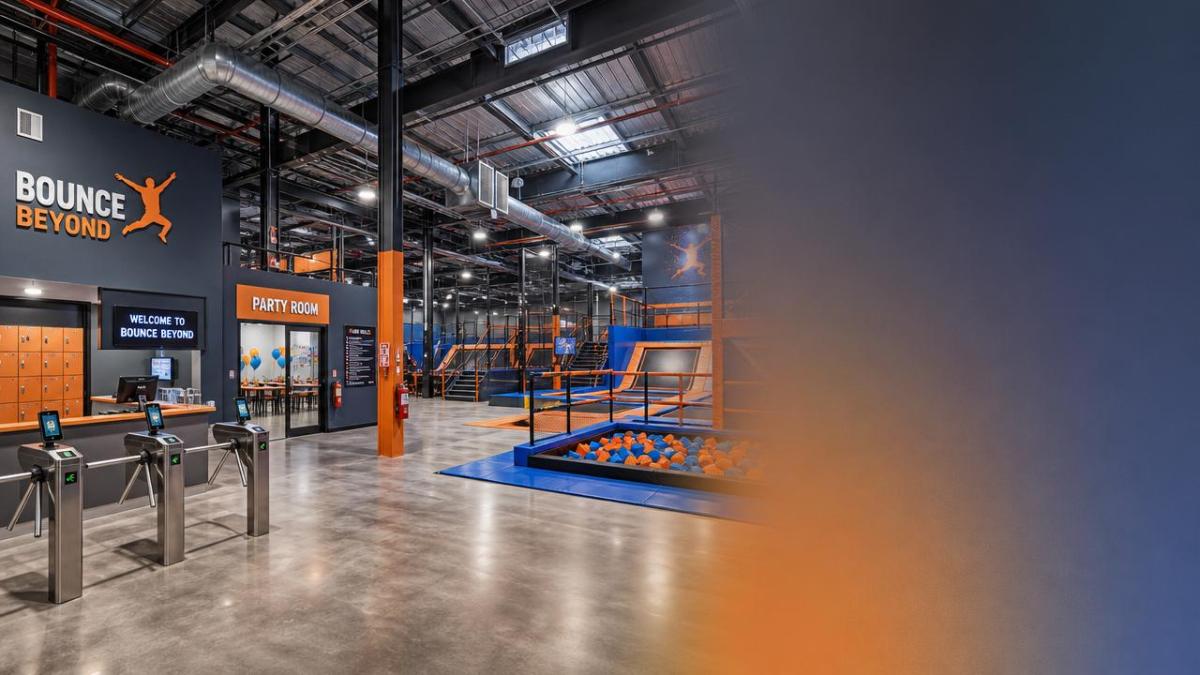
A large new-build or heavily customized destination park may look attractive because it offers branding freedom and room for premium attractions. However, this is also the scenario where trampoline park cost is most likely to be underestimated by square-foot logic. High-bay interiors, reinforced structures, fire suppression adjustments, acoustic treatment, lighting design, restrooms, reception, café space, party rooms, and circulation zones can consume a major share of capital before the jumping equipment is even considered.
The evaluator should test whether the concept depends on peak-volume weekends to make the model work. If so, parking, queuing, check-in technology, waiver management, and staff scheduling become strategic cost centers rather than minor line items. In this scenario, underinvestment creates operational bottlenecks that reduce revenue capacity even if initial build cost looks efficient on paper.
Another hidden issue is mechanical infrastructure. Larger parks with food service and high occupancy loads may require significant HVAC and ventilation upgrades. If local climate conditions are demanding, comfort control affects dwell time and repeat business directly. That makes engineering support systems part of the commercial thesis, not just background infrastructure.
Scenario 2: Retail conversions appear cheaper, but retrofit risk is high
Converting a former retail box or warehouse is one of the most common scenarios considered in trampoline park cost analysis. At first glance, these sites look efficient because rent may be lower than prime entertainment districts and the shell already exists. But business evaluators should be cautious: a low-cost shell can hide expensive corrections.
The first screening questions are practical. Is the ceiling height sufficient for safe attraction design? Does the floor slab support the planned installation? Will occupancy classification trigger costly code work? Are entrances, exits, restrooms, and ADA requirements already aligned with intended use? If not, the retrofit budget can escalate quickly.
Insurance and permitting are also sensitive in conversion projects. A building that was acceptable for passive retail use may require more robust life-safety provisions once active recreation is introduced. Evaluators who benchmark only rent and fit-out allowances often miss the compounding effect of delayed approvals, redesign fees, and contractor change orders. In this scenario, due diligence on property condition is often more valuable than debating a nominal per-square-foot benchmark.
Scenario 3: Mixed-use family entertainment centers need a different cost lens
When trampoline attractions are added to a wider family entertainment center, the correct view of trampoline park cost changes again. The goal is no longer just ticket sales from jumping; it is total customer value across multiple activities. In this scenario, the evaluator should measure how the trampoline area affects traffic flow, length of stay, food conversion, birthday packages, and repeat visits.
This model may tolerate a higher installation cost if the attraction materially lifts group bookings and cross-selling. But it also introduces integration complexity. Shared staff, POS systems, cleaning routines, waiver processes, and supervision standards need coordination. If management assumes the trampoline zone can operate like an isolated module, labor inefficiency and customer friction can dilute the expected return.
For this reason, the evaluator should compare contribution margin at the venue level rather than reviewing trampoline park cost as a standalone expense bucket. In mixed-use environments, the right investment is the one that improves the whole-site economics, even if the attraction itself looks more expensive than a basic setup.
Scenario 4: Franchise models reduce uncertainty, but add structured expenses
Franchise-backed concepts can simplify launch planning because they offer operating procedures, vendor networks, layout standards, and a recognized brand. For evaluators, this can reduce forecast uncertainty. Yet the visible trampoline park cost still does not tell the full story. Franchise fees, royalties, mandated software, marketing contributions, and prescribed equipment packages may materially change the total investment profile.
This scenario is suitable for investors who value execution discipline and market credibility over procurement freedom. However, evaluators should stress-test whether franchise compliance requirements leave enough room to adapt the site to local demand, lease constraints, and labor economics. A franchise can improve launch speed while also limiting the flexibility needed to optimize costs in nonstandard properties.
The biggest expenses that square-foot budgeting misses
Across all scenarios, certain cost drivers consistently distort trampoline park cost estimates when they are ignored or treated too lightly.
- Structural and engineering upgrades: ceiling clearance, slab review, anchoring, HVAC, electrical load, fire systems.
- Insurance and liability management: premiums, legal review, waiver systems, risk controls, claim history impact.
- Safety staffing: court monitors, supervisors, training, turnover replacement, incident response procedures.
- Ongoing maintenance: pads, springs, frames, inspections, downtime, replacement schedules.
- Revenue-supporting amenities: party rooms, café areas, lockers, check-in systems, digital reservations, CRM tools.
These categories matter because they affect both sides of the ROI equation. Some increase capex, while others shape utilization, customer experience, and operating stability. A feasibility model that excludes them may look attractive at the committee stage but fail under real operating conditions.
How business evaluators should compare scenarios before approving a project
Instead of asking for a single benchmark, evaluators should use a scenario-based checklist. This makes trampoline park cost analysis more actionable and less vulnerable to oversimplified comparisons.
Frequent misjudgments in trampoline park cost forecasting
Several errors appear repeatedly in project reviews. First, teams overvalue cheap square footage and undervalue compliant, entertainment-ready space. Second, they assume insurance is a static overhead instead of a cost shaped by design, training, and claim exposure. Third, they treat maintenance as a minor operating item even though equipment wear directly affects uptime and customer trust.
Another common mistake is importing assumptions from unrelated leisure formats. A trampoline venue is not just a retail fit-out, a gym, or an arcade. Its cost logic is hybrid: part real estate adaptation, part amusement infrastructure, part risk-managed operations. That is why precise trampoline park cost evaluation requires cross-functional review involving property, operations, safety, and finance.
FAQ for scenario-based budgeting decisions
Is trampoline park cost per square foot useless?
No. It is useful as a screening tool, but not as a decision tool. It can help compare broad options, yet it should never replace site-specific analysis of retrofit, compliance, staffing, insurance, and maintenance.
Which scenario usually carries the most hidden cost?
Retail and warehouse conversions often carry the most hidden cost because existing buildings may require significant changes to support active recreation safely and legally.
What should a business evaluator request before approving budgets?
Request a site condition review, a code and life-safety assessment, an insurance quote range, an equipment maintenance plan, and a peak-hour staffing model. Those inputs usually improve forecast quality far more than another generic square-foot estimate.
Conclusion: evaluate trampoline park cost through the operating scenario, not the shortcut
For serious investment review, trampoline park cost should be analyzed as a scenario-dependent operating system rather than a simplified construction ratio. The right budget depends on whether the project is a destination venue, a retail conversion, a mixed-use entertainment add-on, or a franchise launch. Each path changes the cost center hierarchy, risk exposure, and return logic.
If your team is assessing whether a trampoline concept fits your portfolio, start with the application scenario, then map the hidden expenses that determine resilience: structure, compliance, insurance, staffing, maintenance, and customer-flow infrastructure. That is the more reliable path to judging feasibility, protecting capital, and building a forecast grounded in operational truth rather than surface-level averages.
Search News
Hot Articles
- Carbon Fiber StructuresHow to Specify Aerospace Carbon Fiber Assemblies for Lightweight, Load-Bearing PartsJul 11, 2026
- Machine VisionXiaomi, Alibaba DAMO Academy Drive Open-Source Robotics Model Ecosystem, Lowering Algorithm Development Barriers for Overseas SMEs Adopting Chinese Robotics SolutionsMar 30, 2026
- Cobots & ArmsShanxi 'AI+' Conference Showcases Embodied Intelligence with Multinational Buyer Engagement: Key Industry ImplicationsMar 30, 2026
Popular Tags
Recommended News
 Jul 11, 2026How to Specify Aerospace Carbon Fiber Assemblies for Lightweight, Load-Bearing PartsAerospace carbon fiber assemblies: learn how to specify laminate design, load data, joining methods, and inspection controls for lighter, reliable load-bearing aerospace parts.Elena Rostova (UAV Systems Researcher)
 Mar 30, 2026Xiaomi, Alibaba DAMO Academy Drive Open-Source Robotics Model Ecosystem, Lowering Algorithm Development Barriers for Overseas SMEs Adopting Chinese Robotics SolutionsXiaomi & Alibaba DAMO Academy's open-source robotics models lower algorithm barriers for global SMEs. Boost efficiency in manufacturing, logistics & smart retail with ROS 2 compatible solutions.TSV Data Lab
 Mar 30, 2026Shanxi 'AI+' Conference Showcases Embodied Intelligence with Multinational Buyer Engagement: Key Industry ImplicationsShanxi 'AI+' Conference highlights embodied intelligence with Tesla, Ubtech & Jiantao showcasing multimodal robotics. 40+ global buyers validated tech on-site, creating new B2B channels for industrial automation & AI solutions.Chen Wei (Automation Lead Engineer)
 Mar 30, 2026Zhongguancun Unveils 6G Integrated Sensing-Computing-Intelligence Platform to Empower Embodied Robots for Global Industrial ApplicationsZhongguancun's new 6G platform revolutionizes industrial robotics with <10ms latency, empowering global automotive, logistics & port automation. Discover how this tech boosts China's smart manufacturing exports.TSV Data Lab
 Mar 30, 2026Mech-Mind Tianjin Embodied Intelligence R&D and Production Base Goes Live, Cutting Delivery Time by 20%–30% for Global Customized AMR+Vision SolutionsMech-Mind's Tianjin AMR+Vision production base cuts delivery time by 20%-30% for欧美 & Latin American markets. Discover how this PLd-certified facility accelerates customized robotics solutions for smart manufacturing and logistics.Chen Wei (Automation Lead Engineer)
 Mar 30, 2026Boao Forum Reveals 'Co-evolution of Big and Small Brains' Trend in Humanoid Robots, China's Embodied Intelligence Accelerates Adaptation to Overseas Manufacturing Service ScenariosDiscover how China's humanoid robots, featuring 'Co-evolution of Big and Small Brains,' are revolutionizing global manufacturing. Learn about Embodied Tian Gong 3.0's ISO compliance and overseas deployment at Boao Forum 2026.Chen Wei (Automation Lead Engineer)
 Mar 30, 2026China Railway Industrial Secures Patent for Embodied Robotics in Material Handling, Boosting High-Precision Delivery Capabilities for Overseas Infrastructure and Manufacturing ProjectsChina Railway Industrial's new patent for embodied robotics in material handling boosts high-precision delivery for global infrastructure & manufacturing. Discover how this innovation enhances logistics accuracy in automotive, rail transit & EPC projects.Chen Wei (Automation Lead Engineer)
 Sep 28, 2026Spindle Runout Measurement in Germany: DIN Standards, Methods, and Acceptance LimitsSpindle runout measurement Germany: explore DIN standards, proven methods, acceptance limits, and audit-ready practices for reliable machining quality.Dr. Marcus Vance
 Sep 27, 2026How to Select Wall-Mount Edge Devices for Space-Constrained Factory NetworksWall mount edge devices for space-constrained factories: evaluate workload, thermal design, power resilience, cable access, and network reliability for smarter deployments.TSV Data Lab
 Sep 26, 2026Machining Tolerance Analysis: How to Set Limits That Meet Function and Cost TargetsMachining tolerance analysis: learn how to set functional limits, control tolerance stacks, reduce inspection risk, and balance precision with production cost.Dr. Marcus Vance
 Sep 25, 2026How to Evaluate an Industrial Infrastructure Data Platform for Multi-Site OperationsIndustrial infrastructure data platform evaluation guide for multi-site operations: compare data quality, edge resilience, interoperability, governance, and scalable proof-of-value criteria.Victor Lin (Chief Software Architect)
 Sep 24, 2026How to Select Machine Vision Optics for Accurate Inspection at Different Working DistancesMachine vision optics selection guide for accurate inspection at every working distance. Compare FOV, pixel scale, DOF, distortion, lighting, and telecentric options.TSV Data Lab
 Sep 23, 2026How to Evaluate a Machine Vision System Integrator for High-Speed Inspection LinesChoose a machine vision system integrator with proven expertise in high-speed inspection, reliable reject timing, robust optics, and measurable acceptance criteria.TSV Data Lab
 Sep 28, 2026When is a SCADA API the right choice for connecting plant systems?SCADA API guide: learn when governed plant data integration improves traceability, security, and scalability—without compromising real-time control.Victor Lin (Chief Software Architect)
 Sep 27, 2026How SCADA data integration improves traceability across production linesSCADA data integration connects production-line data to improve traceability, accelerate quality investigations, and strengthen safety decisions.Victor Lin (Chief Software Architect)
 Sep 26, 2026What to define before starting SCADA integration planningSCADA integration planning starts with clear scope, control boundaries, data models, cybersecurity, and testing. Discover the definitions that reduce risk and costly rework.Victor Lin (Chief Software Architect)
 Sep 25, 2026How a smart factory with Industrial IoT reduces production blind spotsDiscover how a smart factory with Industrial IoT turns real-time machine, quality, and workflow data into actionable insights that reduce production blind spots and delivery risks.Victor Lin (Chief Software Architect)
 Sep 24, 2026When does Industrial IoT make smart manufacturing easier to scale?Smart manufacturing Industrial IoT scales when trusted data, interoperable systems, and secure workflows turn connected assets into measurable gains.TSV Data Lab
 Sep 23, 2026What drives ultra-precision machining cost at 1-micron tolerance?Ultra precision machining cost per part at 1 micron tolerance depends on process, material, metrology, and yield. Learn how to compare quotes confidently.Dr. Marcus Vance
 Sep 22, 2026Drone Engine-T550CC Applications: Build the UAV Power System Around the MissionAn application guide for Drone Engine-T550CC integration, covering payload planning, airframe matching, cooling, fuel, vibration, test procedures, documentation, and service preparation.Elena Rostova (UAV Systems Researcher)
 Sep 22, 2026How to Evaluate Industrial Edge Computing Vendors for Factory DeploymentIndustrial edge computing vendor evaluation guide for factories: compare latency, protocol fit, reliability, security, and lifecycle support before deployment.TSV Data Lab
 Sep 21, 2026Drone Payload Integration: Matching Power, Data, and Center of Gravity for Reliable FlightsDrone payload integration made practical: balance power, data, center of gravity, and endurance to build safer, more reliable mission-ready flights.Elena Rostova (UAV Systems Researcher)
 Sep 20, 2026Autonomous Navigation Pricing: Cost Drivers and Budget Benchmarks for AMR ProjectsAutonomous navigation price explained: compare AMR cost drivers, software, sensors, integration, safety, and lifecycle budgets to build a scalable project plan.Chen Wei (Automation Lead Engineer)
 Sep 19, 2026How to Scope Automation Integration Services for Multi-System Factory ProjectsAutomation integration services: learn how to scope multi-system factory projects with clear workflows, interface contracts, safety boundaries, and acceptance criteria.Victor Lin (Chief Software Architect)