
Palletizing Robot Suppliers Compared by Support After Delivery
Publication Date
author
Choosing among palletizing robot suppliers is not only about payload, speed, or footprint—it is about what happens after installation. For procurement teams, long-term uptime depends on training quality, spare parts access, response speed, software support, and lifecycle service transparency. This comparison focuses on post-delivery support factors that directly affect risk, total cost of ownership, and supplier reliability in real production environments.
For most buyers, the core search intent behind this topic is practical rather than academic: they want to compare suppliers based on post-delivery support, reduce operational risk, and avoid choosing a vendor that looks strong during sales but becomes slow, expensive, or difficult after commissioning. In procurement terms, the best supplier is often not the one with the lowest initial quote, but the one most likely to protect throughput over the next five to ten years.
The biggest concern for procurement teams is simple: if the palletizing cell stops, how fast can the supplier help restore output, and how predictable will that support be over the asset lifecycle? That concern quickly expands into related questions about service-level agreements, local field support, spare parts stocking, software patching, operator training, integration responsibility, and the real cost of ongoing technical support.
To help buyers make a better decision, this article emphasizes the factors that matter after delivery: service response structure, commissioning depth, training effectiveness, spare parts logistics, remote diagnostics, software and controls support, warranty clarity, and lifecycle cost visibility. It deliberately gives less attention to generic marketing claims or broad robot brand reputations unless they directly affect support quality in real factory conditions.
Why after-sales support matters more than a lower purchase price
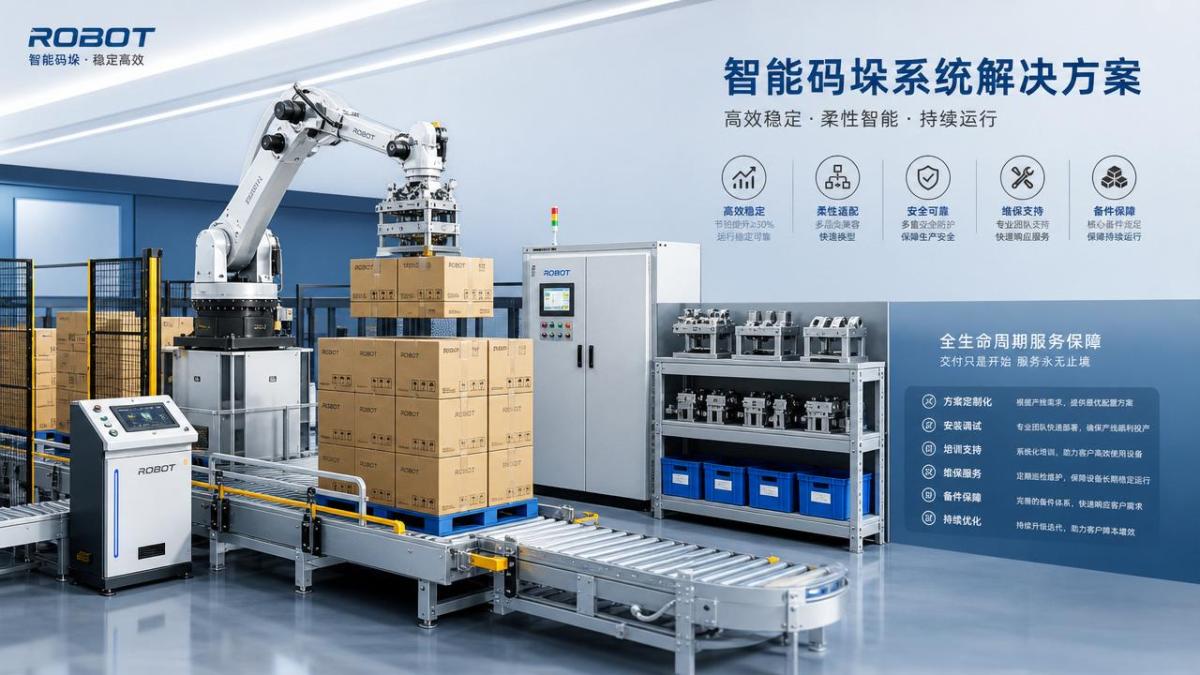
When procurement teams compare palletizing robot suppliers, the visible numbers usually come first: capital cost, rated payload, stacking speed, and line layout fit. Those metrics matter, but they do not determine whether the cell will remain productive during changeovers, staff turnover, packaging variation, or urgent production peaks. Support quality does.
A palletizing robot is not a static machine. It operates inside a live environment with conveyor timing, pallet quality variation, case deformation, barcode logic, end-of-arm tooling wear, safety interlocks, and warehouse workflow dependencies. Even if the robot arm itself is reliable, production losses often come from software adjustments, sensor faults, gripper tuning, or packaging inconsistencies. This is where supplier support becomes the deciding factor.
From a total cost of ownership perspective, one day of downtime can erase a meaningful portion of the savings gained from a lower purchase price. If a supplier cannot provide quick diagnostics, trained local technicians, and spare parts within an acceptable time window, the procurement decision becomes expensive very quickly. Buyers should therefore evaluate support not as a service add-on, but as part of the core system specification.
The most reliable procurement approach is to treat after-delivery support as a measurable performance category. Ask each supplier to document response times, escalation procedures, training scope, spare parts lead times, software update policy, and warranty exclusions. If the supplier cannot provide clear answers before the order, support after delivery will likely be even less transparent.
What procurement teams are really comparing when they assess palletizing robot suppliers
In practice, buyers are usually comparing four different types of suppliers, even if all of them sell “palletizing solutions.” The first is the global robot OEM with a broad service network. The second is a regional system integrator using a well-known robot brand. The third is a turnkey packaging automation specialist. The fourth is a lower-cost supplier with limited local presence and support delivered mostly remotely.
Each model has advantages and risks. A global OEM may offer strong spare parts availability and standardized technical documentation, but less application-specific support for your exact pallet pattern, SKU mix, or line layout. A regional integrator may understand your packaging process better and respond more flexibly, but service depth depends heavily on team size and financial stability. A turnkey specialist may own the whole line problem, which is valuable, but buyers must verify long-term support capacity after the project team moves on.
That means the right comparison is not only supplier versus supplier. It is also support model versus support model. Procurement teams should ask: who owns troubleshooting when the issue is not clearly mechanical, electrical, or software-related? Who takes responsibility if the robot, conveyor, label verification, and safety PLC are all involved? Who can support second-shift and weekend production? Those answers reveal more than brochure specifications.
A strong buying framework compares post-delivery support across five dimensions: responsiveness, technical depth, local presence, lifecycle transparency, and accountability. Suppliers that score well across all five are usually safer choices than vendors that compete mainly on quotation price or a narrow hardware specification.
How to evaluate service response before you sign the contract
Response speed is often advertised vaguely, so procurement teams should convert it into contract-grade detail. “24/7 support” means little unless the supplier defines what is included. Is support phone-only, remote-only, or on-site? Is there a guaranteed callback time? Is there a target time for remote diagnosis? Is there a target time for dispatching a field engineer? Is emergency support included in the annual service package or billed separately?
The most useful comparison table includes at least these service metrics: helpdesk availability window, first-response target, remote access capability, on-site dispatch commitment, escalation ladder, maximum time to critical spare shipment, and named regional service coverage. This lets procurement compare suppliers on measurable risk rather than assumptions.
Buyers should also test the supplier’s support maturity during the sales process. Ask technical questions by email. Request a sample incident workflow. Ask who handles a controls fault at 2 a.m. and what the escalation path looks like if the first technician cannot solve it. Mature suppliers answer with process, names, and service boundaries. Weak suppliers answer with reassurance but little structure.
Reference checks are essential here. Do not ask a reference customer only whether the supplier was “good.” Ask how long critical faults took to resolve, whether spare parts arrived on time, whether support quality changed after acceptance, and whether the supplier stayed engaged after the warranty period began. These operational details are more valuable than general satisfaction comments.
Training, commissioning, and handover quality often predict long-term uptime
Many post-delivery problems are not true equipment failures. They come from weak handover. If operators do not understand fault recovery, if maintenance teams cannot perform basic inspections, or if supervisors are unable to adjust recipes safely, small issues become production stoppages. This is why training quality should be a major part of any comparison of palletizing robot suppliers.
Procurement teams should look beyond the phrase “operator training included.” Training should be role-based. Operators need restart procedures, jam recovery, HMI navigation, and SKU changeover basics. Maintenance technicians need preventive maintenance routines, I/O diagnostics, gripper adjustment, lubrication schedules, and fault code interpretation. Engineers may need backup restore procedures, recipe management, safety reset logic, and remote support access permissions.
Commissioning depth matters just as much. A strong supplier does not only make the robot move; it verifies actual production conditions. That includes different case sizes, variable pallet quality, line speed ramp-up, shift handover behavior, and fault recovery under realistic scenarios. The best commissioning process documents acceptance criteria clearly and leaves behind a stable baseline that plant teams can support internally.
Ask suppliers for a handover package checklist. It should include electrical drawings, software backups, robot programs, spare parts lists, preventive maintenance instructions, network architecture, training records, and escalation contacts. Incomplete documentation is a common hidden cost because it slows every future service event.
Spare parts access and local inventory are not small details
For palletizing systems, spare parts strategy directly affects downtime exposure. Procurement should identify which parts are robot-brand standard items and which are custom application components. The robot controller may be globally supported, but a custom gripper assembly, vision bracket, vacuum manifold, or safety relay layout may not be available quickly unless the supplier has planned for it.
Good suppliers provide a recommended spare parts package at handover, usually divided into critical, recommended, and consumable categories. Critical items may include sensors, vacuum cups, solenoid valves, wear pads, fuses, gripper fingers, communication modules, and safety devices. Procurement should ask how each item is stocked, where it is stocked, and what the replenishment lead time is.
Local presence matters here. A supplier with engineering talent in another country may still create unacceptable downtime if customs delays or export control procedures affect replacement parts. For plants running high-throughput packaging lines, buyers should place greater value on suppliers with local or regional parts hubs and field inventory discipline.
It is also important to understand parts pricing after the warranty period. Some suppliers are competitive on the capital sale but expensive on controls modules, proprietary tooling parts, or service-only replacement assemblies. Procurement should ask for post-warranty parts pricing principles and availability commitments before purchase, not after the first breakdown.
Software support is now as important as mechanical support
Modern palletizing cells depend on more than robot mechanics. They rely on HMI logic, PLC integration, recipe management, safety programming, remote access tools, and sometimes vision or barcode verification layers. As a result, software support has become one of the most overlooked but critical factors when comparing suppliers.
Buyers should ask whether software changes after go-live are included in support packages or treated as billable engineering work. This matters because packaging operations often evolve. New SKU formats, pallet patterns, case dimensions, label positions, or warehouse requirements may require edits to logic or recipes. If every small change depends on a costly engineering visit, flexibility becomes expensive.
Cybersecurity and access control should also be part of the evaluation. Remote diagnostics are extremely valuable, but procurement and IT teams need clarity on how connections are managed, who is authorized, whether sessions are logged, and how software backups are version-controlled. A supplier that supports secure remote access can reduce mean time to resolution significantly.
Another useful question is whether the supplier uses open, maintainable controls architecture or highly proprietary software structures. Proprietary design is not automatically bad, but it can increase dependence on the original vendor. Procurement should understand whether internal engineers or third-party service firms can realistically support the system later if business conditions change.
Warranty terms, service contracts, and accountability gaps to watch for
Not all warranties protect the buyer equally. Some cover parts but not travel. Some cover defects but exclude wear, misalignment, packaging variation, or throughput issues. Some begin at shipment rather than acceptance. Procurement teams should compare warranty structures line by line and identify where operational risk still sits with the plant.
One common gap appears in multi-vendor projects. The robot OEM may blame the integrator, the integrator may blame the conveyor supplier, and the end user is left coordinating the issue. This is why accountability structure is crucial. Buyers should prefer suppliers that clearly define single-point responsibility for system-level troubleshooting, at least during the stabilization period after go-live.
Service contracts deserve the same scrutiny as the original quotation. What preventive maintenance visits are included? Are software backups checked? Are wear components inspected and replaced proactively? Is there a hotline with application support, or only generic technical support? What labor rates apply outside standard hours? The best agreements are transparent and operationally specific.
For procurement, the key is to compare support obligations in commercial terms, not only engineering terms. If two palletizing robot suppliers appear technically similar, the better supplier is often the one whose warranty and service contract remove more ambiguity from future incidents.
A practical scorecard for comparing palletizing robot suppliers after delivery
To make comparisons more objective, procurement teams can use a weighted scorecard. Instead of focusing only on capex, assign scores to support categories that affect uptime. For example: service response and escalation, 25%; training and handover quality, 20%; spare parts strategy, 20%; software and controls support, 15%; warranty and accountability, 10%; local service presence, 10%.
Under each category, define evidence-based questions. For response: documented callback time, remote diagnostics, local engineer coverage. For training: role-based curriculum, number of days on site, training materials, re-training options. For spare parts: critical list, local stock, lead times. For software: backup policy, change management, remote access, cybersecurity readiness. For warranty: exclusions, start date, travel charges, ownership of integration issues.
This structure helps prevent a common procurement mistake: overvaluing visible hardware and undervaluing support mechanisms that determine real operating resilience. It also helps cross-functional teams align. Operations, maintenance, engineering, procurement, and IT can all review the same support matrix from their own perspective.
If possible, include a scenario-based review. Ask each supplier how they would handle three realistic events: a gripper vacuum fault during peak production, a new SKU requiring recipe changes, and a communication fault between the robot and upstream conveyor PLC. The quality and specificity of the answers often reveal more than the proposal itself.
Final judgment: which type of supplier is usually the safer choice?
There is no universal winner among palletizing robot suppliers because support quality depends on application complexity, plant location, internal maintenance capability, and production criticality. However, for most procurement teams, the safer choice is the supplier that combines proven application experience with clearly documented post-delivery support and local execution capacity.
If your operation is highly standardized and your plant has strong internal automation resources, a major robot brand or technically capable integrator with structured remote support may be sufficient. If your packaging environment is variable, your line is uptime-critical, or your internal team is lean, you should usually prioritize suppliers with stronger commissioning, local service presence, and clear system-level accountability—even if the purchase price is higher.
The main lesson is straightforward: after-delivery support is not a secondary commercial detail. It is one of the most important technical and financial criteria in the purchase decision. Procurement teams that compare suppliers on response speed, training depth, spare parts readiness, software maintainability, and warranty transparency are far more likely to select a system that performs well beyond factory acceptance.
In short, when comparing palletizing robot suppliers, do not ask only who can install the system. Ask who can keep it productive, adaptable, and supportable for years. That is the comparison that protects uptime, reduces lifecycle cost, and makes the procurement decision defensible long after the robot is on the floor.
Search News
Hot Articles
- Carbon Fiber StructuresHow to Specify Aerospace Carbon Fiber Assemblies for Lightweight, Load-Bearing PartsJul 11, 2026
- Machine VisionXiaomi, Alibaba DAMO Academy Drive Open-Source Robotics Model Ecosystem, Lowering Algorithm Development Barriers for Overseas SMEs Adopting Chinese Robotics SolutionsMar 30, 2026
- Cobots & ArmsShanxi 'AI+' Conference Showcases Embodied Intelligence with Multinational Buyer Engagement: Key Industry ImplicationsMar 30, 2026
Popular Tags
Recommended News
 Jul 11, 2026How to Specify Aerospace Carbon Fiber Assemblies for Lightweight, Load-Bearing PartsAerospace carbon fiber assemblies: learn how to specify laminate design, load data, joining methods, and inspection controls for lighter, reliable load-bearing aerospace parts.Elena Rostova (UAV Systems Researcher)
 Mar 30, 2026Xiaomi, Alibaba DAMO Academy Drive Open-Source Robotics Model Ecosystem, Lowering Algorithm Development Barriers for Overseas SMEs Adopting Chinese Robotics SolutionsXiaomi & Alibaba DAMO Academy's open-source robotics models lower algorithm barriers for global SMEs. Boost efficiency in manufacturing, logistics & smart retail with ROS 2 compatible solutions.TSV Data Lab
 Mar 30, 2026Shanxi 'AI+' Conference Showcases Embodied Intelligence with Multinational Buyer Engagement: Key Industry ImplicationsShanxi 'AI+' Conference highlights embodied intelligence with Tesla, Ubtech & Jiantao showcasing multimodal robotics. 40+ global buyers validated tech on-site, creating new B2B channels for industrial automation & AI solutions.Chen Wei (Automation Lead Engineer)
 Mar 30, 2026Zhongguancun Unveils 6G Integrated Sensing-Computing-Intelligence Platform to Empower Embodied Robots for Global Industrial ApplicationsZhongguancun's new 6G platform revolutionizes industrial robotics with <10ms latency, empowering global automotive, logistics & port automation. Discover how this tech boosts China's smart manufacturing exports.TSV Data Lab
 Mar 30, 2026Mech-Mind Tianjin Embodied Intelligence R&D and Production Base Goes Live, Cutting Delivery Time by 20%–30% for Global Customized AMR+Vision SolutionsMech-Mind's Tianjin AMR+Vision production base cuts delivery time by 20%-30% for欧美 & Latin American markets. Discover how this PLd-certified facility accelerates customized robotics solutions for smart manufacturing and logistics.Chen Wei (Automation Lead Engineer)
 Mar 30, 2026Boao Forum Reveals 'Co-evolution of Big and Small Brains' Trend in Humanoid Robots, China's Embodied Intelligence Accelerates Adaptation to Overseas Manufacturing Service ScenariosDiscover how China's humanoid robots, featuring 'Co-evolution of Big and Small Brains,' are revolutionizing global manufacturing. Learn about Embodied Tian Gong 3.0's ISO compliance and overseas deployment at Boao Forum 2026.Chen Wei (Automation Lead Engineer)
 Mar 30, 2026China Railway Industrial Secures Patent for Embodied Robotics in Material Handling, Boosting High-Precision Delivery Capabilities for Overseas Infrastructure and Manufacturing ProjectsChina Railway Industrial's new patent for embodied robotics in material handling boosts high-precision delivery for global infrastructure & manufacturing. Discover how this innovation enhances logistics accuracy in automotive, rail transit & EPC projects.Chen Wei (Automation Lead Engineer)
 Sep 29, 2026ISO 9283 Repeatability: How to Evaluate Cobot Positioning PerformanceISO 9283 cobot repeatability explained: learn how payload, reach, approach direction, and test conditions affect positioning performance and cell capability.Chen Wei (Automation Lead Engineer)
 Sep 28, 2026Spindle Runout Measurement in Germany: DIN Standards, Methods, and Acceptance LimitsSpindle runout measurement Germany: explore DIN standards, proven methods, acceptance limits, and audit-ready practices for reliable machining quality.Dr. Marcus Vance
 Sep 27, 2026How to Select Wall-Mount Edge Devices for Space-Constrained Factory NetworksWall mount edge devices for space-constrained factories: evaluate workload, thermal design, power resilience, cable access, and network reliability for smarter deployments.TSV Data Lab
 Sep 26, 2026Machining Tolerance Analysis: How to Set Limits That Meet Function and Cost TargetsMachining tolerance analysis: learn how to set functional limits, control tolerance stacks, reduce inspection risk, and balance precision with production cost.Dr. Marcus Vance
 Sep 25, 2026How to Evaluate an Industrial Infrastructure Data Platform for Multi-Site OperationsIndustrial infrastructure data platform evaluation guide for multi-site operations: compare data quality, edge resilience, interoperability, governance, and scalable proof-of-value criteria.Victor Lin (Chief Software Architect)
 Sep 24, 2026How to Select Machine Vision Optics for Accurate Inspection at Different Working DistancesMachine vision optics selection guide for accurate inspection at every working distance. Compare FOV, pixel scale, DOF, distortion, lighting, and telecentric options.TSV Data Lab
 Sep 23, 2026How to Evaluate a Machine Vision System Integrator for High-Speed Inspection LinesChoose a machine vision system integrator with proven expertise in high-speed inspection, reliable reject timing, robust optics, and measurable acceptance criteria.TSV Data Lab
 Sep 28, 2026When is a SCADA API the right choice for connecting plant systems?SCADA API guide: learn when governed plant data integration improves traceability, security, and scalability—without compromising real-time control.Victor Lin (Chief Software Architect)
 Sep 27, 2026How SCADA data integration improves traceability across production linesSCADA data integration connects production-line data to improve traceability, accelerate quality investigations, and strengthen safety decisions.Victor Lin (Chief Software Architect)
 Sep 26, 2026What to define before starting SCADA integration planningSCADA integration planning starts with clear scope, control boundaries, data models, cybersecurity, and testing. Discover the definitions that reduce risk and costly rework.Victor Lin (Chief Software Architect)
 Sep 25, 2026How a smart factory with Industrial IoT reduces production blind spotsDiscover how a smart factory with Industrial IoT turns real-time machine, quality, and workflow data into actionable insights that reduce production blind spots and delivery risks.Victor Lin (Chief Software Architect)
 Sep 24, 2026When does Industrial IoT make smart manufacturing easier to scale?Smart manufacturing Industrial IoT scales when trusted data, interoperable systems, and secure workflows turn connected assets into measurable gains.TSV Data Lab
 Sep 23, 2026What drives ultra-precision machining cost at 1-micron tolerance?Ultra precision machining cost per part at 1 micron tolerance depends on process, material, metrology, and yield. Learn how to compare quotes confidently.Dr. Marcus Vance
 Sep 22, 2026Drone Engine-T550CC Applications: Build the UAV Power System Around the MissionAn application guide for Drone Engine-T550CC integration, covering payload planning, airframe matching, cooling, fuel, vibration, test procedures, documentation, and service preparation.Elena Rostova (UAV Systems Researcher)
 Sep 22, 2026How to Evaluate Industrial Edge Computing Vendors for Factory DeploymentIndustrial edge computing vendor evaluation guide for factories: compare latency, protocol fit, reliability, security, and lifecycle support before deployment.TSV Data Lab
 Sep 21, 2026Drone Payload Integration: Matching Power, Data, and Center of Gravity for Reliable FlightsDrone payload integration made practical: balance power, data, center of gravity, and endurance to build safer, more reliable mission-ready flights.Elena Rostova (UAV Systems Researcher)
 Sep 20, 2026Autonomous Navigation Pricing: Cost Drivers and Budget Benchmarks for AMR ProjectsAutonomous navigation price explained: compare AMR cost drivers, software, sensors, integration, safety, and lifecycle budgets to build a scalable project plan.Chen Wei (Automation Lead Engineer)























