How to Evaluate Supplier Qualification Support Tools for Industrial Procurement Teams
Publication Date
author
How to Evaluate Supplier Qualification Support Tools for Industrial Procurement Teams
Industrial procurement teams cannot afford supplier decisions based on polished brochures, broad capability statements, or incomplete documentation. Effective supplier qualification support tools help buyers verify technical capability, compliance evidence, production tolerances, test data, and supply chain traceability before expensive commitments are made. For teams sourcing precision components, automation systems, aerospace-grade materials, or edge technologies, the goal is not simply to collect more supplier information. It is to make qualification evidence usable, comparable, and defensible.
That distinction matters. A supplier may appear credible on paper because it holds a familiar certification, operates modern equipment, or has a well-designed website. Yet those signals do not automatically show whether it can maintain a demanding tolerance across a production batch, manage a controlled process change, support material traceability, or respond when a critical component fails in the field. The right tool should expose those gaps early, while changing suppliers is still possible.
Start With the Qualification Decision You Need to Make
Many procurement software evaluations begin with a feature checklist: dashboards, document storage, approval workflows, scoring, and integrations. Those features are useful, but they are not the starting point. First define the decision the team needs to make. Are you approving a machine shop for a low-risk bracket, qualifying a backup source for a servo assembly, or assessing a manufacturer for an aerospace or medical-device-related part? The evidence threshold changes substantially.
A supplier qualification support tool should reflect that difference rather than forcing every vendor through the same generic questionnaire. For a distributor of standard fasteners, inventory controls, authorized-source status, lead-time reliability, and counterfeit-risk procedures may carry the most weight. For a five-axis machining partner, the conversation moves toward process capability, inspection methods, material certificates, revision control, fixturing, and the supplier’s ability to explain how it protects a critical dimension during production.
In practice, the strongest procurement teams separate supplier qualification into three decisions: whether a company is eligible to supply, whether it is technically suitable for a defined part or system, and whether it can remain approved over time. A tool that treats these as one static pass-or-fail event usually creates false confidence.
Look Beyond Document Collection
A shared folder full of certificates is not a qualification system. Nor is a vendor portal that only confirms that files were uploaded. The critical question is whether the platform can connect each document to a requirement, an expiration date, a manufacturing site, a product family, and a responsible reviewer.
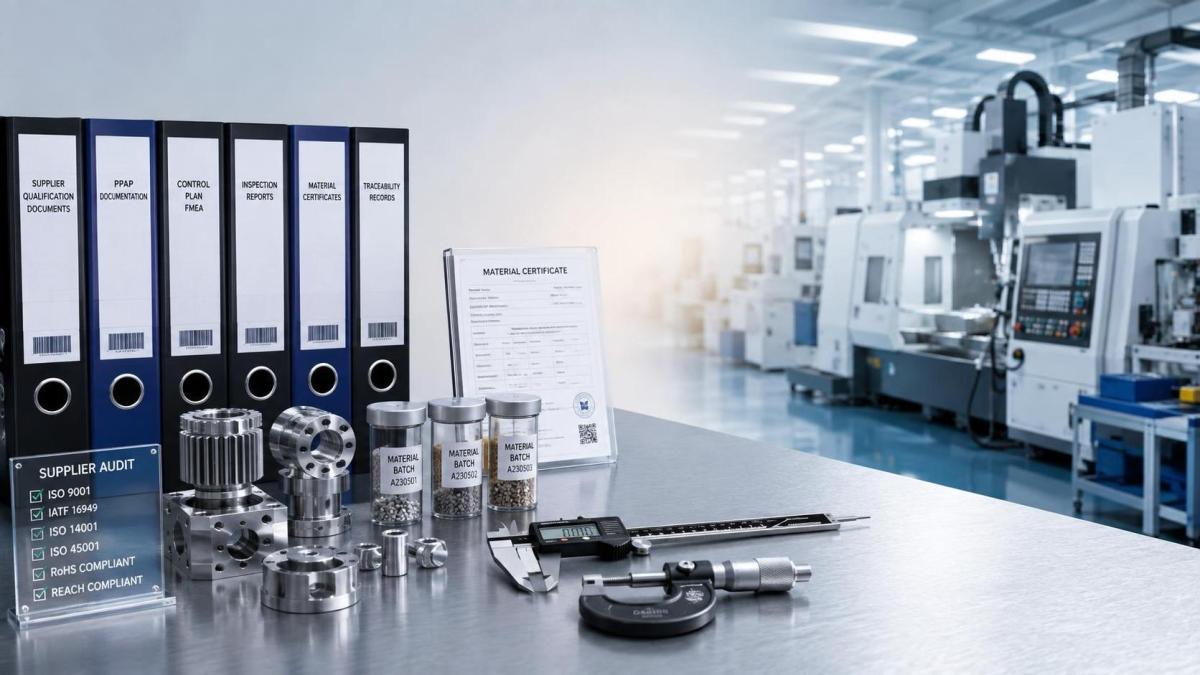
For example, a quality certificate can support supplier eligibility, but it does not prove performance on a particular job. A tool should allow the team to distinguish between a current certification, a material test report tied to a lot, a first article inspection package, a calibration record, and a supplier-generated capability claim. These records carry different evidentiary value. If they are all stored as undifferentiated attachments, reviewers must reconstruct the story manually every time a sourcing decision is challenged.
The practical test is simple: when engineering asks, “Why was this supplier approved for this component?” can procurement retrieve a clear answer without searching through emails, spreadsheets, and individual drives? If the answer is no, the organization has a document repository, not a qualification support tool.
Evaluate the Tool’s Ability to Handle Engineering Evidence
Hard-tech procurement is often undermined by a mismatch between commercial workflows and engineering reality. A standard supplier scorecard may rate “quality” as green based on a broad questionnaire response, while the engineering team is concerned with a specific problem: repeatability under payload, fatigue performance of an alloy, latency under network load, or tolerance stability after a tooling change.
This is where technical benchmarking and structured evidence become more valuable than marketing language. Tools should make room for measurable specifications and their context. For robotics, that may include repeatability, duty cycle assumptions, environmental operating conditions, and documented service intervals. For AGV or AMR sourcing, navigation performance needs to be considered alongside site conditions, floor reflectivity, wireless interference, safety architecture, and recovery behavior after route disruption. A headline specification rarely tells the entire operational story.
For sensors and edge AI systems, procurement should not accept phrases such as “high accuracy” or “low latency” without asking how those claims were measured. Was the test conducted under controlled lighting? At what distance, compute configuration, frame rate, temperature range, or electromagnetic environment? If the tool supports structured test-data fields, source links, reviewer notes, and versioned attachments, it can preserve the conditions behind the number. That makes later comparison possible.
The same principle applies to machining. A quoted tolerance is not enough. Buyers need to understand whether the tolerance applies to a prototype or serial production, which measurement method is used, whether inspection is performed in-process or only at final inspection, and how the supplier manages critical features after a program or fixture revision. In aerospace and medical-device supply chains, standards such as AS9100 or ISO 13485 may be relevant depending on the product and contractual requirement, but certification should be treated as one input—not a shortcut around technical review.
What Good Supplier Qualification Tools Should Make Easier
The best platforms reduce administrative effort without flattening technical judgment. During evaluation, ask vendors to demonstrate real workflows using an example close to your sourcing environment. Avoid being impressed by a polished dashboard alone. Watch how the system handles incomplete evidence, conflicting reviewer opinions, expired documents, site-level differences, and a supplier that is acceptable for one commodity but not another.
Do Not Let Scoring Replace Judgment
Supplier scoring is useful when it exposes trade-offs. It becomes risky when it hides them. A weighted score may place cost, responsiveness, quality-system maturity, financial review, and technical capability on one screen, but a high aggregate score can conceal a fatal weakness. A supplier with attractive pricing and strong communication may still be unfit for a component where traceability, fatigue behavior, or process stability is non-negotiable.
Choose tools that allow disqualifying conditions or “gates,” not only averages. Examples could include missing required material traceability, lack of a required process approval, an unresolved quality nonconformance, or no evidence that a relevant performance threshold has been tested. The exact gates should be defined by internal engineering, quality, contractual, and regulatory needs. The point is that some requirements should never be diluted by a favorable commercial score.
It is also worth challenging opaque risk scores. External data can be useful for identifying possible issues, but procurement should know what the score represents, when it was updated, and what source material supports it. A tool that labels a supplier “low risk” without showing the basis is no better than a marketing claim in a different format.
Integration Matters, but Not at the Expense of Data Quality
Qualification tools often promise integration with ERP, PLM, quality-management systems, contract repositories, and supplier relationship platforms. This can be valuable, particularly when approved-supplier status needs to control purchasing actions. But integration should follow a clear data model. Otherwise, teams simply spread inconsistent supplier records across more systems.
Before selecting a platform, clarify which system owns the supplier master record, which system owns part or specification revision data, and where the final approval decision is recorded. Determine whether the tool can distinguish a corporate supplier from an individual manufacturing site. This matters when one group operates multiple plants with different equipment, quality systems, subcontracting practices, or inspection capacity.
A sensible implementation usually begins with a limited set of high-risk categories rather than attempting to clean every supplier record at once. Precision machining, critical electronics, motion-control components, aerospace structures, LiDAR, and industrial connectivity equipment are often better starting points than low-risk indirect spend because the benefits of better evidence are easier to see.
Use Independent Technical Sources Where Claims Need Context
Procurement teams should expect suppliers to provide evidence. They should also recognize that supplier-issued materials are inherently selective. Independent engineering research, benchmark reports, traceability analysis, and technical whitepapers can provide a useful second lens, especially in fast-moving hard-tech categories.
This is the reasoning behind data-driven benchmarking platforms such as TechStat Vanguard. TSV’s approach is centered on separating promotional language from measurable engineering evidence: robotic repeatability rather than broad automation claims; LiDAR anti-interference performance and point-cloud characteristics rather than generic accuracy statements; machining tolerance and fatigue-test context rather than a simple “high precision” label. Such sources should not replace supplier audits or internal validation, but they can sharpen the questions a procurement team asks.
For complex sourcing decisions, a useful qualification tool should let teams retain that outside context alongside supplier submissions. A benchmark may identify a parameter worth investigating. The supplier’s technical package, quality records, sample-part results, and engineering review then determine whether it is acceptable for the intended application.
A Better Buying Test: Run a Live Qualification Scenario
Before signing a software contract, run a real or simulated qualification scenario through the shortlisted tools. Use a supplier with mixed evidence: a current certificate, an incomplete questionnaire, a technical claim that needs clarification, an expiring document, and a part-specific requirement. Ask the vendor to show how the system captures the gap, routes it to the right reviewer, prevents premature approval, and records the final rationale.
This exercise reveals more than a conventional demo. It shows whether the platform supports disciplined decisions under normal procurement pressure, when engineering wants a quick answer, the supplier is following up, and production dates are approaching. If the system makes it easy to waive missing evidence without recording the owner, reason, scope, and review date, it may speed up purchasing while increasing risk.
The best supplier qualification support tools do not promise certainty. Industrial sourcing rarely offers that. They create a reliable record of what was verified, what remains uncertain, who accepted the residual risk, and when the decision must be reviewed again. For procurement teams operating across automation, aerospace, sensors, edge systems, and precision manufacturing, that discipline is far more valuable than another supplier directory filled with untested claims.
Search News
Hot Articles
- Carbon Fiber StructuresHow to Specify Aerospace Carbon Fiber Assemblies for Lightweight, Load-Bearing PartsJul 11, 2026
- Machine VisionXiaomi, Alibaba DAMO Academy Drive Open-Source Robotics Model Ecosystem, Lowering Algorithm Development Barriers for Overseas SMEs Adopting Chinese Robotics SolutionsMar 30, 2026
- Cobots & ArmsShanxi 'AI+' Conference Showcases Embodied Intelligence with Multinational Buyer Engagement: Key Industry ImplicationsMar 30, 2026
Popular Tags
Recommended News
 Jul 11, 2026How to Specify Aerospace Carbon Fiber Assemblies for Lightweight, Load-Bearing PartsAerospace carbon fiber assemblies: learn how to specify laminate design, load data, joining methods, and inspection controls for lighter, reliable load-bearing aerospace parts.Elena Rostova (UAV Systems Researcher)
 Mar 30, 2026Xiaomi, Alibaba DAMO Academy Drive Open-Source Robotics Model Ecosystem, Lowering Algorithm Development Barriers for Overseas SMEs Adopting Chinese Robotics SolutionsXiaomi & Alibaba DAMO Academy's open-source robotics models lower algorithm barriers for global SMEs. Boost efficiency in manufacturing, logistics & smart retail with ROS 2 compatible solutions.TSV Data Lab
 Mar 30, 2026Shanxi 'AI+' Conference Showcases Embodied Intelligence with Multinational Buyer Engagement: Key Industry ImplicationsShanxi 'AI+' Conference highlights embodied intelligence with Tesla, Ubtech & Jiantao showcasing multimodal robotics. 40+ global buyers validated tech on-site, creating new B2B channels for industrial automation & AI solutions.Chen Wei (Automation Lead Engineer)
 Mar 30, 2026Zhongguancun Unveils 6G Integrated Sensing-Computing-Intelligence Platform to Empower Embodied Robots for Global Industrial ApplicationsZhongguancun's new 6G platform revolutionizes industrial robotics with <10ms latency, empowering global automotive, logistics & port automation. Discover how this tech boosts China's smart manufacturing exports.TSV Data Lab
 Mar 30, 2026Mech-Mind Tianjin Embodied Intelligence R&D and Production Base Goes Live, Cutting Delivery Time by 20%–30% for Global Customized AMR+Vision SolutionsMech-Mind's Tianjin AMR+Vision production base cuts delivery time by 20%-30% for欧美 & Latin American markets. Discover how this PLd-certified facility accelerates customized robotics solutions for smart manufacturing and logistics.Chen Wei (Automation Lead Engineer)
 Mar 30, 2026Boao Forum Reveals 'Co-evolution of Big and Small Brains' Trend in Humanoid Robots, China's Embodied Intelligence Accelerates Adaptation to Overseas Manufacturing Service ScenariosDiscover how China's humanoid robots, featuring 'Co-evolution of Big and Small Brains,' are revolutionizing global manufacturing. Learn about Embodied Tian Gong 3.0's ISO compliance and overseas deployment at Boao Forum 2026.Chen Wei (Automation Lead Engineer)
 Mar 30, 2026China Railway Industrial Secures Patent for Embodied Robotics in Material Handling, Boosting High-Precision Delivery Capabilities for Overseas Infrastructure and Manufacturing ProjectsChina Railway Industrial's new patent for embodied robotics in material handling boosts high-precision delivery for global infrastructure & manufacturing. Discover how this innovation enhances logistics accuracy in automotive, rail transit & EPC projects.Chen Wei (Automation Lead Engineer)
 Oct 20, 2026KUKA Launches iiQKA.AI Vision to Simplify Industrial Image ProcessingKUKA iiQKA.AI Vision simplifies industrial image processing with controller-based 2D and 3D vision. Explore drag-and-drop setup for vision-guided automation.TSV Data Lab
 Oct 20, 2026Smart Industrial Edge Devices: Key Criteria for Legacy PLC IntegrationChoose smart industrial edge devices for legacy PLC integration. Discover key criteria for compatibility, data quality, security, and reliable collection without disrupting control.TSV Data Lab
 Oct 19, 2026Choosing a Radar Sensor by Application: Range, Resolution, and Field of ViewSimplify radar sensor application based product selection. Compare range, resolution, and field of view to avoid blind spots and choose with confidence. Explore the guide.TSV Data Lab
 Oct 18, 2026Comparing Material Options for Procurement: Specs, Costs, and Supply RisksExplore procurement oriented technical content on material options, specs, costs, and supply risks. Compare alternatives to cut hidden expenses and make confident sourcing decisions.Dr. Marcus Vance
 Oct 17, 20265-Axis CNC Positioning Accuracy: How to Interpret ISO 230-2 Test ResultsAssess 5 axis CNC machining positioning accuracy with ISO 230-2. Learn to interpret repeatability, reversal error, and test conditions to compare suppliers and make confident acceptance decisions.Dr. Marcus Vance
 Oct 16, 2026Choosing a Rugged Edge AI Box Supplier: Thermal Tests and Lifecycle SupportChoose a rugged edge AI box supplier with proven thermal performance and reliable lifecycle support. Discover the tests and commitments to verify before you buy.TSV Data Lab
 Oct 15, 2026R&D Cost Reduction Services: How to Evaluate Fees, Savings, and ROIEvaluate R&D cost reduction services with confidence. Compare fees, verify savings, and calculate ROI without compromising performance. Discover how to choose a provider that delivers real value.Chen Wei (Automation Lead Engineer)
 Oct 19, 2026How Do You Verify That Precision Machined Parts Meet Tolerances?Master precision machining tolerance verification with the right tools, datum setups, and acceptance rules. Learn how to validate parts confidently and reduce costly inspection errors.Dr. Marcus Vance
 Oct 18, 2026What Should an AS9100 Machining Supplier Checklist Include?Build an AS9100 machining supplier checklist that verifies capability, traceability, inspection, and outsourced processes. Discover what to check before approving your next aerospace supplier.Dr. Marcus Vance
 Oct 17, 2026How Should You Interpret Industrial Robot Repeatability Specs?Decode industrial robot repeatability specifications, understand ISO 9283 test conditions, and avoid costly selection mistakes. Learn how to verify performance for your process.Chen Wei (Automation Lead Engineer)
 Oct 16, 2026How Can You Fairly Compare MTBF Across Industrial Servo Motors?Make a fair industrial servo motor MTBF comparison with matched operating profiles, failure criteria, and confidence bounds. Discover how to assess reliability beyond advertised numbers.Chen Wei (Automation Lead Engineer)
 Oct 15, 2026How Should You Compare TechStat Vanguard 5-Axis CNC Tolerances?TechStat Vanguard 5-axis CNC tolerance comparison: learn how to verify part accuracy, assess inspection evidence, and choose suppliers that reliably meet your drawing requirements.Dr. Marcus Vance
 Oct 14, 2026Drone Frame Composites: Carbon Fiber vs. Fiberglass for Weight and StiffnessExplore drone structural materials composites: compare carbon fiber and fiberglass for weight, stiffness, cost, and antenna compatibility. Find the right material for your drone frame.Elena Rostova (UAV Systems Researcher)
 Oct 13, 2026Smart Cameras vs. PC-Based Machine Vision: Which Fits High-Speed Inspection?This industrial product comparison for machine vision weighs smart cameras vs. PC-based systems on latency, throughput, and cost. Discover your best fit for high-speed inspection.TSV Data Lab
 Oct 12, 2026How to Verify RoHS Compliance in Industrial Sensing Systems Before DeploymentRoHS compliant sensing systems: learn how to verify materials, supplier declarations, testing, and configuration controls before industrial deployment.TSV Data Lab
 Oct 11, 2026How Procurement-Oriented Content Taxonomy Improves B2B Buying JourneysProcurement-oriented content taxonomy streamlines B2B buying journeys with clearer evidence, supplier comparisons, risk visibility, and faster approvals.TSV Data Lab
 Oct 10, 2026How to Select a Machine Performance Monitoring Platform for OEE and Downtime ReductionMachine performance monitoring platform selection guide: validate machine states, OEE data, downtime reasons, integrations, and scalability to reduce losses with confidence.TSV Data Lab