Why Two Flight Controller Latency Tests Can Tell Opposite Stories
Publication Date
author
Why Two Flight Controller Latency Tests Can Tell Opposite Stories
A flight controller latency benchmark can look definitive—until a second test tells the opposite story. For engineers, operators, buyers, and decision-makers evaluating UAV systems, the key point is simple: conflicting latency results do not automatically mean one test is wrong. More often, they reveal that the controller is being measured under different conditions, with different bottlenecks, priorities, and failure modes. In practice, factors such as drone electromagnetic interference test conditions, payload changes, sensor pipelines, filtering logic, and even UAV center of gravity calculation can materially change the observed outcome. If you want to compare systems responsibly, you need to compare not just the number, but the test architecture behind the number.
Why can two latency tests on the same flight controller produce opposite results?
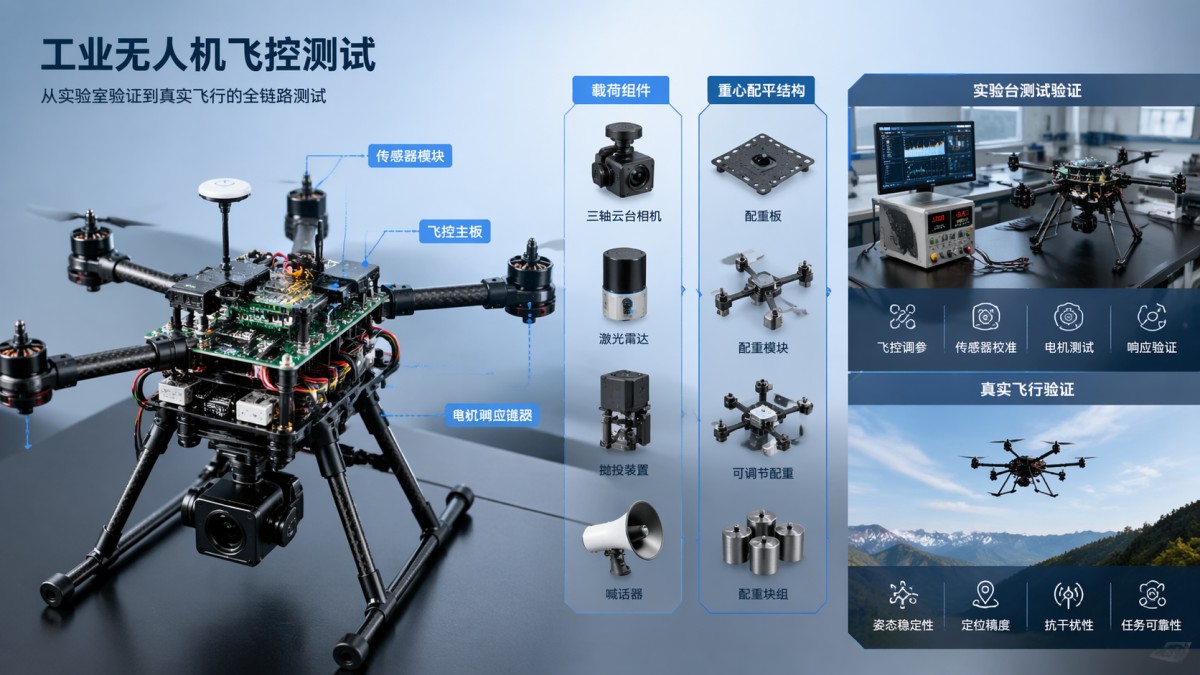
The short answer is that “latency” is rarely one single thing. One test may measure command-to-motor response in a clean lab setup, while another may measure end-to-end control loop delay during real flight, with sensors, payload, radio link, vibration, and onboard computation all active. Both may be valid, but they are not measuring the same engineering reality.
That is why one controller can appear faster in Test A and slower in Test B. The apparent contradiction usually comes from changes in:
- What part of the control chain is being measured
- Whether the system is tested on bench or in flight
- Sensor fusion load and filtering configuration
- Payload mass and balance state
- Electromagnetic environment and interference exposure
- Motor, ESC, and actuator response characteristics
- Sampling rate, logging method, and timing reference
For technical teams, this means a latency number without context has limited decision value. For procurement and management, it means vendor comparisons based only on headline benchmark data can be misleading.
What does “flight controller latency” actually include?
Many disagreements start with definitions. Depending on the test, flight controller latency may refer to only one stage or to a full stack of stages:
- Pilot input to radio receiver processing
- Receiver output to flight controller interpretation
- Sensor acquisition to estimator update
- State estimation to control law output
- Control output to ESC response
- ESC response to motor torque generation
- Aircraft physical response after thrust change
If one benchmark focuses on software loop speed and another looks at real vehicle attitude response, the results can point in opposite directions. A controller with very fast internal computation may still deliver slower apparent flight response if the airframe is poorly balanced, the payload is heavier, or the control filtering is tuned conservatively for stability.
This distinction matters especially in commercial and industrial UAV applications. Mapping, inspection, agriculture, and defense-adjacent operations often care less about the smallest raw latency number and more about predictable latency under mission load.
How do test design choices change the result so much?
Latency tests are highly sensitive to methodology. A small change in setup can alter the ranking between two products.
Common test design variables include:
- Bench test vs flight test: Bench tests reduce environmental noise, but they can hide vibration, airflow, sensor disturbance, and propulsion interactions.
- Closed-loop vs open-loop measurement: Open-loop tests isolate internal delays, while closed-loop tests show how the full aircraft behaves.
- Single-axis vs multi-axis maneuvers: A controller may look excellent in simple roll steps but degrade under coupled attitude changes.
- Low payload vs mission payload: A lightly loaded drone can respond faster than the same system carrying camera, LiDAR, sprayer, or compute hardware.
- Firmware version and parameter settings: Filter settings, estimator tuning, and failsafe logic can shift response behavior significantly.
- Timing instrumentation: Oscilloscope-triggered electrical measurements and software timestamps do not always capture the same reality.
In other words, the test is not just observing the system; it is selecting which system behavior becomes visible.
How do payload and UAV center of gravity calculation affect latency readings?
This is one of the most overlooked reasons for “opposite stories.” Strictly speaking, payload and balance do not always increase the flight controller’s internal computational delay. But they can absolutely change the aircraft’s effective response time, which many field tests interpret as latency.
When payload changes, three things often happen:
- Total inertia rises. The airframe physically reacts more slowly to the same control output.
- Center of gravity shifts. The controller must work harder to stabilize the aircraft, often using different motor output patterns.
- Vibration and sensor quality change. IMU readings may become noisier, leading to heavier filtering or reduced estimator confidence.
This is where UAV center of gravity calculation becomes operationally important. A controller tested on a well-balanced airframe may appear highly responsive. The same unit, mounted with an offset payload or front-heavy sensor stack, can look slower, less stable, or inconsistent in repeated tests.
For operators and integrators, the lesson is clear: do not separate controller evaluation from airframe loading conditions. If the application involves gimbals, mapping cameras, multispectral payloads, delivery boxes, or edge AI modules, latency testing should be repeated in those real configurations.
Why do drone electromagnetic interference test conditions matter?
Electromagnetic interference can change latency outcomes even when the controller hardware itself is unchanged. In UAV systems, EMI can affect sensor buses, GNSS reception, magnetometer reliability, telemetry links, and even internal timing stability depending on shielding and board design.
Under poor drone electromagnetic interference test conditions, a controller may show:
- Delayed or noisy sensor updates
- Temporary estimator instability
- More aggressive filtering behavior
- Communication retries or data dropouts
- Apparent control lag during high-power transmission or motor load events
This is why a controller that performs brilliantly in a clean indoor electronics lab may underperform in a high-interference field environment near power infrastructure, industrial equipment, dense RF traffic, or payloads with strong onboard emissions.
For enterprise buyers, this has direct sourcing implications. A latency claim without EMI disclosure is incomplete. The question is not only “What is the latency?” but also “What is the latency under relevant electromagnetic stress?”
Can a slower-looking controller actually be the better choice?
Yes. In some cases, what looks slower in a benchmark is actually more robust in real operations.
For example, one controller may prioritize aggressive responsiveness in clean conditions, while another applies more filtering, fault tolerance, or sensor validation. The first may win a simplified latency contest; the second may hold stability better in vibration, GPS degradation, or interference-heavy missions.
This matters because many end users do not buy flight controllers for abstract benchmark leadership. They buy them for outcomes such as:
- Safer operation in contested environments
- More stable image capture
- Lower tuning burden across payload changes
- Reduced crash risk from noisy sensor states
- More repeatable behavior across fleets
For decision-makers, the best controller is often not the one with the lowest isolated latency figure, but the one with the most credible mission-level response profile.
How should engineers and buyers compare latency tests correctly?
A useful comparison framework should ask five practical questions:
- What exact latency is being measured?
Internal loop latency, actuator latency, or full vehicle response? - Under what payload and balance condition?
Was UAV center of gravity calculation controlled and documented? - What environmental stress was included?
Were drone electromagnetic interference test conditions, vibration, and thermal load part of the method? - What firmware and tuning state was used?
Default settings, optimized settings, or vendor-assisted tuning? - What mission profile does the benchmark resemble?
FPV agility, mapping stability, inspection hover, delivery load, or autonomous route following?
If a report cannot answer these questions, it should not drive procurement or architecture decisions on its own.
What should a trustworthy latency benchmark report include?
For a benchmark to be decision-grade rather than marketing-grade, it should include:
- Clear latency definition and timing boundaries
- Airframe, motor, ESC, propeller, and payload details
- Firmware version and parameter configuration
- Environmental conditions and EMI exposure notes
- Measurement tools and synchronization method
- Repeatability across multiple runs
- Error bars, not just single best-case values
- Explanation of whether the result reflects bench, simulated, or true flight conditions
This level of disclosure is especially important in hard-tech procurement. It reduces trial-and-error cost, shortens supplier qualification cycles, and prevents teams from overtrusting numbers that are technically correct but operationally incomplete.
Conclusion: opposite test results are often a signal to ask better questions
When two flight controller latency tests tell opposite stories, the right response is not to dismiss one result immediately. It is to investigate what each test actually measured, what conditions shaped the outcome, and which result better matches your real use case.
For engineers, that means separating internal control-loop speed from aircraft-level response. For operators, it means testing with realistic payload and balance states. For procurement teams and enterprise decision-makers, it means requiring benchmark transparency, including drone electromagnetic interference test conditions and UAV center of gravity calculation context.
The most valuable latency number is not the most impressive one. It is the one you can trust under mission-relevant conditions. In UAV evaluation, engineering truth begins when the test method is as visible as the result.
Search News
Hot Articles
- Carbon Fiber StructuresHow to Specify Aerospace Carbon Fiber Assemblies for Lightweight, Load-Bearing PartsJul 11, 2026
- Machine VisionXiaomi, Alibaba DAMO Academy Drive Open-Source Robotics Model Ecosystem, Lowering Algorithm Development Barriers for Overseas SMEs Adopting Chinese Robotics SolutionsMar 30, 2026
- Cobots & ArmsShanxi 'AI+' Conference Showcases Embodied Intelligence with Multinational Buyer Engagement: Key Industry ImplicationsMar 30, 2026
Popular Tags
Recommended News
 Jul 11, 2026How to Specify Aerospace Carbon Fiber Assemblies for Lightweight, Load-Bearing PartsAerospace carbon fiber assemblies: learn how to specify laminate design, load data, joining methods, and inspection controls for lighter, reliable load-bearing aerospace parts.Elena Rostova (UAV Systems Researcher)
 Mar 30, 2026Xiaomi, Alibaba DAMO Academy Drive Open-Source Robotics Model Ecosystem, Lowering Algorithm Development Barriers for Overseas SMEs Adopting Chinese Robotics SolutionsXiaomi & Alibaba DAMO Academy's open-source robotics models lower algorithm barriers for global SMEs. Boost efficiency in manufacturing, logistics & smart retail with ROS 2 compatible solutions.TSV Data Lab
 Mar 30, 2026Shanxi 'AI+' Conference Showcases Embodied Intelligence with Multinational Buyer Engagement: Key Industry ImplicationsShanxi 'AI+' Conference highlights embodied intelligence with Tesla, Ubtech & Jiantao showcasing multimodal robotics. 40+ global buyers validated tech on-site, creating new B2B channels for industrial automation & AI solutions.Chen Wei (Automation Lead Engineer)
 Mar 30, 2026Zhongguancun Unveils 6G Integrated Sensing-Computing-Intelligence Platform to Empower Embodied Robots for Global Industrial ApplicationsZhongguancun's new 6G platform revolutionizes industrial robotics with <10ms latency, empowering global automotive, logistics & port automation. Discover how this tech boosts China's smart manufacturing exports.TSV Data Lab
 Mar 30, 2026Mech-Mind Tianjin Embodied Intelligence R&D and Production Base Goes Live, Cutting Delivery Time by 20%–30% for Global Customized AMR+Vision SolutionsMech-Mind's Tianjin AMR+Vision production base cuts delivery time by 20%-30% for欧美 & Latin American markets. Discover how this PLd-certified facility accelerates customized robotics solutions for smart manufacturing and logistics.Chen Wei (Automation Lead Engineer)
 Mar 30, 2026Boao Forum Reveals 'Co-evolution of Big and Small Brains' Trend in Humanoid Robots, China's Embodied Intelligence Accelerates Adaptation to Overseas Manufacturing Service ScenariosDiscover how China's humanoid robots, featuring 'Co-evolution of Big and Small Brains,' are revolutionizing global manufacturing. Learn about Embodied Tian Gong 3.0's ISO compliance and overseas deployment at Boao Forum 2026.Chen Wei (Automation Lead Engineer)
 Mar 30, 2026China Railway Industrial Secures Patent for Embodied Robotics in Material Handling, Boosting High-Precision Delivery Capabilities for Overseas Infrastructure and Manufacturing ProjectsChina Railway Industrial's new patent for embodied robotics in material handling boosts high-precision delivery for global infrastructure & manufacturing. Discover how this innovation enhances logistics accuracy in automotive, rail transit & EPC projects.Chen Wei (Automation Lead Engineer)
 Oct 23, 2026US Navy Raises Gecko Robotics Contract Ceiling to $300M for Robotic Fleet MaintenanceUS Navy raises Gecko Robotics’ contract ceiling to $300M for Pacific Fleet robotic inspections. Explore potential opportunities for maintenance suppliers and key procurement considerations.Chen Wei (Automation Lead Engineer)
 Oct 23, 2026Choosing Industrial Sensing Systems for Global Plants: Protocol CompatibilityCompare industrial sensing systems international buyers can trust. Explore protocol compatibility, reduce integration risks, and select proven configurations for reliable global plant deployments.TSV Data Lab
 Oct 22, 2026KUKA Showcases Physical AI and iiQKA.AI Vision at NVIDIA GTC BerlinExplore KUKA’s Physical AI showcase at NVIDIA GTC Berlin and discover how iiQKA.AI Vision aims to simplify robotic vision integration and improve 2D and 3D scene recognition.TSV Data Lab
 Oct 22, 2026Robotic Machining of Advanced Composites: What Tolerances Are Achievable?Explore advanced materials machining robotics: discover what drives achievable composite tolerances and how to validate accuracy before investing in your next machining system.Dr. Marcus Vance
 Oct 21, 2026China’s Industrial Robot Exports Near RMB 10 Billion in First Nine Months of 2026China’s industrial robot exports neared RMB 10 billion in January–September 2026, with value rising faster than volume. Explore the data and what it could mean for suppliers.Chen Wei (Automation Lead Engineer)
 Oct 21, 2026Low-Latency Industrial Data Processing: Pricing and Key Cost DriversExplore industrial data latency price drivers, from edge hardware to integration and support. Learn how to compare quotes, verify performance, and avoid unnecessary costs.TSV Data Lab
 Oct 20, 2026KUKA Launches iiQKA.AI Vision to Simplify Industrial Image ProcessingKUKA iiQKA.AI Vision simplifies industrial image processing with controller-based 2D and 3D vision. Explore drag-and-drop setup for vision-guided automation.TSV Data Lab
 Oct 20, 2026Smart Industrial Edge Devices: Key Criteria for Legacy PLC IntegrationChoose smart industrial edge devices for legacy PLC integration. Discover key criteria for compatibility, data quality, security, and reliable collection without disrupting control.TSV Data Lab
 Oct 19, 2026Choosing a Radar Sensor by Application: Range, Resolution, and Field of ViewSimplify radar sensor application based product selection. Compare range, resolution, and field of view to avoid blind spots and choose with confidence. Explore the guide.TSV Data Lab
 Oct 18, 2026Comparing Material Options for Procurement: Specs, Costs, and Supply RisksExplore procurement oriented technical content on material options, specs, costs, and supply risks. Compare alternatives to cut hidden expenses and make confident sourcing decisions.Dr. Marcus Vance
 Oct 17, 20265-Axis CNC Positioning Accuracy: How to Interpret ISO 230-2 Test ResultsAssess 5 axis CNC machining positioning accuracy with ISO 230-2. Learn to interpret repeatability, reversal error, and test conditions to compare suppliers and make confident acceptance decisions.Dr. Marcus Vance
 Oct 16, 2026Choosing a Rugged Edge AI Box Supplier: Thermal Tests and Lifecycle SupportChoose a rugged edge AI box supplier with proven thermal performance and reliable lifecycle support. Discover the tests and commitments to verify before you buy.TSV Data Lab
 Oct 15, 2026R&D Cost Reduction Services: How to Evaluate Fees, Savings, and ROIEvaluate R&D cost reduction services with confidence. Compare fees, verify savings, and calculate ROI without compromising performance. Discover how to choose a provider that delivers real value.Chen Wei (Automation Lead Engineer)
 Oct 23, 2026How Do You Evaluate Solid-State LiDAR Point Cloud Density?Evaluate solid-state LiDAR point cloud density using valid returns, angular spacing, and real-world coverage. Discover how to compare sensors and choose the right fit for your application.TSV Data Lab
 Oct 22, 2026How Do You Test AMR Navigation Accuracy in a Warehouse?Test AMR navigation accuracy in warehouses with practical methods for localization, path tracking, and docking. Learn to set tolerances and compare robots before deployment.Chen Wei (Automation Lead Engineer)
 Oct 21, 2026How Should You Balance Cobot Payload Against Reach?Explore cobot payload versus reach to choose the right robot. Learn how tooling, load limits, workspace, and cycle time affect performance—and avoid costly selection mistakes.Chen Wei (Automation Lead Engineer)
 Oct 20, 2026How Do You Measure Industrial IoT Gateway Latency Under Load?Measure industrial IoT gateway latency under load with reliable timestamps, realistic traffic, and tail-latency analysis. Discover how to expose bottlenecks and choose the right gateway.TSV Data Lab