How Is UAV Climb Rate Testing Conducted for Flight Performance Validation?
Publication Date
author
UAV climb rate testing is a critical step in flight performance validation, giving technical evaluators a data-grounded view of vertical ascent capability under defined payload, power, and environmental conditions. By measuring time-to-altitude, thrust response, and stability margins, this test helps separate nominal specifications from verified engineering performance—exactly the level of evidence required for procurement, benchmarking, and airframe system assessment.
In practice, climb performance is often misunderstood because vendor datasheets typically present a single “maximum climb rate” figure without the conditions that make that number meaningful. A rate achieved with a fresh battery, no payload, low-density altitude, and aggressive motor thermal margins says little about how the same aircraft will behave in mapping, inspection, logistics, or agricultural duty cycles. For technical evaluators, the real question is not whether a UAV can climb fast once, but how climb rate is tested, normalized, repeated, and interpreted for airworthiness, mission fit, and specification compliance.
What climb rate testing is actually validating
At a basic level, climb rate testing measures the vertical speed a UAV can sustain while maintaining controlled flight. For flight performance validation, however, the test is rarely about raw speed alone. It is used to verify the interaction of several subsystems under ascent load:
- available thrust relative to gross takeoff weight;
- powertrain response under increasing current draw;
- flight controller stability during vertical acceleration;
- propulsion efficiency as battery voltage sags;
- thermal behavior of motors, ESCs, and battery packs;
- ability to maintain commanded attitude and heading while climbing.
That is why UAV climb rate testing matters in standard and certification-oriented environments. It is less a single performance metric than a stress-revealing validation event. A platform that posts an impressive peak vertical speed may still fail to demonstrate acceptable stability margins, repeatability, or thermal endurance when tested under controlled criteria.
Why a climb rate number without test conditions is weak evidence
Technical teams reviewing UAV performance claims usually encounter the same problem: the specification states “climb rate: 5 m/s” or “max ascent speed: 8 m/s,” but offers no usable context. Without a test definition, the number cannot support engineering comparison.
The outcome of a climb test is strongly influenced by:
- payload mass and its center-of-gravity position;
- battery state of charge, health, chemistry, and temperature;
- air density, altitude, humidity, and ambient temperature;
- wind profile and gust conditions;
- climb mode logic in autopilot software;
- whether the value reflects peak, sustained, or averaged climb performance.
For a technical evaluator, this means climb rate data is only decision-grade when the test envelope is transparent. Otherwise, comparisons between suppliers are largely marketing comparisons rather than engineering comparisons.
How UAV climb rate testing is typically conducted
Although exact procedures vary by platform class, regulatory framework, and internal validation protocol, the testing sequence usually follows a structured method designed to reduce uncontrolled variables.
1. Configuration definition before the aircraft leaves the ground
The first step is to freeze the aircraft configuration. This includes airframe version, propulsion set, propeller model, firmware revision, payload type, total mass, and battery condition. If a climb test is meant to validate a procurement specification, these variables must match the declared operational build, not a stripped demonstration unit.
Battery preparation is especially important. Teams typically record pack voltage, temperature, cycle count, state of health, and state of charge. A climb test on a nearly new battery and another on an aged battery may produce materially different results, particularly in high-current multirotor platforms.
2. Environmental condition recording
Before testing begins, evaluators document ambient conditions: field elevation, pressure altitude, temperature, humidity, and wind. In serious flight performance programs, density altitude is not a side note; it is central to interpretation. Climb rate declines as air density falls, affecting both rotor thrust generation and thermal loading.
For comparative testing, conditions should either be tightly controlled or the data should be normalized with clear limitations. If normalization is not possible, results should be treated as campaign-specific rather than universally representative.
3. Instrumentation and data logging setup
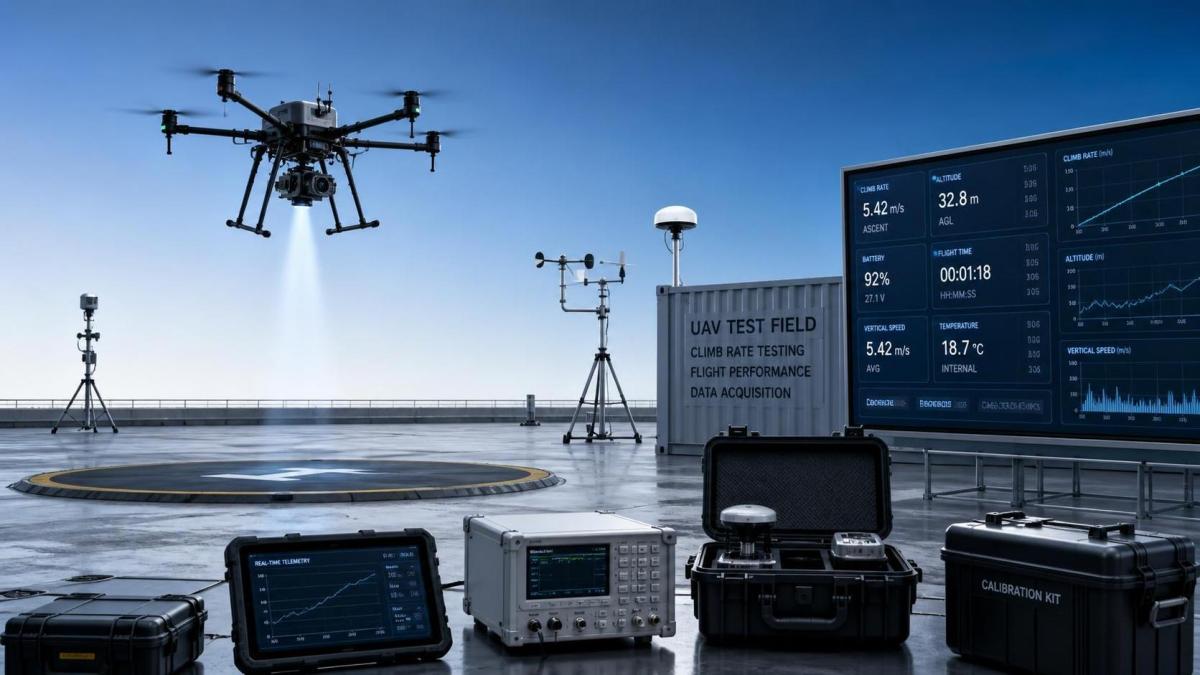
A reliable climb test depends on how vertical performance is measured. Common data sources include onboard GNSS, barometric altitude sensors, inertial measurement units, radar or laser altimetry in some test environments, and high-resolution flight controller logs. GNSS alone is often insufficient for fine-grain validation because vertical accuracy can be noisy, especially over short time windows.
Most technical evaluators prefer synchronized logging of:
- altitude versus time;
- vertical speed command versus achieved vertical speed;
- motor output or throttle percentage;
- battery voltage and current;
- attitude deviation during ascent;
- temperature of key electrical components where available.
In more disciplined programs, the test team also verifies sensor calibration and timestamps before flight. A climb curve is only as defensible as the integrity of its telemetry.
4. Flight profile execution
The actual test profile is normally more controlled than many assume. Rather than simply lifting off and pushing to maximum vertical speed, evaluators define a repeatable climb segment. A typical pattern may include:
- stable hover for baseline power and control check;
- transition into commanded vertical climb at a predefined setpoint or full ascent command;
- climb through a specified altitude window;
- hold or transition at the top of the segment;
- repeat the run multiple times.
For multirotors, the test often examines vertical climb from near-hover conditions. For fixed-wing UAVs or VTOL hybrids, the methodology becomes more complex because climb validation may involve forward flight climb gradient, transition phase behavior, or separate testing for hover climb and wing-borne climb.
5. Repetition and statistical treatment
One of the most common weaknesses in supplier-provided performance data is the absence of repeated runs. Flight performance validation should not rely on a single “best run.” Multiple repetitions are needed to identify variance caused by pilot input, control logic adaptation, battery discharge progression, or light environmental changes.
In a robust process, technical teams do not report only the maximum observed result. They look at average climb rate over the defined altitude band, sustained climb performance, spread between runs, and any signs of degradation as battery energy is consumed.
Which metrics matter most during evaluation
Climb rate itself is just one metric. For standard-oriented review, the more revealing question is which set of metrics together demonstrates acceptable flight performance.
Time-to-altitude
This is often more operationally useful than peak climb rate. For emergency clearance, terrain separation, and mission productivity, how long the aircraft takes to reach a defined altitude may matter more than a brief peak velocity spike.
Sustained versus peak climb rate
Some aircraft can achieve a high initial ascent rate for a few seconds, then taper rapidly as voltage drops or thermal limits intervene. Sustained climb performance usually tells more about real mission capability.
Control stability during ascent
A climb test should confirm that the vehicle remains within acceptable pitch, roll, yaw, and lateral drift margins while ascending. An unstable fast climb is not a validated capability.
Power margin
If the UAV reaches the target climb rate only near maximum throttle or current draw, it may have little reserve for gust rejection, maneuver correction, or payload growth. That is a risk signal, not just a performance number.
Thermal response
Repeated climb runs can expose ESC heating, motor temperature rise, and battery stress. This is especially relevant for heavy-lift multirotors and aircraft operating in hot climates.
How standards and certification logic shape the test
There is no single universal global standard that defines all UAV climb rate testing in one harmonized procedure across every category and application. Requirements depend on aircraft type, use case, jurisdiction, and whether the test supports internal qualification, customer acceptance, design assurance, or a formal certification pathway. Where specific regulations or means of compliance apply, they must be checked against the target market and operational category.
That said, standard certification logic usually imposes a few consistent expectations:
- the test configuration must be documented and traceable;
- instrumentation must be suitable for the required measurement confidence;
- test conditions must be recorded;
- acceptance criteria must be defined before execution;
- results must be repeatable and not based on selective best-case reporting.
For evaluators working with civil UAV procurement or regulated operations, climb performance may also need to be considered alongside broader airworthiness evidence such as controllability, endurance, failed-motor behavior where relevant, and obstacle-clearance capability. In other words, climb testing supports certification logic, but rarely stands alone.
Where testing often goes wrong
Several recurring mistakes reduce the value of UAV climb rate testing and can distort procurement or validation decisions.
Confusing command speed with achieved speed
The flight controller may be set to a particular ascent speed limit, but that does not prove the aircraft can maintain that rate under load. Logged achieved vertical speed is what matters.
Testing with unrealistic payload assumptions
Many platforms are validated with nominal payloads that do not reflect field use, cable routing, auxiliary sensors, or mounting hardware. A technically honest test uses the mission-representative configuration.
Ignoring battery condition effects
Battery age, internal resistance, and temperature materially influence climb results. If these factors are not tracked, repeatability claims are weak.
Using a short altitude window
A very short climb segment may exaggerate initial transient performance. For many evaluations, a broader altitude band provides a more realistic measure of sustained ascent capability.
Failing to separate indoor and outdoor evidence
Indoor tests can reduce environmental noise and help isolate propulsion behavior, but they do not replace outdoor validation for wind sensitivity and operational conditions.
How technical evaluators should interpret the results
For procurement, benchmarking, or supplier qualification, the best use of climb rate data is comparative and conditional. The question is not “Which UAV climbs fastest?” but “Which UAV demonstrates sufficient and repeatable climb performance with acceptable reserve under my expected operating envelope?”
That shifts the review from marketing claims to engineering sufficiency. A slower aircraft with stronger thermal headroom, better stability, and tighter run-to-run consistency may be the lower-risk choice for commercial deployment than a faster aircraft that operates close to propulsion limits.
Technical evaluators should also look for signs that climb performance has been isolated from the rest of the flight envelope. If ascent capability is validated only in ideal conditions and without cross-reference to endurance, hover stability, or payload power draw, the data may be incomplete for system-level decisions.
What good climb rate test documentation should include
If the test is meant to support acceptance, qualification, or compliance review, the report should be specific enough for another engineering team to understand exactly what was proven. At minimum, useful documentation normally includes:
- aircraft identification and software version;
- takeoff weight and payload configuration;
- battery specification and pre-test condition;
- test location and environmental conditions;
- instrumentation and data source description;
- defined climb profile and altitude window;
- number of runs and any discarded runs with justification;
- raw or summarized telemetry results;
- acceptance criteria and pass/fail interpretation;
- limitations, anomalies, and unresolved uncertainties.
Without that level of documentation, UAV climb rate testing may still be useful for internal development, but it is less credible as evidence for supplier comparison or formal performance validation.
Why this test remains strategically important
As UAV deployments move deeper into industrial inspection, surveying, logistics, and public-sector missions, buyers are becoming less tolerant of loosely defined performance claims. Vertical climb capability affects obstacle clearance, deployment speed, payload flexibility, and safety margins in gusty or high-altitude environments. It also exposes whether the aircraft’s propulsion and control systems are robust or merely optimized for headline specifications.
That is why climb rate testing remains a core element of flight performance validation. When conducted properly, it does more than confirm an ascent figure. It reveals whether a UAV can convert design intent into repeatable operational performance under declared conditions. For technical evaluators, that distinction is the difference between reading a datasheet and trusting an aircraft.
Search News
Hot Articles
- Carbon Fiber StructuresHow to Specify Aerospace Carbon Fiber Assemblies for Lightweight, Load-Bearing PartsJul 11, 2026
- Machine VisionXiaomi, Alibaba DAMO Academy Drive Open-Source Robotics Model Ecosystem, Lowering Algorithm Development Barriers for Overseas SMEs Adopting Chinese Robotics SolutionsMar 30, 2026
- Cobots & ArmsShanxi 'AI+' Conference Showcases Embodied Intelligence with Multinational Buyer Engagement: Key Industry ImplicationsMar 30, 2026
Popular Tags
Recommended News
 Jul 11, 2026How to Specify Aerospace Carbon Fiber Assemblies for Lightweight, Load-Bearing PartsAerospace carbon fiber assemblies: learn how to specify laminate design, load data, joining methods, and inspection controls for lighter, reliable load-bearing aerospace parts.Elena Rostova (UAV Systems Researcher)
 Mar 30, 2026Xiaomi, Alibaba DAMO Academy Drive Open-Source Robotics Model Ecosystem, Lowering Algorithm Development Barriers for Overseas SMEs Adopting Chinese Robotics SolutionsXiaomi & Alibaba DAMO Academy's open-source robotics models lower algorithm barriers for global SMEs. Boost efficiency in manufacturing, logistics & smart retail with ROS 2 compatible solutions.TSV Data Lab
 Mar 30, 2026Shanxi 'AI+' Conference Showcases Embodied Intelligence with Multinational Buyer Engagement: Key Industry ImplicationsShanxi 'AI+' Conference highlights embodied intelligence with Tesla, Ubtech & Jiantao showcasing multimodal robotics. 40+ global buyers validated tech on-site, creating new B2B channels for industrial automation & AI solutions.Chen Wei (Automation Lead Engineer)
 Mar 30, 2026Zhongguancun Unveils 6G Integrated Sensing-Computing-Intelligence Platform to Empower Embodied Robots for Global Industrial ApplicationsZhongguancun's new 6G platform revolutionizes industrial robotics with <10ms latency, empowering global automotive, logistics & port automation. Discover how this tech boosts China's smart manufacturing exports.TSV Data Lab
 Mar 30, 2026Mech-Mind Tianjin Embodied Intelligence R&D and Production Base Goes Live, Cutting Delivery Time by 20%–30% for Global Customized AMR+Vision SolutionsMech-Mind's Tianjin AMR+Vision production base cuts delivery time by 20%-30% for欧美 & Latin American markets. Discover how this PLd-certified facility accelerates customized robotics solutions for smart manufacturing and logistics.Chen Wei (Automation Lead Engineer)
 Mar 30, 2026Boao Forum Reveals 'Co-evolution of Big and Small Brains' Trend in Humanoid Robots, China's Embodied Intelligence Accelerates Adaptation to Overseas Manufacturing Service ScenariosDiscover how China's humanoid robots, featuring 'Co-evolution of Big and Small Brains,' are revolutionizing global manufacturing. Learn about Embodied Tian Gong 3.0's ISO compliance and overseas deployment at Boao Forum 2026.Chen Wei (Automation Lead Engineer)
 Mar 30, 2026China Railway Industrial Secures Patent for Embodied Robotics in Material Handling, Boosting High-Precision Delivery Capabilities for Overseas Infrastructure and Manufacturing ProjectsChina Railway Industrial's new patent for embodied robotics in material handling boosts high-precision delivery for global infrastructure & manufacturing. Discover how this innovation enhances logistics accuracy in automotive, rail transit & EPC projects.Chen Wei (Automation Lead Engineer)
 Oct 03, 2026Selecting Automotive Radar Sensor Modules for ADAS Range, Resolution, and IntegrationAutomotive radar sensor module selection guide for ADAS: compare range, resolution, field of view, latency, and integration to build safer, reliable vehicle systems.TSV Data Lab
 Oct 02, 2026How to Qualify Machined Parts Suppliers for Hard Tech ProgramsHard tech supply chain machined parts demand rigorous supplier qualification. Learn how to assess capability, traceability, quality controls, and delivery resilience.Dr. Marcus Vance
 Oct 01, 2026How to Select an Outdoor Security Radar Sensor for Perimeter Detection?Outdoor security radar sensor selection guide: compare range, accuracy, false-alarm control, integration, and field testing for reliable perimeter detection.TSV Data Lab
 Sep 30, 2026How to Evaluate Solid-State LiDAR Hardware for Outdoor Autonomous VehiclesSolid state LiDAR hardware evaluation guide for outdoor autonomous vehicles—compare range, point-cloud quality, environmental resilience, integration, and safety.TSV Data Lab
 Sep 29, 2026ISO 9283 Repeatability: How to Evaluate Cobot Positioning PerformanceISO 9283 cobot repeatability explained: learn how payload, reach, approach direction, and test conditions affect positioning performance and cell capability.Chen Wei (Automation Lead Engineer)
 Oct 03, 2026Is Edge Computing Necessary for Real-Time Quality Inspection?Is industrial edge computing necessary for real-time quality inspection? Explore how latency, data volume, reliability, and control integration shape the right architecture.TSV Data Lab
 Oct 02, 2026What Documents Prove a Precision Machining Supplier Can Hold Tolerance?What documents prove a precision machining supplier can hold tolerance? Explore certificates, FAI reports, calibration, SPC, and traceability evidence to qualify suppliers with confidence.Dr. Marcus Vance
 Oct 01, 2026Can a Machining Supplier Meet Aerospace Fatigue Testing Requirements?Can a machining supplier meet aerospace fatigue testing requirements? Learn the traceability, process control, and test evidence needed for reliable aerospace parts.Dr. Marcus Vance
 Sep 30, 2026Which Industrial Robot Specifications Matter for High-Precision Assembly?Which industrial robot specifications matter most for high-precision assembly? Explore repeatability, accuracy, stiffness, vibration, calibration, and force control for reliable yields.Chen Wei (Automation Lead Engineer)
 Sep 29, 2026How Do You Verify Servo Motor Torque Under Continuous Load?How do I verify servo motor torque under continuous load? Learn RMS torque checks, torque-speed limits, thermal derating, and real-machine testing.Chen Wei (Automation Lead Engineer)
 Oct 02, 2026ZD330 Software Configuration: Verifying Cut-List Import Before PurchaseZD330 software and machine configuration: verify cut-list imports, data mapping, labels, and workflow before purchase to reduce errors and choose with confidence.Victor Lin (Chief Software Architect)
 Sep 28, 2026Spindle Runout Measurement in Germany: DIN Standards, Methods, and Acceptance LimitsSpindle runout measurement Germany: explore DIN standards, proven methods, acceptance limits, and audit-ready practices for reliable machining quality.Dr. Marcus Vance
 Sep 27, 2026How to Select Wall-Mount Edge Devices for Space-Constrained Factory NetworksWall mount edge devices for space-constrained factories: evaluate workload, thermal design, power resilience, cable access, and network reliability for smarter deployments.TSV Data Lab
 Sep 26, 2026Machining Tolerance Analysis: How to Set Limits That Meet Function and Cost TargetsMachining tolerance analysis: learn how to set functional limits, control tolerance stacks, reduce inspection risk, and balance precision with production cost.Dr. Marcus Vance
 Sep 25, 2026How to Evaluate an Industrial Infrastructure Data Platform for Multi-Site OperationsIndustrial infrastructure data platform evaluation guide for multi-site operations: compare data quality, edge resilience, interoperability, governance, and scalable proof-of-value criteria.Victor Lin (Chief Software Architect)
 Sep 24, 2026How to Select Machine Vision Optics for Accurate Inspection at Different Working DistancesMachine vision optics selection guide for accurate inspection at every working distance. Compare FOV, pixel scale, DOF, distortion, lighting, and telecentric options.TSV Data Lab
 Sep 23, 2026How to Evaluate a Machine Vision System Integrator for High-Speed Inspection LinesChoose a machine vision system integrator with proven expertise in high-speed inspection, reliable reject timing, robust optics, and measurable acceptance criteria.TSV Data Lab