
What Should You Check Before Buying an Agricultural Spraying Drone?
Publication Date
author
What should I check before buying an agricultural crop spraying drone? Start with verified field performance, not headline specifications or claimed acreage figures.
The right aircraft must match your crop, terrain, application volume, labor model, local regulations, and maintenance capacity under real operating conditions.
A spraying drone is not simply a flying tank. It is a complete application system whose value depends on liquid delivery, flight reliability, data quality, and disciplined operation.
Begin With the Field and Application Requirement
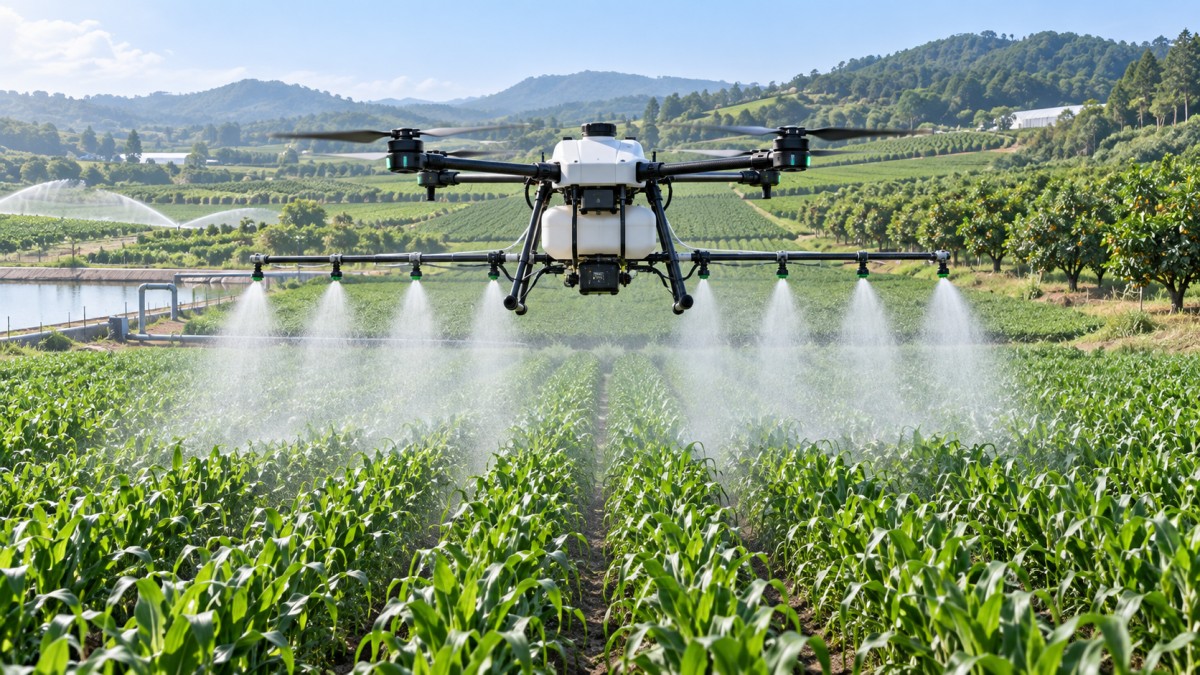
Define the agronomic job before comparing models. Orchard canopies, rice paddies, vineyards, broad-acre cereals, and hilly plots impose very different requirements on aircraft design.
Document the average field size, total seasonal hectares, distance between fields, elevation changes, crop height, row spacing, and available loading locations before requesting quotations.
Also specify whether the drone will apply herbicides, fungicides, insecticides, foliar nutrients, biological products, or granular materials. Each material has different viscosity, mixing, and coverage demands.
Water volume per hectare is especially important. Low-volume applications may suit drones well, while high-volume requirements can make frequent refilling operationally inefficient.
Ask agronomists which treatments require canopy penetration, leaf underside coverage, strict droplet-size control, or timing within a narrow weather window.
A drone that performs well over open rice fields may not provide sufficient penetration in mature fruit trees or dense vegetable canopies.
Build a written application profile containing crop type, annual hectares, target rate, chemical classes, terrain, climate, and expected daily operating hours.
Verify Usable Payload Rather Than Advertised Tank Capacity
Tank capacity is useful, but it does not equal usable payload. The aircraft must safely lift liquid, battery mass, nozzles, landing gear, and any optional spreading equipment.
Request the maximum takeoff weight, empty weight, recommended payload, and payload restrictions for high temperatures, high elevations, and uneven terrain.
Payload performance changes with density. A tank filled with dense fertilizer suspension can weigh substantially more than the same volume of water.
Confirm whether the manufacturer’s claimed payload applies during normal agricultural operations, or only under ideal test conditions with limited wind and fresh batteries.
Evaluate the real refill cycle. A larger tank can reduce stops, but it may increase battery consumption, landing stress, transport difficulty, and pilot workload.
Measure productive output as treated hectares per complete operating hour, including mixing, loading, battery changes, travel, cleaning, and documentation.
For many farms, a smaller but consistently available drone produces more seasonal value than a large platform with complicated logistics or frequent downtime.
Assess Spray Quality, Flow Control, and Distribution Uniformity
The core purchasing question is whether the spraying drone can apply the required dose evenly across the target crop under expected field conditions.
Ask for test data on flow-rate accuracy, pressure stability, nozzle configuration, droplet spectrum, and distribution uniformity at several flight speeds.
Variable-rate flow control should automatically compensate for speed changes. Without reliable compensation, the application rate can vary across turns, slopes, and wind-affected flight paths.
Examine the pump design carefully. Diaphragm, centrifugal, and peristaltic pumps have different chemical compatibility, pressure behavior, wear profiles, and maintenance needs.
Check whether individual nozzles can be controlled independently. Section control can reduce overlap, especially in irregular fields, headlands, and areas around obstacles.
Confirm that nozzles, filters, hoses, seals, and flow sensors are accessible for inspection. A blocked nozzle can create costly underapplication despite accurate navigation.
For high-value crops, require a demonstration using your intended application rate, water-sensitive paper, and representative canopy conditions rather than a generic flight demonstration.
Check Battery Endurance and Daily Energy Logistics
Battery endurance should be evaluated as a work cycle, not as a single flight-time number. Payload, wind, temperature, elevation, and maneuvering all reduce endurance.
Ask how many hectares the drone treats per battery at your target application volume, not merely how many minutes it remains airborne.
Compare battery capacity, discharge limits, charging time, expected cycle life, storage requirements, and replacement cost. Battery economics strongly influence operating cost per hectare.
Fast charging is valuable only when the site has sufficient electrical infrastructure or an approved generator system with stable output and safe grounding.
Determine how many batteries, chargers, transport cases, and technicians are needed to maintain continuous work during the farm’s busiest spraying window.
Battery temperature management matters in hot climates. Repeated high-temperature charging or aggressive discharge can shorten usable life and create avoidable safety risks.
Request documented procedures for battery inspection, cooling, transport, retirement, and incident response. These processes should be part of the supplier’s operational package.
Evaluate Terrain Following and Obstacle Detection in Real Conditions
Terrain-following capability determines whether the spray boom or nozzles maintain a consistent height above the crop, which directly affects coverage and drift risk.
Ask which sensors support terrain following: radar, LiDAR, vision, ultrasonic sensors, GNSS elevation data, or a combination of systems.
Sensor type matters because crop texture, dust, fog, rain, changing light, and dense foliage can degrade performance differently across sensing technologies.
Verify the stated terrain-following accuracy at low crop height, tall canopies, slopes, terraces, and abrupt ground transitions such as drainage ditches.
Obstacle avoidance should be treated as a risk-control function, not a substitute for field planning or trained visual observers where regulations require them.
Test the system near poles, utility lines, irrigation equipment, trellises, isolated trees, and field boundaries. Small wires remain a difficult hazard for many aircraft.
Review manual override behavior. Operators need predictable control authority when automated routing becomes uncertain because of weather, sensor limitations, or unexpected obstacles.
Confirm Positioning Accuracy and Route Management
Accurate navigation reduces skips and overlaps, but positioning specifications should be connected to practical route execution and recorded application evidence.
Determine whether the aircraft uses standard GNSS, RTK positioning, network corrections, onboard base stations, or a hybrid correction method.
RTK can improve repeatability, yet its benefit depends on reliable correction signals, appropriate base-station placement, and procedures for handling signal interruptions.
Ask how the system manages lost positioning, communication drops, low battery events, and return-to-home paths when carrying chemical payloads.
Route planning software should support field boundaries, exclusion zones, headlands, variable-rate prescriptions, terrain data, and clearly controlled resumption after refilling.
Check whether maps and flight records can be exported in usable formats. Procurement teams should avoid systems that trap operational data inside a proprietary dashboard.
Good records support traceability, contractor billing, chemical compliance, incident investigation, and comparison of planned application volume against actual delivered volume.
Examine Drift Control and Weather Operating Limits
Even a technically capable agricultural spraying drone can produce poor results when weather limits, droplet selection, and flight parameters are not managed correctly.
Request the manufacturer’s recommended wind limit, but also ask how that limit was established and whether it changes by nozzle, droplet size, and payload.
Smaller droplets may improve coverage in some applications, yet they generally increase drift susceptibility. Nozzle selection should follow label instructions and agronomic guidance.
Rotor downwash can assist canopy penetration, but it can also alter droplet trajectories. Its effect depends on crop structure, flight height, wind, and application rate.
Confirm whether the software records wind conditions, application height, travel speed, and flow rate. These data help explain performance problems after treatment.
Build operational rules for rain, high humidity, low humidity, gusting wind, thermal inversions, and reduced visibility. Weather judgment remains an operator responsibility.
Do not accept acreage-per-hour claims without understanding the weather assumptions behind them. Narrow spray windows often determine seasonal productivity more than maximum cruise speed.
Review Compliance, Licensing, and Chemical Liability
Before purchasing equipment, confirm that agricultural drone spraying is permitted in every intended operating area and under the proposed business model.
Rules may govern aircraft registration, pilot certification, remote identification, visual line-of-sight operations, nighttime work, pesticide application, and record retention.
Commercial operators may also require aviation approvals, pesticide applicator licenses, insurance coverage, chemical handling training, and documented maintenance programs.
Ask the seller to provide model-specific compliance documents, radio certifications, safety manuals, battery transport information, and local service contacts.
Do not rely solely on a supplier’s verbal assurance that a model is legal. Regulations can vary by country, state, province, municipality, and crop-protection product.
Insurance discussions should include third-party injury, property damage, environmental contamination, chemical drift, equipment damage, and contractor liability.
Compliance costs belong in the total cost of ownership. A lower purchase price has limited value when permits, training, or operating restrictions prevent profitable deployment.
Investigate Maintenance, Parts Availability, and Support Quality
Spraying drones operate around chemicals, vibration, dust, moisture, and repetitive loading cycles. Maintenance quality directly affects safety, uptime, and application consistency.
Ask for the preventive maintenance schedule covering motors, propellers, arms, pumps, valves, filters, seals, sensors, landing gear, and electrical connectors.
Clarify which parts are considered consumables, their typical replacement intervals, local stock availability, and the expected lead time for critical repairs.
Check whether the manufacturer publishes repair manuals, diagnostic tools, firmware release notes, and component-level service instructions for authorized technicians.
A closed support model can be acceptable when local response is fast. It becomes risky when every minor repair requires international shipping or remote approval.
Request warranty terms in writing, including exclusions related to crashes, chemical corrosion, improper storage, firmware updates, and battery degradation.
Supplier evaluation should include training quality, emergency support hours, field commissioning, spare-parts packages, and documented experience with similar crops and climates.
Calculate Total Cost per Treated Hectare
The purchase price is only one part of the investment. A meaningful comparison estimates the total cost per treated hectare over the drone’s expected service life.
Include aircraft depreciation, batteries, chargers, generators, maintenance, insurance, software subscriptions, permits, labor, transport, chemical mixing, and downtime.
Then compare those costs with current alternatives such as tractor sprayers, backpack crews, manned aircraft, contracted services, or delayed application caused by wet ground.
Quantify operational value beyond labor savings. Drones may reduce crop damage from wheel tracks, improve access after rainfall, and enable treatment of difficult terrain.
However, do not assume that every field benefits equally. Large, flat fields with high-water-volume requirements may remain more economical for ground equipment.
Use conservative productivity assumptions and include weather delays. A business case based on ideal daily acreage can overstate annual revenue and understate operating constraints.
For service providers, calculate utilization across the entire season. Profitability depends on enough billable hectares, efficient travel routes, and a reliable customer schedule.
Use a Demonstration and Acceptance Test Before Final Purchase
The strongest procurement method is a documented acceptance test using your crops, local terrain, intended chemicals, and ordinary operators rather than supplier-controlled conditions.
Set measurable criteria before the demonstration. These may include flow-rate error, completed hectares per hour, route accuracy, refill time, terrain-following stability, and battery turnaround.
Test both straightforward and difficult fields. Include slopes, irregular boundaries, canopy variation, moderate wind within legal limits, and normal loading procedures.
Record chemical volume loaded, chemical volume remaining, hectares treated, flight logs, battery use, weather conditions, and any alarms or manual interventions.
Inspect deposition quality with appropriate field methods and obtain agronomic review. Flight completion alone does not prove that the crop received an effective treatment.
Ask operators to perform routine tasks during the trial, including nozzle cleaning, filter inspection, battery exchange, route creation, and post-flight washing.
Purchase only after the supplier can demonstrate that the system meets agreed operational criteria and can support it throughout your intended service period.
Make the Decision Around Reliable Application Outcomes
Buying an agricultural spraying drone is an engineering, agronomic, and operational decision. The best platform is the one that reliably delivers the required treatment in your fields.
Prioritize verified payload capability, accurate flow control, suitable spray quality, realistic battery logistics, dependable terrain following, compliance, and maintainable hardware.
When asking what should I check before buying an agricultural crop spraying drone, focus on evidence from representative field tests rather than promotional specifications.
A disciplined comparison process reduces procurement risk, protects crop-treatment quality, and reveals whether the drone can generate measurable value across the full spraying season.
Search News
Hot Articles
- Carbon Fiber StructuresHow to Specify Aerospace Carbon Fiber Assemblies for Lightweight, Load-Bearing PartsJul 11, 2026
- Machine VisionXiaomi, Alibaba DAMO Academy Drive Open-Source Robotics Model Ecosystem, Lowering Algorithm Development Barriers for Overseas SMEs Adopting Chinese Robotics SolutionsMar 30, 2026
- Cobots & ArmsShanxi 'AI+' Conference Showcases Embodied Intelligence with Multinational Buyer Engagement: Key Industry ImplicationsMar 30, 2026
Popular Tags
Recommended News
 Jul 11, 2026How to Specify Aerospace Carbon Fiber Assemblies for Lightweight, Load-Bearing PartsAerospace carbon fiber assemblies: learn how to specify laminate design, load data, joining methods, and inspection controls for lighter, reliable load-bearing aerospace parts.Elena Rostova (UAV Systems Researcher)
 Mar 30, 2026Xiaomi, Alibaba DAMO Academy Drive Open-Source Robotics Model Ecosystem, Lowering Algorithm Development Barriers for Overseas SMEs Adopting Chinese Robotics SolutionsXiaomi & Alibaba DAMO Academy's open-source robotics models lower algorithm barriers for global SMEs. Boost efficiency in manufacturing, logistics & smart retail with ROS 2 compatible solutions.TSV Data Lab
 Mar 30, 2026Shanxi 'AI+' Conference Showcases Embodied Intelligence with Multinational Buyer Engagement: Key Industry ImplicationsShanxi 'AI+' Conference highlights embodied intelligence with Tesla, Ubtech & Jiantao showcasing multimodal robotics. 40+ global buyers validated tech on-site, creating new B2B channels for industrial automation & AI solutions.Chen Wei (Automation Lead Engineer)
 Mar 30, 2026Zhongguancun Unveils 6G Integrated Sensing-Computing-Intelligence Platform to Empower Embodied Robots for Global Industrial ApplicationsZhongguancun's new 6G platform revolutionizes industrial robotics with <10ms latency, empowering global automotive, logistics & port automation. Discover how this tech boosts China's smart manufacturing exports.TSV Data Lab
 Mar 30, 2026Mech-Mind Tianjin Embodied Intelligence R&D and Production Base Goes Live, Cutting Delivery Time by 20%–30% for Global Customized AMR+Vision SolutionsMech-Mind's Tianjin AMR+Vision production base cuts delivery time by 20%-30% for欧美 & Latin American markets. Discover how this PLd-certified facility accelerates customized robotics solutions for smart manufacturing and logistics.Chen Wei (Automation Lead Engineer)
 Mar 30, 2026Boao Forum Reveals 'Co-evolution of Big and Small Brains' Trend in Humanoid Robots, China's Embodied Intelligence Accelerates Adaptation to Overseas Manufacturing Service ScenariosDiscover how China's humanoid robots, featuring 'Co-evolution of Big and Small Brains,' are revolutionizing global manufacturing. Learn about Embodied Tian Gong 3.0's ISO compliance and overseas deployment at Boao Forum 2026.Chen Wei (Automation Lead Engineer)
 Mar 30, 2026China Railway Industrial Secures Patent for Embodied Robotics in Material Handling, Boosting High-Precision Delivery Capabilities for Overseas Infrastructure and Manufacturing ProjectsChina Railway Industrial's new patent for embodied robotics in material handling boosts high-precision delivery for global infrastructure & manufacturing. Discover how this innovation enhances logistics accuracy in automotive, rail transit & EPC projects.Chen Wei (Automation Lead Engineer)
 Oct 13, 2026Smart Cameras vs. PC-Based Machine Vision: Which Fits High-Speed Inspection?This industrial product comparison for machine vision weighs smart cameras vs. PC-based systems on latency, throughput, and cost. Discover your best fit for high-speed inspection.TSV Data Lab
 Oct 12, 2026How to Verify RoHS Compliance in Industrial Sensing Systems Before DeploymentRoHS compliant sensing systems: learn how to verify materials, supplier declarations, testing, and configuration controls before industrial deployment.TSV Data Lab
 Oct 11, 2026How Procurement-Oriented Content Taxonomy Improves B2B Buying JourneysProcurement-oriented content taxonomy streamlines B2B buying journeys with clearer evidence, supplier comparisons, risk visibility, and faster approvals.TSV Data Lab
 Oct 10, 2026How to Select a Machine Performance Monitoring Platform for OEE and Downtime ReductionMachine performance monitoring platform selection guide: validate machine states, OEE data, downtime reasons, integrations, and scalability to reduce losses with confidence.TSV Data Lab
 Oct 08, 2026How to Machine Inconel 625 Blades Without Heat Cracks or Edge ChippingInconel 625 blade machining guide: prevent heat cracks, edge chipping, chatter, and work hardening with proven tooling, cooling, fixturing, and inspection strategies.Dr. Marcus Vance
 Oct 07, 2026How to Evaluate an HMI Panel Distributor for Industrial Automation ProjectsHMI panel distributor evaluation guide: verify technical compatibility, traceability, supply reliability, lifecycle support, and total cost for automation projects.Victor Lin (Chief Software Architect)
 Oct 06, 2026Navigation Fault Tolerance Standards for AMRs: What Safety Teams Must VerifyNavigation fault tolerance standards: learn what AMR safety teams must verify, from localization loss and sensor faults to stopping distance, safe restart, and site-specific validation.Chen Wei (Automation Lead Engineer)
 Oct 05, 2026Calculating Edge Computing Total Cost of Ownership Across Distributed SitesEdge computing ownership cost explained: calculate deployment, energy, connectivity, security, remote support, and refresh costs across distributed sites.TSV Data Lab
 Oct 04, 2026CAD/CAM Benchmarking in the GCC: What Manufacturers Should Ask a ConsultantCAD CAM benchmark consultant GCC guide: learn the key questions manufacturers should ask to validate post-processors, workflows, machine performance, and production risk.Victor Lin (Chief Software Architect)
 Oct 03, 2026Selecting Automotive Radar Sensor Modules for ADAS Range, Resolution, and IntegrationAutomotive radar sensor module selection guide for ADAS: compare range, resolution, field of view, latency, and integration to build safer, reliable vehicle systems.TSV Data Lab
 Oct 02, 2026How to Qualify Machined Parts Suppliers for Hard Tech ProgramsHard tech supply chain machined parts demand rigorous supplier qualification. Learn how to assess capability, traceability, quality controls, and delivery resilience.Dr. Marcus Vance
 Oct 01, 2026How to Select an Outdoor Security Radar Sensor for Perimeter Detection?Outdoor security radar sensor selection guide: compare range, accuracy, false-alarm control, integration, and field testing for reliable perimeter detection.TSV Data Lab
 Sep 30, 2026How to Evaluate Solid-State LiDAR Hardware for Outdoor Autonomous VehiclesSolid state LiDAR hardware evaluation guide for outdoor autonomous vehicles—compare range, point-cloud quality, environmental resilience, integration, and safety.TSV Data Lab
 Sep 29, 2026ISO 9283 Repeatability: How to Evaluate Cobot Positioning PerformanceISO 9283 cobot repeatability explained: learn how payload, reach, approach direction, and test conditions affect positioning performance and cell capability.Chen Wei (Automation Lead Engineer)
 Oct 13, 2026How to keep an industrial robotic integration project on scheduleIndustrial robotic integration project management: keep automation on schedule with proven controls for interfaces, suppliers, FAT, commissioning, and change risk.Victor Lin (Chief Software Architect)
 Oct 12, 2026What should be included in predictive maintenance pricing for factories?Predictive maintenance pricing for factories: compare sensors, software, integration, support, and total cost to secure measurable uptime gains and avoid hidden expenses.TSV Data Lab
 Oct 11, 2026How payload and reach change the cost of an industrial robotCost of industrial robot systems depends heavily on payload and reach. Learn how sizing, torque, tooling, safety, and lifecycle factors shape smarter automation investments.Chen Wei (Automation Lead Engineer)























