What Limits a Heavy Lift UAV for Construction Projects First?
Publication Date
author
Before a heavy lift UAV for construction reaches its advertised payload, the first real limit is usually not the brochure number itself. It is the aircraft’s ability to stay stable, controllable, and energy-efficient once a real construction payload changes the center of gravity, increases power draw, and exposes the platform to gusts, dust, and signal complexity. In practice, buyers comparing drone payload capacity vs flight time, UAV center of gravity calculation, and flight controller latency benchmark data often discover that “how well it carries” matters more than “how much it can theoretically lift.”
For construction teams, procurement managers, and technical decision-makers, the most useful question is not “What is the maximum payload?” but “What fails first under real site conditions?” The short answer: system balance under load. That includes thrust margin, battery sag, center-of-gravity shift, wind resistance, and control response latency. Those factors decide whether a heavy lift UAV can deliver materials safely, repeatably, and economically on a live project.
What actually limits a heavy lift UAV first on construction projects?
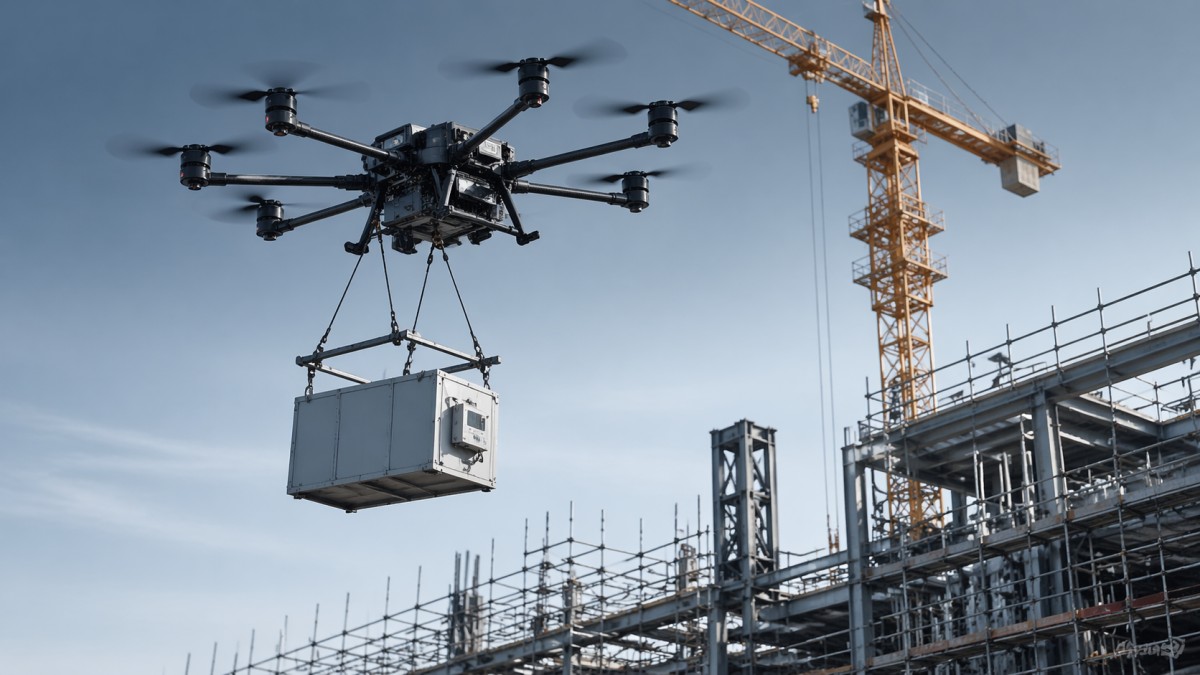
On real construction sites, the first limiting factor is usually integrated flight stability under load, not the nominal payload rating alone. A heavy lift UAV may be advertised to carry a certain mass, but once it lifts uneven tools, rebar bundles, sensors, concrete test samples, or site-specific delivery fixtures, the aircraft begins operating against several constraints at once:
- Center of gravity shift: Off-center or swinging payloads make the aircraft work harder to stay level.
- Power draw escalation: More thrust is required to stabilize and climb, which cuts usable flight time quickly.
- Wind loading: Construction sites often create turbulent airflow around structures, cranes, scaffolding, and partially enclosed areas.
- Flight controller latency: Small delays in sensing and correction become more critical as payload mass and inertia increase.
- Thermal and battery stress: High current draw under repeated missions can reduce performance before the UAV reaches its theoretical maximum lift.
This is why a UAV that looks strong in a static payload chart may become operationally weak in a construction workflow. The “first limit” is often the moment when the aircraft can still lift the load, but can no longer maintain enough control margin to do so safely and consistently.
Why advertised payload capacity often misleads buyers
Many buyers begin with payload capacity because it is easy to compare. But in heavy lift UAV procurement, a single payload number without testing context has limited value. The important questions are:
- At what altitude and temperature was the payload measured?
- Was the load compact, balanced, and rigidly mounted?
- How much flight time remained at that payload?
- What was the wind speed during testing?
- How much control authority remained for emergency correction?
For construction projects, these details matter because payloads are rarely laboratory-clean. Real loads may be asymmetrical, poorly aerodynamic, or attached with custom rigging. A drone payload capacity vs flight time chart is far more useful than a single maximum payload figure because it reveals the operating zone where the UAV is still practical.
For example, a platform that can carry 40 kg for 4 minutes may be less valuable than one that can carry 28 kg for 12 minutes with stronger stability margin. On site, repeatability, safety reserve, and turnaround efficiency usually matter more than headline lift capability.
How center of gravity becomes the hidden operational bottleneck
UAV center of gravity calculation is one of the most overlooked factors in construction deployment. Heavy lift systems are highly sensitive to where the mass sits relative to the aircraft’s thrust geometry and controller assumptions.
If the payload is mounted too low, too far forward, or unevenly distributed, the UAV may experience:
- Persistent pitch or roll correction demand
- Reduced hover efficiency
- Higher motor temperature
- More battery consumption per minute
- Poor braking and directional response
- Increased oscillation in gusty conditions
On construction projects, center-of-gravity issues become more severe because payloads are not always standardized. Even when the total weight is within specification, the aircraft can become operationally unstable if the load geometry is wrong. This is why engineering teams should ask suppliers for load envelope data, approved rigging configurations, and performance benchmarks across different mounting positions.
In practical terms, the question is not “Can it carry 30 kg?” It is “Can it carry this 30 kg object, in this orientation, with this rigging, in this wind, while maintaining safe control margin?”
Why flight controller latency matters more as payload increases
As payload mass rises, the aircraft’s response becomes less forgiving. More inertia means the UAV needs faster and more accurate corrections to maintain stability. That makes flight controller latency benchmark data highly relevant for serious buyers.
Latency affects the full loop:
- Sensor detection
- Signal processing
- Controller output
- ESC and motor response
- Physical aircraft correction
In a lightly loaded UAV, moderate latency may still be manageable. In a heavy lift construction UAV, the same delay can mean wider oscillation, less precise positioning, rougher hover, and higher risk near structures or personnel. This is especially important when the drone is operating in confined spaces, around steel structures, or in environments with complex electromagnetic interference.
For procurement and evaluation, buyers should look beyond vague claims such as “high stability” and request measurable data such as hover deviation under load, correction time after gust disturbance, and loaded response behavior under mission-relevant conditions.
What construction teams should compare instead of just maximum lift
If your goal is actual project use rather than showroom comparison, these metrics are more valuable than headline payload alone:
- Payload vs usable flight time: Not theoretical endurance, but mission-ready endurance with reserve margin.
- Thrust reserve: How much extra control authority remains after lifting the working payload.
- Wind resistance under load: Not empty-airframe wind rating, but loaded wind performance.
- Center-of-gravity tolerance: How sensitive the UAV is to mounting variation and non-ideal loads.
- Flight controller response speed: Especially important for stability around structures.
- Battery voltage sag under peak draw: A key predictor of sudden performance loss.
- Thermal stability: Motors, ESCs, and batteries must survive repeated site cycles, not one demonstration flight.
- Redundancy and fault tolerance: Critical for operations above active work zones.
These are the parameters that help operators and decision-makers judge whether a platform can function safely in repetitive construction logistics, inspection support, or material transport missions.
How to evaluate a heavy lift UAV for real construction deployment
For buyers and technical teams, the best approach is to evaluate the aircraft as a complete load-control-energy system. A practical review process should include:
- Define the real payload profile
Document not only weight, but size, shape, mounting method, and balance characteristics. - Check payload capacity vs flight time curves
Reject platforms that only provide a single maximum-lift number. - Review center-of-gravity limits
Confirm approved attachment positions and tolerance for load shift. - Request loaded stability data
Look for hover accuracy, gust recovery, and trajectory deviation under realistic payloads. - Validate controller responsiveness
Ask for flight controller latency benchmark data or equivalent dynamic-control testing. - Assess environmental robustness
Dust, wind corridors, steel interference, and temperature swings are normal construction realities. - Evaluate cycle economics
Battery swaps, charging logistics, maintenance intervals, and failure risk affect project ROI.
This framework helps both procurement teams and site operators move from marketing comparison to engineering-based selection.
What different stakeholders should care about most
Operators and site users should focus on controllability, rigging practicality, wind behavior, and mission repeatability. A platform that is difficult to balance or sensitive to changing payload geometry will create operational friction and safety concerns.
Procurement teams should prioritize verifiable performance data, maintenance burden, battery lifecycle cost, and supplier transparency. The right question is not just purchase price, but cost per reliable mission.
Enterprise decision-makers should look at risk reduction, throughput, and deployment fit. A heavy lift UAV creates value only if it reduces labor exposure, shortens movement cycles, and integrates cleanly into construction workflows without adding excessive compliance or incident risk.
Technical researchers should examine benchmark integrity: test conditions, data repeatability, load cases, and how the supplier defines safe operating limits versus absolute limits.
Bottom line: the first real limit is control margin, not brochure payload
For most construction applications, a heavy lift UAV is limited first by system balance under real load: center of gravity, power draw, wind response, and controller latency. That is why maximum payload alone is a weak purchasing metric. The platforms that perform best in the field are usually not the ones with the boldest headline number, but the ones with the strongest loaded stability, predictable endurance, and measurable control reserve.
If you are comparing heavy lift UAV options for construction projects, prioritize drone payload capacity vs flight time, UAV center of gravity calculation support, and flight controller latency benchmark data. Those indicators will tell you far more about safe operational value than marketing claims ever will.
Search News
Hot Articles
- Carbon Fiber StructuresHow to Specify Aerospace Carbon Fiber Assemblies for Lightweight, Load-Bearing PartsJul 11, 2026
- Machine VisionXiaomi, Alibaba DAMO Academy Drive Open-Source Robotics Model Ecosystem, Lowering Algorithm Development Barriers for Overseas SMEs Adopting Chinese Robotics SolutionsMar 30, 2026
- Cobots & ArmsShanxi 'AI+' Conference Showcases Embodied Intelligence with Multinational Buyer Engagement: Key Industry ImplicationsMar 30, 2026
Popular Tags
Recommended News
 Jul 11, 2026How to Specify Aerospace Carbon Fiber Assemblies for Lightweight, Load-Bearing PartsAerospace carbon fiber assemblies: learn how to specify laminate design, load data, joining methods, and inspection controls for lighter, reliable load-bearing aerospace parts.Elena Rostova (UAV Systems Researcher)
 Mar 30, 2026Xiaomi, Alibaba DAMO Academy Drive Open-Source Robotics Model Ecosystem, Lowering Algorithm Development Barriers for Overseas SMEs Adopting Chinese Robotics SolutionsXiaomi & Alibaba DAMO Academy's open-source robotics models lower algorithm barriers for global SMEs. Boost efficiency in manufacturing, logistics & smart retail with ROS 2 compatible solutions.TSV Data Lab
 Mar 30, 2026Shanxi 'AI+' Conference Showcases Embodied Intelligence with Multinational Buyer Engagement: Key Industry ImplicationsShanxi 'AI+' Conference highlights embodied intelligence with Tesla, Ubtech & Jiantao showcasing multimodal robotics. 40+ global buyers validated tech on-site, creating new B2B channels for industrial automation & AI solutions.Chen Wei (Automation Lead Engineer)
 Mar 30, 2026Zhongguancun Unveils 6G Integrated Sensing-Computing-Intelligence Platform to Empower Embodied Robots for Global Industrial ApplicationsZhongguancun's new 6G platform revolutionizes industrial robotics with <10ms latency, empowering global automotive, logistics & port automation. Discover how this tech boosts China's smart manufacturing exports.TSV Data Lab
 Mar 30, 2026Mech-Mind Tianjin Embodied Intelligence R&D and Production Base Goes Live, Cutting Delivery Time by 20%–30% for Global Customized AMR+Vision SolutionsMech-Mind's Tianjin AMR+Vision production base cuts delivery time by 20%-30% for欧美 & Latin American markets. Discover how this PLd-certified facility accelerates customized robotics solutions for smart manufacturing and logistics.Chen Wei (Automation Lead Engineer)
 Mar 30, 2026Boao Forum Reveals 'Co-evolution of Big and Small Brains' Trend in Humanoid Robots, China's Embodied Intelligence Accelerates Adaptation to Overseas Manufacturing Service ScenariosDiscover how China's humanoid robots, featuring 'Co-evolution of Big and Small Brains,' are revolutionizing global manufacturing. Learn about Embodied Tian Gong 3.0's ISO compliance and overseas deployment at Boao Forum 2026.Chen Wei (Automation Lead Engineer)
 Mar 30, 2026China Railway Industrial Secures Patent for Embodied Robotics in Material Handling, Boosting High-Precision Delivery Capabilities for Overseas Infrastructure and Manufacturing ProjectsChina Railway Industrial's new patent for embodied robotics in material handling boosts high-precision delivery for global infrastructure & manufacturing. Discover how this innovation enhances logistics accuracy in automotive, rail transit & EPC projects.Chen Wei (Automation Lead Engineer)
 Oct 23, 2026Choosing Industrial Sensing Systems for Global Plants: Protocol CompatibilityCompare industrial sensing systems international buyers can trust. Explore protocol compatibility, reduce integration risks, and select proven configurations for reliable global plant deployments.TSV Data Lab
 Oct 22, 2026KUKA Showcases Physical AI and iiQKA.AI Vision at NVIDIA GTC BerlinExplore KUKA’s Physical AI showcase at NVIDIA GTC Berlin and discover how iiQKA.AI Vision aims to simplify robotic vision integration and improve 2D and 3D scene recognition.TSV Data Lab
 Oct 22, 2026Robotic Machining of Advanced Composites: What Tolerances Are Achievable?Explore advanced materials machining robotics: discover what drives achievable composite tolerances and how to validate accuracy before investing in your next machining system.Dr. Marcus Vance
 Oct 21, 2026China’s Industrial Robot Exports Near RMB 10 Billion in First Nine Months of 2026China’s industrial robot exports neared RMB 10 billion in January–September 2026, with value rising faster than volume. Explore the data and what it could mean for suppliers.Chen Wei (Automation Lead Engineer)
 Oct 21, 2026Low-Latency Industrial Data Processing: Pricing and Key Cost DriversExplore industrial data latency price drivers, from edge hardware to integration and support. Learn how to compare quotes, verify performance, and avoid unnecessary costs.TSV Data Lab
 Oct 20, 2026KUKA Launches iiQKA.AI Vision to Simplify Industrial Image ProcessingKUKA iiQKA.AI Vision simplifies industrial image processing with controller-based 2D and 3D vision. Explore drag-and-drop setup for vision-guided automation.TSV Data Lab
 Oct 20, 2026Smart Industrial Edge Devices: Key Criteria for Legacy PLC IntegrationChoose smart industrial edge devices for legacy PLC integration. Discover key criteria for compatibility, data quality, security, and reliable collection without disrupting control.TSV Data Lab
 Oct 19, 2026Choosing a Radar Sensor by Application: Range, Resolution, and Field of ViewSimplify radar sensor application based product selection. Compare range, resolution, and field of view to avoid blind spots and choose with confidence. Explore the guide.TSV Data Lab
 Oct 18, 2026Comparing Material Options for Procurement: Specs, Costs, and Supply RisksExplore procurement oriented technical content on material options, specs, costs, and supply risks. Compare alternatives to cut hidden expenses and make confident sourcing decisions.Dr. Marcus Vance
 Oct 17, 20265-Axis CNC Positioning Accuracy: How to Interpret ISO 230-2 Test ResultsAssess 5 axis CNC machining positioning accuracy with ISO 230-2. Learn to interpret repeatability, reversal error, and test conditions to compare suppliers and make confident acceptance decisions.Dr. Marcus Vance
 Oct 16, 2026Choosing a Rugged Edge AI Box Supplier: Thermal Tests and Lifecycle SupportChoose a rugged edge AI box supplier with proven thermal performance and reliable lifecycle support. Discover the tests and commitments to verify before you buy.TSV Data Lab
 Oct 15, 2026R&D Cost Reduction Services: How to Evaluate Fees, Savings, and ROIEvaluate R&D cost reduction services with confidence. Compare fees, verify savings, and calculate ROI without compromising performance. Discover how to choose a provider that delivers real value.Chen Wei (Automation Lead Engineer)
 Oct 22, 2026How Do You Test AMR Navigation Accuracy in a Warehouse?Test AMR navigation accuracy in warehouses with practical methods for localization, path tracking, and docking. Learn to set tolerances and compare robots before deployment.Chen Wei (Automation Lead Engineer)
 Oct 21, 2026How Should You Balance Cobot Payload Against Reach?Explore cobot payload versus reach to choose the right robot. Learn how tooling, load limits, workspace, and cycle time affect performance—and avoid costly selection mistakes.Chen Wei (Automation Lead Engineer)
 Oct 20, 2026How Do You Measure Industrial IoT Gateway Latency Under Load?Measure industrial IoT gateway latency under load with reliable timestamps, realistic traffic, and tail-latency analysis. Discover how to expose bottlenecks and choose the right gateway.TSV Data Lab
 Oct 19, 2026How Do You Verify That Precision Machined Parts Meet Tolerances?Master precision machining tolerance verification with the right tools, datum setups, and acceptance rules. Learn how to validate parts confidently and reduce costly inspection errors.Dr. Marcus Vance
 Oct 18, 2026What Should an AS9100 Machining Supplier Checklist Include?Build an AS9100 machining supplier checklist that verifies capability, traceability, inspection, and outsourced processes. Discover what to check before approving your next aerospace supplier.Dr. Marcus Vance