Trampoline Park Maintenance Tasks That Should Never Be Delayed
Publication Date
author
In high-traffic venues, trampoline park maintenance is never just routine—it is a frontline safety and uptime discipline. For after-sales maintenance teams, delaying inspections, surface repairs, frame checks, or spring replacement can quickly turn minor wear into costly shutdowns and injury risks. This guide highlights the maintenance tasks that demand immediate attention to keep equipment compliant, reliable, and ready for continuous operation.
Why Maintenance Priorities Change by Operating Scenario
Not every trampoline zone fails in the same way, and that is why effective trampoline park maintenance must be scenario-based rather than generic. A dodgeball court experiences different loads than a foam pit lane. A children’s area sees frequent edge impacts and pad abuse, while a performance zone for older jumpers may expose springs, bed stitching, and frame joints to far greater dynamic stress. For after-sales maintenance personnel, the central question is not simply what to inspect, but where delayed action creates the highest safety and downtime risk.
This matters operationally as well. In a low-traffic weekday environment, some cosmetic issues can be scheduled. In a weekend surge, the same issue may become an urgent hazard because throughput amplifies wear, user behavior becomes less controlled, and one failed component can force closure of an entire section. Good trampoline park maintenance is therefore a risk-ranking exercise: identify the components that degrade fastest, understand which business scenario accelerates failure, and act before the issue migrates from repairable to reportable.
The Maintenance Tasks That Should Never Be Delayed
Across nearly all operating models, several tasks belong in the non-deferrable category. These are the items most closely tied to user safety, compliance exposure, and unplanned shutdowns.
- Immediate inspection of torn trampoline beds, frayed stitching, or detached webbing.
- Replacement of cracked springs, overstretched springs, or visibly corroded spring elements.
- Repair or replacement of compressed, split, displaced, or missing safety pads.
- Frame and weld checks where unusual noise, looseness, vibration, or movement is detected.
- Netting, barrier, and enclosure repair in any zone with height transitions or off-axis jumping risk.
- Surface cleaning and traction control where liquid contamination, dust buildup, or foam debris affects footing.
- Anchor, connector, and fastener tightening after heavy traffic periods, special events, or impact incidents.
If a maintenance team delays these tasks, the result is often cumulative damage. A small mat tear widens. A weakened spring shifts load to adjacent springs. A displaced pad exposes hardware. A loose frame connection increases fatigue at the next joint. In practical terms, delayed trampoline park maintenance raises the probability of both injury and secondary component failure.
Scenario Comparison: Where Urgency Is Highest
The table below helps after-sales teams prioritize trampoline park maintenance by real operating environment rather than by a one-size-fits-all checklist.
This scenario view makes one point clear: the same component can carry very different urgency depending on traffic density, user profile, and movement pattern. Smart trampoline park maintenance is always tied to actual use conditions.
Open Jump Courts: Fast Wear, Fast Decisions
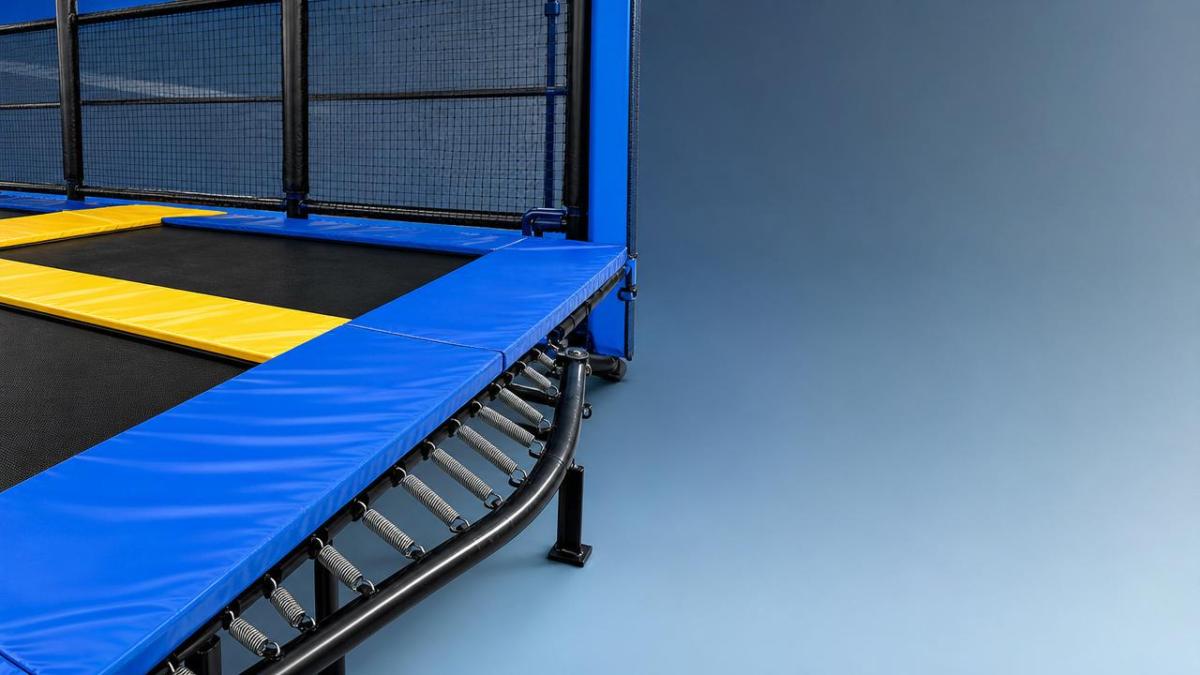
In open jump areas, the priority is repetitive impact management. These courts typically carry the highest footfall and the widest range of user weights and jump styles. Delayed trampoline park maintenance here usually starts with “minor” visible wear: slight sagging, reduced rebound uniformity, stitching abrasion, and pad cover separation. Because these areas are used continuously, deterioration can advance within days rather than weeks.
After-sales teams should treat any asymmetrical bounce, squeaking under load, or localized softness as an inspection trigger. The reason is simple: users distribute themselves unpredictably, and hidden fatigue can localize stress. When one bay is compromised, neighboring bays may start carrying redistributed dynamic loads. The correct response is not to monitor casually, but to isolate, inspect, and restore.
Children’s Areas: Edge Safety Matters More Than Operators Expect
In children’s zones, the maintenance pattern is different. Load levels may be lower, but misuse, crawling, sitting, and edge contact are much more common. That means pad integrity, seam closure, and barrier effectiveness become the most time-sensitive parts of trampoline park maintenance. A pad that has shifted only slightly in an adult court may be a direct impact hazard in a children’s area.
Common mistakes include postponing replacement of torn pad vinyl, underestimating the importance of pad compression recovery, and assuming that low user weight means lower risk. In reality, the unpredictability of movement and the frequency of boundary contact mean that exposed frame steel or spring hardware should never remain in service, even temporarily.
Performance, Dodgeball, and Competitive Zones: Structural Checks Take Priority
Zones designed for stronger jumpers or lateral game activity place special demands on frames, attachment points, and spring systems. Here, trampoline park maintenance must focus less on appearance and more on structural response. Repeated side loading, abrupt redirection, and synchronized user impacts can loosen hardware and accelerate metal fatigue faster than basic visual cleaning routines reveal.
In these scenarios, teams should never delay bolt torque verification, weld line inspection, and spring count matching. Even a single replaced spring with mismatched performance characteristics can create uneven rebound and increase stress concentration. For facilities that host tournaments, school groups, or frequent organized activities, the post-session inspection window is critical. Waiting until the next weekly service cycle is often too late.
Foam Pits, Airbags, and Transition Zones: Cleanliness Is a Safety Issue
Some operators still treat cleaning as a lower-tier task compared with mechanical repair, but in transition zones this is a mistake. Foam dust, loose cubes, fabric fragments, moisture, and foreign objects can alter takeoff consistency and user footing. For these applications, trampoline park maintenance includes immediate debris control, landing-zone leveling, and inspection of approach beds for hidden cuts or stretched sections.
The key scenario difference is that users commit to the movement before they land. If the approach bed response has changed or the pit edge padding has shifted, the user has little chance to compensate. That is why transition zones deserve tighter inspection intervals than many general areas, especially during high-turnover sessions.
How After-Sales Teams Should Set Repair Priority
A practical trampoline park maintenance system should rank tasks using three filters: injury exposure, failure acceleration, and operational dependency. Injury exposure asks whether the issue could directly harm a user. Failure acceleration asks whether the defect will damage adjacent components if ignored. Operational dependency asks whether one component failure can close a larger attraction zone.
Using that logic, cracked springs, exposed frames, detached pads, torn beds, and loose frame joints belong in the highest urgency category. Surface discoloration, minor scuffs, or non-contact cosmetic fading usually do not. This distinction matters because maintenance resources are finite. The best teams are not those who do everything at once; they are the ones who respond fastest to the defects that multiply risk.
A Simple Field Triage Model
- Remove from service immediately: exposed hardware, structural looseness, torn jumping surfaces, failed netting.
- Repair within same shift: shifting pads, moderate spring wear, traction contamination, seam opening.
- Schedule with monitoring: cosmetic cover wear, low-risk trim issues, non-contact surface aging.
Common Misjudgments That Lead to Delayed Maintenance
Many maintenance delays come from bad assumptions rather than lack of effort. One frequent error is relying only on visual appearance. A trampoline bed may look acceptable but feel uneven under load. Another is assuming that if a venue has had no incident, the condition is still acceptable. In reality, incident-free operation may simply mean the failure has not aligned with the wrong user movement yet.
A third misjudgment is grouping all areas under the same inspection interval. This weakens trampoline park maintenance because wear is not evenly distributed. Entry-adjacent bays, competition zones, and landing transitions generally degrade faster than peripheral areas. Finally, some teams delay replacement because the part has not fully failed. In safety-critical systems, waiting for full failure is the wrong threshold; loss of design performance is often enough reason to act.
Scenario-Based Maintenance Planning for Better Uptime
The strongest maintenance programs align inspection frequency with traffic pattern, attraction type, and user behavior. A practical plan may include opening checks, mid-day rapid inspections, post-peak reviews, and weekly deep technical audits. High-use courts need tighter cycles than low-use corners. Event days require expanded post-session checks. Seasonal traffic spikes should trigger preemptive stock preparation for springs, pads, fasteners, and bed sections.
Documentation also matters. Every trampoline park maintenance action should record defect type, location, severity, corrective action, and repeat frequency. Over time, this creates a failure map that helps teams predict where wear will emerge next. For after-sales personnel, that data is not just administrative; it improves parts planning, labor scheduling, and customer trust.
FAQ: Practical Questions About Urgent Trampoline Park Maintenance
Can a small tear wait until the next planned service visit?
Usually no. In trampoline park maintenance, a small tear often grows quickly under cyclic load. If the area remains active, isolate it and assess repair or replacement immediately.
Are pads a lower priority than springs or frames?
Not in edge-contact or children’s scenarios. Pads are frontline impact protection. If they shift, compress permanently, or expose hardware, they become a high-priority repair item.
How often should high-traffic areas be inspected?
The answer depends on throughput, user profile, and attraction type, but high-use zones generally need pre-opening inspection, in-shift checks, and post-peak review. Scenario-based trampoline park maintenance always outperforms calendar-only routines.
Final Action Guide for Maintenance Teams
If you support a trampoline venue after sale, do not treat every defect equally and do not rely on delayed bundled repairs for safety-critical items. Prioritize by scenario. Open jump courts need rapid surface and spring decisions. Children’s zones demand uncompromising pad and boundary protection. Performance and game areas require tighter structural control. Transition zones call for aggressive cleanliness and launch-surface monitoring.
The most effective trampoline park maintenance strategy is simple: identify the area, understand the use pattern, rank the failure consequence, and intervene before wear becomes an incident. When in doubt, remove the affected section from service, document the condition, and restore it to verified operating standard before reopening. That is how after-sales teams protect both uptime and trust.
Search News
Hot Articles
- Carbon Fiber StructuresHow to Specify Aerospace Carbon Fiber Assemblies for Lightweight, Load-Bearing PartsJul 11, 2026
- Machine VisionXiaomi, Alibaba DAMO Academy Drive Open-Source Robotics Model Ecosystem, Lowering Algorithm Development Barriers for Overseas SMEs Adopting Chinese Robotics SolutionsMar 30, 2026
- Cobots & ArmsShanxi 'AI+' Conference Showcases Embodied Intelligence with Multinational Buyer Engagement: Key Industry ImplicationsMar 30, 2026
Popular Tags
Recommended News
 Jul 11, 2026How to Specify Aerospace Carbon Fiber Assemblies for Lightweight, Load-Bearing PartsAerospace carbon fiber assemblies: learn how to specify laminate design, load data, joining methods, and inspection controls for lighter, reliable load-bearing aerospace parts.Elena Rostova (UAV Systems Researcher)
 Mar 30, 2026Xiaomi, Alibaba DAMO Academy Drive Open-Source Robotics Model Ecosystem, Lowering Algorithm Development Barriers for Overseas SMEs Adopting Chinese Robotics SolutionsXiaomi & Alibaba DAMO Academy's open-source robotics models lower algorithm barriers for global SMEs. Boost efficiency in manufacturing, logistics & smart retail with ROS 2 compatible solutions.TSV Data Lab
 Mar 30, 2026Shanxi 'AI+' Conference Showcases Embodied Intelligence with Multinational Buyer Engagement: Key Industry ImplicationsShanxi 'AI+' Conference highlights embodied intelligence with Tesla, Ubtech & Jiantao showcasing multimodal robotics. 40+ global buyers validated tech on-site, creating new B2B channels for industrial automation & AI solutions.Chen Wei (Automation Lead Engineer)
 Mar 30, 2026Zhongguancun Unveils 6G Integrated Sensing-Computing-Intelligence Platform to Empower Embodied Robots for Global Industrial ApplicationsZhongguancun's new 6G platform revolutionizes industrial robotics with <10ms latency, empowering global automotive, logistics & port automation. Discover how this tech boosts China's smart manufacturing exports.TSV Data Lab
 Mar 30, 2026Mech-Mind Tianjin Embodied Intelligence R&D and Production Base Goes Live, Cutting Delivery Time by 20%–30% for Global Customized AMR+Vision SolutionsMech-Mind's Tianjin AMR+Vision production base cuts delivery time by 20%-30% for欧美 & Latin American markets. Discover how this PLd-certified facility accelerates customized robotics solutions for smart manufacturing and logistics.Chen Wei (Automation Lead Engineer)
 Mar 30, 2026Boao Forum Reveals 'Co-evolution of Big and Small Brains' Trend in Humanoid Robots, China's Embodied Intelligence Accelerates Adaptation to Overseas Manufacturing Service ScenariosDiscover how China's humanoid robots, featuring 'Co-evolution of Big and Small Brains,' are revolutionizing global manufacturing. Learn about Embodied Tian Gong 3.0's ISO compliance and overseas deployment at Boao Forum 2026.Chen Wei (Automation Lead Engineer)
 Mar 30, 2026China Railway Industrial Secures Patent for Embodied Robotics in Material Handling, Boosting High-Precision Delivery Capabilities for Overseas Infrastructure and Manufacturing ProjectsChina Railway Industrial's new patent for embodied robotics in material handling boosts high-precision delivery for global infrastructure & manufacturing. Discover how this innovation enhances logistics accuracy in automotive, rail transit & EPC projects.Chen Wei (Automation Lead Engineer)
 Sep 28, 2026Spindle Runout Measurement in Germany: DIN Standards, Methods, and Acceptance LimitsSpindle runout measurement Germany: explore DIN standards, proven methods, acceptance limits, and audit-ready practices for reliable machining quality.Dr. Marcus Vance
 Sep 27, 2026How to Select Wall-Mount Edge Devices for Space-Constrained Factory NetworksWall mount edge devices for space-constrained factories: evaluate workload, thermal design, power resilience, cable access, and network reliability for smarter deployments.TSV Data Lab
 Sep 26, 2026Machining Tolerance Analysis: How to Set Limits That Meet Function and Cost TargetsMachining tolerance analysis: learn how to set functional limits, control tolerance stacks, reduce inspection risk, and balance precision with production cost.Dr. Marcus Vance
 Sep 25, 2026How to Evaluate an Industrial Infrastructure Data Platform for Multi-Site OperationsIndustrial infrastructure data platform evaluation guide for multi-site operations: compare data quality, edge resilience, interoperability, governance, and scalable proof-of-value criteria.Victor Lin (Chief Software Architect)
 Sep 24, 2026How to Select Machine Vision Optics for Accurate Inspection at Different Working DistancesMachine vision optics selection guide for accurate inspection at every working distance. Compare FOV, pixel scale, DOF, distortion, lighting, and telecentric options.TSV Data Lab
 Sep 23, 2026How to Evaluate a Machine Vision System Integrator for High-Speed Inspection LinesChoose a machine vision system integrator with proven expertise in high-speed inspection, reliable reject timing, robust optics, and measurable acceptance criteria.TSV Data Lab
 Sep 28, 2026When is a SCADA API the right choice for connecting plant systems?SCADA API guide: learn when governed plant data integration improves traceability, security, and scalability—without compromising real-time control.Victor Lin (Chief Software Architect)
 Sep 27, 2026How SCADA data integration improves traceability across production linesSCADA data integration connects production-line data to improve traceability, accelerate quality investigations, and strengthen safety decisions.Victor Lin (Chief Software Architect)
 Sep 26, 2026What to define before starting SCADA integration planningSCADA integration planning starts with clear scope, control boundaries, data models, cybersecurity, and testing. Discover the definitions that reduce risk and costly rework.Victor Lin (Chief Software Architect)
 Sep 25, 2026How a smart factory with Industrial IoT reduces production blind spotsDiscover how a smart factory with Industrial IoT turns real-time machine, quality, and workflow data into actionable insights that reduce production blind spots and delivery risks.Victor Lin (Chief Software Architect)
 Sep 24, 2026When does Industrial IoT make smart manufacturing easier to scale?Smart manufacturing Industrial IoT scales when trusted data, interoperable systems, and secure workflows turn connected assets into measurable gains.TSV Data Lab
 Sep 23, 2026What drives ultra-precision machining cost at 1-micron tolerance?Ultra precision machining cost per part at 1 micron tolerance depends on process, material, metrology, and yield. Learn how to compare quotes confidently.Dr. Marcus Vance
 Sep 22, 2026Drone Engine-T550CC Applications: Build the UAV Power System Around the MissionAn application guide for Drone Engine-T550CC integration, covering payload planning, airframe matching, cooling, fuel, vibration, test procedures, documentation, and service preparation.Elena Rostova (UAV Systems Researcher)
 Sep 22, 2026How to Evaluate Industrial Edge Computing Vendors for Factory DeploymentIndustrial edge computing vendor evaluation guide for factories: compare latency, protocol fit, reliability, security, and lifecycle support before deployment.TSV Data Lab
 Sep 21, 2026Drone Payload Integration: Matching Power, Data, and Center of Gravity for Reliable FlightsDrone payload integration made practical: balance power, data, center of gravity, and endurance to build safer, more reliable mission-ready flights.Elena Rostova (UAV Systems Researcher)
 Sep 20, 2026Autonomous Navigation Pricing: Cost Drivers and Budget Benchmarks for AMR ProjectsAutonomous navigation price explained: compare AMR cost drivers, software, sensors, integration, safety, and lifecycle budgets to build a scalable project plan.Chen Wei (Automation Lead Engineer)
 Sep 19, 2026How to Scope Automation Integration Services for Multi-System Factory ProjectsAutomation integration services: learn how to scope multi-system factory projects with clear workflows, interface contracts, safety boundaries, and acceptance criteria.Victor Lin (Chief Software Architect)