Tethered UAV Continuous Flight Time: What Changes in Real Use?
Publication Date
author
Tethered UAV continuous flight time looks simple on a spec sheet, but real deployment changes everything—from payload drag and wind exposure to flight controller latency benchmark results and drone electromagnetic interference test performance. This article examines what actually shifts in field operations, helping engineers, operators, and buyers judge reliability, mission endurance, and system trade-offs with data-driven clarity.
For R&D teams, operators, and procurement managers, the main question is not whether a tethered UAV can stay airborne for 8 hours, 24 hours, or several days. The practical question is what conditions must be maintained for that endurance claim to remain true. In real use, cable weight, generator stability, wind loading, payload power draw, and electromagnetic conditions all influence mission continuity.
This matters across inspection, security, emergency response, temporary communications, and industrial monitoring. A tethered UAV system is often selected to replace repeated battery swaps, reduce manpower, or support fixed-area observation. But without engineering-level evaluation, buyers can easily compare marketing numbers instead of field-ready endurance.
At TechStat Vanguard, the useful benchmark is not the headline flight time alone. The more valuable metrics are stable hover duration under rated payload, usable altitude with full tether length, recovery time after voltage fluctuation, and control performance under real electromagnetic interference. Those are the factors that separate paper endurance from operational endurance.
Why Continuous Flight Time Changes Once the UAV Leaves the Lab
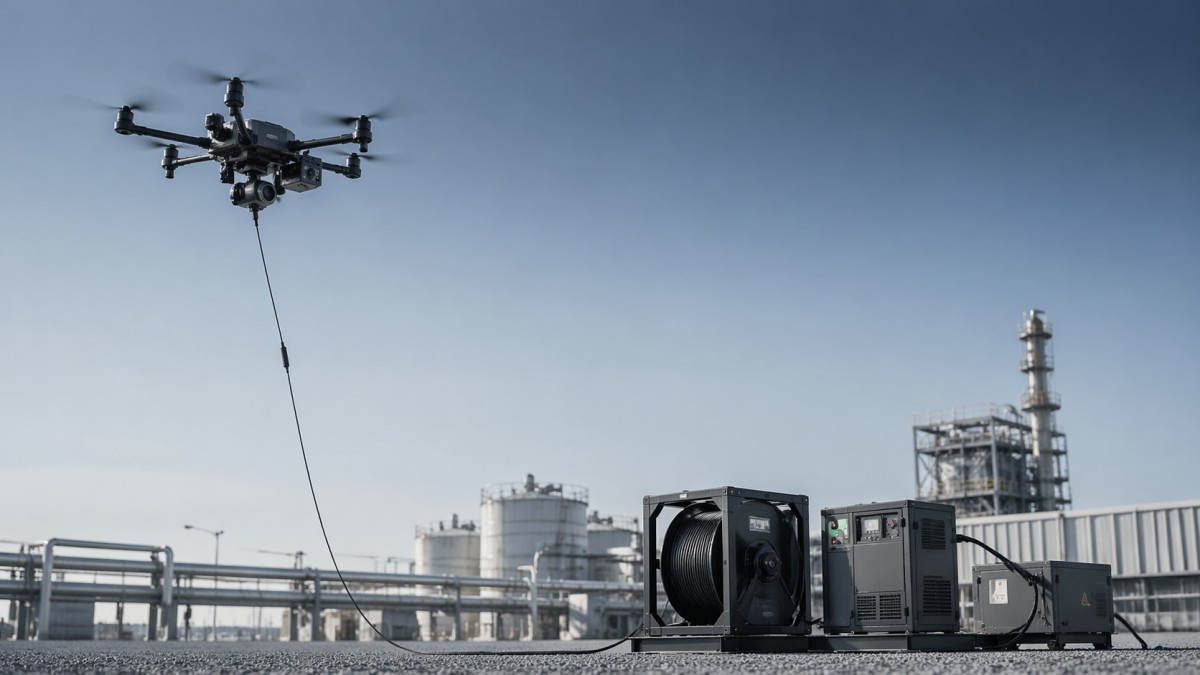
In controlled testing, tethered UAV continuous flight time is often measured under near-ideal conditions: low wind, standard temperature, limited payload, and clean power input. In field deployment, those assumptions rarely hold for more than 30–60 minutes. A system rated for continuous operation may still face performance degradation if ambient wind rises from 3 m/s to 9 m/s or if the payload configuration changes by 1–2 kg.
The tether itself is a major variable. As altitude increases from 50 m to 100 m, cable weight and drag increase the thrust required to maintain stable hover. This means “continuous flight” is not only an electrical issue. It is also an aerodynamic and power-distribution problem. In practical use, every extra meter of tether adds both mechanical load and exposure to lateral wind force.
Another change comes from onboard equipment. A surveillance payload drawing 80–120 W behaves differently from a communications relay package drawing 250–400 W. Even when lift capacity remains acceptable, higher payload power demand increases thermal stress inside the power conversion chain. Over missions lasting 6–12 hours, heat management becomes a reliability factor, not a minor design detail.
Operators also encounter control-system effects not visible on standard brochures. Flight controller latency, correction frequency, and sensor filtering performance determine whether the aircraft can hold station smoothly under turbulence. Small variations in control response may appear insignificant in a 10-minute test, but over a 24-hour mission they can increase motor workload, structural fatigue, and system drift.
The difference between theoretical endurance and usable endurance
Theoretical endurance assumes uninterrupted external power. Usable endurance depends on the full chain remaining stable: power source, tether management, voltage conversion, thermal dissipation, flight control, and mission payload. If one link becomes unstable after 4 hours, the advertised 24-hour flight claim has limited procurement value.
- Rated endurance may be based on payload levels below 50% of maximum capacity.
- Hover stability at 80 m may differ significantly from hover stability at 120 m.
- Wind gusts above 10 m/s can sharply increase thrust demand and positional correction activity.
- Generator or ground power ripple can affect onboard electronics over long-duration missions.
For this reason, procurement comparisons should separate three metrics: electrical supply duration, stable mission duration, and maintenance-free duration. These are related but not identical.
Which Real-World Variables Most Affect Tethered UAV Endurance
When evaluating tethered UAV continuous flight time, field teams should focus on variable interactions rather than isolated specifications. Endurance changes most when four categories shift together: payload, weather, power quality, and control behavior. A system that performs well in only one category may still underperform in a mission-critical scenario.
Payload is the most visible factor. A UAV carrying an EO/IR gimbal, spotlight, and communication repeater may gain 1.5–3.0 kg compared with a baseline camera-only setup. That additional mass changes rotor efficiency, climb rate, and station-keeping energy demand. It can also alter cable motion, especially during crosswind conditions.
Weather is not limited to average wind speed. Gust frequency, humidity, temperature, and airborne dust all matter. In many industrial zones, a daytime temperature shift from 18°C to 34°C changes cooling performance in the power unit and onboard electronics. In coastal or high-salinity environments, long-duration hovering also increases corrosion exposure for connectors, tether surfaces, and fasteners.
Power quality is another overlooked variable. Tethered platforms depend on stable ground-side electricity, whether from a generator, vehicle power take-off system, or grid connection. Voltage instability, harmonics, or brief drops of even 1–3 seconds can trigger protective behavior in converters or payload modules. For security or emergency missions, that interruption may be operationally unacceptable.
Operational variables that change mission endurance
The table below summarizes how common field variables typically affect continuous operation. These ranges are practical engineering references, not universal limits, because final performance depends on airframe design, tether architecture, and mission load.
The key takeaway is that endurance is conditional. A tethered UAV may remain airborne continuously, but mission effectiveness depends on whether it can do so while preserving payload functionality, positional stability, and system safety across the actual operating envelope.
What engineers and buyers should verify
- Check endurance at rated payload, not empty-load demonstration conditions.
- Ask for operating wind thresholds at each target altitude band, such as 50 m, 80 m, and 120 m.
- Confirm thermal behavior after 4 hours, 8 hours, and 24 hours of continuous operation.
- Review fault behavior during brief voltage loss, link interruption, or payload surge current.
These checks help convert endurance from a brochure number into a planning parameter that operations teams can trust.
Flight Controller Latency and EMI Performance: Small Metrics, Big Operational Consequences
Many tethered UAV discussions focus on power and overlook control quality. In reality, flight controller latency benchmark results and drone electromagnetic interference test performance often determine whether continuous flight is merely possible or consistently usable. A platform can have ample power reserve and still perform poorly if control response becomes noisy or delayed under complex field conditions.
Latency matters because a tethered aircraft is not freely moving through air like a standard battery drone. It is mechanically linked to the ground through a cable that introduces drag, tension changes, and directional bias. If the control system reacts too slowly to gusts or cable-induced motion, the UAV may oscillate, consume more thrust, and increase component fatigue over time.
In practical benchmarking, even a difference of 15–30 milliseconds in control response can affect hover steadiness when wind and tether force fluctuate together. This does not necessarily cause immediate mission failure. Instead, it degrades long-duration efficiency, increases correction frequency, and can reduce payload image stability or antenna pointing precision.
Electromagnetic interference is equally important. Tethered UAV systems are often deployed near substations, ports, temporary command centers, industrial yards, broadcasting equipment, and vehicle-mounted generators. These environments can introduce EMI that affects navigation sensors, communication links, and payload electronics. A platform with weak anti-interference design may remain airborne but produce unreliable data or unstable control behavior.
What to look for in control and interference benchmarks
The benchmark framework below helps decision-makers compare systems beyond basic endurance claims. It is especially useful for procurement teams reviewing multiple suppliers with similar flight-time statements.
A procurement team does not always need identical test methods from every vendor, but it does need comparable field-relevant evidence. If a supplier can state “24-hour continuous flight” but cannot describe latency behavior, disturbance recovery, or EMI test conditions, the endurance figure is incomplete.
Common misunderstanding
A stable power tether does not eliminate control risk. It only removes one variable: battery depletion. Long-duration missions still depend on signal integrity, control loop quality, sensor reliability, and noise resistance. For industrial users, these are not secondary metrics. They are part of the endurance equation.
How to Evaluate Tethered UAV Systems for Procurement and Deployment
For procurement managers and enterprise decision-makers, the best evaluation method is a use-case matrix rather than a single “best model” assumption. A security deployment operating at 60–80 m for perimeter watch has different priorities from a communications relay mission at 100–150 m or a temporary event-monitoring platform that must run for 3–7 consecutive days.
The first step is defining mission continuity in measurable terms. Some organizations need uninterrupted airborne time. Others need uninterrupted data service, which is stricter because the aircraft, payload, and backhaul link must all remain stable. Procurement specifications should therefore define endurance together with altitude, payload power, wind tolerance, maintenance window, and acceptable interruption threshold.
The second step is matching the power architecture to the site. Grid-powered systems may offer better continuity in urban fixed installations. Generator-based systems can be more flexible for disaster response or mobile command posts, but they introduce fuel logistics, acoustic constraints, and voltage quality considerations. In remote use, serviceability and spare-parts access may be as important as flight endurance.
The third step is requesting evidence from realistic acceptance tests. A 20-minute hover demonstration is not enough for a system intended for 12-hour, 24-hour, or multi-day deployment. Practical acceptance often requires staged verification at 2 hours, 8 hours, and full mission duration, with checks for thermal stability, data link continuity, and tether handling safety.
Procurement checklist by decision priority
The following table helps buyers organize technical evaluation around actual decision criteria rather than generic sales claims.
A strong procurement outcome usually comes from linking this checklist to a site acceptance protocol. That means the selected vendor should agree in advance on test duration, payload configuration, wind conditions, pass/fail criteria, and fault recovery procedures.
Recommended 5-step evaluation workflow
- Define mission profile: altitude, payload, expected duty cycle, and deployment environment.
- Request field-condition endurance data, not only nominal flight claims.
- Evaluate control and EMI performance with disturbance-focused test scenarios.
- Review maintenance intervals, replaceable modules, and support response time.
- Run acceptance trials over staged durations such as 2 hours, 8 hours, and full intended operation.
This process reduces the gap between engineering expectations and commercial delivery, which is especially important in hard-tech procurement where downtime can affect safety, compliance, or service continuity.
Deployment Risks, Maintenance Strategy, and FAQ for Long-Duration Operations
Even when a tethered UAV system is well matched to its mission, continuous flight time depends on disciplined maintenance and risk control. Long-duration operation introduces cumulative effects that short demonstrations may not reveal. Cable abrasion, connector heating, rotor fatigue, dust loading, and enclosure temperature rise can all emerge gradually over 8–24 hours of duty.
A practical maintenance strategy should define pre-flight, intra-mission, and post-mission checks. For example, cable surface inspection may be required before each deployment, cooling path checks every 8–12 hours in dusty environments, and connector inspection at fixed cycle intervals. These are small tasks compared with the cost of an interrupted industrial surveillance or temporary communications mission.
Another important point is spare strategy. If the system supports rapid replacement of power modules, reel components, or payload mounts within 15–30 minutes, operational resilience improves significantly. For remote deployments, keeping one critical spare set on site can reduce downtime far more effectively than relying only on long headline endurance.
For enterprise users, the most effective long-term approach is lifecycle thinking. Compare not only capital cost, but also maintenance frequency, operator training time, consumables, and service access. A cheaper system that requires more frequent intervention may become more expensive over a 12-month operating cycle.
Common deployment risks
- Treating continuous power as proof of continuous mission capability.
- Ignoring wind-gradient effects at higher tether lengths above the local structure line.
- Running heavy payload combinations without confirming thermal reserve after several hours.
- Assuming industrial EMI conditions are similar to open-field demonstration sites.
- Underestimating inspection and replacement time for wear items in high-duty deployments.
How should buyers interpret “24-hour continuous flight” claims?
Treat the claim as a starting point, not a final procurement basis. Confirm altitude, payload mass, payload power draw, wind condition, ambient temperature, and whether the figure refers to airborne time only or full mission service continuity. A good technical review asks what changes after 2 hours, 8 hours, and 24 hours.
What sites benefit most from tethered UAV systems?
Typical high-value sites include temporary security perimeters, disaster-response staging zones, industrial inspection areas, ports, mining locations, and event-command posts. These use cases often need fixed-area coverage for several hours or several days, where repeated battery changes are inefficient or operationally risky.
Which metrics are most important for operators?
Operators should prioritize stable hover behavior, disturbance recovery, tether handling reliability, alarm logic, and maintenance simplicity. In many real deployments, those factors affect mission success more directly than the maximum theoretical flight duration listed on a data sheet.
Tethered UAV continuous flight time only becomes meaningful when measured against actual deployment conditions. Payload configuration, wind exposure, power quality, flight controller latency, EMI resilience, and maintenance discipline all change what “continuous” truly means in practice. For engineers, buyers, and decision-makers, the goal is not the longest claim, but the most reliable mission endurance under defined operating conditions.
If you are comparing tethered UAV platforms for inspection, security, communications, or industrial monitoring, build your selection around measurable field criteria and acceptance testing. For deeper benchmarking support, procurement review, or application-specific evaluation guidance, contact TSV to discuss your mission profile and get a more precise technical assessment.
Search News
Hot Articles
- Carbon Fiber StructuresHow to Specify Aerospace Carbon Fiber Assemblies for Lightweight, Load-Bearing PartsJul 11, 2026
- Machine VisionXiaomi, Alibaba DAMO Academy Drive Open-Source Robotics Model Ecosystem, Lowering Algorithm Development Barriers for Overseas SMEs Adopting Chinese Robotics SolutionsMar 30, 2026
- Cobots & ArmsShanxi 'AI+' Conference Showcases Embodied Intelligence with Multinational Buyer Engagement: Key Industry ImplicationsMar 30, 2026
Popular Tags
Recommended News
 Jul 11, 2026How to Specify Aerospace Carbon Fiber Assemblies for Lightweight, Load-Bearing PartsAerospace carbon fiber assemblies: learn how to specify laminate design, load data, joining methods, and inspection controls for lighter, reliable load-bearing aerospace parts.Elena Rostova (UAV Systems Researcher)
 Mar 30, 2026Xiaomi, Alibaba DAMO Academy Drive Open-Source Robotics Model Ecosystem, Lowering Algorithm Development Barriers for Overseas SMEs Adopting Chinese Robotics SolutionsXiaomi & Alibaba DAMO Academy's open-source robotics models lower algorithm barriers for global SMEs. Boost efficiency in manufacturing, logistics & smart retail with ROS 2 compatible solutions.TSV Data Lab
 Mar 30, 2026Shanxi 'AI+' Conference Showcases Embodied Intelligence with Multinational Buyer Engagement: Key Industry ImplicationsShanxi 'AI+' Conference highlights embodied intelligence with Tesla, Ubtech & Jiantao showcasing multimodal robotics. 40+ global buyers validated tech on-site, creating new B2B channels for industrial automation & AI solutions.Chen Wei (Automation Lead Engineer)
 Mar 30, 2026Zhongguancun Unveils 6G Integrated Sensing-Computing-Intelligence Platform to Empower Embodied Robots for Global Industrial ApplicationsZhongguancun's new 6G platform revolutionizes industrial robotics with <10ms latency, empowering global automotive, logistics & port automation. Discover how this tech boosts China's smart manufacturing exports.TSV Data Lab
 Mar 30, 2026Mech-Mind Tianjin Embodied Intelligence R&D and Production Base Goes Live, Cutting Delivery Time by 20%–30% for Global Customized AMR+Vision SolutionsMech-Mind's Tianjin AMR+Vision production base cuts delivery time by 20%-30% for欧美 & Latin American markets. Discover how this PLd-certified facility accelerates customized robotics solutions for smart manufacturing and logistics.Chen Wei (Automation Lead Engineer)
 Mar 30, 2026Boao Forum Reveals 'Co-evolution of Big and Small Brains' Trend in Humanoid Robots, China's Embodied Intelligence Accelerates Adaptation to Overseas Manufacturing Service ScenariosDiscover how China's humanoid robots, featuring 'Co-evolution of Big and Small Brains,' are revolutionizing global manufacturing. Learn about Embodied Tian Gong 3.0's ISO compliance and overseas deployment at Boao Forum 2026.Chen Wei (Automation Lead Engineer)
 Mar 30, 2026China Railway Industrial Secures Patent for Embodied Robotics in Material Handling, Boosting High-Precision Delivery Capabilities for Overseas Infrastructure and Manufacturing ProjectsChina Railway Industrial's new patent for embodied robotics in material handling boosts high-precision delivery for global infrastructure & manufacturing. Discover how this innovation enhances logistics accuracy in automotive, rail transit & EPC projects.Chen Wei (Automation Lead Engineer)
 Oct 22, 2026KUKA Showcases Physical AI and iiQKA.AI Vision at NVIDIA GTC BerlinExplore KUKA’s Physical AI showcase at NVIDIA GTC Berlin and discover how iiQKA.AI Vision aims to simplify robotic vision integration and improve 2D and 3D scene recognition.TSV Data Lab
 Oct 22, 2026Robotic Machining of Advanced Composites: What Tolerances Are Achievable?Explore advanced materials machining robotics: discover what drives achievable composite tolerances and how to validate accuracy before investing in your next machining system.Dr. Marcus Vance
 Oct 21, 2026China’s Industrial Robot Exports Near RMB 10 Billion in First Nine Months of 2026China’s industrial robot exports neared RMB 10 billion in January–September 2026, with value rising faster than volume. Explore the data and what it could mean for suppliers.Chen Wei (Automation Lead Engineer)
 Oct 21, 2026Low-Latency Industrial Data Processing: Pricing and Key Cost DriversExplore industrial data latency price drivers, from edge hardware to integration and support. Learn how to compare quotes, verify performance, and avoid unnecessary costs.TSV Data Lab
 Oct 20, 2026KUKA Launches iiQKA.AI Vision to Simplify Industrial Image ProcessingKUKA iiQKA.AI Vision simplifies industrial image processing with controller-based 2D and 3D vision. Explore drag-and-drop setup for vision-guided automation.TSV Data Lab
 Oct 20, 2026Smart Industrial Edge Devices: Key Criteria for Legacy PLC IntegrationChoose smart industrial edge devices for legacy PLC integration. Discover key criteria for compatibility, data quality, security, and reliable collection without disrupting control.TSV Data Lab
 Oct 19, 2026Choosing a Radar Sensor by Application: Range, Resolution, and Field of ViewSimplify radar sensor application based product selection. Compare range, resolution, and field of view to avoid blind spots and choose with confidence. Explore the guide.TSV Data Lab
 Oct 18, 2026Comparing Material Options for Procurement: Specs, Costs, and Supply RisksExplore procurement oriented technical content on material options, specs, costs, and supply risks. Compare alternatives to cut hidden expenses and make confident sourcing decisions.Dr. Marcus Vance
 Oct 17, 20265-Axis CNC Positioning Accuracy: How to Interpret ISO 230-2 Test ResultsAssess 5 axis CNC machining positioning accuracy with ISO 230-2. Learn to interpret repeatability, reversal error, and test conditions to compare suppliers and make confident acceptance decisions.Dr. Marcus Vance
 Oct 16, 2026Choosing a Rugged Edge AI Box Supplier: Thermal Tests and Lifecycle SupportChoose a rugged edge AI box supplier with proven thermal performance and reliable lifecycle support. Discover the tests and commitments to verify before you buy.TSV Data Lab
 Oct 15, 2026R&D Cost Reduction Services: How to Evaluate Fees, Savings, and ROIEvaluate R&D cost reduction services with confidence. Compare fees, verify savings, and calculate ROI without compromising performance. Discover how to choose a provider that delivers real value.Chen Wei (Automation Lead Engineer)
 Oct 22, 2026How Do You Test AMR Navigation Accuracy in a Warehouse?Test AMR navigation accuracy in warehouses with practical methods for localization, path tracking, and docking. Learn to set tolerances and compare robots before deployment.Chen Wei (Automation Lead Engineer)
 Oct 21, 2026How Should You Balance Cobot Payload Against Reach?Explore cobot payload versus reach to choose the right robot. Learn how tooling, load limits, workspace, and cycle time affect performance—and avoid costly selection mistakes.Chen Wei (Automation Lead Engineer)
 Oct 20, 2026How Do You Measure Industrial IoT Gateway Latency Under Load?Measure industrial IoT gateway latency under load with reliable timestamps, realistic traffic, and tail-latency analysis. Discover how to expose bottlenecks and choose the right gateway.TSV Data Lab
 Oct 19, 2026How Do You Verify That Precision Machined Parts Meet Tolerances?Master precision machining tolerance verification with the right tools, datum setups, and acceptance rules. Learn how to validate parts confidently and reduce costly inspection errors.Dr. Marcus Vance
 Oct 18, 2026What Should an AS9100 Machining Supplier Checklist Include?Build an AS9100 machining supplier checklist that verifies capability, traceability, inspection, and outsourced processes. Discover what to check before approving your next aerospace supplier.Dr. Marcus Vance
 Oct 17, 2026How Should You Interpret Industrial Robot Repeatability Specs?Decode industrial robot repeatability specifications, understand ISO 9283 test conditions, and avoid costly selection mistakes. Learn how to verify performance for your process.Chen Wei (Automation Lead Engineer)