How useful is a commercial drone payload capacity benchmark
Publication Date
author
For technical evaluators, a commercial drone payload capacity benchmark matters only when it replaces claims with verified operating data.
Payload numbers shape endurance, stability, thermal load, safety margin, and total mission cost across industrial UAV deployments.
A credible commercial drone payload capacity benchmark helps compare platforms under consistent test methods and realistic configurations.
That makes it highly useful for mapping, inspection, agriculture, logistics trials, and other cross-industry operations where engineering truth matters.
Why a commercial drone payload capacity benchmark matters in real deployment scenarios
A brochure payload figure usually describes lift under limited conditions, not complete mission performance.
In practice, payload interacts with battery discharge, propeller efficiency, motor temperature, vibration, and control stability.
A commercial drone payload capacity benchmark becomes useful when it measures these interactions in repeatable test environments.
This is especially important in the broader hard-tech ecosystem that TechStat Vanguard examines through data-driven benchmarking.
Within comprehensive industry applications, one payload number can support one mission and fail another.
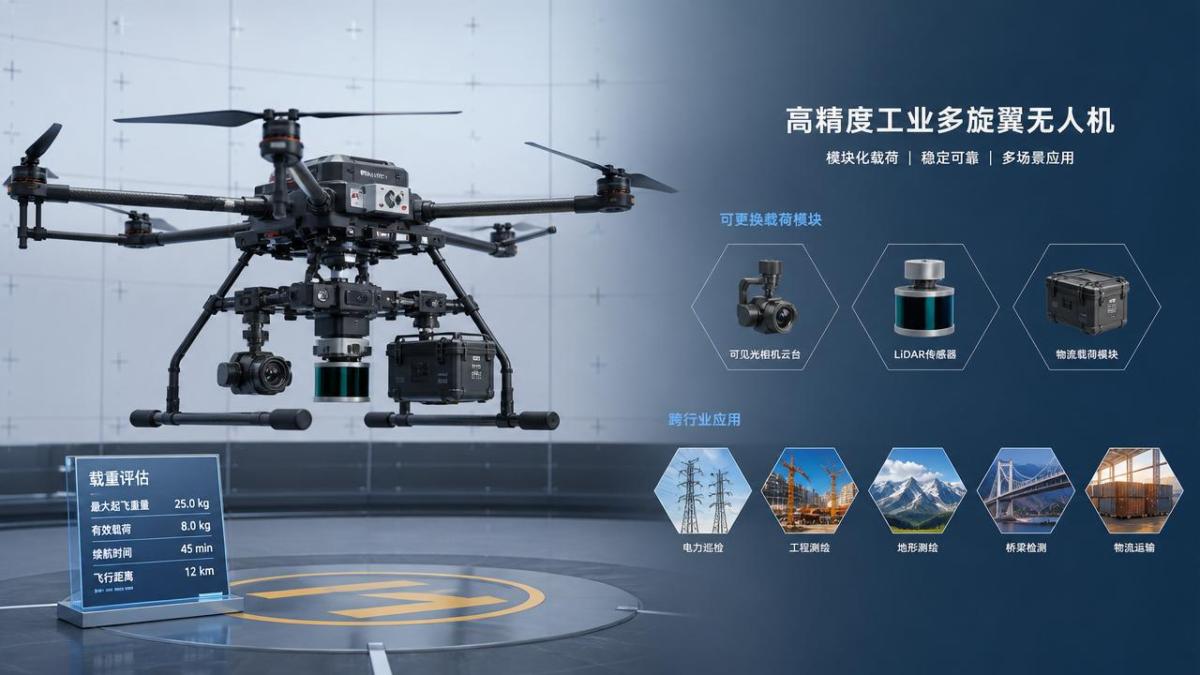
A camera gimbal, multispectral sensor, LiDAR, spraying tank, or edge processor creates very different aerodynamic and electrical loads.
Therefore, the value of a commercial drone payload capacity benchmark depends on scenario relevance, not headline weight alone.
Scenario background: why payload needs differ across industries
Different industries use commercial drones for different mission profiles, and payload capacity affects each profile differently.
Some missions need short flights with heavy sensing packages. Others need long endurance with moderate payload and strict stability.
A commercial drone payload capacity benchmark should separate static lift capability from operational usefulness.
That separation prevents poor decisions based on maximum payload ratings measured without mission accessories or environmental stress.
Useful benchmarks typically include battery state, altitude, wind, temperature, takeoff weight, flight mode, and reserve energy threshold.
Without that context, a commercial drone payload capacity benchmark becomes a marketing line instead of an engineering tool.
Mapping and surveying: payload is useful only when stability remains measurable
Photogrammetry missions
For mapping, payload capacity is not just about carrying a camera.
It must support camera mass, gimbal damping, storage module, RTK hardware, and enough battery reserve for planned overlap.
A commercial drone payload capacity benchmark is useful here when it also reports hover jitter, route deviation, and endurance loss.
LiDAR and hybrid sensor payloads
LiDAR adds more than weight. It changes power draw, mounting geometry, and vibration sensitivity.
A strong commercial drone payload capacity benchmark should show whether point cloud quality remains consistent near rated payload limits.
If stability drops, the stated payload may be technically liftable but commercially less useful.
Infrastructure inspection: benchmark usefulness depends on hover precision and safety margin
Inspection missions often involve bridges, towers, substations, pipelines, and industrial assets in complex airflow conditions.
These tasks require stable hover with zoom cameras, thermal imagers, or corona detection modules.
A commercial drone payload capacity benchmark is useful only if it includes close-range maneuvering performance.
Operators need to know how payload affects braking distance, gust recovery, control latency, and battery reserve before return-to-home.
An inspection platform may carry the sensor, yet still underperform if electromagnetic interference or thermal buildup reduces control reliability.
That is why the best commercial drone payload capacity benchmark is multidimensional, not weight-only.
Agriculture and spraying: payload benchmarks must connect weight to productivity
Agricultural drones are the clearest example of why payload benchmarks need scenario context.
A larger tank payload can increase productivity, but it also changes rotor wash, droplet distribution, and flight endurance.
A useful commercial drone payload capacity benchmark should measure area coverage per battery cycle, refill frequency, and spray uniformity.
It should also report takeoff behavior on uneven ground and power margin at different fill levels.
In agriculture, maximum payload alone does not reveal mission efficiency.
The right commercial drone payload capacity benchmark converts payload into operational throughput and treatment consistency.
Industrial delivery and remote logistics: the benchmark must include risk, range, and reserve energy
Logistics trials often focus on package weight, but route safety is equally important.
A commercial drone payload capacity benchmark becomes useful when it measures loaded range, landing performance, and reserve power after contingencies.
Cargo mounting can alter center of gravity and aerodynamic drag.
Therefore, one benchmark should compare internal bay loads, underslung loads, and box-shaped external payloads separately.
For remote sites, useful payload benchmarking also includes altitude impact, temperature derating, and repeated landing cycle reliability.
How scenario requirements differ in a commercial drone payload capacity benchmark
This table shows why one commercial drone payload capacity benchmark format cannot serve every use case equally well.
Practical guidance for choosing the right benchmark format
- Match payload tests to mission accessories, not bare airframe conditions.
- Request endurance curves at multiple payload steps, not one maximum number.
- Check center-of-gravity tolerance and mounting constraints.
- Review motor temperature, current draw, and battery sag under load.
- Look for wind, altitude, and temperature test disclosure.
- Confirm data quality metrics, not just takeoff success.
A useful commercial drone payload capacity benchmark should support specification writing, trial planning, and supplier screening.
That aligns with the TSV approach of filtering noise and emphasizing measurable engineering thresholds.
Common mistakes when interpreting a commercial drone payload capacity benchmark
One common mistake is treating rated payload as sustained mission payload.
Another is ignoring the mass of brackets, cables, dampers, protection housings, and onboard compute modules.
Some evaluations also miss the difference between hover lift and route performance.
Others compare payload values across drones tested at different temperatures or battery health conditions.
A flawed commercial drone payload capacity benchmark may still look precise, yet remain misleading.
The strongest interpretation always asks whether the benchmark predicts mission success, not only airborne capability.
Actionable next steps for data-driven UAV evaluation
Start by defining the actual mission payload, accessory mass, endurance target, and minimum control margin.
Then build a commercial drone payload capacity benchmark around repeatable operating conditions and pass-fail thresholds.
Use comparable test matrices for wind, temperature, altitude, and battery reserve.
Prioritize evidence that links payload to output quality, safety, and lifecycle efficiency.
In that form, a commercial drone payload capacity benchmark is extremely useful.
It reduces uncertainty, improves platform selection, and turns UAV sourcing into a measurable engineering decision.
For organizations following a hard-tech evaluation model, that is where benchmark data creates lasting value.
Search News
Hot Articles
- Carbon Fiber StructuresHow to Specify Aerospace Carbon Fiber Assemblies for Lightweight, Load-Bearing PartsJul 11, 2026
- Machine VisionXiaomi, Alibaba DAMO Academy Drive Open-Source Robotics Model Ecosystem, Lowering Algorithm Development Barriers for Overseas SMEs Adopting Chinese Robotics SolutionsMar 30, 2026
- Cobots & ArmsShanxi 'AI+' Conference Showcases Embodied Intelligence with Multinational Buyer Engagement: Key Industry ImplicationsMar 30, 2026
Popular Tags
Recommended News
 Jul 11, 2026How to Specify Aerospace Carbon Fiber Assemblies for Lightweight, Load-Bearing PartsAerospace carbon fiber assemblies: learn how to specify laminate design, load data, joining methods, and inspection controls for lighter, reliable load-bearing aerospace parts.Elena Rostova (UAV Systems Researcher)
 Mar 30, 2026Xiaomi, Alibaba DAMO Academy Drive Open-Source Robotics Model Ecosystem, Lowering Algorithm Development Barriers for Overseas SMEs Adopting Chinese Robotics SolutionsXiaomi & Alibaba DAMO Academy's open-source robotics models lower algorithm barriers for global SMEs. Boost efficiency in manufacturing, logistics & smart retail with ROS 2 compatible solutions.TSV Data Lab
 Mar 30, 2026Shanxi 'AI+' Conference Showcases Embodied Intelligence with Multinational Buyer Engagement: Key Industry ImplicationsShanxi 'AI+' Conference highlights embodied intelligence with Tesla, Ubtech & Jiantao showcasing multimodal robotics. 40+ global buyers validated tech on-site, creating new B2B channels for industrial automation & AI solutions.Chen Wei (Automation Lead Engineer)
 Mar 30, 2026Zhongguancun Unveils 6G Integrated Sensing-Computing-Intelligence Platform to Empower Embodied Robots for Global Industrial ApplicationsZhongguancun's new 6G platform revolutionizes industrial robotics with <10ms latency, empowering global automotive, logistics & port automation. Discover how this tech boosts China's smart manufacturing exports.TSV Data Lab
 Mar 30, 2026Mech-Mind Tianjin Embodied Intelligence R&D and Production Base Goes Live, Cutting Delivery Time by 20%–30% for Global Customized AMR+Vision SolutionsMech-Mind's Tianjin AMR+Vision production base cuts delivery time by 20%-30% for欧美 & Latin American markets. Discover how this PLd-certified facility accelerates customized robotics solutions for smart manufacturing and logistics.Chen Wei (Automation Lead Engineer)
 Mar 30, 2026Boao Forum Reveals 'Co-evolution of Big and Small Brains' Trend in Humanoid Robots, China's Embodied Intelligence Accelerates Adaptation to Overseas Manufacturing Service ScenariosDiscover how China's humanoid robots, featuring 'Co-evolution of Big and Small Brains,' are revolutionizing global manufacturing. Learn about Embodied Tian Gong 3.0's ISO compliance and overseas deployment at Boao Forum 2026.Chen Wei (Automation Lead Engineer)
 Mar 30, 2026China Railway Industrial Secures Patent for Embodied Robotics in Material Handling, Boosting High-Precision Delivery Capabilities for Overseas Infrastructure and Manufacturing ProjectsChina Railway Industrial's new patent for embodied robotics in material handling boosts high-precision delivery for global infrastructure & manufacturing. Discover how this innovation enhances logistics accuracy in automotive, rail transit & EPC projects.Chen Wei (Automation Lead Engineer)
 Sep 29, 2026ISO 9283 Repeatability: How to Evaluate Cobot Positioning PerformanceISO 9283 cobot repeatability explained: learn how payload, reach, approach direction, and test conditions affect positioning performance and cell capability.Chen Wei (Automation Lead Engineer)
 Sep 28, 2026Spindle Runout Measurement in Germany: DIN Standards, Methods, and Acceptance LimitsSpindle runout measurement Germany: explore DIN standards, proven methods, acceptance limits, and audit-ready practices for reliable machining quality.Dr. Marcus Vance
 Sep 27, 2026How to Select Wall-Mount Edge Devices for Space-Constrained Factory NetworksWall mount edge devices for space-constrained factories: evaluate workload, thermal design, power resilience, cable access, and network reliability for smarter deployments.TSV Data Lab
 Sep 26, 2026Machining Tolerance Analysis: How to Set Limits That Meet Function and Cost TargetsMachining tolerance analysis: learn how to set functional limits, control tolerance stacks, reduce inspection risk, and balance precision with production cost.Dr. Marcus Vance
 Sep 25, 2026How to Evaluate an Industrial Infrastructure Data Platform for Multi-Site OperationsIndustrial infrastructure data platform evaluation guide for multi-site operations: compare data quality, edge resilience, interoperability, governance, and scalable proof-of-value criteria.Victor Lin (Chief Software Architect)
 Sep 24, 2026How to Select Machine Vision Optics for Accurate Inspection at Different Working DistancesMachine vision optics selection guide for accurate inspection at every working distance. Compare FOV, pixel scale, DOF, distortion, lighting, and telecentric options.TSV Data Lab
 Sep 23, 2026How to Evaluate a Machine Vision System Integrator for High-Speed Inspection LinesChoose a machine vision system integrator with proven expertise in high-speed inspection, reliable reject timing, robust optics, and measurable acceptance criteria.TSV Data Lab
 Sep 28, 2026When is a SCADA API the right choice for connecting plant systems?SCADA API guide: learn when governed plant data integration improves traceability, security, and scalability—without compromising real-time control.Victor Lin (Chief Software Architect)
 Sep 27, 2026How SCADA data integration improves traceability across production linesSCADA data integration connects production-line data to improve traceability, accelerate quality investigations, and strengthen safety decisions.Victor Lin (Chief Software Architect)
 Sep 26, 2026What to define before starting SCADA integration planningSCADA integration planning starts with clear scope, control boundaries, data models, cybersecurity, and testing. Discover the definitions that reduce risk and costly rework.Victor Lin (Chief Software Architect)
 Sep 25, 2026How a smart factory with Industrial IoT reduces production blind spotsDiscover how a smart factory with Industrial IoT turns real-time machine, quality, and workflow data into actionable insights that reduce production blind spots and delivery risks.Victor Lin (Chief Software Architect)
 Sep 24, 2026When does Industrial IoT make smart manufacturing easier to scale?Smart manufacturing Industrial IoT scales when trusted data, interoperable systems, and secure workflows turn connected assets into measurable gains.TSV Data Lab
 Sep 23, 2026What drives ultra-precision machining cost at 1-micron tolerance?Ultra precision machining cost per part at 1 micron tolerance depends on process, material, metrology, and yield. Learn how to compare quotes confidently.Dr. Marcus Vance
 Sep 22, 2026Drone Engine-T550CC Applications: Build the UAV Power System Around the MissionAn application guide for Drone Engine-T550CC integration, covering payload planning, airframe matching, cooling, fuel, vibration, test procedures, documentation, and service preparation.Elena Rostova (UAV Systems Researcher)
 Sep 22, 2026How to Evaluate Industrial Edge Computing Vendors for Factory DeploymentIndustrial edge computing vendor evaluation guide for factories: compare latency, protocol fit, reliability, security, and lifecycle support before deployment.TSV Data Lab
 Sep 21, 2026Drone Payload Integration: Matching Power, Data, and Center of Gravity for Reliable FlightsDrone payload integration made practical: balance power, data, center of gravity, and endurance to build safer, more reliable mission-ready flights.Elena Rostova (UAV Systems Researcher)
 Sep 20, 2026Autonomous Navigation Pricing: Cost Drivers and Budget Benchmarks for AMR ProjectsAutonomous navigation price explained: compare AMR cost drivers, software, sensors, integration, safety, and lifecycle budgets to build a scalable project plan.Chen Wei (Automation Lead Engineer)