How to Evaluate a Commercial Drone Supplier in China for Mapping and Inspection Projects
Publication Date
author
Why does choosing a commercial drone supplier in China require deeper verification?
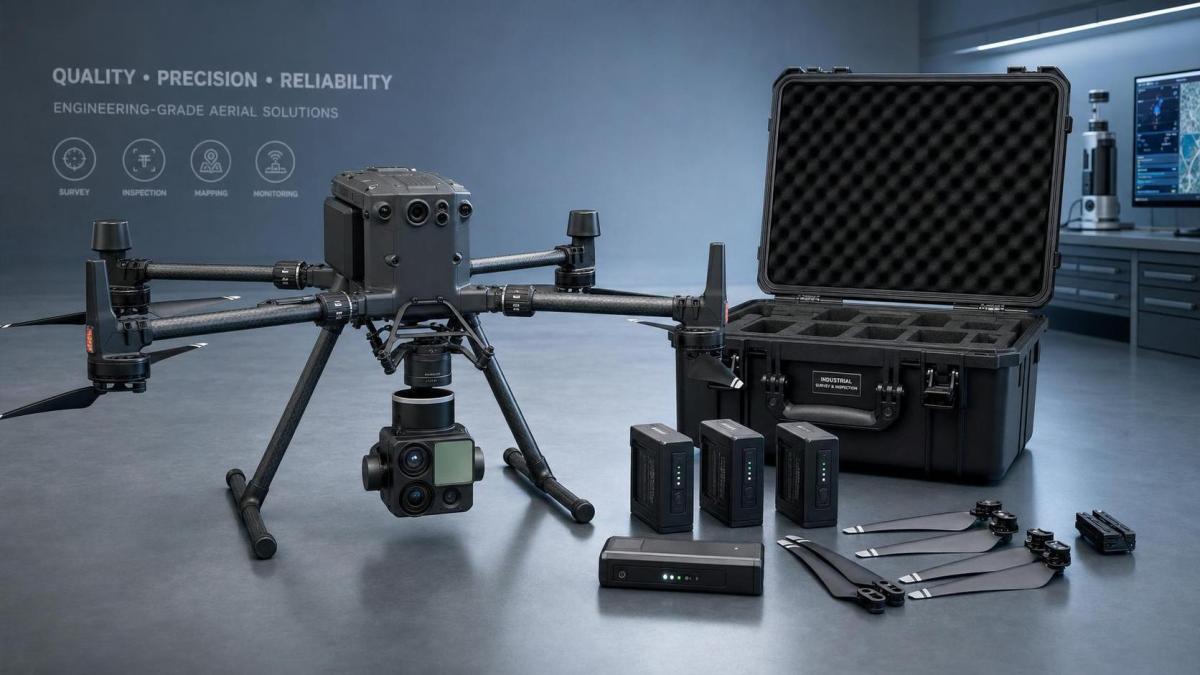
Selecting a commercial drone supplier China is rarely a simple price exercise.
For mapping and inspection work, the real issue is repeatable performance under field pressure.
A brochure may highlight flight time and payload, yet leave out vibration behavior, sensor integration limits, or battery derating in heat.
That gap creates sourcing risk, especially when missions depend on data accuracy rather than simple visual flights.
In practical terms, a strong supplier should prove engineering capability, not just sales readiness.
This is where a data-first approach matters.
TechStat Vanguard often frames supplier evaluation around measurable thresholds, because parameters reveal far more than marketing language.
For a commercial drone supplier China, that means looking at flight controller stability, payload power interfaces, GNSS performance, structural fatigue, and traceable quality records.
If those details are vague, qualification usually becomes slower and more expensive later.
What should be confirmed first for mapping and inspection projects?
Before comparing suppliers, define the mission profile with enough precision to filter out unsuitable platforms early.
A mapping mission and a flare-stack inspection mission may both use UAVs, but the technical demands differ sharply.
The most useful first check is whether the supplier understands your application constraints without oversimplifying them.
- Required payload type: RGB, LiDAR, thermal, multispectral, or zoom inspection camera.
- Target accuracy: corridor mapping, topographic output, asset condition capture, or defect detection.
- Operational environment: offshore wind, transmission lines, mines, refineries, or urban infrastructure.
- Flight constraints: endurance, wind tolerance, electromagnetic interference, takeoff area, and mission radius.
- Compliance needs: local import documentation, firmware control, geofencing, and data security policies.
A capable commercial drone supplier China should ask these questions early.
If discussions stay focused on generic “high quality” claims, the supplier may not be ready for engineering-led qualification.
Which technical signals separate a reliable supplier from a polished catalog?
This is usually the turning point in supplier shortlisting.
A serious commercial drone supplier China should present evidence that the airframe, avionics, and payload stack work as a controlled system.
Look beyond top-line specifications and ask for boundary conditions.
The table matters because it changes the conversation.
Instead of asking whether a drone is “good,” you ask whether performance is documented, repeatable, and auditable.
That is often the most efficient way to compare one commercial drone supplier China against another.
How do cost and lead time really compare when sourcing from China?
Lower unit pricing can be real, but total acquisition cost depends on more than the aircraft invoice.
The hidden variables usually come from integration work, spare parts planning, training time, and failure response speed.
A commercial drone supplier China can look cost-effective on paper, then become expensive if batteries are difficult to replace or firmware support is slow.
Lead time also needs careful interpretation.
Some suppliers quote fast assembly time, but not sensor calibration, export preparation, acceptance testing, or packaging for lithium battery shipment.
More useful cost questions include these:
- What is included in the delivered system, not just the airframe?
- How many spare propellers, batteries, chargers, and dampers are recommended per fleet unit?
- What is the average turnaround time for warranty analysis and non-warranty repair?
- Are replacement payload cables, arms, landing gear, and ESC modules stocked?
- How often does firmware require field updates, and who validates compatibility?
In many cases, the best-value supplier is not the cheapest quotation.
It is the one with the shortest path from purchase order to stable operational output.
What mistakes show up most often during supplier qualification?
Several recurring errors can distort supplier comparison.
The first is evaluating the drone without evaluating the data workflow.
For mapping, camera synchronization, PPK support, and processing compatibility often matter more than headline endurance.
The second is accepting payload compatibility claims without a validated reference configuration.
An inspection camera may mount physically, yet still cause unstable power draw or control latency.
Another common mistake is skipping factory process checks.
A commercial drone supplier China should be able to explain incoming inspection, burn-in practice, and how engineering changes are controlled between batches.
This point aligns with the broader TSV view that supply chain truth lives in traceability, not slogans.
One more risk deserves attention: service localization.
If all troubleshooting depends on one remote engineer and undocumented messaging threads, downtime can expand quickly.
A stronger supplier documents escalation steps, response windows, and spare-part support clearly.
When does a commercial drone supplier in China become a strong long-term fit?
The answer usually appears after the first technical review, not before it.
A strong long-term fit is a supplier that reduces uncertainty across the entire lifecycle.
That includes sourcing, acceptance, deployment, maintenance, and future payload upgrades.
In real projects, the better commercial drone supplier China tends to share certain habits.
- Provides application-specific test evidence rather than generic spec sheets.
- Explains limitations openly, including payload, weather, and endurance tradeoffs.
- Supports structured FAT or acceptance criteria before shipment.
- Maintains version control for hardware, firmware, and accessories.
- Responds with engineering language, drawings, logs, and root-cause detail.
That combination is often more valuable than broad product range alone.
For organizations using benchmark-driven sourcing methods, this is the point where comparison becomes defensible.
If the next step is qualification, build a short evaluation matrix around mission profile, payload validation, traceability, spare support, and total operating cost.
That framework helps identify whether a commercial drone supplier China can support mapping and inspection projects with real engineering confidence, not just an attractive quote.
Search News
Hot Articles
- Carbon Fiber StructuresHow to Specify Aerospace Carbon Fiber Assemblies for Lightweight, Load-Bearing PartsJul 11, 2026
- Machine VisionXiaomi, Alibaba DAMO Academy Drive Open-Source Robotics Model Ecosystem, Lowering Algorithm Development Barriers for Overseas SMEs Adopting Chinese Robotics SolutionsMar 30, 2026
- Cobots & ArmsShanxi 'AI+' Conference Showcases Embodied Intelligence with Multinational Buyer Engagement: Key Industry ImplicationsMar 30, 2026
Popular Tags
Recommended News
 Jul 11, 2026How to Specify Aerospace Carbon Fiber Assemblies for Lightweight, Load-Bearing PartsAerospace carbon fiber assemblies: learn how to specify laminate design, load data, joining methods, and inspection controls for lighter, reliable load-bearing aerospace parts.Elena Rostova (UAV Systems Researcher)
 Mar 30, 2026Xiaomi, Alibaba DAMO Academy Drive Open-Source Robotics Model Ecosystem, Lowering Algorithm Development Barriers for Overseas SMEs Adopting Chinese Robotics SolutionsXiaomi & Alibaba DAMO Academy's open-source robotics models lower algorithm barriers for global SMEs. Boost efficiency in manufacturing, logistics & smart retail with ROS 2 compatible solutions.TSV Data Lab
 Mar 30, 2026Shanxi 'AI+' Conference Showcases Embodied Intelligence with Multinational Buyer Engagement: Key Industry ImplicationsShanxi 'AI+' Conference highlights embodied intelligence with Tesla, Ubtech & Jiantao showcasing multimodal robotics. 40+ global buyers validated tech on-site, creating new B2B channels for industrial automation & AI solutions.Chen Wei (Automation Lead Engineer)
 Mar 30, 2026Zhongguancun Unveils 6G Integrated Sensing-Computing-Intelligence Platform to Empower Embodied Robots for Global Industrial ApplicationsZhongguancun's new 6G platform revolutionizes industrial robotics with <10ms latency, empowering global automotive, logistics & port automation. Discover how this tech boosts China's smart manufacturing exports.TSV Data Lab
 Mar 30, 2026Mech-Mind Tianjin Embodied Intelligence R&D and Production Base Goes Live, Cutting Delivery Time by 20%–30% for Global Customized AMR+Vision SolutionsMech-Mind's Tianjin AMR+Vision production base cuts delivery time by 20%-30% for欧美 & Latin American markets. Discover how this PLd-certified facility accelerates customized robotics solutions for smart manufacturing and logistics.Chen Wei (Automation Lead Engineer)
 Mar 30, 2026Boao Forum Reveals 'Co-evolution of Big and Small Brains' Trend in Humanoid Robots, China's Embodied Intelligence Accelerates Adaptation to Overseas Manufacturing Service ScenariosDiscover how China's humanoid robots, featuring 'Co-evolution of Big and Small Brains,' are revolutionizing global manufacturing. Learn about Embodied Tian Gong 3.0's ISO compliance and overseas deployment at Boao Forum 2026.Chen Wei (Automation Lead Engineer)
 Mar 30, 2026China Railway Industrial Secures Patent for Embodied Robotics in Material Handling, Boosting High-Precision Delivery Capabilities for Overseas Infrastructure and Manufacturing ProjectsChina Railway Industrial's new patent for embodied robotics in material handling boosts high-precision delivery for global infrastructure & manufacturing. Discover how this innovation enhances logistics accuracy in automotive, rail transit & EPC projects.Chen Wei (Automation Lead Engineer)
 Oct 02, 2026How to Qualify Machined Parts Suppliers for Hard Tech ProgramsHard tech supply chain machined parts demand rigorous supplier qualification. Learn how to assess capability, traceability, quality controls, and delivery resilience.Dr. Marcus Vance
 Oct 01, 2026How to Select an Outdoor Security Radar Sensor for Perimeter Detection?Outdoor security radar sensor selection guide: compare range, accuracy, false-alarm control, integration, and field testing for reliable perimeter detection.TSV Data Lab
 Sep 30, 2026How to Evaluate Solid-State LiDAR Hardware for Outdoor Autonomous VehiclesSolid state LiDAR hardware evaluation guide for outdoor autonomous vehicles—compare range, point-cloud quality, environmental resilience, integration, and safety.TSV Data Lab
 Sep 29, 2026ISO 9283 Repeatability: How to Evaluate Cobot Positioning PerformanceISO 9283 cobot repeatability explained: learn how payload, reach, approach direction, and test conditions affect positioning performance and cell capability.Chen Wei (Automation Lead Engineer)
 Oct 02, 2026What Documents Prove a Precision Machining Supplier Can Hold Tolerance?What documents prove a precision machining supplier can hold tolerance? Explore certificates, FAI reports, calibration, SPC, and traceability evidence to qualify suppliers with confidence.Dr. Marcus Vance
 Oct 01, 2026Can a Machining Supplier Meet Aerospace Fatigue Testing Requirements?Can a machining supplier meet aerospace fatigue testing requirements? Learn the traceability, process control, and test evidence needed for reliable aerospace parts.Dr. Marcus Vance
 Sep 30, 2026Which Industrial Robot Specifications Matter for High-Precision Assembly?Which industrial robot specifications matter most for high-precision assembly? Explore repeatability, accuracy, stiffness, vibration, calibration, and force control for reliable yields.Chen Wei (Automation Lead Engineer)
 Sep 29, 2026How Do You Verify Servo Motor Torque Under Continuous Load?How do I verify servo motor torque under continuous load? Learn RMS torque checks, torque-speed limits, thermal derating, and real-machine testing.Chen Wei (Automation Lead Engineer)
 Oct 02, 2026ZD330 Software Configuration: Verifying Cut-List Import Before PurchaseZD330 software and machine configuration: verify cut-list imports, data mapping, labels, and workflow before purchase to reduce errors and choose with confidence.Victor Lin (Chief Software Architect)
 Sep 28, 2026Spindle Runout Measurement in Germany: DIN Standards, Methods, and Acceptance LimitsSpindle runout measurement Germany: explore DIN standards, proven methods, acceptance limits, and audit-ready practices for reliable machining quality.Dr. Marcus Vance
 Sep 27, 2026How to Select Wall-Mount Edge Devices for Space-Constrained Factory NetworksWall mount edge devices for space-constrained factories: evaluate workload, thermal design, power resilience, cable access, and network reliability for smarter deployments.TSV Data Lab
 Sep 26, 2026Machining Tolerance Analysis: How to Set Limits That Meet Function and Cost TargetsMachining tolerance analysis: learn how to set functional limits, control tolerance stacks, reduce inspection risk, and balance precision with production cost.Dr. Marcus Vance
 Sep 25, 2026How to Evaluate an Industrial Infrastructure Data Platform for Multi-Site OperationsIndustrial infrastructure data platform evaluation guide for multi-site operations: compare data quality, edge resilience, interoperability, governance, and scalable proof-of-value criteria.Victor Lin (Chief Software Architect)
 Sep 24, 2026How to Select Machine Vision Optics for Accurate Inspection at Different Working DistancesMachine vision optics selection guide for accurate inspection at every working distance. Compare FOV, pixel scale, DOF, distortion, lighting, and telecentric options.TSV Data Lab
 Sep 23, 2026How to Evaluate a Machine Vision System Integrator for High-Speed Inspection LinesChoose a machine vision system integrator with proven expertise in high-speed inspection, reliable reject timing, robust optics, and measurable acceptance criteria.TSV Data Lab
 Oct 02, 2026What affects the cost of a pick and place robot cell?Pick and place robot cost depends on throughput, tooling, vision, safety, and integration. Compare quotes confidently and avoid hidden automation costs.Chen Wei (Automation Lead Engineer)
 Oct 01, 2026What is included in a robotic system integration project cost?Robotic system integration project cost explained: compare equipment, engineering, safety, testing, installation, and lifecycle factors for smarter automation investments.Chen Wei (Automation Lead Engineer)