Embedded Vision AI Systems Explained: Key Components, Latency, and Edge Deployment Limits
Publication Date
author
Why Embedded Vision AI Systems Matter Outside the Lab
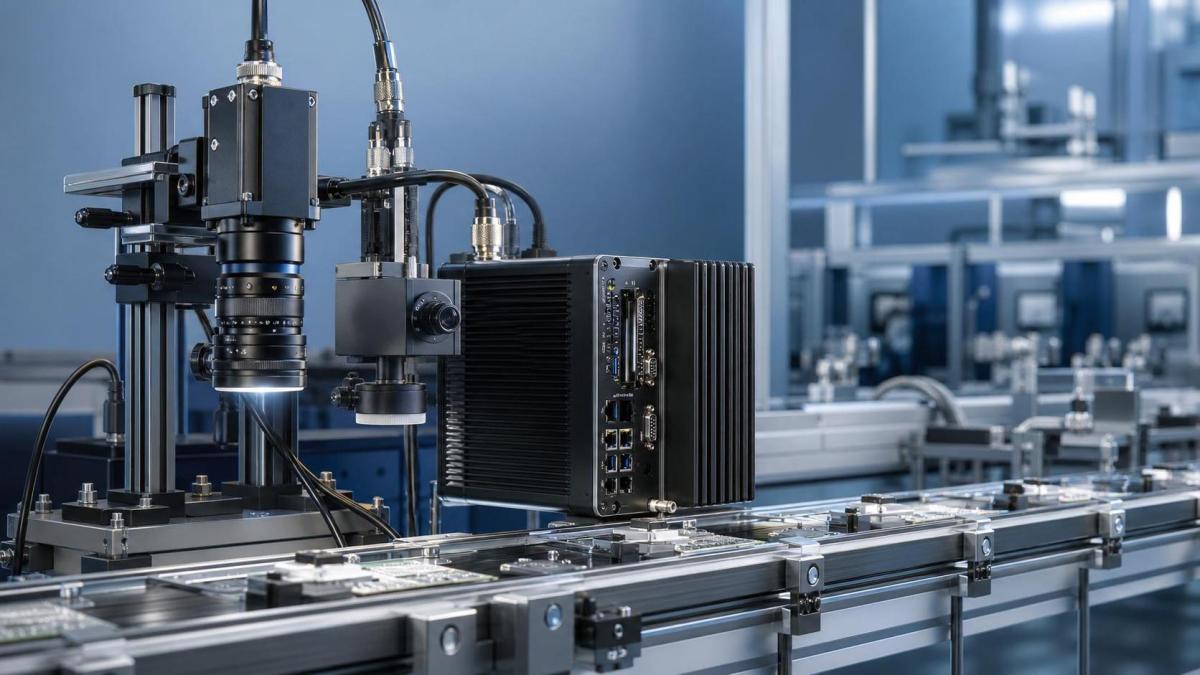
Embedded vision AI systems now sit inside inspection stations, mobile robots, drones, and smart cameras. Their value is obvious when demos run well. The harder question is whether they keep that performance under production constraints.
That is where evaluation often changes direction. Model accuracy still matters, but it stops being the only decision variable. Real deployment depends on throughput, power draw, memory pressure, thermal behavior, and I/O timing.
For teams comparing embedded vision AI systems, the main task is not finding the flashiest benchmark. It is verifying whether the full stack can sustain deterministic behavior at the edge.
This distinction matters across manufacturing and autonomous platforms. A vision node that misses a defect, drops frames, or throttles after ten minutes can invalidate the business case, even when offline testing looked strong.
From an engineering perspective, embedded vision AI systems are a balancing act. Sensor quality, compute architecture, software optimization, and enclosure design all shape the final result.
Core Components That Define System Throughput
When reviewing embedded vision AI systems, start with the data path. Every stage adds cost in time, bandwidth, and energy. Bottlenecks often appear between blocks, not inside a single component.
1. Image Sensor and Optics
The sensor determines the raw signal quality. Resolution, frame rate, dynamic range, shutter type, and pixel size all affect downstream AI performance.
A global shutter may be necessary for conveyors, drones, or robot arms. Rolling shutter can reduce cost, but motion distortion may raise detection errors before inference even begins.
Optics also deserve harder scrutiny than they usually get. Lens MTF, distortion, field coverage, and vibration stability can reshape practical accuracy more than small changes in model architecture.
2. ISP and Preprocessing Pipeline
The image signal processor handles demosaicing, exposure, white balance, denoise, and color correction. In embedded vision AI systems, bad ISP tuning creates unstable inputs that no model can fully fix.
Preprocessing then adds resize, crop, normalization, and format conversion. These look minor on paper, yet they can consume meaningful CPU cycles and memory bandwidth at scale.
3. Compute Engine
Compute usually spans CPU, GPU, NPU, DSP, or FPGA resources. The best choice depends on workload shape, determinism requirements, and software maturity.
NPUs often lead on TOPS per watt, but supported operators may be limited. GPUs offer flexibility, though they may raise thermal load and power budget in compact edge devices.
For technical evaluation, raw TOPS is not enough. The more useful metric is sustained application throughput after preprocessing, memory transfer, and post-processing overhead are included.
4. Memory and Storage
Many embedded vision AI systems fail at memory, not compute. Large feature maps, multiple video streams, and temporary buffers can saturate RAM bandwidth quickly.
Storage also affects boot speed, model loading, and logging reliability. In edge environments, endurance and write consistency matter as much as nominal read performance.
5. Interfaces and Industrial I/O
Camera links, Ethernet, USB, MIPI CSI, GPIO, and fieldbus integration define whether the system fits the machine. Interface mismatch can add gateways, latency, and failure points.
In short, embedded vision AI systems should be evaluated as complete pipelines. A strong accelerator paired with weak memory or unstable I/O still produces weak field performance.
How Latency Really Builds Up at the Edge
Latency in embedded vision AI systems is rarely a single number. It is a chain of delays, and small delays add up quickly when the device must react in real time.
A practical latency budget often includes these stages:
- sensor exposure and readout
- ISP and frame conversion
- buffering and memory copies
- inference scheduling and execution
- post-processing, such as NMS or tracking
- control output or network transmission
This is why headline inference speed can mislead. A model running in 12 milliseconds may still produce a 45 millisecond system response once queueing and output handling are added.
Jitter matters as much as average latency. On a pick-and-place line or AGV perception stack, occasional timing spikes can be more damaging than a slightly slower but stable pipeline.
More recent deployments also show a pattern: multi-model edge workloads are becoming common. Detection, segmentation, OCR, and anomaly scoring may run on the same node, raising contention across shared resources.
For that reason, latency testing should include burst loads, thermal soak, and concurrent tasks. A single clean benchmark run does not represent field reality.
Edge Deployment Limits You Cannot Ignore
Most embedded vision AI systems hit a deployment limit before they hit theoretical compute capacity. In practice, four constraints show up repeatedly.
Power Budget
Battery platforms, sealed enclosures, and remote devices have strict power ceilings. A board that performs well at 30 watts may be unusable in a drone bay or pole-mounted sensor housing.
Thermal Headroom
Thermal throttling is one of the most common hidden failures in embedded vision AI systems. Sustained frame rates often drop once ambient temperature rises or airflow disappears.
This becomes more visible in factory cabinets, outdoor kiosks, and mobile robots. A system may pass lab validation at 22 degrees Celsius, then miss targets on a summer production floor.
Memory Ceiling
As models grow, memory becomes a structural limit. Quantization helps, but intermediate activations, image buffers, and multitasking still consume significant space.
Software and Toolchain Friction
Vendor SDK maturity can decide success or failure. Unsupported layers, unstable drivers, or weak profiling tools can delay deployment more than any hardware shortfall.
This is especially relevant when embedded vision AI systems must support long life cycles, over-the-air updates, or regulated validation paths. Toolchain stability is part of the technical specification.
What a Practical Evaluation Matrix Should Include
A useful review framework should compare embedded vision AI systems against operating conditions, not just marketing claims. The fastest way to improve decision quality is to score measurable constraints.
In actual sourcing work, this matrix shortens comparison cycles. It also aligns engineering, operations, and procurement around the same physical limits instead of isolated benchmark numbers.
Common Failure Patterns in Embedded Vision AI Systems
Several failure modes appear again and again during field rollout. They are worth checking early because each one can survive a polished prototype stage.
- The model was trained on ideal images, but the deployment camera sees different lighting, blur, or angle variation.
- The accelerator supports the model only after unsupported operations are rewritten, which changes timing and accuracy.
- Thermal behavior was measured in short tests, so long-run throttling was missed.
- Network assumptions were unrealistic, and edge-to-cloud fallback added unacceptable delays.
- Maintenance teams lacked observability tools, making on-site diagnosis slow and expensive.
The pattern behind these issues is simple. Embedded vision AI systems are constrained systems. Any evaluation process that isolates the neural network from the hardware and environment will miss critical risk.
A Better Way to Qualify an Edge Vision Stack
A stronger qualification path starts with the target operating window. Define acceptable response time, minimum sustained FPS, ambient temperature range, power cap, and integration interfaces first.
Then validate embedded vision AI systems in staged conditions. Begin with operator data, then add motion, lighting drift, multi-task load, and thermal soak. The objective is to expose edge limits before scale-up.
This approach matches a broader engineering principle that TSV consistently emphasizes. Parameters matter only when they remain true under operating stress.
For teams making technical or sourcing decisions, the best embedded vision AI systems are not the ones with the loudest claims. They are the ones with measurable margins across latency, memory, thermal load, and interface stability.
In other words, evaluate the stack the way it will actually live. That is how an edge vision platform moves from an impressive demo to a reliable production asset.
Search News
Hot Articles
- Carbon Fiber StructuresHow to Specify Aerospace Carbon Fiber Assemblies for Lightweight, Load-Bearing PartsJul 11, 2026
- Machine VisionXiaomi, Alibaba DAMO Academy Drive Open-Source Robotics Model Ecosystem, Lowering Algorithm Development Barriers for Overseas SMEs Adopting Chinese Robotics SolutionsMar 30, 2026
- Cobots & ArmsShanxi 'AI+' Conference Showcases Embodied Intelligence with Multinational Buyer Engagement: Key Industry ImplicationsMar 30, 2026
Popular Tags
Recommended News
 Jul 11, 2026How to Specify Aerospace Carbon Fiber Assemblies for Lightweight, Load-Bearing PartsAerospace carbon fiber assemblies: learn how to specify laminate design, load data, joining methods, and inspection controls for lighter, reliable load-bearing aerospace parts.Elena Rostova (UAV Systems Researcher)
 Mar 30, 2026Xiaomi, Alibaba DAMO Academy Drive Open-Source Robotics Model Ecosystem, Lowering Algorithm Development Barriers for Overseas SMEs Adopting Chinese Robotics SolutionsXiaomi & Alibaba DAMO Academy's open-source robotics models lower algorithm barriers for global SMEs. Boost efficiency in manufacturing, logistics & smart retail with ROS 2 compatible solutions.TSV Data Lab
 Mar 30, 2026Shanxi 'AI+' Conference Showcases Embodied Intelligence with Multinational Buyer Engagement: Key Industry ImplicationsShanxi 'AI+' Conference highlights embodied intelligence with Tesla, Ubtech & Jiantao showcasing multimodal robotics. 40+ global buyers validated tech on-site, creating new B2B channels for industrial automation & AI solutions.Chen Wei (Automation Lead Engineer)
 Mar 30, 2026Zhongguancun Unveils 6G Integrated Sensing-Computing-Intelligence Platform to Empower Embodied Robots for Global Industrial ApplicationsZhongguancun's new 6G platform revolutionizes industrial robotics with <10ms latency, empowering global automotive, logistics & port automation. Discover how this tech boosts China's smart manufacturing exports.TSV Data Lab
 Mar 30, 2026Mech-Mind Tianjin Embodied Intelligence R&D and Production Base Goes Live, Cutting Delivery Time by 20%–30% for Global Customized AMR+Vision SolutionsMech-Mind's Tianjin AMR+Vision production base cuts delivery time by 20%-30% for欧美 & Latin American markets. Discover how this PLd-certified facility accelerates customized robotics solutions for smart manufacturing and logistics.Chen Wei (Automation Lead Engineer)
 Mar 30, 2026Boao Forum Reveals 'Co-evolution of Big and Small Brains' Trend in Humanoid Robots, China's Embodied Intelligence Accelerates Adaptation to Overseas Manufacturing Service ScenariosDiscover how China's humanoid robots, featuring 'Co-evolution of Big and Small Brains,' are revolutionizing global manufacturing. Learn about Embodied Tian Gong 3.0's ISO compliance and overseas deployment at Boao Forum 2026.Chen Wei (Automation Lead Engineer)
 Mar 30, 2026China Railway Industrial Secures Patent for Embodied Robotics in Material Handling, Boosting High-Precision Delivery Capabilities for Overseas Infrastructure and Manufacturing ProjectsChina Railway Industrial's new patent for embodied robotics in material handling boosts high-precision delivery for global infrastructure & manufacturing. Discover how this innovation enhances logistics accuracy in automotive, rail transit & EPC projects.Chen Wei (Automation Lead Engineer)
 Oct 02, 2026How to Qualify Machined Parts Suppliers for Hard Tech ProgramsHard tech supply chain machined parts demand rigorous supplier qualification. Learn how to assess capability, traceability, quality controls, and delivery resilience.Dr. Marcus Vance
 Oct 01, 2026How to Select an Outdoor Security Radar Sensor for Perimeter Detection?Outdoor security radar sensor selection guide: compare range, accuracy, false-alarm control, integration, and field testing for reliable perimeter detection.TSV Data Lab
 Sep 30, 2026How to Evaluate Solid-State LiDAR Hardware for Outdoor Autonomous VehiclesSolid state LiDAR hardware evaluation guide for outdoor autonomous vehicles—compare range, point-cloud quality, environmental resilience, integration, and safety.TSV Data Lab
 Sep 29, 2026ISO 9283 Repeatability: How to Evaluate Cobot Positioning PerformanceISO 9283 cobot repeatability explained: learn how payload, reach, approach direction, and test conditions affect positioning performance and cell capability.Chen Wei (Automation Lead Engineer)
 Oct 02, 2026What Documents Prove a Precision Machining Supplier Can Hold Tolerance?What documents prove a precision machining supplier can hold tolerance? Explore certificates, FAI reports, calibration, SPC, and traceability evidence to qualify suppliers with confidence.Dr. Marcus Vance
 Oct 01, 2026Can a Machining Supplier Meet Aerospace Fatigue Testing Requirements?Can a machining supplier meet aerospace fatigue testing requirements? Learn the traceability, process control, and test evidence needed for reliable aerospace parts.Dr. Marcus Vance
 Sep 30, 2026Which Industrial Robot Specifications Matter for High-Precision Assembly?Which industrial robot specifications matter most for high-precision assembly? Explore repeatability, accuracy, stiffness, vibration, calibration, and force control for reliable yields.Chen Wei (Automation Lead Engineer)
 Sep 29, 2026How Do You Verify Servo Motor Torque Under Continuous Load?How do I verify servo motor torque under continuous load? Learn RMS torque checks, torque-speed limits, thermal derating, and real-machine testing.Chen Wei (Automation Lead Engineer)
 Oct 02, 2026ZD330 Software Configuration: Verifying Cut-List Import Before PurchaseZD330 software and machine configuration: verify cut-list imports, data mapping, labels, and workflow before purchase to reduce errors and choose with confidence.Victor Lin (Chief Software Architect)
 Sep 28, 2026Spindle Runout Measurement in Germany: DIN Standards, Methods, and Acceptance LimitsSpindle runout measurement Germany: explore DIN standards, proven methods, acceptance limits, and audit-ready practices for reliable machining quality.Dr. Marcus Vance
 Sep 27, 2026How to Select Wall-Mount Edge Devices for Space-Constrained Factory NetworksWall mount edge devices for space-constrained factories: evaluate workload, thermal design, power resilience, cable access, and network reliability for smarter deployments.TSV Data Lab
 Sep 26, 2026Machining Tolerance Analysis: How to Set Limits That Meet Function and Cost TargetsMachining tolerance analysis: learn how to set functional limits, control tolerance stacks, reduce inspection risk, and balance precision with production cost.Dr. Marcus Vance
 Sep 25, 2026How to Evaluate an Industrial Infrastructure Data Platform for Multi-Site OperationsIndustrial infrastructure data platform evaluation guide for multi-site operations: compare data quality, edge resilience, interoperability, governance, and scalable proof-of-value criteria.Victor Lin (Chief Software Architect)
 Sep 24, 2026How to Select Machine Vision Optics for Accurate Inspection at Different Working DistancesMachine vision optics selection guide for accurate inspection at every working distance. Compare FOV, pixel scale, DOF, distortion, lighting, and telecentric options.TSV Data Lab
 Sep 23, 2026How to Evaluate a Machine Vision System Integrator for High-Speed Inspection LinesChoose a machine vision system integrator with proven expertise in high-speed inspection, reliable reject timing, robust optics, and measurable acceptance criteria.TSV Data Lab
 Oct 02, 2026What affects the cost of a pick and place robot cell?Pick and place robot cost depends on throughput, tooling, vision, safety, and integration. Compare quotes confidently and avoid hidden automation costs.Chen Wei (Automation Lead Engineer)
 Oct 01, 2026What is included in a robotic system integration project cost?Robotic system integration project cost explained: compare equipment, engineering, safety, testing, installation, and lifecycle factors for smarter automation investments.Chen Wei (Automation Lead Engineer)