How to Choose Basketball Hoops for School Gymnasiums and Outdoor Courts
Publication Date
author
How to Choose Basketball Hoops for School Gymnasiums and Outdoor Courts
Choosing the right basketball hoops for school gymnasiums and outdoor courts is a procurement decision that affects safety, durability, and long-term value. For buyers sourcing basketball hoops for school, the real challenge is not finding a hoop that looks sturdy in a catalog. It is separating what can survive daily school use from what only looks good on paper. Indoor gym equipment and outdoor court equipment face very different loads, environments, and maintenance realities, so the same specification rarely fits both.
In school purchasing, the most expensive mistake is usually not a higher unit price. It is buying a system that creates recurring service calls, unsafe play conditions, or installation issues that were never visible during the quote stage. That is why procurement teams should treat hoop selection as a technical review, not a simple price comparison.
Start with the setting, not the catalog
Gymnasiums and outdoor courts demand different design priorities. In a school gym, the hoop system must fit ceiling height, wall clearance, backboard projection, and the daily rhythm of classes, practices, and events. Retractable or wall-mounted systems are often considered when floor space is tight, but the building structure has to support the load. That point is easy to overlook when the quote is focused only on the rim and backboard.
Outdoor courts bring a different set of problems: UV exposure, rain, temperature swings, corrosion, and sometimes vandalism. A hoop that performs well indoors can fail early outside if the finish, fasteners, and anchor system were not designed for weather exposure. For schools, the correct choice often comes down to whether the equipment is expected to stay in place year-round or be inspected and serviced on a seasonal schedule.
This is where buyers need to resist over-specifying features that add cost without solving the real site issue. A heavy-duty system is not automatically better if the school cannot support the installation or maintain it properly. On the other hand, a lightweight unit may save upfront cost but become a liability when used by hundreds of students every week.
Frame strength and structure are the first technical filter
For basketball hoops for school use, frame integrity matters more than marketing language around “reinforced design.” Procurement teams should ask how the main support structure is built, how the rim connects to the backboard or support arm, and how the load is transferred into the wall, floor, or pole base. If the answer is vague, that is a warning sign.
In gymnasiums, wall-mounted or ceiling-suspended systems need careful review of structural anchoring. The hoop itself may be strong, but the building interface is what ultimately carries the stress. In outdoor settings, the pole thickness, base design, and weld quality become more important, especially where the court sees frequent use or rough play. Schools often underestimate the strain caused by repeated hanging, leaning, and contact around the rim area. That kind of use may not look dramatic in a demo, but it drives wear over time.
Buyers should also check whether replacement parts are practical to source. A hoop system that requires a full assembly replacement for a damaged rim or actuator is rarely a good long-term purchase for a school district. Serviceability matters, even if it does not show up in the initial bid sheet.
 Weather resistance is not optional outdoors
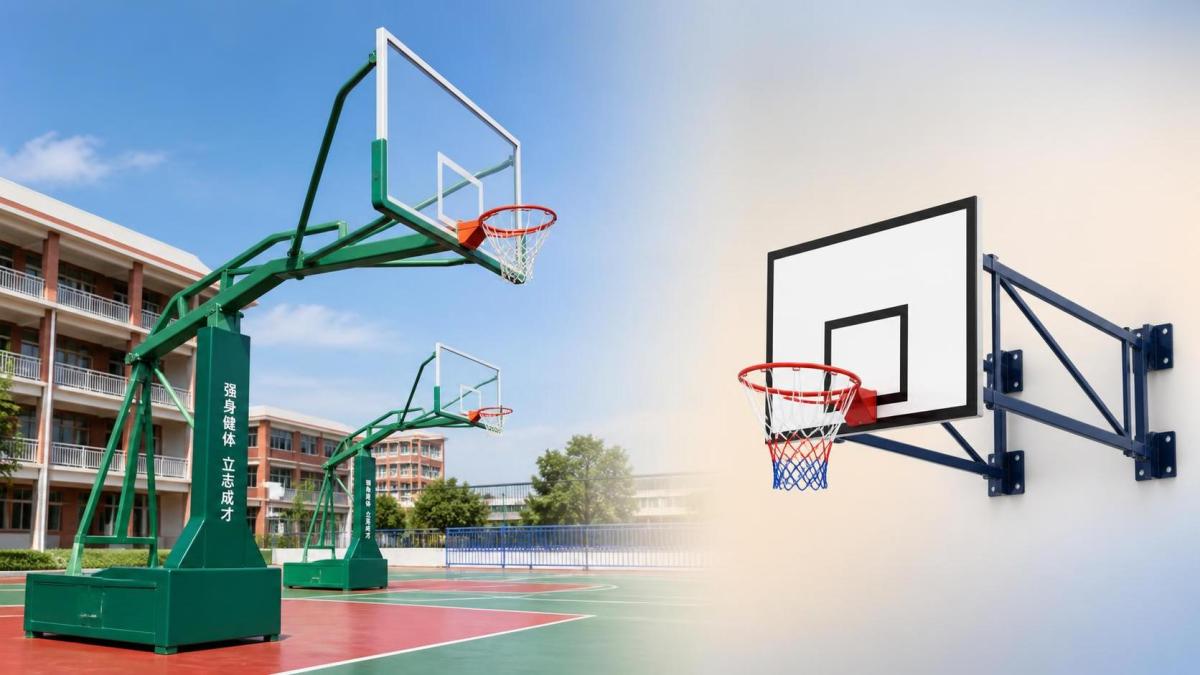
Outdoor basketball hoops live or die by corrosion control. Galvanized steel, powder-coated finishes, stainless or treated fasteners, and sealed moving parts are all worth checking, but none of them should be judged in isolation. A strong coating can still fail if the welds, joints, or anchor points are left exposed. Likewise, a good finish can be undermined by poor drainage around the base.
Schools in coastal areas, freeze-thaw climates, or regions with heavy rainfall usually need a more conservative specification than inland facilities with mild weather. That does not always mean buying the most expensive model. It means matching the material system to the actual environment. Procurement teams should ask suppliers how the hoop is intended to handle outdoor exposure over time, not just whether it is “weather-resistant.” The difference is not cosmetic.
For outdoor courts, the base or anchor method also matters. Portable hoops offer flexibility, but they are rarely the best answer for school courts that need stable, repeatable play. Fixed systems are usually the safer route when the court is in regular use. If mobility is required for multipurpose grounds, the locking mechanism and tip-resistance design should be reviewed as carefully as the backboard itself.
Height adjustment: useful, but only when it is truly needed
Height-adjustable systems are popular in schools because they support younger age groups, skills training, and mixed-use programming. Still, adjustment is one of those features that sounds better than it behaves if the mechanism is flimsy or hard to operate. A well-designed system should move smoothly, lock securely, and stay consistent after repeated use. If the adjustment process requires too much force or creates play in the rim position, it becomes a maintenance headache.
Many school buyers also have to decide whether they actually need adjustment on every court. In some facilities, fixed-height systems on outdoor courts and adjustable systems in the gym make more sense than standardizing everything. That approach simplifies maintenance and keeps the critical indoor equipment more durable. The right answer depends on how the courts are used, who operates them, and whether staff can safely manage the mechanism.
If adjustment will be used by teachers or facilities staff rather than specialized technicians, ease of operation becomes a procurement requirement, not a convenience feature.
Installation and compliance are where projects often slip
The best hoop on paper can still become a bad purchase if the installation is underestimated. Wall-mounted gym systems may require reinforcement work. Ceiling-suspended systems may need coordination with lighting, HVAC, or sprinkler layouts. Outdoor installations bring footing depth, anchor alignment, drainage, and surface preparation into the conversation. These are not side notes; they affect project timing, cost, and safety.
Schools also need to check facility standards, local building rules, and any sport-specific requirements that apply to their project. If the purchase is part of a larger renovation, the hoop cannot be selected in isolation from the court layout or structural design. Procurement teams that skip this step often discover that the cheapest quote becomes the most expensive change order.
A useful internal question is simple: will this system be easy to inspect, tighten, clean, and service over the next several years? If the answer is unclear, the school is taking on hidden cost.
Where procurement teams should spend, and where they can save
It usually makes sense to spend more on structural durability, corrosion protection, and installation quality than on cosmetic extras. Features such as decorative finishes, premium branding, or nonessential accessories rarely improve the daily experience enough to justify a higher price. In contrast, a better rim assembly, stronger support arm, or more reliable anchor system can reduce maintenance calls and extend useful life.
Savings are more defensible when they come from simplification: choosing the right mounting style for the space, avoiding unnecessary mobility features, or standardizing parts across multiple courts. That kind of decision makes sense in school purchasing because it lowers spare-part complexity and keeps maintenance more predictable.
The procurement team should think in lifecycle terms. A basketball hoop is not just an item to receive and install. It is a piece of facility infrastructure that will be used hard, adjusted, cleaned, inspected, and eventually replaced. The winning bid is the one that survives that cycle with the least friction.
A practical shortlist before you sign
Before approving basketball hoops for school projects, confirm a few things in plain language: where the hoop will be installed, who will operate it, how often it will be used, what the local environment looks like, and what maintenance support is actually available. Those five questions eliminate more bad purchases than any glossy brochure ever will.
In the end, the right hoop is rarely the most feature-rich one. It is the one that matches the site, stands up to student use, and does not create avoidable work for facilities staff. That is the level of judgment procurement teams need when comparing basketball hoops for school gymnasiums and outdoor courts.
Search News
Hot Articles
- Carbon Fiber StructuresHow to Specify Aerospace Carbon Fiber Assemblies for Lightweight, Load-Bearing PartsJul 11, 2026
- Machine VisionXiaomi, Alibaba DAMO Academy Drive Open-Source Robotics Model Ecosystem, Lowering Algorithm Development Barriers for Overseas SMEs Adopting Chinese Robotics SolutionsMar 30, 2026
- Cobots & ArmsShanxi 'AI+' Conference Showcases Embodied Intelligence with Multinational Buyer Engagement: Key Industry ImplicationsMar 30, 2026
Popular Tags
Recommended News
 Jul 11, 2026How to Specify Aerospace Carbon Fiber Assemblies for Lightweight, Load-Bearing PartsAerospace carbon fiber assemblies: learn how to specify laminate design, load data, joining methods, and inspection controls for lighter, reliable load-bearing aerospace parts.Elena Rostova (UAV Systems Researcher)
 Mar 30, 2026Xiaomi, Alibaba DAMO Academy Drive Open-Source Robotics Model Ecosystem, Lowering Algorithm Development Barriers for Overseas SMEs Adopting Chinese Robotics SolutionsXiaomi & Alibaba DAMO Academy's open-source robotics models lower algorithm barriers for global SMEs. Boost efficiency in manufacturing, logistics & smart retail with ROS 2 compatible solutions.TSV Data Lab
 Mar 30, 2026Shanxi 'AI+' Conference Showcases Embodied Intelligence with Multinational Buyer Engagement: Key Industry ImplicationsShanxi 'AI+' Conference highlights embodied intelligence with Tesla, Ubtech & Jiantao showcasing multimodal robotics. 40+ global buyers validated tech on-site, creating new B2B channels for industrial automation & AI solutions.Chen Wei (Automation Lead Engineer)
 Mar 30, 2026Zhongguancun Unveils 6G Integrated Sensing-Computing-Intelligence Platform to Empower Embodied Robots for Global Industrial ApplicationsZhongguancun's new 6G platform revolutionizes industrial robotics with <10ms latency, empowering global automotive, logistics & port automation. Discover how this tech boosts China's smart manufacturing exports.TSV Data Lab
 Mar 30, 2026Mech-Mind Tianjin Embodied Intelligence R&D and Production Base Goes Live, Cutting Delivery Time by 20%–30% for Global Customized AMR+Vision SolutionsMech-Mind's Tianjin AMR+Vision production base cuts delivery time by 20%-30% for欧美 & Latin American markets. Discover how this PLd-certified facility accelerates customized robotics solutions for smart manufacturing and logistics.Chen Wei (Automation Lead Engineer)
 Mar 30, 2026Boao Forum Reveals 'Co-evolution of Big and Small Brains' Trend in Humanoid Robots, China's Embodied Intelligence Accelerates Adaptation to Overseas Manufacturing Service ScenariosDiscover how China's humanoid robots, featuring 'Co-evolution of Big and Small Brains,' are revolutionizing global manufacturing. Learn about Embodied Tian Gong 3.0's ISO compliance and overseas deployment at Boao Forum 2026.Chen Wei (Automation Lead Engineer)
 Mar 30, 2026China Railway Industrial Secures Patent for Embodied Robotics in Material Handling, Boosting High-Precision Delivery Capabilities for Overseas Infrastructure and Manufacturing ProjectsChina Railway Industrial's new patent for embodied robotics in material handling boosts high-precision delivery for global infrastructure & manufacturing. Discover how this innovation enhances logistics accuracy in automotive, rail transit & EPC projects.Chen Wei (Automation Lead Engineer)
 Sep 29, 2026ISO 9283 Repeatability: How to Evaluate Cobot Positioning PerformanceISO 9283 cobot repeatability explained: learn how payload, reach, approach direction, and test conditions affect positioning performance and cell capability.Chen Wei (Automation Lead Engineer)
 Sep 28, 2026Spindle Runout Measurement in Germany: DIN Standards, Methods, and Acceptance LimitsSpindle runout measurement Germany: explore DIN standards, proven methods, acceptance limits, and audit-ready practices for reliable machining quality.Dr. Marcus Vance
 Sep 27, 2026How to Select Wall-Mount Edge Devices for Space-Constrained Factory NetworksWall mount edge devices for space-constrained factories: evaluate workload, thermal design, power resilience, cable access, and network reliability for smarter deployments.TSV Data Lab
 Sep 26, 2026Machining Tolerance Analysis: How to Set Limits That Meet Function and Cost TargetsMachining tolerance analysis: learn how to set functional limits, control tolerance stacks, reduce inspection risk, and balance precision with production cost.Dr. Marcus Vance
 Sep 25, 2026How to Evaluate an Industrial Infrastructure Data Platform for Multi-Site OperationsIndustrial infrastructure data platform evaluation guide for multi-site operations: compare data quality, edge resilience, interoperability, governance, and scalable proof-of-value criteria.Victor Lin (Chief Software Architect)
 Sep 24, 2026How to Select Machine Vision Optics for Accurate Inspection at Different Working DistancesMachine vision optics selection guide for accurate inspection at every working distance. Compare FOV, pixel scale, DOF, distortion, lighting, and telecentric options.TSV Data Lab
 Sep 23, 2026How to Evaluate a Machine Vision System Integrator for High-Speed Inspection LinesChoose a machine vision system integrator with proven expertise in high-speed inspection, reliable reject timing, robust optics, and measurable acceptance criteria.TSV Data Lab
 Sep 28, 2026When is a SCADA API the right choice for connecting plant systems?SCADA API guide: learn when governed plant data integration improves traceability, security, and scalability—without compromising real-time control.Victor Lin (Chief Software Architect)
 Sep 27, 2026How SCADA data integration improves traceability across production linesSCADA data integration connects production-line data to improve traceability, accelerate quality investigations, and strengthen safety decisions.Victor Lin (Chief Software Architect)
 Sep 26, 2026What to define before starting SCADA integration planningSCADA integration planning starts with clear scope, control boundaries, data models, cybersecurity, and testing. Discover the definitions that reduce risk and costly rework.Victor Lin (Chief Software Architect)
 Sep 25, 2026How a smart factory with Industrial IoT reduces production blind spotsDiscover how a smart factory with Industrial IoT turns real-time machine, quality, and workflow data into actionable insights that reduce production blind spots and delivery risks.Victor Lin (Chief Software Architect)
 Sep 24, 2026When does Industrial IoT make smart manufacturing easier to scale?Smart manufacturing Industrial IoT scales when trusted data, interoperable systems, and secure workflows turn connected assets into measurable gains.TSV Data Lab
 Sep 23, 2026What drives ultra-precision machining cost at 1-micron tolerance?Ultra precision machining cost per part at 1 micron tolerance depends on process, material, metrology, and yield. Learn how to compare quotes confidently.Dr. Marcus Vance
 Sep 22, 2026Drone Engine-T550CC Applications: Build the UAV Power System Around the MissionAn application guide for Drone Engine-T550CC integration, covering payload planning, airframe matching, cooling, fuel, vibration, test procedures, documentation, and service preparation.Elena Rostova (UAV Systems Researcher)
 Sep 22, 2026How to Evaluate Industrial Edge Computing Vendors for Factory DeploymentIndustrial edge computing vendor evaluation guide for factories: compare latency, protocol fit, reliability, security, and lifecycle support before deployment.TSV Data Lab
 Sep 21, 2026Drone Payload Integration: Matching Power, Data, and Center of Gravity for Reliable FlightsDrone payload integration made practical: balance power, data, center of gravity, and endurance to build safer, more reliable mission-ready flights.Elena Rostova (UAV Systems Researcher)
 Sep 20, 2026Autonomous Navigation Pricing: Cost Drivers and Budget Benchmarks for AMR ProjectsAutonomous navigation price explained: compare AMR cost drivers, software, sensors, integration, safety, and lifecycle budgets to build a scalable project plan.Chen Wei (Automation Lead Engineer)