What Should Suppliers Prepare Before Joining a Supplier Qualification Support Portal?
Publication Date
author
Before joining a supplier qualification support portal, many suppliers make the same mistake: they treat the portal like a form to complete, instead of a decision environment to win trust. For business evaluators, the submission is rarely about one document alone. It is about whether the supplier can prove consistency, traceability, and operational control without forcing the buyer to dig for answers.
That is why preparation matters so much. In procurement and technical sourcing, the fastest way to slow down a review is to upload incomplete files, vague capability statements, or certifications that cannot be verified against the actual production scope. A strong submission does not need flashy language. It needs evidence that connects what you claim with what you can repeatedly deliver.
In industries where tolerances, compliance, and delivery reliability shape the final decision, the most useful preparation is practical, not decorative. Suppliers should think in terms of what an engineer, QA manager, or procurement director will check first: identity, scope, process control, technical fit, and proof of performance. That mindset changes everything.
Start with the documents that establish who you are
Every supplier profile should begin with basic identity and legal documents, but the key is not just possession. The documents must match across systems, business names, addresses, and operating entities. Even a small mismatch can create unnecessary review loops, especially when the portal is used for cross-border sourcing or regulated procurement.
Prepare items such as your business registration, tax details, ownership information if requested, and the correct legal name used in contracts and invoices. If your company operates through multiple plants or divisions, clarify which site is being qualified. Evaluators dislike ambiguity because ambiguity creates risk. A clean identity package tells them the rest of the file will likely be just as controlled.
Make certifications easy to verify, not just easy to upload
Certificates are often the first thing buyers look for, but they are also one of the most misunderstood parts of a supplier qualification support portal. A certificate without scope, validity, or issuing-body context may look complete on the surface while still failing the real test.
Suppliers should prepare current certifications, along with the details that make them meaningful: certificate number, effective dates, applicable sites, product categories, and any exclusions. If the certification covers only part of your operation, say so clearly. It is better to be precise than to appear overextended. For technical buyers, a correctly scoped certificate is more credible than a broad claim that cannot be substantiated.
Show production capability in a way evaluators can compare
This is where many submissions weaken. A supplier may say they have “advanced capacity” or “flexible manufacturing,” but those phrases do not help a qualification team determine fit. What they need is a visible production footprint: equipment types, process range, available shifts, facility layout, annual or monthly capacity where appropriate, and the types of parts or assemblies you actually handle.
For machining, electronics, robotics, aerospace, or other precision sectors, details matter even more. List the machines, process steps, inspection tools, and material capabilities that are relevant to the buyer’s requirements. If you operate multiple lines or have outsourced steps, explain the chain clearly. Qualification teams want to know where control begins, where it ends, and which parts of the process remain internal.
Quality control records do more work than promises
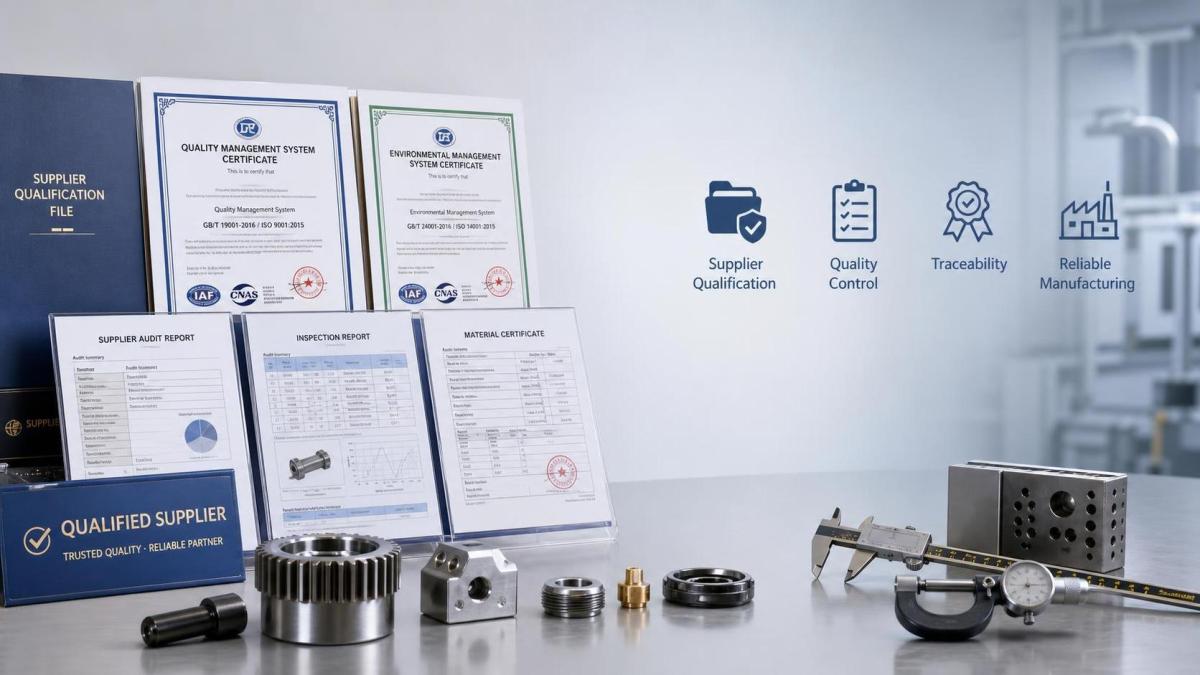
A portal submission becomes much stronger when it includes real quality evidence instead of generic statements about “strict standards.” Business evaluators trust records that show how quality is monitored over time: inspection procedures, incoming material checks, process control methods, nonconformance handling, corrective action flow, calibration records, and internal audit practices.
You do not need to overload the portal with every file in your archive. What matters is relevance and traceability. If you are applying to a buyer in a regulated sector, they will want to see whether your quality system is disciplined enough to prevent repeat issues. If your process depends on measurement accuracy, then metrology control and equipment calibration become especially important. The more technical the sourcing decision, the more the buyer reads quality as operational reality rather than branding.
Technical specifications should be written for review, not marketing
One of the biggest advantages of a supplier qualification support portal is that it gives technical teams a structured way to compare suppliers. But that only works when specifications are written clearly. Avoid broad claims that cannot be tested. Instead, present dimensions, tolerances, materials, environmental limits, performance ranges, interface standards, and any applicable test conditions.
Where possible, match the terminology used by the buyer. If the request mentions fatigue resistance, operating temperature, or signal latency, reflect those terms in your submission. This does not mean copying language blindly; it means showing that you understand the engineering question being asked. The best technical profiles feel like answers, not advertisements.
Compliance documents should reduce friction, not create a scavenger hunt
Compliance preparation often becomes stressful because different buyers ask for different things. But from the supplier side, the goal is the same: organize the documents so the reviewer does not have to chase them.
Depending on your industry and market, this may include environmental compliance records, labor and ethical sourcing policies, product safety declarations, export-related documents, REACH or RoHS-related declarations, medical or aerospace quality references, and any site-specific permits. What matters is not collecting everything possible, but curating what is relevant to the buyer’s risk profile. If a document is missing or outdated, acknowledge it early rather than letting it surface late in the review.
Proof of performance should look traceable, not promotional
In a data-driven portal, performance evidence carries real weight. This can include test reports, inspection summaries, shipment performance history, rejection rates where appropriate, traceability logs, or product validation records. The stronger the evidence, the easier it is for a buyer to move from curiosity to confidence.
Suppliers sometimes worry that sharing too much operational detail exposes them. In reality, the opposite is often true: a controlled, relevant set of evidence makes the supplier look mature. Business evaluators are not looking for perfection. They are looking for consistency, corrective discipline, and a record that matches the stated capability.
What buyers usually notice before they even open the files
A qualification portal is not only about document content. It is also about how the submission is organized. File names, version control, language clarity, and the order of attachments all affect the review experience. A messy file set suggests the same level of messiness may exist in production or compliance management.
Before submitting, check whether every file is current, readable, and labeled clearly. Use the same terminology across your profile, certificates, and technical sheets. If translations are needed, make sure they are consistent. If a document has been revised, remove outdated versions. Small details like these often determine whether a reviewer sees a supplier as ready or still developing.
The best submissions answer the reviewer’s hidden questions
Experienced suppliers understand that every qualification review contains a few unspoken questions: Can this company deliver consistently? Do they understand their own process boundaries? Can their documents be trusted? Will they respond quickly when something changes?
Preparing for a supplier qualification support portal means answering those questions before they are asked. That is why the strongest submissions are usually the clearest ones. They do not rely on volume. They rely on structure, evidence, and honesty about scope.
For suppliers entering a competitive sourcing environment, this preparation is more than administrative work. It is part of how engineering trust is built. When the evidence is traceable and the language is precise, the review process becomes shorter, cleaner, and far less painful for everyone involved.
In the end, the portal is not asking for perfection. It is asking for proof. Suppliers who prepare with that in mind give evaluators something far more valuable than marketing claims: confidence.
Search News
Hot Articles
- Carbon Fiber StructuresHow to Specify Aerospace Carbon Fiber Assemblies for Lightweight, Load-Bearing PartsJul 11, 2026
- Machine VisionXiaomi, Alibaba DAMO Academy Drive Open-Source Robotics Model Ecosystem, Lowering Algorithm Development Barriers for Overseas SMEs Adopting Chinese Robotics SolutionsMar 30, 2026
- Cobots & ArmsShanxi 'AI+' Conference Showcases Embodied Intelligence with Multinational Buyer Engagement: Key Industry ImplicationsMar 30, 2026
Popular Tags
Recommended News
 Jul 11, 2026How to Specify Aerospace Carbon Fiber Assemblies for Lightweight, Load-Bearing PartsAerospace carbon fiber assemblies: learn how to specify laminate design, load data, joining methods, and inspection controls for lighter, reliable load-bearing aerospace parts.Elena Rostova (UAV Systems Researcher)
 Mar 30, 2026Xiaomi, Alibaba DAMO Academy Drive Open-Source Robotics Model Ecosystem, Lowering Algorithm Development Barriers for Overseas SMEs Adopting Chinese Robotics SolutionsXiaomi & Alibaba DAMO Academy's open-source robotics models lower algorithm barriers for global SMEs. Boost efficiency in manufacturing, logistics & smart retail with ROS 2 compatible solutions.TSV Data Lab
 Mar 30, 2026Shanxi 'AI+' Conference Showcases Embodied Intelligence with Multinational Buyer Engagement: Key Industry ImplicationsShanxi 'AI+' Conference highlights embodied intelligence with Tesla, Ubtech & Jiantao showcasing multimodal robotics. 40+ global buyers validated tech on-site, creating new B2B channels for industrial automation & AI solutions.Chen Wei (Automation Lead Engineer)
 Mar 30, 2026Zhongguancun Unveils 6G Integrated Sensing-Computing-Intelligence Platform to Empower Embodied Robots for Global Industrial ApplicationsZhongguancun's new 6G platform revolutionizes industrial robotics with <10ms latency, empowering global automotive, logistics & port automation. Discover how this tech boosts China's smart manufacturing exports.TSV Data Lab
 Mar 30, 2026Mech-Mind Tianjin Embodied Intelligence R&D and Production Base Goes Live, Cutting Delivery Time by 20%–30% for Global Customized AMR+Vision SolutionsMech-Mind's Tianjin AMR+Vision production base cuts delivery time by 20%-30% for欧美 & Latin American markets. Discover how this PLd-certified facility accelerates customized robotics solutions for smart manufacturing and logistics.Chen Wei (Automation Lead Engineer)
 Mar 30, 2026Boao Forum Reveals 'Co-evolution of Big and Small Brains' Trend in Humanoid Robots, China's Embodied Intelligence Accelerates Adaptation to Overseas Manufacturing Service ScenariosDiscover how China's humanoid robots, featuring 'Co-evolution of Big and Small Brains,' are revolutionizing global manufacturing. Learn about Embodied Tian Gong 3.0's ISO compliance and overseas deployment at Boao Forum 2026.Chen Wei (Automation Lead Engineer)
 Mar 30, 2026China Railway Industrial Secures Patent for Embodied Robotics in Material Handling, Boosting High-Precision Delivery Capabilities for Overseas Infrastructure and Manufacturing ProjectsChina Railway Industrial's new patent for embodied robotics in material handling boosts high-precision delivery for global infrastructure & manufacturing. Discover how this innovation enhances logistics accuracy in automotive, rail transit & EPC projects.Chen Wei (Automation Lead Engineer)
 Sep 30, 2026How to Evaluate Solid-State LiDAR Hardware for Outdoor Autonomous VehiclesSolid state LiDAR hardware evaluation guide for outdoor autonomous vehicles—compare range, point-cloud quality, environmental resilience, integration, and safety.TSV Data Lab
 Sep 29, 2026ISO 9283 Repeatability: How to Evaluate Cobot Positioning PerformanceISO 9283 cobot repeatability explained: learn how payload, reach, approach direction, and test conditions affect positioning performance and cell capability.Chen Wei (Automation Lead Engineer)
 Sep 30, 2026Which Industrial Robot Specifications Matter for High-Precision Assembly?Which industrial robot specifications matter most for high-precision assembly? Explore repeatability, accuracy, stiffness, vibration, calibration, and force control for reliable yields.Chen Wei (Automation Lead Engineer)
 Sep 29, 2026How Do You Verify Servo Motor Torque Under Continuous Load?How do I verify servo motor torque under continuous load? Learn RMS torque checks, torque-speed limits, thermal derating, and real-machine testing.Chen Wei (Automation Lead Engineer)
 Sep 28, 2026Spindle Runout Measurement in Germany: DIN Standards, Methods, and Acceptance LimitsSpindle runout measurement Germany: explore DIN standards, proven methods, acceptance limits, and audit-ready practices for reliable machining quality.Dr. Marcus Vance
 Sep 27, 2026How to Select Wall-Mount Edge Devices for Space-Constrained Factory NetworksWall mount edge devices for space-constrained factories: evaluate workload, thermal design, power resilience, cable access, and network reliability for smarter deployments.TSV Data Lab
 Sep 26, 2026Machining Tolerance Analysis: How to Set Limits That Meet Function and Cost TargetsMachining tolerance analysis: learn how to set functional limits, control tolerance stacks, reduce inspection risk, and balance precision with production cost.Dr. Marcus Vance
 Sep 25, 2026How to Evaluate an Industrial Infrastructure Data Platform for Multi-Site OperationsIndustrial infrastructure data platform evaluation guide for multi-site operations: compare data quality, edge resilience, interoperability, governance, and scalable proof-of-value criteria.Victor Lin (Chief Software Architect)
 Sep 24, 2026How to Select Machine Vision Optics for Accurate Inspection at Different Working DistancesMachine vision optics selection guide for accurate inspection at every working distance. Compare FOV, pixel scale, DOF, distortion, lighting, and telecentric options.TSV Data Lab
 Sep 23, 2026How to Evaluate a Machine Vision System Integrator for High-Speed Inspection LinesChoose a machine vision system integrator with proven expertise in high-speed inspection, reliable reject timing, robust optics, and measurable acceptance criteria.TSV Data Lab
 Sep 30, 2026How much does warehouse automation cost for a growing distribution center?How much does warehouse automation cost? Explore equipment, integration, facility upgrades, lifecycle expenses, and ROI factors for a growing distribution center.Chen Wei (Automation Lead Engineer)
 Sep 29, 2026How MES and OEE work together to identify production lossesMES and OEE work together to uncover hidden production losses, connect downtime, speed, and quality data, and drive smarter shop-floor improvements.Victor Lin (Chief Software Architect)
 Sep 28, 2026When is a SCADA API the right choice for connecting plant systems?SCADA API guide: learn when governed plant data integration improves traceability, security, and scalability—without compromising real-time control.Victor Lin (Chief Software Architect)
 Sep 27, 2026How SCADA data integration improves traceability across production linesSCADA data integration connects production-line data to improve traceability, accelerate quality investigations, and strengthen safety decisions.Victor Lin (Chief Software Architect)
 Sep 26, 2026What to define before starting SCADA integration planningSCADA integration planning starts with clear scope, control boundaries, data models, cybersecurity, and testing. Discover the definitions that reduce risk and costly rework.Victor Lin (Chief Software Architect)
 Sep 25, 2026How a smart factory with Industrial IoT reduces production blind spotsDiscover how a smart factory with Industrial IoT turns real-time machine, quality, and workflow data into actionable insights that reduce production blind spots and delivery risks.Victor Lin (Chief Software Architect)
 Sep 24, 2026When does Industrial IoT make smart manufacturing easier to scale?Smart manufacturing Industrial IoT scales when trusted data, interoperable systems, and secure workflows turn connected assets into measurable gains.TSV Data Lab