
Drone Parachute Recovery System: Is It Necessary
Publication Date
author
As UAV operations scale across inspection, mapping, and delivery, one question keeps surfacing: is a drone parachute recovery system truly necessary, or just another compliance cost? For engineers, operators, and buyers comparing a fixed wing uav supplier, commercial drone manufacturer china, or pixhawk flight controller supplier, the answer depends on risk, payload value, airspace rules, and real-world failure data.
For B2B teams making procurement or design decisions, this is not a theoretical debate. A drone parachute recovery system affects aircraft weight, integration complexity, maintenance intervals, certification pathways, and the acceptable risk profile of every mission. In practical terms, it can be the difference between a recoverable incident and a six-figure loss involving airframe damage, payload destruction, project delay, or third-party liability.
At TechStat Vanguard, the useful question is not whether parachutes sound safer in marketing material. The useful question is when they create measurable engineering value. That means evaluating descent rate, trigger logic, deployment altitude, fail-safe architecture, operational environment, and the true cost of adding 300 g to 2.5 kg of hardware to an already weight-sensitive UAV platform.
Why Drone Parachute Recovery Systems Matter in Commercial UAV Operations
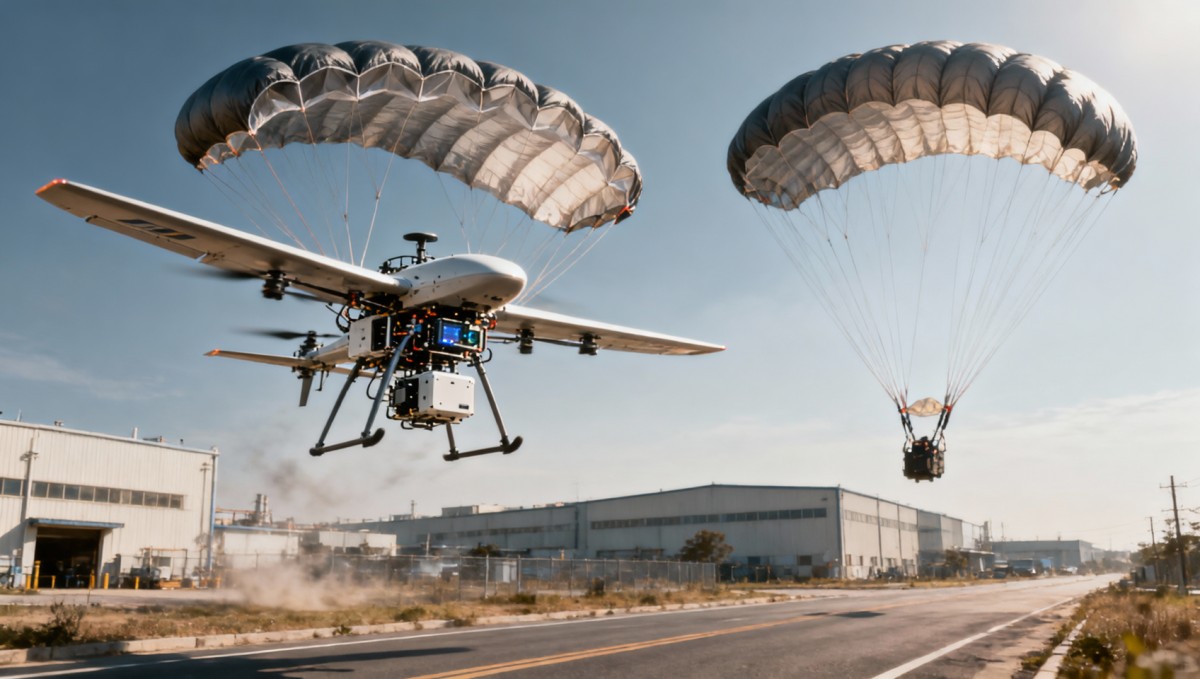
A drone parachute recovery system is an emergency safety mechanism designed to reduce impact energy after a critical failure. In most commercial configurations, it includes a packed canopy, deployment launcher, trigger electronics, health-status monitoring, and integration with the flight controller or power bus. On multirotor platforms, deployment is often triggered after catastrophic power loss, motor failure beyond controllable limits, or flight termination logic. On fixed wing platforms, use cases can include propulsion failure, structural issues, or unrecoverable navigation events.
Necessity depends first on kinetic risk. A 3 kg inspection drone operating at 60 m over an isolated field presents a different hazard profile than a 20 kg mapping UAV flying near roads, utility corridors, or industrial assets. The larger the takeoff mass, the higher the payload value, and the denser the surrounding environment, the stronger the case for a recovery system. In many operations, the parachute is less about saving the airframe and more about reducing ground impact severity.
The second factor is mission criticality. Enterprise operators do not only calculate hardware replacement cost. They also account for survey reflight time, labor rescheduling, data loss, insurance impact, and contract penalties. If a delayed corridor mapping mission pushes a project back by 3 to 7 days, the indirect cost can exceed the price of the parachute system several times over.
The third factor is regulatory trajectory. In some operating environments, especially for flights over people, near infrastructure, or in higher-risk categories, a drone parachute recovery system may support the safety case submitted to regulators or clients. It is not a universal substitute for operational discipline, but it can strengthen compliance documentation and risk mitigation planning.
Where the system adds the most value
- Urban or semi-urban missions where falling debris risk must be reduced.
- Operations with payload values above typical airframe cost, such as LiDAR, thermal, or multispectral systems.
- Fixed wing UAV deployments covering long routes where a forced landing area may not be available within 1 to 2 km.
- Programs requiring structured safety documentation for enterprise clients, utilities, or public agencies.
When a Parachute Recovery System Is Necessary and When It Is Not
The phrase “necessary” should be defined by scenario, not by product trend. For some low-mass UAV missions, a parachute may be optional and even counterproductive if it reduces endurance, complicates maintenance, or creates false confidence. For other missions, not having one may expose the operator to unacceptable risk. A structured assessment is more useful than a generic yes-or-no answer.
Start with four variables: maximum takeoff weight, cruise altitude, ground risk density, and payload value. If even two of these variables are high, a parachute deserves serious evaluation. For example, a 12 kg fixed wing UAV flying BVLOS over mixed terrain at 120 m with a high-value EO/IR payload is in a different category from a 1.2 kg quadcopter used for local roof imaging over a restricted site.
The table below helps operators, procurement teams, and engineering reviewers translate mission conditions into a practical decision path rather than relying on broad assumptions.
A clear pattern emerges: parachute recovery becomes more relevant as mission value, environmental exposure, and aircraft mass rise together. For many enterprise fleets, the threshold is not one single number, but a stacked-risk model in which 3 to 4 elevated factors justify the added hardware.
There are also cases where a parachute may not be the best investment. Very small UAVs with low impact energy, short missions under strict site control, and highly redundant systems may benefit more from battery health analytics, propeller inspection discipline, or geofencing improvements than from parachute integration. In other words, safety spending should target the dominant failure mode, not the most visible accessory.
A practical necessity test
Use these 5 screening questions
- Does the UAV exceed 5 kg to 7 kg takeoff mass?
- Will it operate above or near roads, buildings, people, or critical assets?
- Is payload replacement cost or mission delay cost materially significant?
- Does the airframe have limited emergency landing options?
- Will clients, regulators, or insurers ask for additional mitigations?
If the answer is “yes” to 3 or more questions, a drone parachute recovery system is usually worth technical and commercial evaluation. If the answer is “yes” to 4 or 5, it often moves from optional to strategically necessary.
Engineering Trade-Offs: Weight, Integration, Trigger Logic, and Reliability
The strongest objection to a drone parachute recovery system is not usually purchase cost. It is systems engineering friction. Added mass reduces endurance, increases stall sensitivity on fixed wing designs, shifts the center of gravity, and may reduce useful payload margin. On multirotors, an extra 400 g to 900 g can noticeably affect hover efficiency. On compact fixed wing platforms, packaging volume may be as limiting as weight.
Integration quality matters more than brochure claims. A poorly integrated parachute can introduce new failure points: false deployment from vibration, poor separation from the propeller arc, delayed ignition, or incomplete canopy inflation below safe altitude. For this reason, buyers evaluating a commercial drone manufacturer china or a subsystem integrator should ask for trigger logic documentation, deployment test conditions, and airframe-specific mounting validation rather than generic compatibility statements.
Flight controller integration is especially important for teams working with open architectures. If you are sourcing from a pixhawk flight controller supplier or developing around PX4 or ArduPilot ecosystems, review whether the parachute function is linked to independent sensors, IMU thresholds, attitude limits, manual trigger options, and power isolation. A recovery system that depends on the same failure-prone power path as the primary avionics is not a robust last line of defense.
Deployment altitude is another critical constraint. Some systems need enough vertical space to detect failure, eject the parachute, achieve line stretch, and fully inflate. In very low-altitude work, such as 20 m to 30 m infrastructure inspection, the system may have limited effect depending on aircraft speed and failure mode. At 80 m to 120 m, recovery margins are generally better, but performance still depends on platform dynamics and canopy sizing.
Key engineering checks before procurement
Before selecting a system, technical teams should benchmark the following parameters. These are the details that reduce information noise and improve supplier comparison quality.
For most enterprise buyers, the best option is not the lightest or cheapest unit. It is the one with the most credible fit to the airframe, mission altitude, and acceptable descent profile. Reliability is measured through integration discipline and test repeatability, not headline language.
Common integration mistakes
- Installing the parachute without revalidating center-of-gravity limits.
- Assuming all fixed wing airframes have similar deployment geometry.
- Skipping low-temperature and vibration tests before field use.
- Treating parachute integration as a substitute for propulsion redundancy or maintenance.
How Buyers Should Evaluate Suppliers and System Compatibility
Procurement teams often compare airframe suppliers, autopilot vendors, and safety subsystem providers separately. That is a mistake when assessing parachute recovery. A drone parachute recovery system only performs as intended when the aircraft structure, trigger interface, firmware behavior, and maintenance workflow are aligned. Procurement should therefore assess system compatibility across the full UAV stack, not as an isolated accessory purchase.
When speaking with a fixed wing uav supplier, ask whether parachute deployment has been validated on the exact airframe class, payload envelope, and launch method. Catapult-launched fixed wing platforms, VTOL hybrids, and belly-landed designs each introduce different packaging and deployment dynamics. A test on one airframe geometry does not automatically transfer to another.
When speaking with a commercial drone manufacturer china, request engineering documentation rather than only a compliance statement. Useful documents include installation drawings, maintenance intervals, trigger architecture description, recommended inspection cycles after deployment, and known operating limits such as wind thresholds or minimum effective altitude. If those details are unavailable, the risk of post-purchase integration delay rises sharply.
For teams sourcing from a pixhawk flight controller supplier, the key procurement question is not just “does it support parachute deployment?” but “what failure channels can initiate it, and how are false positives prevented?” A robust answer should include trigger priority logic, manual override options, health monitoring, and the relationship between autopilot state and independent deployment electronics.
Supplier evaluation checklist
- Ask for platform-specific test evidence, not generic product videos.
- Confirm the added mass and power draw across your real payload configuration.
- Review field reset time after deployment; 15 to 30 minutes matters in survey operations.
- Check spare parts availability and repacking procedures over a 12-month cycle.
- Verify whether the system supports both manual and automatic trigger modes.
The table below summarizes what different buyer roles should prioritize during supplier selection.
This role-based approach prevents a common B2B failure: choosing a system that satisfies a purchasing spreadsheet but fails in flight line reality. The best buying decision aligns engineering proof, operational practicality, and risk reduction economics.
Implementation, Maintenance, and Real-World Decision Guidance
Even the right system fails commercially if implementation is weak. A drone parachute recovery system should enter operations through a controlled rollout: bench validation, firmware integration checks, tethered or staged deployment testing where appropriate, field SOP updates, and crew training. In most enterprise programs, a 4-step introduction process is more effective than immediate fleet-wide installation.
Maintenance also deserves more attention than buyers often give it. Packed canopy condition, launcher health, battery status, electrical continuity, and post-deployment repacking quality all influence real readiness. Depending on environment and usage, inspection intervals may be tied to every mission day, every 25 to 50 flight hours, or a fixed calendar cycle such as every 3 to 6 months. The exact schedule should follow the integrator’s guidance and the operator’s internal reliability practice.
From a business standpoint, the real return on a parachute system is risk-adjusted. If the aircraft flies only in remote agricultural fields with limited public exposure, the ROI may be modest. If the same aircraft performs utility corridor surveys, construction progress mapping, or industrial inspections around people, vehicles, and expensive assets, the value equation changes. In those conditions, preventing one serious impact event over a 12- to 24-month period can justify the entire safety package.
For readers asking for a direct answer, here it is: a drone parachute recovery system is not universally necessary, but it is increasingly necessary for medium- and high-value commercial UAV operations where mass, payload, route complexity, and exposure to third parties are all rising. It should be treated as part of a broader safety architecture, not as a standalone guarantee.
FAQ for engineers, operators, and buyers
How do I know if my fixed wing UAV needs a parachute?
Review takeoff mass, minimum safe deployment altitude, route environment, and payload value together. A fixed wing platform above roughly 5 kg to 7 kg operating beyond easy emergency landing zones is a strong candidate for recovery integration.
Does parachute integration reduce flight endurance?
Yes, in most cases. The effect depends on airframe efficiency and added mass. On some platforms, endurance reduction may be modest; on others, especially payload-limited designs, the trade-off can be operationally significant. Always request before-and-after mass and endurance figures for your real payload setup.
Is autopilot compatibility enough to approve procurement?
No. Compatibility is only the starting point. Procurement should also validate trigger independence, physical installation geometry, reset procedures, inspection intervals, and actual deployment testing on the target aircraft type.
What should enterprise buyers ask suppliers first?
Ask for platform-specific test conditions, deployment altitude assumptions, system mass, descent rate range, maintenance cycle, and recovery workflow after deployment. Those six items reveal more practical value than generic claims about safety improvement.
For teams navigating crowded UAV supply chains, the right decision starts with measurable parameters, not assumptions. TechStat Vanguard helps engineers, procurement leaders, and enterprise operators filter claims, compare real integration factors, and identify when a drone parachute recovery system delivers genuine operational value. If you are evaluating a fixed wing uav supplier, a commercial drone manufacturer china, or a pixhawk flight controller supplier, contact us to discuss your mission profile, compare safety architectures, and get a more rigorous basis for supplier selection.
Search News
Hot Articles
- Carbon Fiber StructuresHow to Specify Aerospace Carbon Fiber Assemblies for Lightweight, Load-Bearing PartsJul 11, 2026
- Machine VisionXiaomi, Alibaba DAMO Academy Drive Open-Source Robotics Model Ecosystem, Lowering Algorithm Development Barriers for Overseas SMEs Adopting Chinese Robotics SolutionsMar 30, 2026
- Cobots & ArmsShanxi 'AI+' Conference Showcases Embodied Intelligence with Multinational Buyer Engagement: Key Industry ImplicationsMar 30, 2026
Popular Tags
Recommended News
 Jul 11, 2026How to Specify Aerospace Carbon Fiber Assemblies for Lightweight, Load-Bearing PartsAerospace carbon fiber assemblies: learn how to specify laminate design, load data, joining methods, and inspection controls for lighter, reliable load-bearing aerospace parts.Elena Rostova (UAV Systems Researcher)
 Mar 30, 2026Xiaomi, Alibaba DAMO Academy Drive Open-Source Robotics Model Ecosystem, Lowering Algorithm Development Barriers for Overseas SMEs Adopting Chinese Robotics SolutionsXiaomi & Alibaba DAMO Academy's open-source robotics models lower algorithm barriers for global SMEs. Boost efficiency in manufacturing, logistics & smart retail with ROS 2 compatible solutions.TSV Data Lab
 Mar 30, 2026Shanxi 'AI+' Conference Showcases Embodied Intelligence with Multinational Buyer Engagement: Key Industry ImplicationsShanxi 'AI+' Conference highlights embodied intelligence with Tesla, Ubtech & Jiantao showcasing multimodal robotics. 40+ global buyers validated tech on-site, creating new B2B channels for industrial automation & AI solutions.Chen Wei (Automation Lead Engineer)
 Mar 30, 2026Zhongguancun Unveils 6G Integrated Sensing-Computing-Intelligence Platform to Empower Embodied Robots for Global Industrial ApplicationsZhongguancun's new 6G platform revolutionizes industrial robotics with <10ms latency, empowering global automotive, logistics & port automation. Discover how this tech boosts China's smart manufacturing exports.TSV Data Lab
 Mar 30, 2026Mech-Mind Tianjin Embodied Intelligence R&D and Production Base Goes Live, Cutting Delivery Time by 20%–30% for Global Customized AMR+Vision SolutionsMech-Mind's Tianjin AMR+Vision production base cuts delivery time by 20%-30% for欧美 & Latin American markets. Discover how this PLd-certified facility accelerates customized robotics solutions for smart manufacturing and logistics.Chen Wei (Automation Lead Engineer)
 Mar 30, 2026Boao Forum Reveals 'Co-evolution of Big and Small Brains' Trend in Humanoid Robots, China's Embodied Intelligence Accelerates Adaptation to Overseas Manufacturing Service ScenariosDiscover how China's humanoid robots, featuring 'Co-evolution of Big and Small Brains,' are revolutionizing global manufacturing. Learn about Embodied Tian Gong 3.0's ISO compliance and overseas deployment at Boao Forum 2026.Chen Wei (Automation Lead Engineer)
 Mar 30, 2026China Railway Industrial Secures Patent for Embodied Robotics in Material Handling, Boosting High-Precision Delivery Capabilities for Overseas Infrastructure and Manufacturing ProjectsChina Railway Industrial's new patent for embodied robotics in material handling boosts high-precision delivery for global infrastructure & manufacturing. Discover how this innovation enhances logistics accuracy in automotive, rail transit & EPC projects.Chen Wei (Automation Lead Engineer)
 Oct 16, 2026Choosing a Rugged Edge AI Box Supplier: Thermal Tests and Lifecycle SupportChoose a rugged edge AI box supplier with proven thermal performance and reliable lifecycle support. Discover the tests and commitments to verify before you buy.TSV Data Lab
 Oct 15, 2026R&D Cost Reduction Services: How to Evaluate Fees, Savings, and ROIEvaluate R&D cost reduction services with confidence. Compare fees, verify savings, and calculate ROI without compromising performance. Discover how to choose a provider that delivers real value.Chen Wei (Automation Lead Engineer)
 Oct 15, 2026How Should You Compare TechStat Vanguard 5-Axis CNC Tolerances?TechStat Vanguard 5-axis CNC tolerance comparison: learn how to verify part accuracy, assess inspection evidence, and choose suppliers that reliably meet your drawing requirements.Dr. Marcus Vance
 Oct 14, 2026Drone Frame Composites: Carbon Fiber vs. Fiberglass for Weight and StiffnessExplore drone structural materials composites: compare carbon fiber and fiberglass for weight, stiffness, cost, and antenna compatibility. Find the right material for your drone frame.Elena Rostova (UAV Systems Researcher)
 Oct 13, 2026Smart Cameras vs. PC-Based Machine Vision: Which Fits High-Speed Inspection?This industrial product comparison for machine vision weighs smart cameras vs. PC-based systems on latency, throughput, and cost. Discover your best fit for high-speed inspection.TSV Data Lab
 Oct 12, 2026How to Verify RoHS Compliance in Industrial Sensing Systems Before DeploymentRoHS compliant sensing systems: learn how to verify materials, supplier declarations, testing, and configuration controls before industrial deployment.TSV Data Lab
 Oct 11, 2026How Procurement-Oriented Content Taxonomy Improves B2B Buying JourneysProcurement-oriented content taxonomy streamlines B2B buying journeys with clearer evidence, supplier comparisons, risk visibility, and faster approvals.TSV Data Lab
 Oct 10, 2026How to Select a Machine Performance Monitoring Platform for OEE and Downtime ReductionMachine performance monitoring platform selection guide: validate machine states, OEE data, downtime reasons, integrations, and scalability to reduce losses with confidence.TSV Data Lab
 Oct 08, 2026How to Machine Inconel 625 Blades Without Heat Cracks or Edge ChippingInconel 625 blade machining guide: prevent heat cracks, edge chipping, chatter, and work hardening with proven tooling, cooling, fixturing, and inspection strategies.Dr. Marcus Vance
 Oct 07, 2026How to Evaluate an HMI Panel Distributor for Industrial Automation ProjectsHMI panel distributor evaluation guide: verify technical compatibility, traceability, supply reliability, lifecycle support, and total cost for automation projects.Victor Lin (Chief Software Architect)
 Oct 06, 2026Navigation Fault Tolerance Standards for AMRs: What Safety Teams Must VerifyNavigation fault tolerance standards: learn what AMR safety teams must verify, from localization loss and sensor faults to stopping distance, safe restart, and site-specific validation.Chen Wei (Automation Lead Engineer)
 Oct 05, 2026Calculating Edge Computing Total Cost of Ownership Across Distributed SitesEdge computing ownership cost explained: calculate deployment, energy, connectivity, security, remote support, and refresh costs across distributed sites.TSV Data Lab
 Oct 04, 2026CAD/CAM Benchmarking in the GCC: What Manufacturers Should Ask a ConsultantCAD CAM benchmark consultant GCC guide: learn the key questions manufacturers should ask to validate post-processors, workflows, machine performance, and production risk.Victor Lin (Chief Software Architect)
 Oct 03, 2026Selecting Automotive Radar Sensor Modules for ADAS Range, Resolution, and IntegrationAutomotive radar sensor module selection guide for ADAS: compare range, resolution, field of view, latency, and integration to build safer, reliable vehicle systems.TSV Data Lab
 Oct 02, 2026How to Qualify Machined Parts Suppliers for Hard Tech ProgramsHard tech supply chain machined parts demand rigorous supplier qualification. Learn how to assess capability, traceability, quality controls, and delivery resilience.Dr. Marcus Vance
 Oct 01, 2026How to Select an Outdoor Security Radar Sensor for Perimeter Detection?Outdoor security radar sensor selection guide: compare range, accuracy, false-alarm control, integration, and field testing for reliable perimeter detection.TSV Data Lab
 Sep 30, 2026How to Evaluate Solid-State LiDAR Hardware for Outdoor Autonomous VehiclesSolid state LiDAR hardware evaluation guide for outdoor autonomous vehicles—compare range, point-cloud quality, environmental resilience, integration, and safety.TSV Data Lab























