
When Is Carbon Fiber Tube Worth It in Aerospace
Publication Date
author
In aerospace, choosing a carbon fiber tube for aerospace is only justified when weight reduction, stiffness-to-mass ratio, fatigue resistance, and lifecycle performance deliver measurable value over metal alternatives. For teams sourcing custom aerospace structural parts, evaluating UAV platforms, or benchmarking suppliers from fixed wing uav supplier to custom vtol uav factory, the real question is not hype—it is whether the engineering data supports the investment.
That question matters because aerospace programs rarely fail on brochure claims; they fail on margins, tolerances, test evidence, and field performance. A carbon fiber tube can unlock payload, endurance, and vibration control, but it can also add cost, qualification work, and sourcing complexity if the application does not truly need it.
For research teams, operators, procurement managers, and executive decision-makers, the most useful approach is practical: compare load case, duty cycle, environmental stress, certification pathway, and total lifecycle economics. When those factors align, carbon fiber becomes a strategic engineering choice rather than a premium material upgrade.
Where Carbon Fiber Tube Creates Real Aerospace Value
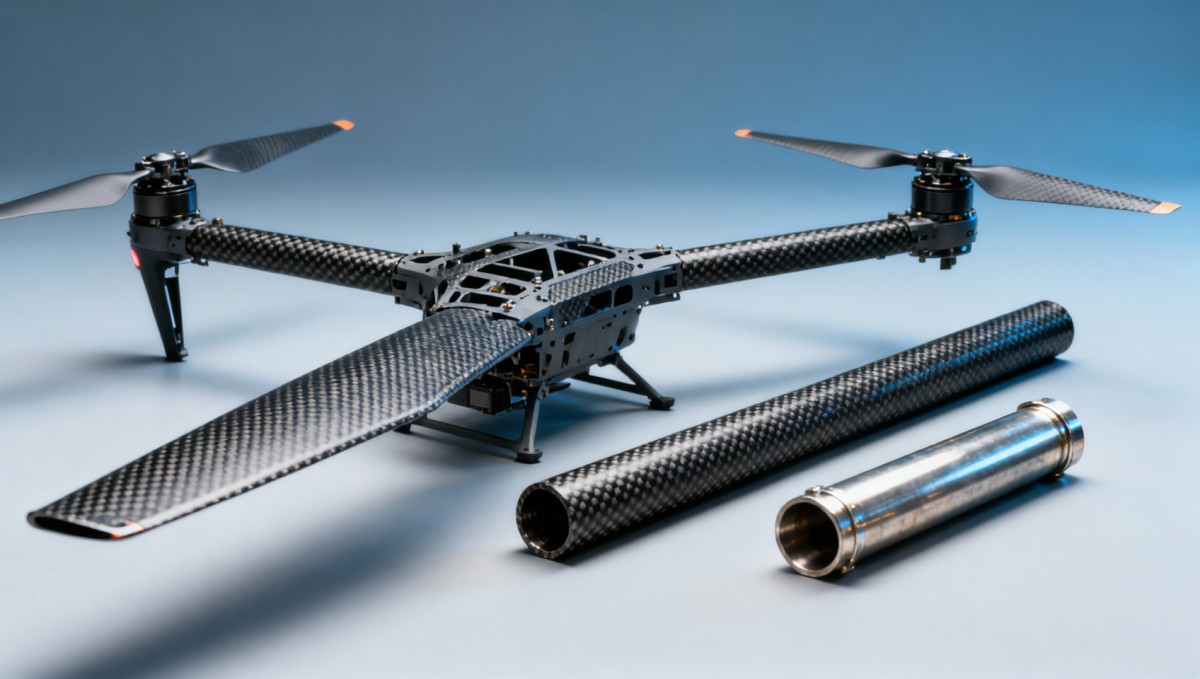
In aerospace structures, a carbon fiber tube becomes worth the investment when the airframe is constrained by mass, bending stiffness, or fatigue life. This is common in UAV booms, wing spars, sensor masts, landing struts, payload frames, antenna supports, and lightweight satellite-adjacent support assemblies. In these cases, every 100 g removed can influence endurance, payload reserve, or control authority.
Compared with aluminum or steel, a well-designed composite tube often delivers a better stiffness-to-weight ratio, especially in long-span members. That benefit is most visible in structures with high slenderness ratios, repeated vibration, and cyclic loading over 10,000 to 1,000,000 duty cycles. In UAV and VTOL architectures, reducing boom flex by even a small margin can improve flight controller stability and sensor consistency.
However, carbon fiber is not automatically superior. If the component is short, lightly loaded, easy to machine from metal, and not mass critical, the value case weakens quickly. A low-cost aluminum tube may meet the same functional requirement with easier grounding, lower joining complexity, and shorter lead time, often within 2 to 4 weeks instead of a longer custom composite qualification path.
The practical threshold is not simply “lighter is better.” The real threshold is whether lower mass translates into measurable system-level gain. In a fixed-wing UAV, that may mean 8% to 15% more endurance. In a multirotor or custom VTOL UAV, it may mean more stable transition behavior, 5% to 12% higher payload margin, or lower motor current under the same mission profile.
Typical aerospace use cases where tubes outperform metal
- Long UAV booms where bending stiffness and mass directly affect flutter, rotor interaction, or camera vibration.
- Wing and tail support elements that see repeated fatigue loading and must maintain shape under thermal variation.
- Payload frames for ISR, mapping, or agricultural systems where a 0.5 kg to 2 kg reduction changes mission economics.
- Custom aerospace structural parts that require directional layup tuning rather than isotropic metal behavior.
The table below compares common decision conditions engineers and buyers review when choosing between carbon fiber tube and metal tube in aerospace sourcing.
The key takeaway is simple: carbon fiber tube is most valuable when its material advantages improve the aircraft, not just the component. If the program cannot quantify endurance gain, vibration reduction, or lifecycle durability improvement, the premium may not be justified.
The Engineering Metrics That Should Drive the Decision
Aerospace selection should begin with measurable requirements, not generic material rankings. At minimum, teams should evaluate tensile load, compressive load, bending stiffness, torsional stiffness, operating temperature, fatigue cycle target, hole or insert requirements, and allowable dimensional tolerance. A tube that looks excellent in a catalog can still underperform if its layup direction does not match the real load path.
For many UAV structures, the most important metric is not peak strength but stiffness under service load. Excess deflection can degrade flight control, sensor alignment, and repeatability of payload data. A tube that holds alignment within ±0.3 mm or angular drift within a narrow threshold under repeated loading may be more valuable than one with a headline ultimate strength that is never reached in operation.
Environmental exposure also matters. Aerospace parts may face -40°C to 80°C duty windows, UV exposure, moisture ingress, cyclic rain, de-icing fluids, or salt-laden coastal operation. Carbon fiber tube performance depends not only on fiber type but also on resin system, cure consistency, wall thickness control, and bond integrity around inserts or drilled features.
For buyers comparing a fixed wing uav supplier and a custom vtol uav factory, it is useful to request test-relevant data rather than generic specification sheets. Ask for bending test setup, fatigue cycle definition, laminate schedule summary, concentricity tolerance, void control method, and evidence of repeatability over at least 3 to 5 production lots where possible.
Metrics that matter more than marketing claims
Structural metrics
- Axial stiffness and bending stiffness under expected service load.
- Buckling resistance for thin-wall tubes over long unsupported spans.
- Torsional rigidity for rotor arms, tail booms, and control-sensitive structures.
Manufacturing metrics
- Outer diameter and inner diameter consistency, often within ±0.1 mm to ±0.25 mm for precision assemblies.
- Straightness and runout control across full tube length.
- Insert bonding quality, surface preparation method, and cure traceability.
The following table shows a practical engineering checklist procurement and technical teams can use during supplier comparison and RFQ review.
A supplier that can explain these numbers clearly is usually more valuable than one that only offers broad claims about “high strength” or “aerospace grade.” In a data-driven sourcing process, transparency on tolerances and test method is often the strongest quality signal.
When Carbon Fiber Tube Is Not Worth the Premium
There are several aerospace scenarios where carbon fiber tube may not be the right answer. If the component sees low duty cycle, short span, modest vibration, and minimal mass sensitivity, a metal solution can provide better value. This is especially true for brackets, short connectors, non-flight-critical test fixtures, and assemblies that need frequent field rework or welding.
Another weak case appears when joining complexity outweighs material benefits. Carbon fiber tubes often require bonded metallic inserts, controlled drilling, anti-crush design, galvanic isolation, and more disciplined torque management. If the assembly environment is not mature enough to manage those steps, failure risk can increase even if the base tube is excellent.
Procurement teams should also be careful when order volumes are low and design changes remain frequent. A custom tube with tuned layup, specific surface finish, and precision secondary machining may be fully justified in production, but uneconomical in early prototype phases where 2 to 3 redesign loops are still likely. In those cases, metal can accelerate iteration and preserve budget.
For enterprise decision-makers, the hidden cost is qualification overhead. Material substitution can trigger additional testing, drawing revision, assembly retraining, and vendor approval work. If the expected system gain is less than roughly 5%, and if validation adds 6 to 10 weeks, the return on change may be too small.
Common misjudgments during sourcing
- Assuming lighter always means better without checking modal behavior and stiffness retention.
- Comparing unit price only, instead of total installed cost including inserts, fixtures, and testing.
- Ignoring repairability and replacement logistics in remote UAV operations.
- Using a generic tube specification for mission-critical structures that need tailored layup.
A simple reject filter
If the part is not weight critical, if the load path is uncertain, if the joining method is not validated, or if the supplier cannot show repeatable dimensional control, carbon fiber tube should probably not be selected yet. In these cases, pausing the upgrade is often the more disciplined engineering decision.
This is where a hard-tech sourcing mindset matters. Teams should reject broad claims and ask for evidence tied to application conditions. A tube that works on a marketing sample rig may not survive a harsh UAV launch-recovery cycle or prolonged VTOL hover vibration exposure.
How Buyers and Engineers Should Evaluate Suppliers
Selecting the right source for custom aerospace structural parts requires more than material knowledge. It also requires manufacturing process visibility, batch consistency, documentation discipline, and communication quality during RFQ and pre-production review. Whether you are assessing a specialist component shop or a custom vtol uav factory with integrated production, the evaluation process should be structured.
A strong supplier should be able to describe tube forming method, fiber orientation strategy, cure controls, machining approach, insert integration, and inspection checkpoints. It should also communicate what it cannot guarantee. That honesty is important in aerospace supply chains where tolerance stack-up, hole quality, and bond line variation can decide long-term reliability.
Lead time is another key factor. Standard tube formats may ship in 2 to 3 weeks, but custom diameters, tapered sections, hybrid joints, or tight post-machining tolerances can push the cycle to 4 to 8 weeks or more. Buyers should ask for prototype timing, pilot batch timing, and stable production timing separately instead of accepting one blended estimate.
For UAV programs, supplier evaluation should also include operational understanding. A fixed wing uav supplier may prioritize span efficiency and long-duration vibration behavior, while a custom VTOL maker may focus more on torsion, arm resonance, and concentrated insert loads near motor mounts. The best supplier is the one that understands your actual failure modes.
Procurement checklist for carbon fiber tube sourcing
The table below provides a practical framework that procurement teams and technical reviewers can use before supplier nomination.
The practical conclusion is that supplier quality in aerospace is proven through process detail. If the vendor can discuss 4 to 6 control points, not just product features, you are closer to a dependable sourcing decision.
A 5-step implementation path
- Define the load case, allowable deflection, environment, and joining method.
- Request a technical RFQ with tolerances, laminate intent, and test expectations.
- Validate one prototype batch through fit, vibration, and static or cyclic checks.
- Run pilot production with at least one documented inspection plan.
- Approve stable production only after process repeatability is demonstrated.
FAQ: Practical Questions Before You Specify a Carbon Fiber Tube
How do I know if the weight savings are meaningful?
Measure the effect at aircraft level, not part level. If tube substitution improves endurance, payload reserve, vibration control, or fuel or battery margin by more than 5% to 10%, the change may be worth deeper validation. If the impact is below that level and qualification burden is high, metal may remain the better choice.
What should operators care about beyond strength?
Operators should look at damage visibility, replacement speed, attachment durability, and environmental wear. A very light tube is not operationally efficient if field crews need complex bonding repairs or special handling every 50 to 100 flight hours.
Is carbon fiber tube always better for UAVs?
No. It is often excellent for booms, spars, and long lightweight members, but not always for short brackets, frequently modified structures, or parts with heavy concentrated loads and poor insert design. The right answer depends on geometry, loading, assembly, and mission profile.
What should procurement request in an RFQ?
Request nominal dimensions, tolerances, operating temperature range, layup intent, insert specification, inspection plan, and expected lead times for prototype and production. If possible, also request evidence of relevant bending or fatigue testing and documentation of surface preparation for bonded joints.
Carbon fiber tube is worth it in aerospace when it changes mission performance, structural efficiency, or lifecycle reliability in a measurable way. It is less compelling when the decision is driven by prestige, generic weight reduction claims, or incomplete understanding of joining and validation requirements.
For engineering teams, the winning approach is to quantify the load case, request supplier process detail, and compare system-level outcomes rather than material labels. For buyers and decision-makers, the strongest sourcing advantage comes from suppliers who can prove tolerance control, test logic, and repeatable production discipline.
If you are evaluating carbon fiber tube options for UAV platforms, custom aerospace structural parts, or broader supply chain benchmarking, now is the right time to request a data-based review. Contact us to discuss your application, compare material pathways, and get a more precise sourcing framework for your next aerospace program.
Search News
Hot Articles
- Carbon Fiber StructuresHow to Specify Aerospace Carbon Fiber Assemblies for Lightweight, Load-Bearing PartsJul 11, 2026
- Machine VisionXiaomi, Alibaba DAMO Academy Drive Open-Source Robotics Model Ecosystem, Lowering Algorithm Development Barriers for Overseas SMEs Adopting Chinese Robotics SolutionsMar 30, 2026
- Cobots & ArmsShanxi 'AI+' Conference Showcases Embodied Intelligence with Multinational Buyer Engagement: Key Industry ImplicationsMar 30, 2026
Popular Tags
Recommended News
 Jul 11, 2026How to Specify Aerospace Carbon Fiber Assemblies for Lightweight, Load-Bearing PartsAerospace carbon fiber assemblies: learn how to specify laminate design, load data, joining methods, and inspection controls for lighter, reliable load-bearing aerospace parts.Elena Rostova (UAV Systems Researcher)
 Mar 30, 2026Xiaomi, Alibaba DAMO Academy Drive Open-Source Robotics Model Ecosystem, Lowering Algorithm Development Barriers for Overseas SMEs Adopting Chinese Robotics SolutionsXiaomi & Alibaba DAMO Academy's open-source robotics models lower algorithm barriers for global SMEs. Boost efficiency in manufacturing, logistics & smart retail with ROS 2 compatible solutions.TSV Data Lab
 Mar 30, 2026Shanxi 'AI+' Conference Showcases Embodied Intelligence with Multinational Buyer Engagement: Key Industry ImplicationsShanxi 'AI+' Conference highlights embodied intelligence with Tesla, Ubtech & Jiantao showcasing multimodal robotics. 40+ global buyers validated tech on-site, creating new B2B channels for industrial automation & AI solutions.Chen Wei (Automation Lead Engineer)
 Mar 30, 2026Zhongguancun Unveils 6G Integrated Sensing-Computing-Intelligence Platform to Empower Embodied Robots for Global Industrial ApplicationsZhongguancun's new 6G platform revolutionizes industrial robotics with <10ms latency, empowering global automotive, logistics & port automation. Discover how this tech boosts China's smart manufacturing exports.TSV Data Lab
 Mar 30, 2026Mech-Mind Tianjin Embodied Intelligence R&D and Production Base Goes Live, Cutting Delivery Time by 20%–30% for Global Customized AMR+Vision SolutionsMech-Mind's Tianjin AMR+Vision production base cuts delivery time by 20%-30% for欧美 & Latin American markets. Discover how this PLd-certified facility accelerates customized robotics solutions for smart manufacturing and logistics.Chen Wei (Automation Lead Engineer)
 Mar 30, 2026Boao Forum Reveals 'Co-evolution of Big and Small Brains' Trend in Humanoid Robots, China's Embodied Intelligence Accelerates Adaptation to Overseas Manufacturing Service ScenariosDiscover how China's humanoid robots, featuring 'Co-evolution of Big and Small Brains,' are revolutionizing global manufacturing. Learn about Embodied Tian Gong 3.0's ISO compliance and overseas deployment at Boao Forum 2026.Chen Wei (Automation Lead Engineer)
 Mar 30, 2026China Railway Industrial Secures Patent for Embodied Robotics in Material Handling, Boosting High-Precision Delivery Capabilities for Overseas Infrastructure and Manufacturing ProjectsChina Railway Industrial's new patent for embodied robotics in material handling boosts high-precision delivery for global infrastructure & manufacturing. Discover how this innovation enhances logistics accuracy in automotive, rail transit & EPC projects.Chen Wei (Automation Lead Engineer)
 Oct 16, 2026Choosing a Rugged Edge AI Box Supplier: Thermal Tests and Lifecycle SupportChoose a rugged edge AI box supplier with proven thermal performance and reliable lifecycle support. Discover the tests and commitments to verify before you buy.TSV Data Lab
 Oct 15, 2026R&D Cost Reduction Services: How to Evaluate Fees, Savings, and ROIEvaluate R&D cost reduction services with confidence. Compare fees, verify savings, and calculate ROI without compromising performance. Discover how to choose a provider that delivers real value.Chen Wei (Automation Lead Engineer)
 Oct 15, 2026How Should You Compare TechStat Vanguard 5-Axis CNC Tolerances?TechStat Vanguard 5-axis CNC tolerance comparison: learn how to verify part accuracy, assess inspection evidence, and choose suppliers that reliably meet your drawing requirements.Dr. Marcus Vance
 Oct 14, 2026Drone Frame Composites: Carbon Fiber vs. Fiberglass for Weight and StiffnessExplore drone structural materials composites: compare carbon fiber and fiberglass for weight, stiffness, cost, and antenna compatibility. Find the right material for your drone frame.Elena Rostova (UAV Systems Researcher)
 Oct 13, 2026Smart Cameras vs. PC-Based Machine Vision: Which Fits High-Speed Inspection?This industrial product comparison for machine vision weighs smart cameras vs. PC-based systems on latency, throughput, and cost. Discover your best fit for high-speed inspection.TSV Data Lab
 Oct 12, 2026How to Verify RoHS Compliance in Industrial Sensing Systems Before DeploymentRoHS compliant sensing systems: learn how to verify materials, supplier declarations, testing, and configuration controls before industrial deployment.TSV Data Lab
 Oct 11, 2026How Procurement-Oriented Content Taxonomy Improves B2B Buying JourneysProcurement-oriented content taxonomy streamlines B2B buying journeys with clearer evidence, supplier comparisons, risk visibility, and faster approvals.TSV Data Lab
 Oct 10, 2026How to Select a Machine Performance Monitoring Platform for OEE and Downtime ReductionMachine performance monitoring platform selection guide: validate machine states, OEE data, downtime reasons, integrations, and scalability to reduce losses with confidence.TSV Data Lab
 Oct 08, 2026How to Machine Inconel 625 Blades Without Heat Cracks or Edge ChippingInconel 625 blade machining guide: prevent heat cracks, edge chipping, chatter, and work hardening with proven tooling, cooling, fixturing, and inspection strategies.Dr. Marcus Vance
 Oct 07, 2026How to Evaluate an HMI Panel Distributor for Industrial Automation ProjectsHMI panel distributor evaluation guide: verify technical compatibility, traceability, supply reliability, lifecycle support, and total cost for automation projects.Victor Lin (Chief Software Architect)
 Oct 06, 2026Navigation Fault Tolerance Standards for AMRs: What Safety Teams Must VerifyNavigation fault tolerance standards: learn what AMR safety teams must verify, from localization loss and sensor faults to stopping distance, safe restart, and site-specific validation.Chen Wei (Automation Lead Engineer)
 Oct 05, 2026Calculating Edge Computing Total Cost of Ownership Across Distributed SitesEdge computing ownership cost explained: calculate deployment, energy, connectivity, security, remote support, and refresh costs across distributed sites.TSV Data Lab
 Oct 04, 2026CAD/CAM Benchmarking in the GCC: What Manufacturers Should Ask a ConsultantCAD CAM benchmark consultant GCC guide: learn the key questions manufacturers should ask to validate post-processors, workflows, machine performance, and production risk.Victor Lin (Chief Software Architect)
 Oct 03, 2026Selecting Automotive Radar Sensor Modules for ADAS Range, Resolution, and IntegrationAutomotive radar sensor module selection guide for ADAS: compare range, resolution, field of view, latency, and integration to build safer, reliable vehicle systems.TSV Data Lab
 Oct 02, 2026How to Qualify Machined Parts Suppliers for Hard Tech ProgramsHard tech supply chain machined parts demand rigorous supplier qualification. Learn how to assess capability, traceability, quality controls, and delivery resilience.Dr. Marcus Vance
 Oct 01, 2026How to Select an Outdoor Security Radar Sensor for Perimeter Detection?Outdoor security radar sensor selection guide: compare range, accuracy, false-alarm control, integration, and field testing for reliable perimeter detection.TSV Data Lab
 Sep 30, 2026How to Evaluate Solid-State LiDAR Hardware for Outdoor Autonomous VehiclesSolid state LiDAR hardware evaluation guide for outdoor autonomous vehicles—compare range, point-cloud quality, environmental resilience, integration, and safety.TSV Data Lab























