Why the aerospace carbon fiber molding process matters
Publication Date
author
Why does the aerospace carbon fiber molding process matter so much in modern manufacturing? It determines whether lightweight structures also deliver repeatable strength, fatigue resistance, dimensional stability, and traceable production quality.
As aerospace programs expand into UAVs, advanced mobility, satellites, and commercial aircraft systems, composite expectations are rising quickly. Weight reduction alone is no longer enough. Engineering teams now need predictable performance under strict operating conditions.
That is why the aerospace carbon fiber molding process has become a strategic evaluation point. It affects certification readiness, supplier qualification, lifecycle cost, and the credibility of every technical claim attached to a composite part.
The aerospace carbon fiber molding process is moving from craft expertise to measurable engineering control
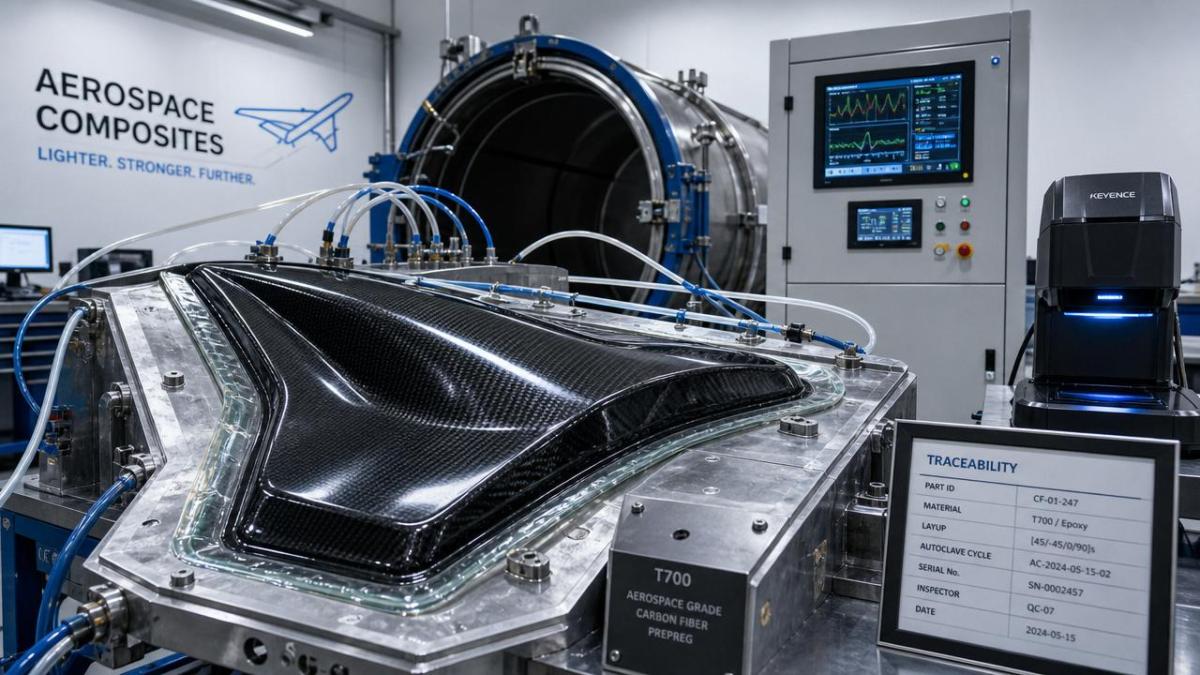
The industry is shifting away from intuition-based composite fabrication. Today, the aerospace carbon fiber molding process is judged by data integrity, repeatability, and process window stability across multiple production lots.
This change reflects broader hard-tech trends. Aerospace programs require lower mass, better fuel efficiency, longer service intervals, and tighter structural tolerances. Composite molding now sits at the center of those demands.
In earlier stages, some carbon fiber parts were accepted if they met basic geometry and static load targets. That benchmark has changed. Now, void content, resin distribution, curing consistency, and delamination resistance receive much closer scrutiny.
The result is clear. The aerospace carbon fiber molding process matters because it directly links process parameters to field performance. When process discipline improves, design confidence improves as well.
Several trend signals explain why the aerospace carbon fiber molding process is under stronger review
Multiple signals show why this topic is attracting greater engineering attention across the composite supply chain and the broader advanced manufacturing sector.
- Aircraft and UAV structures are becoming lighter while carrying more electronics, payload, and thermal stress.
- Certification expectations now emphasize repeatability, traceability, and documented process control.
- Production scaling requires less variation between prototype, pilot runs, and serial manufacturing.
- Lifecycle economics increasingly depend on damage tolerance and maintenance predictability.
- Digital manufacturing systems make it easier to compare claimed capability against actual process data.
These signals are not temporary. They reflect a structural move toward evidence-based sourcing and engineering validation, especially in sectors where composite failure can trigger severe operational and regulatory consequences.
Why the aerospace carbon fiber molding process influences performance more than many assume
Carbon fiber itself does not guarantee superior performance. The aerospace carbon fiber molding process determines how fibers align, how resin wets reinforcement, and how defects are controlled during curing and consolidation.
A well-designed laminate can still underperform if the molding route introduces waviness, resin-rich zones, porosity, or poor interlaminar bonding. In aerospace structures, these small defects can create major reliability penalties.
This is why the aerospace carbon fiber molding process cannot be reduced to a simple manufacturing step. It is a performance-defining system that shapes structural behavior from the inside out.
The strongest drivers are traceability, scale, and real-world fatigue expectations
Several forces are pushing the aerospace carbon fiber molding process toward tighter discipline and deeper benchmarking.
- Traceability requirements are expanding across material batches, cure logs, and inspection data.
- Programs want faster scaling without sacrificing laminate quality or geometric accuracy.
- Fatigue and impact resistance are becoming more important than peak strength alone.
- Automation is increasing, but automated equipment still depends on stable process windows.
- Supply chain risk now includes undocumented process variation, not only delivery delays.
In practical terms, a composite part is only as reliable as the data supporting its production history. Without that history, material pedigree and design simulation lose decision-making value.
The impact spreads across design validation, sourcing confidence, and production economics
The aerospace carbon fiber molding process influences more than the final part. It shapes qualification speed, tooling strategy, inspection cost, maintenance assumptions, and even redesign frequency after initial deployment.
When process capability is poorly characterized, teams often compensate with extra safety factors, heavier laminates, more inspection steps, or longer approval cycles. That reduces the full value of composite adoption.
Key effects on critical business and engineering stages
- Concept design: better process knowledge supports realistic mass and stiffness targets.
- Prototype validation: fewer hidden defects improve test relevance and correlation.
- Supplier comparison: process transparency enables fact-based qualification.
- Serial production: controlled molding reduces scrap and rework rates.
- In-service reliability: stable laminates support stronger fatigue and damage tolerance outcomes.
For advanced manufacturing ecosystems, this means the aerospace carbon fiber molding process is both a technical discipline and a trust mechanism. It helps separate documented capability from polished marketing language.
What deserves closer attention when evaluating the aerospace carbon fiber molding process
A useful evaluation should go beyond asking whether a supplier can mold carbon fiber parts. The better question is whether the aerospace carbon fiber molding process is measurable, stable, and repeatable under production conditions.
Core checkpoints worth reviewing
- Documented cure cycles with temperature and pressure records
- Void content targets and supporting nondestructive inspection methods
- Tooling maintenance discipline and dimensional control records
- Fiber orientation control and layup verification procedures
- Mechanical test data across multiple lots, not a single qualification sample
- Corrective action systems for resin flow, warpage, and bonding variation
These checkpoints support a more rigorous view of composite readiness. They also align with TSV’s belief that parameters, tolerances, and repeatability matter more than broad quality claims.
A practical response is to benchmark process capability before relying on headline performance
The safest approach is to treat the aerospace carbon fiber molding process as a benchmark category, not just a fabrication detail. Performance claims should be tied to process evidence, not isolated test results.
This framework helps turn composite sourcing and validation into a structured engineering exercise. It reduces the chance of overestimating capability based on limited samples or general claims.
The next step is to treat process data as the real proof of aerospace composite quality
The aerospace carbon fiber molding process matters because it converts theoretical material potential into measurable operational reality. It defines whether lightweight design becomes durable performance or expensive uncertainty.
As aerospace and broader hard-tech sectors demand stronger traceability, tighter tolerance control, and better fatigue outcomes, composite decisions should begin with process evidence. That means reviewing cure data, defect control, repeatability, and lot-level consistency before accepting any claim.
A practical next move is simple: build internal comparison sheets around the aerospace carbon fiber molding process itself. Compare suppliers by measurable process capability, not brand language. In advanced manufacturing, data remains the shortest path to engineering truth.
Search News
Hot Articles
- Carbon Fiber StructuresHow to Specify Aerospace Carbon Fiber Assemblies for Lightweight, Load-Bearing PartsJul 11, 2026
- Machine VisionXiaomi, Alibaba DAMO Academy Drive Open-Source Robotics Model Ecosystem, Lowering Algorithm Development Barriers for Overseas SMEs Adopting Chinese Robotics SolutionsMar 30, 2026
- Cobots & ArmsShanxi 'AI+' Conference Showcases Embodied Intelligence with Multinational Buyer Engagement: Key Industry ImplicationsMar 30, 2026
Popular Tags
Recommended News
 Jul 11, 2026How to Specify Aerospace Carbon Fiber Assemblies for Lightweight, Load-Bearing PartsAerospace carbon fiber assemblies: learn how to specify laminate design, load data, joining methods, and inspection controls for lighter, reliable load-bearing aerospace parts.Elena Rostova (UAV Systems Researcher)
 Mar 30, 2026Xiaomi, Alibaba DAMO Academy Drive Open-Source Robotics Model Ecosystem, Lowering Algorithm Development Barriers for Overseas SMEs Adopting Chinese Robotics SolutionsXiaomi & Alibaba DAMO Academy's open-source robotics models lower algorithm barriers for global SMEs. Boost efficiency in manufacturing, logistics & smart retail with ROS 2 compatible solutions.TSV Data Lab
 Mar 30, 2026Shanxi 'AI+' Conference Showcases Embodied Intelligence with Multinational Buyer Engagement: Key Industry ImplicationsShanxi 'AI+' Conference highlights embodied intelligence with Tesla, Ubtech & Jiantao showcasing multimodal robotics. 40+ global buyers validated tech on-site, creating new B2B channels for industrial automation & AI solutions.Chen Wei (Automation Lead Engineer)
 Mar 30, 2026Zhongguancun Unveils 6G Integrated Sensing-Computing-Intelligence Platform to Empower Embodied Robots for Global Industrial ApplicationsZhongguancun's new 6G platform revolutionizes industrial robotics with <10ms latency, empowering global automotive, logistics & port automation. Discover how this tech boosts China's smart manufacturing exports.TSV Data Lab
 Mar 30, 2026Mech-Mind Tianjin Embodied Intelligence R&D and Production Base Goes Live, Cutting Delivery Time by 20%–30% for Global Customized AMR+Vision SolutionsMech-Mind's Tianjin AMR+Vision production base cuts delivery time by 20%-30% for欧美 & Latin American markets. Discover how this PLd-certified facility accelerates customized robotics solutions for smart manufacturing and logistics.Chen Wei (Automation Lead Engineer)
 Mar 30, 2026Boao Forum Reveals 'Co-evolution of Big and Small Brains' Trend in Humanoid Robots, China's Embodied Intelligence Accelerates Adaptation to Overseas Manufacturing Service ScenariosDiscover how China's humanoid robots, featuring 'Co-evolution of Big and Small Brains,' are revolutionizing global manufacturing. Learn about Embodied Tian Gong 3.0's ISO compliance and overseas deployment at Boao Forum 2026.Chen Wei (Automation Lead Engineer)
 Mar 30, 2026China Railway Industrial Secures Patent for Embodied Robotics in Material Handling, Boosting High-Precision Delivery Capabilities for Overseas Infrastructure and Manufacturing ProjectsChina Railway Industrial's new patent for embodied robotics in material handling boosts high-precision delivery for global infrastructure & manufacturing. Discover how this innovation enhances logistics accuracy in automotive, rail transit & EPC projects.Chen Wei (Automation Lead Engineer)
 Oct 04, 2026CAD/CAM Benchmarking in the GCC: What Manufacturers Should Ask a ConsultantCAD CAM benchmark consultant GCC guide: learn the key questions manufacturers should ask to validate post-processors, workflows, machine performance, and production risk.Victor Lin (Chief Software Architect)
 Oct 03, 2026Selecting Automotive Radar Sensor Modules for ADAS Range, Resolution, and IntegrationAutomotive radar sensor module selection guide for ADAS: compare range, resolution, field of view, latency, and integration to build safer, reliable vehicle systems.TSV Data Lab
 Oct 02, 2026How to Qualify Machined Parts Suppliers for Hard Tech ProgramsHard tech supply chain machined parts demand rigorous supplier qualification. Learn how to assess capability, traceability, quality controls, and delivery resilience.Dr. Marcus Vance
 Oct 01, 2026How to Select an Outdoor Security Radar Sensor for Perimeter Detection?Outdoor security radar sensor selection guide: compare range, accuracy, false-alarm control, integration, and field testing for reliable perimeter detection.TSV Data Lab
 Sep 30, 2026How to Evaluate Solid-State LiDAR Hardware for Outdoor Autonomous VehiclesSolid state LiDAR hardware evaluation guide for outdoor autonomous vehicles—compare range, point-cloud quality, environmental resilience, integration, and safety.TSV Data Lab
 Sep 29, 2026ISO 9283 Repeatability: How to Evaluate Cobot Positioning PerformanceISO 9283 cobot repeatability explained: learn how payload, reach, approach direction, and test conditions affect positioning performance and cell capability.Chen Wei (Automation Lead Engineer)
 Oct 04, 2026How Should You Compare 5-Axis CNC Machine Accuracy Claims?How do I compare 5-axis CNC machine accuracy claims? Learn how to assess standards, thermal stability, TCP accuracy, and real-world test evidence.Dr. Marcus Vance
 Oct 03, 2026Is Edge Computing Necessary for Real-Time Quality Inspection?Is industrial edge computing necessary for real-time quality inspection? Explore how latency, data volume, reliability, and control integration shape the right architecture.TSV Data Lab
 Oct 02, 2026What Documents Prove a Precision Machining Supplier Can Hold Tolerance?What documents prove a precision machining supplier can hold tolerance? Explore certificates, FAI reports, calibration, SPC, and traceability evidence to qualify suppliers with confidence.Dr. Marcus Vance
 Oct 01, 2026Can a Machining Supplier Meet Aerospace Fatigue Testing Requirements?Can a machining supplier meet aerospace fatigue testing requirements? Learn the traceability, process control, and test evidence needed for reliable aerospace parts.Dr. Marcus Vance
 Sep 30, 2026Which Industrial Robot Specifications Matter for High-Precision Assembly?Which industrial robot specifications matter most for high-precision assembly? Explore repeatability, accuracy, stiffness, vibration, calibration, and force control for reliable yields.Chen Wei (Automation Lead Engineer)
 Sep 29, 2026How Do You Verify Servo Motor Torque Under Continuous Load?How do I verify servo motor torque under continuous load? Learn RMS torque checks, torque-speed limits, thermal derating, and real-machine testing.Chen Wei (Automation Lead Engineer)
 Oct 02, 2026ZD330 Software Configuration: Verifying Cut-List Import Before PurchaseZD330 software and machine configuration: verify cut-list imports, data mapping, labels, and workflow before purchase to reduce errors and choose with confidence.Victor Lin (Chief Software Architect)
 Sep 28, 2026Spindle Runout Measurement in Germany: DIN Standards, Methods, and Acceptance LimitsSpindle runout measurement Germany: explore DIN standards, proven methods, acceptance limits, and audit-ready practices for reliable machining quality.Dr. Marcus Vance
 Sep 27, 2026How to Select Wall-Mount Edge Devices for Space-Constrained Factory NetworksWall mount edge devices for space-constrained factories: evaluate workload, thermal design, power resilience, cable access, and network reliability for smarter deployments.TSV Data Lab
 Sep 26, 2026Machining Tolerance Analysis: How to Set Limits That Meet Function and Cost TargetsMachining tolerance analysis: learn how to set functional limits, control tolerance stacks, reduce inspection risk, and balance precision with production cost.Dr. Marcus Vance
 Sep 25, 2026How to Evaluate an Industrial Infrastructure Data Platform for Multi-Site OperationsIndustrial infrastructure data platform evaluation guide for multi-site operations: compare data quality, edge resilience, interoperability, governance, and scalable proof-of-value criteria.Victor Lin (Chief Software Architect)