
Laser Engraving Machines for Jewelry: Which Power, Precision, and Materials Matter Most?
Publication Date
author
Laser Engraving Machines for Jewelry: Which Power, Precision, and Materials Matter Most?
Choosing the right laser engraving machines jewelry professionals can rely on is not just about wattage or speed.
For clean marks and fine detail, three factors decide most outcomes: power, precision, and material compatibility.
That sounds simple, but real selection decisions are rarely simple on the shop floor.
A machine that engraves silver beautifully may struggle with reflective gold.
A system with high power may also create unnecessary heat on thin rings or delicate pendants.
In actual production, stable repeatability matters more than brochure claims.
That is also where a more engineering-based evaluation becomes useful.
At TechStat Vanguard, we look past marketing labels and focus on the parameters that truly affect engraving quality and process confidence.
Start with the Real Job, Not the Spec Sheet
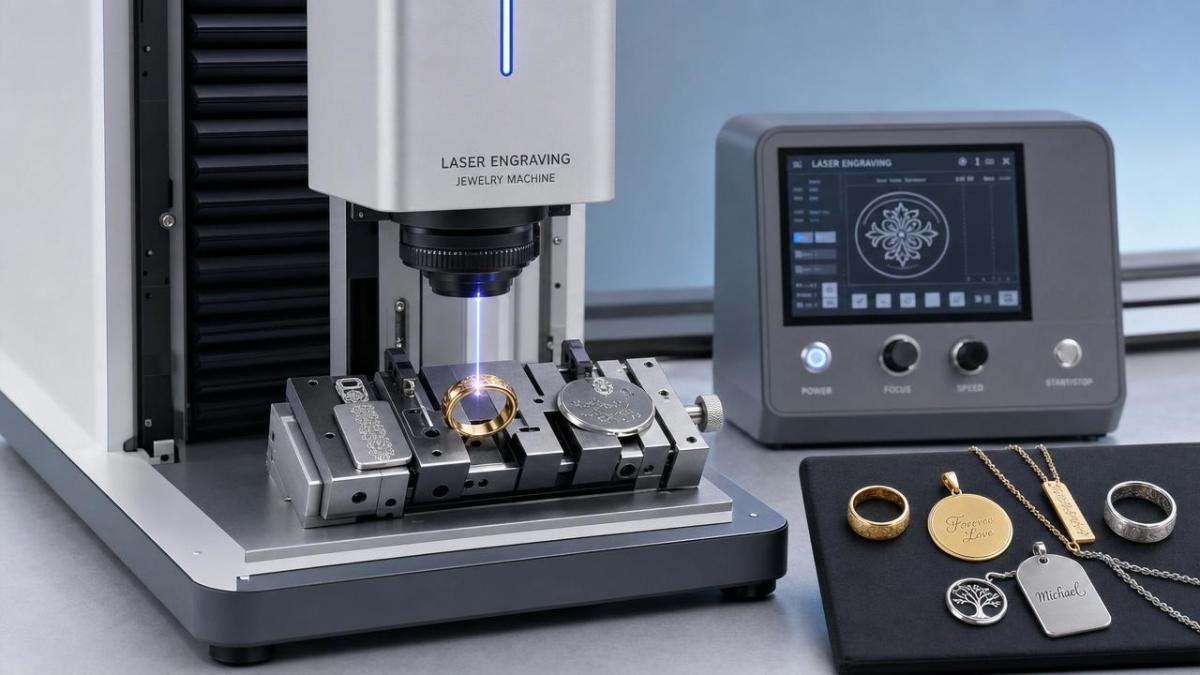
Before comparing laser engraving machines jewelry workshops should map the actual work mix.
Are you engraving names, serial numbers, logos, patterns, or deep decorative textures?
Are pieces mostly flat tags, curved rings, watch backs, or stone-set surfaces?
These questions shape the machine choice more than a headline power rating.
For example, shallow branding marks need different settings than deep black annealed marks.
Small batch customization also needs faster setup, easier focusing, and better software handling.
A useful selection checklist should include:
- Main materials processed each week
- Average part thickness and geometry
- Required mark depth and visual contrast
- Typical batch size and changeover frequency
- Tolerance for scrap, rework, and heat discoloration
Once that baseline is clear, comparing laser engraving machines jewelry buyers see online becomes far more practical.
How Much Power Do Jewelry Applications Really Need?
Power is important, but more power is not automatically better.
For laser engraving machines jewelry applications, useful power depends on mark type, surface finish, and cycle time targets.
Lower-power systems can perform well for fine lettering and light surface marking.
They often give better control on thin pieces where heat spread becomes a risk.
Mid-range power usually fits mixed jewelry work best.
It balances marking speed, visible contrast, and manageable thermal impact.
Higher-power systems make more sense when deeper engraving is required or throughput matters most.
Still, extra wattage without pulse control can reduce finesse.
What to Evaluate Beyond Wattage
In recent buying trends, a clearer signal is that operators care more about energy control than raw maximum output.
- Pulse duration affects edge sharpness and heat input
- Pulse frequency influences surface texture and darkness
- Peak power affects how reflective metals respond
- Beam quality influences line clarity at small scales
This means a well-tuned 20W or 30W platform can outperform a poorly controlled higher-power system for many jewelry tasks.
Why Precision Often Matters More Than Speed
Precision is where many buying decisions are won or lost.
Jewelry surfaces are small, curved, reflective, and often expensive.
Even minor tracking error can ruin a monogram or blur a micro-logo.
When assessing laser engraving machines jewelry users should focus on repeatability, spot size, and motion stability.
Fine engraving depends on how consistently the machine places energy exactly where intended.
That includes the scanner, optics, fixture quality, and focusing process.
Precision Markers That Actually Matter
- Minimum spot size for tiny fonts and detailed patterns
- Positional repeatability across repeated jobs
- Focus consistency on curved items
- Stable galvo response during fast vector marking
- Software compensation for distortion near field edges
In practical terms, precision reduces scrap and saves finishing time.
That often delivers more value than a few seconds saved per cycle.
Material Compatibility Changes Everything
Material behavior is the third major selection factor.
Laser engraving machines jewelry teams choose must match not only the metal family but also the finish and coating.
Gold, silver, platinum, stainless steel, titanium, and plated surfaces do not react the same way.
Highly reflective metals can be harder to mark consistently.
Thin plated layers may show excellent contrast at first, then reveal damage under magnification.
Coated surfaces may char, peel, or discolor if settings are not tightly controlled.
Common Jewelry Materials and Engraving Risks
This is why sample testing is essential.
A machine that looks versatile on paper may still fail on your most profitable material mix.
Software, Fixtures, and Workflow Stability Matter Too
Selection mistakes often happen because buyers focus only on the laser source.
But laser engraving machines jewelry operations depend on the full process chain.
If software is clumsy, setup time grows.
If fixtures are weak, repeatability disappears.
If focus adjustment is slow, small-batch customization becomes frustrating.
More importantly, inconsistent workflow creates operator hesitation, and hesitation slows production.
Look for These Process Features
- Simple job import for text, logos, and serial data
- Reliable rotary support for rings and curved parts
- Fast recipe saving for recurring materials
- Preview tools for alignment before firing
- Stable exhaust and debris management
In real business conditions, these details often decide whether a system feels dependable after six months.
A Practical Way to Compare Laser Engraving Machines Jewelry Buyers Shortlist
A practical comparison method keeps emotion out of the purchase.
Score each candidate machine against the same test parts and the same success criteria.
That approach matches TSV’s belief that parameters, not adjectives, should guide decisions.
- Pick three to five representative jewelry samples.
- Define success by edge clarity, contrast, depth, and cycle time.
- Repeat the same job multiple times for consistency.
- Check marks under magnification, not only by eye.
- Record setup time, operator effort, and rework frequency.
This framework reveals which laser engraving machines jewelry production can trust every day, not just during a sales demo.
Final Decision: Balance Capability with Control
The best laser engraving machines jewelry businesses choose are rarely the ones with the biggest headline numbers.
The better choice is usually the machine that gives the most control across your core materials and daily jobs.
Power matters when depth and speed are priorities.
Precision matters when detail and repeatability protect value.
Material compatibility matters because every metal reacts differently under real process conditions.
Put together, these three factors create engraving quality, workflow stability, and long-term confidence.
If you are evaluating laser engraving machines jewelry teams will use daily, start with sample-based testing and measurable criteria.
That is the clearest path to cleaner marks, fewer surprises, and a purchase decision grounded in engineering truth.
Search News
Hot Articles
- Carbon Fiber StructuresHow to Specify Aerospace Carbon Fiber Assemblies for Lightweight, Load-Bearing PartsJul 11, 2026
- Machine VisionXiaomi, Alibaba DAMO Academy Drive Open-Source Robotics Model Ecosystem, Lowering Algorithm Development Barriers for Overseas SMEs Adopting Chinese Robotics SolutionsMar 30, 2026
- Cobots & ArmsShanxi 'AI+' Conference Showcases Embodied Intelligence with Multinational Buyer Engagement: Key Industry ImplicationsMar 30, 2026
Popular Tags
Recommended News
 Jul 11, 2026How to Specify Aerospace Carbon Fiber Assemblies for Lightweight, Load-Bearing PartsAerospace carbon fiber assemblies: learn how to specify laminate design, load data, joining methods, and inspection controls for lighter, reliable load-bearing aerospace parts.Elena Rostova (UAV Systems Researcher)
 Mar 30, 2026Xiaomi, Alibaba DAMO Academy Drive Open-Source Robotics Model Ecosystem, Lowering Algorithm Development Barriers for Overseas SMEs Adopting Chinese Robotics SolutionsXiaomi & Alibaba DAMO Academy's open-source robotics models lower algorithm barriers for global SMEs. Boost efficiency in manufacturing, logistics & smart retail with ROS 2 compatible solutions.TSV Data Lab
 Mar 30, 2026Shanxi 'AI+' Conference Showcases Embodied Intelligence with Multinational Buyer Engagement: Key Industry ImplicationsShanxi 'AI+' Conference highlights embodied intelligence with Tesla, Ubtech & Jiantao showcasing multimodal robotics. 40+ global buyers validated tech on-site, creating new B2B channels for industrial automation & AI solutions.Chen Wei (Automation Lead Engineer)
 Mar 30, 2026Zhongguancun Unveils 6G Integrated Sensing-Computing-Intelligence Platform to Empower Embodied Robots for Global Industrial ApplicationsZhongguancun's new 6G platform revolutionizes industrial robotics with <10ms latency, empowering global automotive, logistics & port automation. Discover how this tech boosts China's smart manufacturing exports.TSV Data Lab
 Mar 30, 2026Mech-Mind Tianjin Embodied Intelligence R&D and Production Base Goes Live, Cutting Delivery Time by 20%–30% for Global Customized AMR+Vision SolutionsMech-Mind's Tianjin AMR+Vision production base cuts delivery time by 20%-30% for欧美 & Latin American markets. Discover how this PLd-certified facility accelerates customized robotics solutions for smart manufacturing and logistics.Chen Wei (Automation Lead Engineer)
 Mar 30, 2026Boao Forum Reveals 'Co-evolution of Big and Small Brains' Trend in Humanoid Robots, China's Embodied Intelligence Accelerates Adaptation to Overseas Manufacturing Service ScenariosDiscover how China's humanoid robots, featuring 'Co-evolution of Big and Small Brains,' are revolutionizing global manufacturing. Learn about Embodied Tian Gong 3.0's ISO compliance and overseas deployment at Boao Forum 2026.Chen Wei (Automation Lead Engineer)
 Mar 30, 2026China Railway Industrial Secures Patent for Embodied Robotics in Material Handling, Boosting High-Precision Delivery Capabilities for Overseas Infrastructure and Manufacturing ProjectsChina Railway Industrial's new patent for embodied robotics in material handling boosts high-precision delivery for global infrastructure & manufacturing. Discover how this innovation enhances logistics accuracy in automotive, rail transit & EPC projects.Chen Wei (Automation Lead Engineer)
 Oct 26, 2026AMAXiMAL Releases Open-Source TopMod 3D v3 With Claude AIExplore AMAXiMAL’s free, open-source TopMod 3D v3 with Claude AI assistance, topology-based modeling and plywood fabrication tools that connect complex designs to physical builds.Dr. Marcus Vance
 Oct 26, 2026Choosing a SCADA System Integrator Company: PLC Compatibility and Long-Term SupportChoose a scada system integrator company with proven PLC compatibility and reliable long-term support. Discover what to test, compare, and require before investing.Victor Lin (Chief Software Architect)
 Oct 25, 2026Hesai Leads Global ADAS Main Lidar Shipments in Yole’s 2026 ReportHesai led global ADAS main lidar shipments with a 43% share in 2025, according to Yole’s 2026 report. Explore what this ranking reveals about its automotive market position.TSV Data Lab
 Oct 25, 2026Choosing an Aerospace Materials Manufacturer: Quality and Traceability ChecksChoosing an aerospace materials manufacturer? Learn how to verify certifications, test reports, and lot traceability to qualify suppliers confidently and reduce costly sourcing risks.Dr. Marcus Vance
 Oct 24, 2026Guotai Haitong: Global Entry-Level 3D Printer Shipments Rose 39% in Q1 2026Entry-level 3D printer shipments rose 39% in Q1 2026, Guotai Haitong reports. Explore how AI, multicolor printing and print farms are shaping market growth.Dr. Marcus Vance
 Oct 24, 2026Choosing an Industrial Vision Inspection Supplier: Acceptance Tests That MatterChoose an industrial vision inspection supplier with confidence. Discover acceptance tests for defect detection, false rejects, production speed, and reliable part rejection before you buy.TSV Data Lab
 Oct 23, 2026US Navy Raises Gecko Robotics Contract Ceiling to $300M for Robotic Fleet MaintenanceUS Navy raises Gecko Robotics’ contract ceiling to $300M for Pacific Fleet robotic inspections. Explore potential opportunities for maintenance suppliers and key procurement considerations.Chen Wei (Automation Lead Engineer)
 Oct 23, 2026Choosing Industrial Sensing Systems for Global Plants: Protocol CompatibilityCompare industrial sensing systems international buyers can trust. Explore protocol compatibility, reduce integration risks, and select proven configurations for reliable global plant deployments.TSV Data Lab
 Oct 22, 2026KUKA Showcases Physical AI and iiQKA.AI Vision at NVIDIA GTC BerlinExplore KUKA’s Physical AI showcase at NVIDIA GTC Berlin and discover how iiQKA.AI Vision aims to simplify robotic vision integration and improve 2D and 3D scene recognition.TSV Data Lab
 Oct 22, 2026Robotic Machining of Advanced Composites: What Tolerances Are Achievable?Explore advanced materials machining robotics: discover what drives achievable composite tolerances and how to validate accuracy before investing in your next machining system.Dr. Marcus Vance
 Oct 21, 2026China’s Industrial Robot Exports Near RMB 10 Billion in First Nine Months of 2026China’s industrial robot exports neared RMB 10 billion in January–September 2026, with value rising faster than volume. Explore the data and what it could mean for suppliers.Chen Wei (Automation Lead Engineer)
 Oct 21, 2026Low-Latency Industrial Data Processing: Pricing and Key Cost DriversExplore industrial data latency price drivers, from edge hardware to integration and support. Learn how to compare quotes, verify performance, and avoid unnecessary costs.TSV Data Lab
 Oct 20, 2026KUKA Launches iiQKA.AI Vision to Simplify Industrial Image ProcessingKUKA iiQKA.AI Vision simplifies industrial image processing with controller-based 2D and 3D vision. Explore drag-and-drop setup for vision-guided automation.TSV Data Lab
 Oct 20, 2026Smart Industrial Edge Devices: Key Criteria for Legacy PLC IntegrationChoose smart industrial edge devices for legacy PLC integration. Discover key criteria for compatibility, data quality, security, and reliable collection without disrupting control.TSV Data Lab
 Oct 19, 2026Choosing a Radar Sensor by Application: Range, Resolution, and Field of ViewSimplify radar sensor application based product selection. Compare range, resolution, and field of view to avoid blind spots and choose with confidence. Explore the guide.TSV Data Lab
 Oct 18, 2026Comparing Material Options for Procurement: Specs, Costs, and Supply RisksExplore procurement oriented technical content on material options, specs, costs, and supply risks. Compare alternatives to cut hidden expenses and make confident sourcing decisions.Dr. Marcus Vance
 Oct 17, 20265-Axis CNC Positioning Accuracy: How to Interpret ISO 230-2 Test ResultsAssess 5 axis CNC machining positioning accuracy with ISO 230-2. Learn to interpret repeatability, reversal error, and test conditions to compare suppliers and make confident acceptance decisions.Dr. Marcus Vance























