
640 vs 1280: drone thermal camera resolution comparison
Publication Date
author
In this drone thermal camera resolution comparison, we examine 640 vs 1280 sensors through the lens of real engineering outcomes for inspection, mapping, and vtol drone for pipeline inspection workflows. Instead of marketing claims, this guide focuses on thermal detail, detection distance, data reliability, and cost-to-performance factors that matter to operators, procurement teams, and decision-makers.
For teams buying UAV payloads, resolution is not a cosmetic specification. It directly affects anomaly visibility, flight height, coverage efficiency, revisit rates, and the confidence level of thermal reports used for maintenance or capital planning. A 640 thermal sensor and a 1280 thermal sensor can both produce useful imagery, but they do not produce the same engineering outcome.
That difference becomes critical in industrial inspection. A utility operator may need to distinguish a 3–5°C hotspot on a connector from surrounding structure at 40–60 meters. A pipeline inspection team using a VTOL drone may need wider-area thermal screening over 5–20 km corridors without losing the ability to identify leakage signatures, insulation loss, or buried line anomalies. In these cases, higher pixel count changes mission design, not just image appearance.
For procurement leaders and CTOs, the right question is not whether 1280 is “better” in absolute terms. The practical question is whether its higher acquisition cost, storage load, bandwidth demand, and integration complexity translate into measurable operational value. The sections below break that decision down into performance, application fit, workflow impact, and purchasing criteria.
What 640 and 1280 Thermal Resolution Actually Mean in Drone Operations
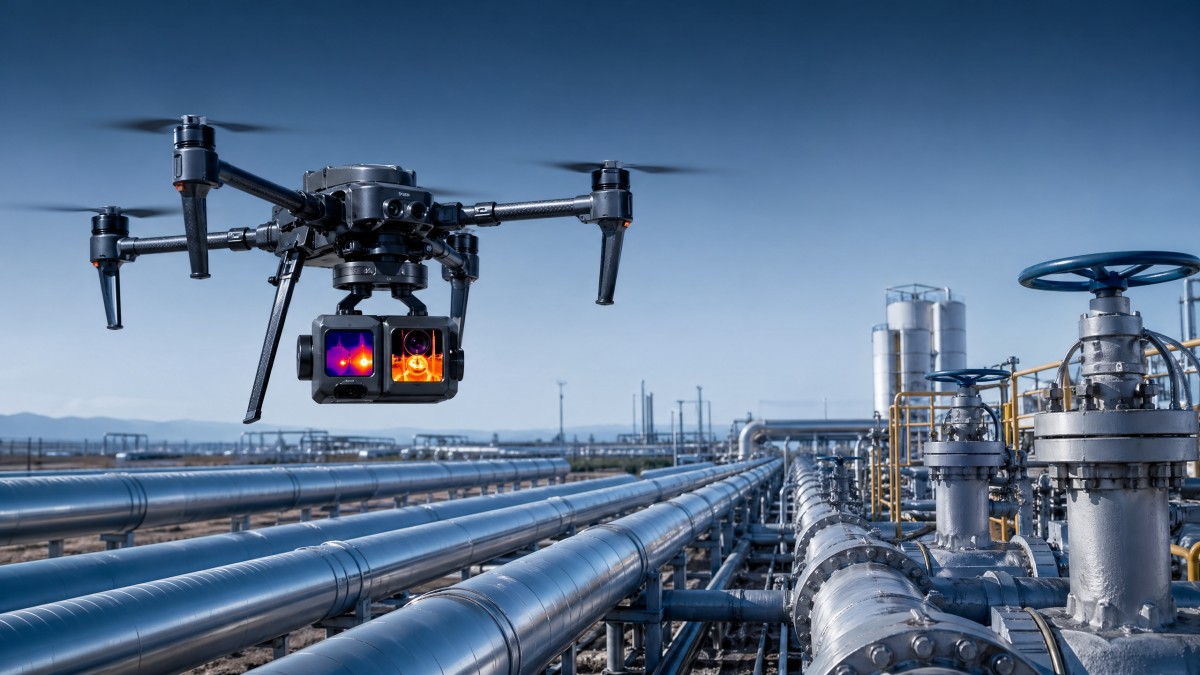
In drone thermal camera resolution comparison work, the first source of confusion is that buyers often treat resolution as a standalone quality metric. In reality, 640 usually refers to a thermal sensor around 640 × 512 pixels, while 1280 often refers to 1280 × 1024 or a similar high-pixel thermal format. That means the 1280 class can deliver roughly 4 times the total pixel count, depending on aspect ratio and sensor design.
More pixels matter because each target occupies more image area at the same flight altitude and lens setting. If a hotspot only covers 3 × 3 pixels on a 640 system, classification confidence is limited. If the same target covers 6 × 6 or more pixels on a 1280 system, the operator can separate target edges, background noise, and heat spread with better consistency. This is especially important when the goal is not simple detection, but diagnosis.
However, thermal resolution should never be evaluated without four companion variables: lens focal length, NETD or thermal sensitivity, frame rate, and radiometric capability. A 640 sensor with a well-matched lens and strong thermal sensitivity can outperform a poorly integrated 1280 payload in some field conditions. Engineering teams should therefore evaluate the complete imaging chain rather than one headline number.
Another practical issue is mission geometry. When the flight altitude increases from 30 meters to 80 meters, pixel density on target drops quickly. In mapping, flare stack inspection, roof surveys, and long linear asset patrols, this relationship affects whether the team can cover more area per sortie or must fly lower and slower. That is where the difference between 640 and 1280 starts influencing cost per inspection.
Key technical variables behind usable thermal detail
A useful thermal payload is shaped by more than resolution. Operators should verify the full thermal stack before comparing quotations or writing a specification sheet.
- Sensor resolution: commonly 640-class or 1280-class for professional drone inspection.
- Lens option: 13 mm, 19 mm, 25 mm, or longer lenses change field of view and target size.
- Thermal sensitivity: lower NETD values generally help distinguish subtle temperature differences below 50 mK.
- Radiometric output: essential when teams need temperature measurement, not only thermal visualization.
- Frame rate and stabilization: important for fast flight, wind conditions, and repeatable data capture.
For inspection buyers, this means a lower-cost 640 payload may remain the better fit for routine roof scans, solar string checks, and close-range mechanical inspections at 10–40 meters. A 1280 payload becomes more compelling when the same enterprise must inspect larger structures, fly longer stand-off distances, or reduce the number of sorties required across a large asset base.
The table below translates sensor resolution into field-level implications instead of generic marketing language.
The main takeaway is simple: 1280 adds operational value when higher pixel density lets you fly farther, cover more area, or identify smaller thermal anomalies with fewer repeat flights. If those gains do not exist in your workflow, a 640 system may deliver better cost efficiency.
Performance Differences in Inspection, Mapping, and Pipeline Workflows
The most useful drone thermal camera resolution comparison is scenario-based. Different industries define “enough detail” differently. An electrical substation team may need component-level hotspot discrimination at 20–50 meters. A building envelope consultant may prioritize rapid area coverage across 10,000–50,000 square meters. A pipeline operator may need thermal context over long corridors while still isolating subtle anomalies from soil, vegetation, or solar loading effects.
In close-range industrial inspection, 640 often remains operationally sufficient. If the drone can fly safely within 15–30 meters of switchgear, transformers, motors, or rooftop HVAC units, target fill ratio can be adequate for maintenance decisions. In these cases, investing in better radiometric calibration, operator training, and repeatable mission protocols may produce more value than moving to 1280.
In corridor mapping and VTOL drone for pipeline inspection, the calculation changes. Long-range linear assets create pressure to maximize ground covered per battery cycle. If a 640 system forces lower altitude, narrower swaths, or more overlap, the operator may need 30–50% more flight lines to maintain usable anomaly visibility. Over a 12 km route, that can translate into extra battery swaps, more field crew time, and slower report turnaround.
A 1280 thermal sensor can improve this by preserving target detail at greater altitude or wider field of regard. That does not guarantee better detection in every thermal condition, but it can improve the probability of seeing small heat signatures without sacrificing coverage. For enterprises managing thousands of hectares or hundreds of kilometers of pipeline, that efficiency matters to annual operating cost.
Application-by-application impact
The table below outlines how the resolution decision shifts by task type rather than by general preference.
For mapping and surveillance-style workflows, the higher-resolution payload often earns its premium only when the organization can convert that detail into fewer sorties, less field risk, or better downstream decisions. If the reporting team lacks software capacity or the field team cannot exploit the extra range, the return on 1280 may remain unrealized.
Common operator mistakes when comparing thermal payloads
- Comparing only sensor resolution while ignoring lens selection and target size in pixels.
- Assuming higher resolution alone improves temperature accuracy; radiometric design still matters.
- Using daytime demo results for pipeline leak work without testing different thermal contrast windows.
- Underestimating file size, processing time, and wireless downlink requirements of 1280-class data.
These mistakes are expensive because they affect not only payload selection but also aircraft endurance, storage planning, operator training, and report quality. For hard-tech procurement, a field trial with defined success criteria is often more valuable than any brochure comparison.
Cost-to-Performance: When 1280 Delivers ROI and When 640 Is the Smarter Buy
A common purchasing error is to frame the 640 vs 1280 decision as entry level versus premium. In B2B operations, the better choice depends on asset scale, inspection frequency, acceptable revisit rates, and the cost of a missed defect. If a utility team inspects 50 substations per quarter, the economics differ from a pipeline operator surveying 300 km of corridor each month.
The 640 option usually wins on acquisition budget, payload integration simplicity, storage efficiency, and easier deployment across multiple field teams. For organizations building a thermal drone program from zero to first operational capability in 4–8 weeks, 640 can reduce initial friction. It is often the practical choice for routine maintenance departments that need reliable screening rather than high-end forensic detail.
The 1280 option starts making economic sense when there is measurable gain in one or more of four areas: more area covered per flight, fewer false negatives, longer stand-off distance for safety, or fewer repeat missions caused by ambiguous imagery. If those gains reduce labor hours by even 10–20% over a high-volume annual program, the cost gap can narrow faster than buyers expect.
Decision-makers should therefore model total workflow cost, not only payload price. Storage infrastructure, analytics software, training, QA review time, battery cycles, and report turnaround can all influence the real business case. In many programs, the most expensive payload is not the one with the higher invoice, but the one that produces unusable or inconclusive data.
A practical procurement checklist
- Define the smallest target that must be detected or classified, not just “seen.”
- Set flight altitude and stand-off limits based on safety and airspace constraints.
- Estimate monthly inspection volume in kilometers, hectares, or asset count.
- Confirm whether reports require only visual thermal evidence or radiometric measurement.
- Calculate processing time per mission for both 640 and 1280 datasets.
The table below helps procurement teams compare total operational implications in a structured way.
A robust purchasing decision often comes from quantifying these four dimensions over a 12-month operating plan. That approach aligns better with engineering procurement than feature-led comparison alone.
Implementation, Data Reliability, and Field Validation Before You Standardize
Even the best thermal payload will disappoint if the deployment model is weak. Resolution affects not only image detail, but also data transfer, mission planning, storage retention, QA procedures, and operator discipline. Before standardizing on 640 or 1280, enterprises should run a structured validation process with repeatable acceptance criteria.
A practical validation program usually takes 2–6 weeks and should test at least 3 mission types under different thermal conditions: close-range inspection, area survey, and one long-duration corridor or VTOL drone for pipeline inspection profile. The goal is to compare usable defect detection, not just visual sharpness on a monitor. Procurement teams should request raw files, processed outputs, and operator notes for each trial.
Reliability also depends on repeatability. If two operators flying the same route produce materially different thermal evidence because altitude, angle, overlap, or thermal range settings vary, the sensor resolution will not solve the underlying problem. Standard operating procedures, preflight checklists, and reporting templates matter as much as hardware choice.
For hard-tech organizations, this is where engineering discipline should replace sales rhetoric. A valid comparison should include target pixel coverage, thermal contrast conditions, acceptable false-positive rate, and file-to-report cycle time. Without these criteria, resolution selection becomes subjective and difficult to defend in procurement reviews.
Recommended field validation workflow
- Define 5–10 representative defects or thermal targets across actual operating assets.
- Fly both 640 and 1280 payloads at matched altitudes, then repeat at higher stand-off ranges.
- Measure whether each target can be detected, localized, and classified with confidence.
- Record battery usage, mission duration, data volume, processing time, and analyst effort.
- Select the configuration that delivers the required decision quality at the lowest operational burden.
FAQ: questions buyers and operators ask most often
Is 1280 always better for drone thermal inspection?
No. It is usually better for stand-off range, broad-area coverage, and finer target separation, but it is not always the best-value choice. If your missions are flown at 10–25 meters and targets are large, a 640 system may meet requirements with lower total cost.
Does higher resolution improve temperature accuracy?
Not by itself. Temperature accuracy depends on radiometric calibration, emissivity handling, environmental conditions, optics, and measurement workflow. Resolution improves spatial detail more directly than absolute temperature precision.
Which option is better for VTOL pipeline inspection?
For long corridors, 1280 often has a stronger case because it can preserve more thermal detail at higher altitude or broader coverage settings. But teams should test it during the correct thermal contrast window, because soil heating, vegetation, and weather can influence results more than sensor resolution alone.
How should enterprises make the final decision?
Use a defined field trial with real assets, measurable defect targets, and a 12-month workflow model. The best choice is the one that delivers reliable decisions, acceptable turnaround, and controllable operating cost across the full program.
A disciplined drone thermal camera resolution comparison shows that 640 and 1280 serve different operational priorities. A 640 sensor is often the right tool for close-range, routine, and budget-sensitive inspection programs. A 1280 sensor becomes strategically valuable when enterprises need longer stand-off distance, better small-target separation, and higher area coverage efficiency in mapping or VTOL pipeline inspection workflows.
For operators, the critical issue is usable thermal detail on target. For procurement teams, it is total workflow cost over 12 months. For decision-makers, it is whether better data reduces risk, revisits, and uncertainty. If you are evaluating drone thermal payloads for industrial inspection, corridor monitoring, or UAV program standardization, contact us to discuss a specification-led comparison, request a tailored evaluation framework, or explore a solution matched to your operational profile.
Search News
Hot Articles
- Carbon Fiber StructuresHow to Specify Aerospace Carbon Fiber Assemblies for Lightweight, Load-Bearing PartsJul 11, 2026
- Machine VisionXiaomi, Alibaba DAMO Academy Drive Open-Source Robotics Model Ecosystem, Lowering Algorithm Development Barriers for Overseas SMEs Adopting Chinese Robotics SolutionsMar 30, 2026
- Cobots & ArmsShanxi 'AI+' Conference Showcases Embodied Intelligence with Multinational Buyer Engagement: Key Industry ImplicationsMar 30, 2026
Popular Tags
Recommended News
 Jul 11, 2026How to Specify Aerospace Carbon Fiber Assemblies for Lightweight, Load-Bearing PartsAerospace carbon fiber assemblies: learn how to specify laminate design, load data, joining methods, and inspection controls for lighter, reliable load-bearing aerospace parts.Elena Rostova (UAV Systems Researcher)
 Mar 30, 2026Xiaomi, Alibaba DAMO Academy Drive Open-Source Robotics Model Ecosystem, Lowering Algorithm Development Barriers for Overseas SMEs Adopting Chinese Robotics SolutionsXiaomi & Alibaba DAMO Academy's open-source robotics models lower algorithm barriers for global SMEs. Boost efficiency in manufacturing, logistics & smart retail with ROS 2 compatible solutions.TSV Data Lab
 Mar 30, 2026Shanxi 'AI+' Conference Showcases Embodied Intelligence with Multinational Buyer Engagement: Key Industry ImplicationsShanxi 'AI+' Conference highlights embodied intelligence with Tesla, Ubtech & Jiantao showcasing multimodal robotics. 40+ global buyers validated tech on-site, creating new B2B channels for industrial automation & AI solutions.Chen Wei (Automation Lead Engineer)
 Mar 30, 2026Zhongguancun Unveils 6G Integrated Sensing-Computing-Intelligence Platform to Empower Embodied Robots for Global Industrial ApplicationsZhongguancun's new 6G platform revolutionizes industrial robotics with <10ms latency, empowering global automotive, logistics & port automation. Discover how this tech boosts China's smart manufacturing exports.TSV Data Lab
 Mar 30, 2026Mech-Mind Tianjin Embodied Intelligence R&D and Production Base Goes Live, Cutting Delivery Time by 20%–30% for Global Customized AMR+Vision SolutionsMech-Mind's Tianjin AMR+Vision production base cuts delivery time by 20%-30% for欧美 & Latin American markets. Discover how this PLd-certified facility accelerates customized robotics solutions for smart manufacturing and logistics.Chen Wei (Automation Lead Engineer)
 Mar 30, 2026Boao Forum Reveals 'Co-evolution of Big and Small Brains' Trend in Humanoid Robots, China's Embodied Intelligence Accelerates Adaptation to Overseas Manufacturing Service ScenariosDiscover how China's humanoid robots, featuring 'Co-evolution of Big and Small Brains,' are revolutionizing global manufacturing. Learn about Embodied Tian Gong 3.0's ISO compliance and overseas deployment at Boao Forum 2026.Chen Wei (Automation Lead Engineer)
 Mar 30, 2026China Railway Industrial Secures Patent for Embodied Robotics in Material Handling, Boosting High-Precision Delivery Capabilities for Overseas Infrastructure and Manufacturing ProjectsChina Railway Industrial's new patent for embodied robotics in material handling boosts high-precision delivery for global infrastructure & manufacturing. Discover how this innovation enhances logistics accuracy in automotive, rail transit & EPC projects.Chen Wei (Automation Lead Engineer)
 Oct 26, 2026AMAXiMAL Releases Open-Source TopMod 3D v3 With Claude AIExplore AMAXiMAL’s free, open-source TopMod 3D v3 with Claude AI assistance, topology-based modeling and plywood fabrication tools that connect complex designs to physical builds.Dr. Marcus Vance
 Oct 26, 2026Choosing a SCADA System Integrator Company: PLC Compatibility and Long-Term SupportChoose a scada system integrator company with proven PLC compatibility and reliable long-term support. Discover what to test, compare, and require before investing.Victor Lin (Chief Software Architect)
 Oct 25, 2026Hesai Leads Global ADAS Main Lidar Shipments in Yole’s 2026 ReportHesai led global ADAS main lidar shipments with a 43% share in 2025, according to Yole’s 2026 report. Explore what this ranking reveals about its automotive market position.TSV Data Lab
 Oct 25, 2026Choosing an Aerospace Materials Manufacturer: Quality and Traceability ChecksChoosing an aerospace materials manufacturer? Learn how to verify certifications, test reports, and lot traceability to qualify suppliers confidently and reduce costly sourcing risks.Dr. Marcus Vance
 Oct 24, 2026Guotai Haitong: Global Entry-Level 3D Printer Shipments Rose 39% in Q1 2026Entry-level 3D printer shipments rose 39% in Q1 2026, Guotai Haitong reports. Explore how AI, multicolor printing and print farms are shaping market growth.Dr. Marcus Vance
 Oct 24, 2026Choosing an Industrial Vision Inspection Supplier: Acceptance Tests That MatterChoose an industrial vision inspection supplier with confidence. Discover acceptance tests for defect detection, false rejects, production speed, and reliable part rejection before you buy.TSV Data Lab
 Oct 23, 2026US Navy Raises Gecko Robotics Contract Ceiling to $300M for Robotic Fleet MaintenanceUS Navy raises Gecko Robotics’ contract ceiling to $300M for Pacific Fleet robotic inspections. Explore potential opportunities for maintenance suppliers and key procurement considerations.Chen Wei (Automation Lead Engineer)
 Oct 23, 2026Choosing Industrial Sensing Systems for Global Plants: Protocol CompatibilityCompare industrial sensing systems international buyers can trust. Explore protocol compatibility, reduce integration risks, and select proven configurations for reliable global plant deployments.TSV Data Lab
 Oct 22, 2026KUKA Showcases Physical AI and iiQKA.AI Vision at NVIDIA GTC BerlinExplore KUKA’s Physical AI showcase at NVIDIA GTC Berlin and discover how iiQKA.AI Vision aims to simplify robotic vision integration and improve 2D and 3D scene recognition.TSV Data Lab
 Oct 22, 2026Robotic Machining of Advanced Composites: What Tolerances Are Achievable?Explore advanced materials machining robotics: discover what drives achievable composite tolerances and how to validate accuracy before investing in your next machining system.Dr. Marcus Vance
 Oct 21, 2026China’s Industrial Robot Exports Near RMB 10 Billion in First Nine Months of 2026China’s industrial robot exports neared RMB 10 billion in January–September 2026, with value rising faster than volume. Explore the data and what it could mean for suppliers.Chen Wei (Automation Lead Engineer)
 Oct 21, 2026Low-Latency Industrial Data Processing: Pricing and Key Cost DriversExplore industrial data latency price drivers, from edge hardware to integration and support. Learn how to compare quotes, verify performance, and avoid unnecessary costs.TSV Data Lab
 Oct 20, 2026KUKA Launches iiQKA.AI Vision to Simplify Industrial Image ProcessingKUKA iiQKA.AI Vision simplifies industrial image processing with controller-based 2D and 3D vision. Explore drag-and-drop setup for vision-guided automation.TSV Data Lab
 Oct 20, 2026Smart Industrial Edge Devices: Key Criteria for Legacy PLC IntegrationChoose smart industrial edge devices for legacy PLC integration. Discover key criteria for compatibility, data quality, security, and reliable collection without disrupting control.TSV Data Lab
 Oct 19, 2026Choosing a Radar Sensor by Application: Range, Resolution, and Field of ViewSimplify radar sensor application based product selection. Compare range, resolution, and field of view to avoid blind spots and choose with confidence. Explore the guide.TSV Data Lab
 Oct 18, 2026Comparing Material Options for Procurement: Specs, Costs, and Supply RisksExplore procurement oriented technical content on material options, specs, costs, and supply risks. Compare alternatives to cut hidden expenses and make confident sourcing decisions.Dr. Marcus Vance
 Oct 17, 20265-Axis CNC Positioning Accuracy: How to Interpret ISO 230-2 Test ResultsAssess 5 axis CNC machining positioning accuracy with ISO 230-2. Learn to interpret repeatability, reversal error, and test conditions to compare suppliers and make confident acceptance decisions.Dr. Marcus Vance























