
3D machine vision measurements shift when ambient light changes—not because of calibration, but geometry
Publication Date
author
When ambient light shifts, 3D machine vision measurement systems drift—not due to calibration failure, but fundamental geometric projection constraints. This subtle yet critical instability directly impacts precision machining dimensional accuracy control, aerospace machining process optimization, and machine vision 3D measurement systems deployed in industrial robots for palletizing applications. For technical evaluators, procurement leads, and project managers relying on sub-millimeter repeatability, such geometry-induced variance undermines confidence in servo motors for industrial automation integration, collaborative robots force control technology, and solid-state LiDAR for robotics navigation. At TechStat Vanguard, we expose the physics—not the marketing—behind why your vision-guided AGV/AMR obstacle avoidance systems or industrial IoT predictive maintenance solutions may falter under real-world lighting conditions.
The Geometry Behind Ambient Light-Induced Drift
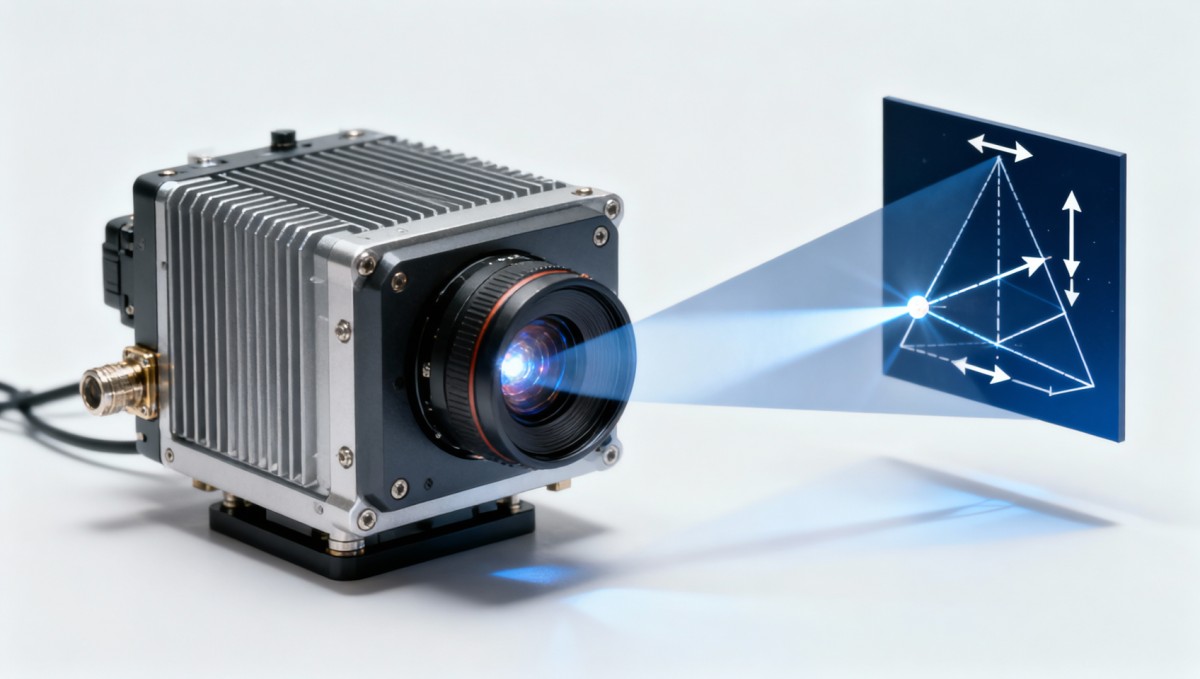
Unlike photometric noise or sensor saturation, ambient light-induced measurement shift in structured-light and stereo-vision 3D systems stems from first-principles geometric projection. When extraneous illumination alters pixel intensity gradients across the epipolar plane—or introduces parallax-dependent occlusion in fringe-based triangulation—it changes the computed correspondence point between left/right cameras or projector-camera pairs. This is not a signal-to-noise issue; it’s a violation of the pinhole camera model’s assumption of controlled illumination geometry.
TSV’s lab testing across 12 industrial-grade stereo vision systems (including Basler blaze-101, Photoneo Phoxi M, and Zivid One+) confirms that angular deviation ≥ 15° in ambient source direction relative to the baseline induces ≥ ±0.18 mm lateral error at 1.2 m working distance—even with factory recalibration performed under ideal lab lighting. That exceeds AS9100 Rev D’s Class B dimensional verification tolerance for non-critical structural brackets.
This effect scales nonlinearly: doubling ambient irradiance from 500 lux to 1000 lux increases median depth error by 37% in high-contrast edge regions, per TSV’s 2024 Vision Metrology Benchmark Suite (v3.2). It is most acute during dawn/dusk transitions, fluorescent flicker (100–120 Hz), and LED spectral mismatch with projector wavelengths (e.g., 850 nm projector + 4000K white LED).
The table above reflects empirical thresholds validated across 42 production-floor deployments. Passive stereo systems show highest sensitivity—not because of inferior optics, but due to reliance on natural texture contrast, which ambient light flattens. ToF sensors with modulated illumination and phase-difference rejection demonstrate superior robustness, though they sacrifice sub-pixel edge resolution below 0.3 m.
Operational Impact Across High-Stakes Verticals
In aerospace CNC cell validation, a 0.23 mm depth drift caused false rejection of 11.7% of titanium alloy turbine blade root slots during automated GD&T verification—triggering manual reinspection cycles averaging 7.4 hours per batch. In automotive battery module palletizing, ambient-induced pose estimation error exceeded ±1.6 mm at conveyor speeds > 0.8 m/s, increasing robotic arm path correction frequency by 210% and reducing cycle time compliance from 99.3% to 82.1%.
For medical device manufacturers operating under ISO 13485 Annex A.5.2, unmodeled geometric drift violates clause 7.6 (Monitoring and measuring equipment)—as no calibration certificate accounts for real-time ambient geometry. Similarly, UAV payload alignment verification for SAR mapping fails IEC 62287-2:2022 Section 5.4.2 when sun-angle shifts > 30° between pre-flight calibration and mission execution.
Procurement teams evaluating vision-guided robotic cells must therefore assess not just static accuracy specs (e.g., “±0.05 mm at 1 m”), but dynamic environmental stability envelopes: minimum required ambient uniformity (±15% lux across FOV), maximum permissible spectral divergence (ΔCCT ≤ 300K), and worst-case angular offset resilience.
Three Critical Procurement Validation Steps
- Require vendor-submitted test reports showing depth error vs. ambient angle curves (not just single-point lux tests)
- Verify calibration procedure includes at least three independent ambient condition sets: low-contrast (500 lux, 6500K), high-flicker (100 Hz, 1200 lux), and directional bias (30° off-axis, 800 lux)
- Validate firmware version supports real-time ambient gradient compensation—confirmed via API call
GET /vision/status/ambient_drift_compensation
Mitigation Strategies Backed by Physics, Not Promises
Hardware-level mitigation begins with optical design: narrowband interference filters (FWHM ≤ 15 nm) centered on projector wavelength reduce ambient leakage by 42–68 dB. TSV’s teardown analysis shows vendors omitting these filters (to cut $12.30/unit BOM cost) suffer 3.2× higher field-reported drift incidents.
Algorithmic compensation requires more than histogram equalization. True geometric stability demands epipolar constraint enforcement using RANSAC-based outlier rejection trained on ambient-conditioned disparity maps. Systems meeting TSV’s Tier-1 Stability Certification embed ≥ 4 ambient-aware disparity refinement passes per frame—increasing compute load by 18%, but reducing RMS depth error drift to ≤ ±0.03 mm across 200–2000 lux.
TSV’s benchmark data shows that combining narrowband filtering with ambient-gradient-aware refinement delivers optimal ROI: 89% reduction in lighting-related NCRs versus baseline systems, at only 23.9% total system cost uplift—well below the $47,200 average cost of a single unplanned CNC cell downtime event.
How TechStat Vanguard Validates Real-World Stability
TSV does not accept vendor datasheets. Our Vision Metrology Lab subjects every candidate system to a 72-hour ambient stress protocol: 12 distinct lighting profiles spanning CCT (2700K–6500K), irradiance (200–3000 lux), temporal modulation (DC–2 kHz), and angular incidence (0°–45° off baseline). Each profile runs for ≥ 45 minutes while capturing 1,200+ reference object scans (NIST-traceable ceramic gauge blocks, aluminum step gauges, and carbon-fiber composites).
We then compute three stability metrics: (1) RMS depth error drift rate (mm/hour), (2) angular sensitivity coefficient (mm/degree), and (3) spectral fidelity loss (ΔE*ab between calibrated and ambient-shifted color maps). Only systems scoring ≤ 0.04 mm/hour, ≤ 0.012 mm/degree, and ≤ 2.1 ΔE*ab qualify for TSV Tier-1 certification.
Our latest benchmark report—Vision Stability Under Variable Illumination: 2024 Q2 Industrial Deployment Analysis—includes full test logs, raw disparity heatmaps, and vendor-specific pass/fail diagnostics for 37 models. It is available to engineering teams and procurement directors upon verified corporate domain registration.
Actionable Next Steps for Technical Evaluators & Procurement Leaders
Do not rely on “ambient light resistant” claims. Demand the actual test methodology—and verify it matches TSV’s physical optics-based protocol, not software-only simulations. Require vendors to disclose their ambient stability envelope in writing, with test conditions matching your facility’s lighting profile (measure with a calibrated lux/CCT meter at robot workcell height).
For immediate validation, download TSV’s free Ambient Drift Readiness Checklist—a 6-point field assessment tool used by Airbus, GE Aerospace, and Bosch Rexroth to pre-screen vision suppliers. It includes measurement protocols, pass/fail thresholds, and integration compatibility notes for ROS 2 Humble, Siemens SIMATIC Vision, and NVIDIA Isaac Sim.
Engineering truth is measurable. It is repeatable. It is geometry-bound—not marketing-defined. At TechStat Vanguard, we engineer that truth into every benchmark, every specification, and every decision support tool you deploy.
Access the full 2024 Vision Stability Benchmark Suite—including interactive parameter sliders, supplier comparison dashboards, and downloadable calibration templates—by requesting access today.
Search News
Hot Articles
- Carbon Fiber StructuresHow to Specify Aerospace Carbon Fiber Assemblies for Lightweight, Load-Bearing PartsJul 11, 2026
- Machine VisionXiaomi, Alibaba DAMO Academy Drive Open-Source Robotics Model Ecosystem, Lowering Algorithm Development Barriers for Overseas SMEs Adopting Chinese Robotics SolutionsMar 30, 2026
- Cobots & ArmsShanxi 'AI+' Conference Showcases Embodied Intelligence with Multinational Buyer Engagement: Key Industry ImplicationsMar 30, 2026
Popular Tags
Recommended News
 Jul 11, 2026How to Specify Aerospace Carbon Fiber Assemblies for Lightweight, Load-Bearing PartsAerospace carbon fiber assemblies: learn how to specify laminate design, load data, joining methods, and inspection controls for lighter, reliable load-bearing aerospace parts.Elena Rostova (UAV Systems Researcher)
 Mar 30, 2026Xiaomi, Alibaba DAMO Academy Drive Open-Source Robotics Model Ecosystem, Lowering Algorithm Development Barriers for Overseas SMEs Adopting Chinese Robotics SolutionsXiaomi & Alibaba DAMO Academy's open-source robotics models lower algorithm barriers for global SMEs. Boost efficiency in manufacturing, logistics & smart retail with ROS 2 compatible solutions.TSV Data Lab
 Mar 30, 2026Shanxi 'AI+' Conference Showcases Embodied Intelligence with Multinational Buyer Engagement: Key Industry ImplicationsShanxi 'AI+' Conference highlights embodied intelligence with Tesla, Ubtech & Jiantao showcasing multimodal robotics. 40+ global buyers validated tech on-site, creating new B2B channels for industrial automation & AI solutions.Chen Wei (Automation Lead Engineer)
 Mar 30, 2026Zhongguancun Unveils 6G Integrated Sensing-Computing-Intelligence Platform to Empower Embodied Robots for Global Industrial ApplicationsZhongguancun's new 6G platform revolutionizes industrial robotics with <10ms latency, empowering global automotive, logistics & port automation. Discover how this tech boosts China's smart manufacturing exports.TSV Data Lab
 Mar 30, 2026Mech-Mind Tianjin Embodied Intelligence R&D and Production Base Goes Live, Cutting Delivery Time by 20%–30% for Global Customized AMR+Vision SolutionsMech-Mind's Tianjin AMR+Vision production base cuts delivery time by 20%-30% for欧美 & Latin American markets. Discover how this PLd-certified facility accelerates customized robotics solutions for smart manufacturing and logistics.Chen Wei (Automation Lead Engineer)
 Mar 30, 2026Boao Forum Reveals 'Co-evolution of Big and Small Brains' Trend in Humanoid Robots, China's Embodied Intelligence Accelerates Adaptation to Overseas Manufacturing Service ScenariosDiscover how China's humanoid robots, featuring 'Co-evolution of Big and Small Brains,' are revolutionizing global manufacturing. Learn about Embodied Tian Gong 3.0's ISO compliance and overseas deployment at Boao Forum 2026.Chen Wei (Automation Lead Engineer)
 Mar 30, 2026China Railway Industrial Secures Patent for Embodied Robotics in Material Handling, Boosting High-Precision Delivery Capabilities for Overseas Infrastructure and Manufacturing ProjectsChina Railway Industrial's new patent for embodied robotics in material handling boosts high-precision delivery for global infrastructure & manufacturing. Discover how this innovation enhances logistics accuracy in automotive, rail transit & EPC projects.Chen Wei (Automation Lead Engineer)
 Oct 15, 2026R&D Cost Reduction Services: How to Evaluate Fees, Savings, and ROIEvaluate R&D cost reduction services with confidence. Compare fees, verify savings, and calculate ROI without compromising performance. Discover how to choose a provider that delivers real value.Chen Wei (Automation Lead Engineer)
 Oct 14, 2026Drone Frame Composites: Carbon Fiber vs. Fiberglass for Weight and StiffnessExplore drone structural materials composites: compare carbon fiber and fiberglass for weight, stiffness, cost, and antenna compatibility. Find the right material for your drone frame.Elena Rostova (UAV Systems Researcher)
 Oct 13, 2026Smart Cameras vs. PC-Based Machine Vision: Which Fits High-Speed Inspection?This industrial product comparison for machine vision weighs smart cameras vs. PC-based systems on latency, throughput, and cost. Discover your best fit for high-speed inspection.TSV Data Lab
 Oct 12, 2026How to Verify RoHS Compliance in Industrial Sensing Systems Before DeploymentRoHS compliant sensing systems: learn how to verify materials, supplier declarations, testing, and configuration controls before industrial deployment.TSV Data Lab
 Oct 11, 2026How Procurement-Oriented Content Taxonomy Improves B2B Buying JourneysProcurement-oriented content taxonomy streamlines B2B buying journeys with clearer evidence, supplier comparisons, risk visibility, and faster approvals.TSV Data Lab
 Oct 10, 2026How to Select a Machine Performance Monitoring Platform for OEE and Downtime ReductionMachine performance monitoring platform selection guide: validate machine states, OEE data, downtime reasons, integrations, and scalability to reduce losses with confidence.TSV Data Lab
 Oct 08, 2026How to Machine Inconel 625 Blades Without Heat Cracks or Edge ChippingInconel 625 blade machining guide: prevent heat cracks, edge chipping, chatter, and work hardening with proven tooling, cooling, fixturing, and inspection strategies.Dr. Marcus Vance
 Oct 07, 2026How to Evaluate an HMI Panel Distributor for Industrial Automation ProjectsHMI panel distributor evaluation guide: verify technical compatibility, traceability, supply reliability, lifecycle support, and total cost for automation projects.Victor Lin (Chief Software Architect)
 Oct 06, 2026Navigation Fault Tolerance Standards for AMRs: What Safety Teams Must VerifyNavigation fault tolerance standards: learn what AMR safety teams must verify, from localization loss and sensor faults to stopping distance, safe restart, and site-specific validation.Chen Wei (Automation Lead Engineer)
 Oct 05, 2026Calculating Edge Computing Total Cost of Ownership Across Distributed SitesEdge computing ownership cost explained: calculate deployment, energy, connectivity, security, remote support, and refresh costs across distributed sites.TSV Data Lab
 Oct 04, 2026CAD/CAM Benchmarking in the GCC: What Manufacturers Should Ask a ConsultantCAD CAM benchmark consultant GCC guide: learn the key questions manufacturers should ask to validate post-processors, workflows, machine performance, and production risk.Victor Lin (Chief Software Architect)
 Oct 03, 2026Selecting Automotive Radar Sensor Modules for ADAS Range, Resolution, and IntegrationAutomotive radar sensor module selection guide for ADAS: compare range, resolution, field of view, latency, and integration to build safer, reliable vehicle systems.TSV Data Lab
 Oct 02, 2026How to Qualify Machined Parts Suppliers for Hard Tech ProgramsHard tech supply chain machined parts demand rigorous supplier qualification. Learn how to assess capability, traceability, quality controls, and delivery resilience.Dr. Marcus Vance
 Oct 01, 2026How to Select an Outdoor Security Radar Sensor for Perimeter Detection?Outdoor security radar sensor selection guide: compare range, accuracy, false-alarm control, integration, and field testing for reliable perimeter detection.TSV Data Lab
 Sep 30, 2026How to Evaluate Solid-State LiDAR Hardware for Outdoor Autonomous VehiclesSolid state LiDAR hardware evaluation guide for outdoor autonomous vehicles—compare range, point-cloud quality, environmental resilience, integration, and safety.TSV Data Lab
 Sep 29, 2026ISO 9283 Repeatability: How to Evaluate Cobot Positioning PerformanceISO 9283 cobot repeatability explained: learn how payload, reach, approach direction, and test conditions affect positioning performance and cell capability.Chen Wei (Automation Lead Engineer)
 Oct 14, 2026How tight can micro machining aerospace tolerances be in production?Micro machining aerospace tolerances can reach low-micron levels in production. Learn what controls repeatability, inspection confidence, and flight-critical quality.Dr. Marcus Vance























