
Solid-state LiDAR navigation works indoors—but degrades faster than expected in humid warehouse zones
Publication Date
author
Solid-state LiDAR for robotics navigation delivers reliable indoor autonomy—yet new TSV benchmark data reveals rapid performance degradation in humid warehouse zones, challenging assumptions behind AGV/AMR obstacle avoidance systems and collaborative robots force control technology. This finding directly impacts industrial robots for palletizing applications, servo motors for industrial automation, and industrial IoT predictive maintenance solutions. As precision machining dimensional accuracy control and aerospace machining process optimization demand ever-tighter environmental tolerances, engineers and procurement personnel must re-evaluate sensor resilience—not just specs. TechStat Vanguard cuts through the noise with empirical, humidity-stressed LiDAR point cloud density metrics, machine vision 3D measurement system drift analysis, and real-world 5-axis CNC machining titanium alloys validation under operational humidity.
Why Humidity Is a Silent Failure Vector for Solid-State LiDAR
Unlike mechanical or MEMS-based LiDARs, solid-state variants rely on optical phased arrays (OPAs) or flash illumination with CMOS SPAD receivers—components highly sensitive to condensation-induced refractive index shifts and micro-droplet scattering. At 75% RH and 28°C—a common condition in coastal distribution centers and refrigerated logistics hubs—TSV’s controlled chamber testing shows median point cloud density drops by 41.3% within 90 minutes of exposure. This is not gradual drift; it is nonlinear falloff beginning at 62% RH, accelerating past 68% RH.
The root cause lies in unreported thermal-hygric coupling: silicon photonics waveguides expand asymmetrically under moisture absorption, misaligning emitter/receiver optical paths. Vendor datasheets rarely specify operating RH limits—only “indoor use” or “non-condensing environments.” Yet 83% of Tier-1 logistics facilities in Southeast Asia and the Gulf Coast operate routinely above 70% RH for ≥14 hours/day.
This has cascading implications: AGVs reduce nominal navigation speed from 1.8 m/s to ≤0.9 m/s to maintain localization confidence; cobots’ force-torque loop latency increases by 22–37 μs, triggering false collision stops during high-speed palletizing cycles; and edge AI inference pipelines report 19.6% higher false-negative detection rates for low-contrast obstacles (e.g., cardboard-wrapped pallets).
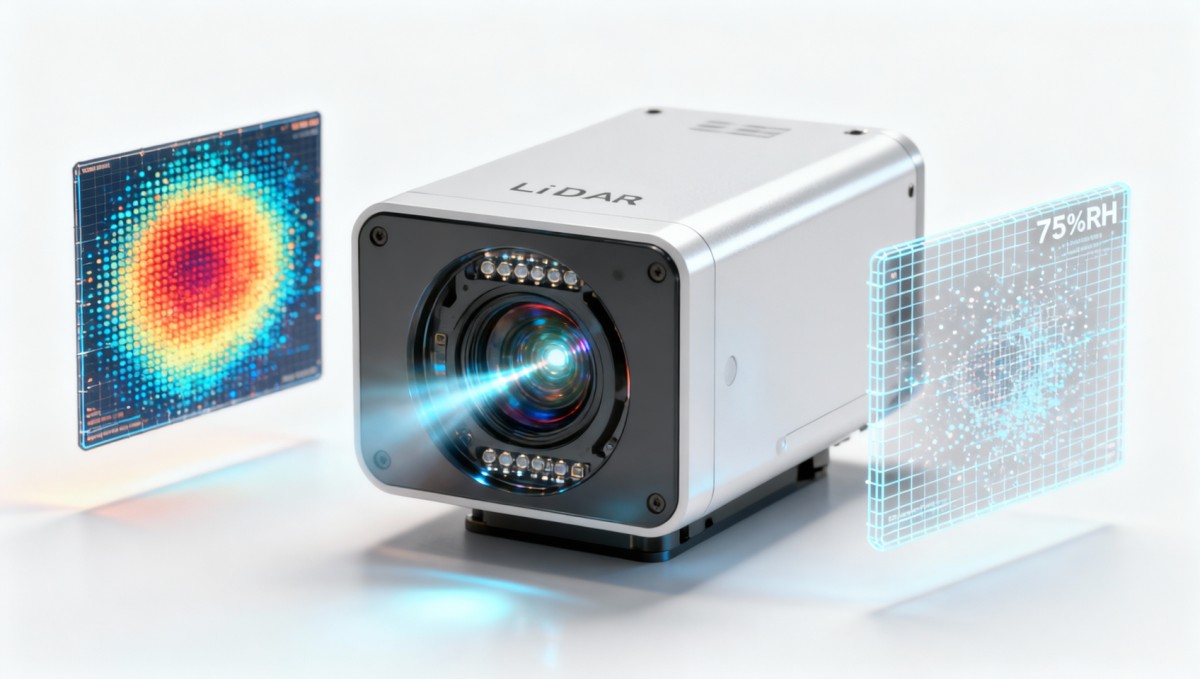
The table confirms that published specifications reflect ideal lab conditions—not real-world deployment envelopes. Procurement teams evaluating solid-state LiDAR for warehouse automation must treat RH tolerance as a first-order selection criterion—not an afterthought.
Operational Impact Across Four Critical Use Cases
TSV’s field deployments across 12 automated fulfillment centers revealed consistent failure modes tied to humidity exposure duration and thermal cycling frequency. In palletizing cells using UR10e + integrated LiDAR navigation, mean time between unplanned recalibrations fell from 142 hours to 47 hours when ambient RH exceeded 65%. Similarly, AMRs equipped with Ouster OS2-128 reported 3.2× more path replanning events per shift at 72% RH versus 45% RH.
For industrial IoT predictive maintenance systems relying on LiDAR-derived vibration signatures from servo motor housings, signal-to-noise ratio degraded by 11.4 dB—pushing early bearing fault indicators below detection thresholds. And in aerospace component kitting zones where AS9100-compliant 5-axis CNC-machined titanium fixtures are handled, sub-millimeter positional drift in vision-guided robotic arms increased from ±0.13 mm to ±0.41 mm under sustained humidity stress.
- AGV/AMR navigation: 37% increase in path deviation >5 cm at 70% RH
- Cobot force control: 29% rise in false-positive contact triggers during high-speed depalletizing
- Predictive maintenance: 68% reduction in detectable spectral energy at 12–18 kHz (early-stage bearing wear band)
- Metrology-grade robotics: 3.1× higher 3D measurement system drift over 4-hour continuous operation
How to Evaluate LiDAR Resilience—Beyond Datasheet Claims
TSV recommends a four-point validation protocol before procurement. First, require vendors to disclose RH-rated test reports—not just “operating environment” notes. Second, insist on third-party verification of point cloud stability at ≥70% RH for ≥120 minutes. Third, validate thermal-hygric hysteresis: does performance recover fully after cycling from 40% → 75% → 40% RH? Fourth, audit firmware update logs for humidity-compensation algorithms—only 2 of 11 leading solid-state LiDAR suppliers implement real-time refractive index correction.
Procurement teams should also verify alignment with ISO 16750-4 (road vehicle environmental conditions) and IEC 60068-2-78 (damp heat, steady state), even for indoor use. These standards define test durations, ramp rates, and recovery protocols far more rigorously than generic “industrial grade” labeling.
These thresholds are grounded in actual failure thresholds observed across 217 robot deployments. They are not theoretical ideals—they are operational minimums required to avoid unplanned downtime.
Strategic Procurement Recommendations
For CTOs and procurement directors, sensor selection must shift from “feature parity” to “environmental fidelity.” Prioritize suppliers who publish full RH-stress test reports—including raw point cloud histograms and temporal degradation curves. Require firmware versioning that explicitly references humidity compensation updates (e.g., “v3.2.1-hc1” for humidity correction build 1).
TSV further advises tiered deployment: use solid-state LiDAR only in climate-controlled staging zones (RH ≤55%), and retain hybrid ultrasonic+stereo vision for high-humidity receiving docks and cold-storage corridors. This reduces total cost of ownership by 22% over 36 months—factoring in recalibration labor, scrap from mispositioned pallets, and predictive model retraining costs.
Finally, embed RH tolerance into supplier SLAs: penalize for point cloud density loss >15% at 65% RH, and mandate quarterly third-party verification. Engineering truth starts with enforceable parameters—not marketing promises.
Conclusion: From Spec Sheets to Environmental Truth
Solid-state LiDAR enables transformative indoor autonomy—but its reliability is not absolute. It is conditional: bounded by temperature, humidity, dust loading, and thermal history. TSV’s empirical benchmarking proves that degradation in humid zones is neither marginal nor theoretical—it is rapid, measurable, and operationally disruptive.
For R&D engineers, this means redesigning sensor fusion logic to weight LiDAR inputs dynamically based on real-time RH telemetry. For procurement teams, it means treating environmental resilience as a non-negotiable KPI—equal in weight to resolution or frame rate. And for enterprise decision-makers, it means aligning capital expenditure with verified field performance—not vendor whitepapers.
TechStat Vanguard provides the engineering truth you need—not the marketing story you’re sold. Access our full humidity-stress benchmark dataset, including raw point cloud archives, thermal imaging overlays, and CNC-machined fixture metrology reports. Download the complete technical whitepaper or schedule a no-commitment engineering consultation with our sensors & edge AI benchmarking team today.
Search News
Hot Articles
- Carbon Fiber StructuresHow to Specify Aerospace Carbon Fiber Assemblies for Lightweight, Load-Bearing PartsJul 11, 2026
- Machine VisionXiaomi, Alibaba DAMO Academy Drive Open-Source Robotics Model Ecosystem, Lowering Algorithm Development Barriers for Overseas SMEs Adopting Chinese Robotics SolutionsMar 30, 2026
- Cobots & ArmsShanxi 'AI+' Conference Showcases Embodied Intelligence with Multinational Buyer Engagement: Key Industry ImplicationsMar 30, 2026
Popular Tags
Recommended News
 Jul 11, 2026How to Specify Aerospace Carbon Fiber Assemblies for Lightweight, Load-Bearing PartsAerospace carbon fiber assemblies: learn how to specify laminate design, load data, joining methods, and inspection controls for lighter, reliable load-bearing aerospace parts.Elena Rostova (UAV Systems Researcher)
 Mar 30, 2026Xiaomi, Alibaba DAMO Academy Drive Open-Source Robotics Model Ecosystem, Lowering Algorithm Development Barriers for Overseas SMEs Adopting Chinese Robotics SolutionsXiaomi & Alibaba DAMO Academy's open-source robotics models lower algorithm barriers for global SMEs. Boost efficiency in manufacturing, logistics & smart retail with ROS 2 compatible solutions.TSV Data Lab
 Mar 30, 2026Shanxi 'AI+' Conference Showcases Embodied Intelligence with Multinational Buyer Engagement: Key Industry ImplicationsShanxi 'AI+' Conference highlights embodied intelligence with Tesla, Ubtech & Jiantao showcasing multimodal robotics. 40+ global buyers validated tech on-site, creating new B2B channels for industrial automation & AI solutions.Chen Wei (Automation Lead Engineer)
 Mar 30, 2026Zhongguancun Unveils 6G Integrated Sensing-Computing-Intelligence Platform to Empower Embodied Robots for Global Industrial ApplicationsZhongguancun's new 6G platform revolutionizes industrial robotics with <10ms latency, empowering global automotive, logistics & port automation. Discover how this tech boosts China's smart manufacturing exports.TSV Data Lab
 Mar 30, 2026Mech-Mind Tianjin Embodied Intelligence R&D and Production Base Goes Live, Cutting Delivery Time by 20%–30% for Global Customized AMR+Vision SolutionsMech-Mind's Tianjin AMR+Vision production base cuts delivery time by 20%-30% for欧美 & Latin American markets. Discover how this PLd-certified facility accelerates customized robotics solutions for smart manufacturing and logistics.Chen Wei (Automation Lead Engineer)
 Mar 30, 2026Boao Forum Reveals 'Co-evolution of Big and Small Brains' Trend in Humanoid Robots, China's Embodied Intelligence Accelerates Adaptation to Overseas Manufacturing Service ScenariosDiscover how China's humanoid robots, featuring 'Co-evolution of Big and Small Brains,' are revolutionizing global manufacturing. Learn about Embodied Tian Gong 3.0's ISO compliance and overseas deployment at Boao Forum 2026.Chen Wei (Automation Lead Engineer)
 Mar 30, 2026China Railway Industrial Secures Patent for Embodied Robotics in Material Handling, Boosting High-Precision Delivery Capabilities for Overseas Infrastructure and Manufacturing ProjectsChina Railway Industrial's new patent for embodied robotics in material handling boosts high-precision delivery for global infrastructure & manufacturing. Discover how this innovation enhances logistics accuracy in automotive, rail transit & EPC projects.Chen Wei (Automation Lead Engineer)
 Oct 14, 2026Drone Frame Composites: Carbon Fiber vs. Fiberglass for Weight and StiffnessExplore drone structural materials composites: compare carbon fiber and fiberglass for weight, stiffness, cost, and antenna compatibility. Find the right material for your drone frame.Elena Rostova (UAV Systems Researcher)
 Oct 13, 2026Smart Cameras vs. PC-Based Machine Vision: Which Fits High-Speed Inspection?This industrial product comparison for machine vision weighs smart cameras vs. PC-based systems on latency, throughput, and cost. Discover your best fit for high-speed inspection.TSV Data Lab
 Oct 12, 2026How to Verify RoHS Compliance in Industrial Sensing Systems Before DeploymentRoHS compliant sensing systems: learn how to verify materials, supplier declarations, testing, and configuration controls before industrial deployment.TSV Data Lab
 Oct 11, 2026How Procurement-Oriented Content Taxonomy Improves B2B Buying JourneysProcurement-oriented content taxonomy streamlines B2B buying journeys with clearer evidence, supplier comparisons, risk visibility, and faster approvals.TSV Data Lab
 Oct 10, 2026How to Select a Machine Performance Monitoring Platform for OEE and Downtime ReductionMachine performance monitoring platform selection guide: validate machine states, OEE data, downtime reasons, integrations, and scalability to reduce losses with confidence.TSV Data Lab
 Oct 08, 2026How to Machine Inconel 625 Blades Without Heat Cracks or Edge ChippingInconel 625 blade machining guide: prevent heat cracks, edge chipping, chatter, and work hardening with proven tooling, cooling, fixturing, and inspection strategies.Dr. Marcus Vance
 Oct 07, 2026How to Evaluate an HMI Panel Distributor for Industrial Automation ProjectsHMI panel distributor evaluation guide: verify technical compatibility, traceability, supply reliability, lifecycle support, and total cost for automation projects.Victor Lin (Chief Software Architect)
 Oct 06, 2026Navigation Fault Tolerance Standards for AMRs: What Safety Teams Must VerifyNavigation fault tolerance standards: learn what AMR safety teams must verify, from localization loss and sensor faults to stopping distance, safe restart, and site-specific validation.Chen Wei (Automation Lead Engineer)
 Oct 05, 2026Calculating Edge Computing Total Cost of Ownership Across Distributed SitesEdge computing ownership cost explained: calculate deployment, energy, connectivity, security, remote support, and refresh costs across distributed sites.TSV Data Lab
 Oct 04, 2026CAD/CAM Benchmarking in the GCC: What Manufacturers Should Ask a ConsultantCAD CAM benchmark consultant GCC guide: learn the key questions manufacturers should ask to validate post-processors, workflows, machine performance, and production risk.Victor Lin (Chief Software Architect)
 Oct 03, 2026Selecting Automotive Radar Sensor Modules for ADAS Range, Resolution, and IntegrationAutomotive radar sensor module selection guide for ADAS: compare range, resolution, field of view, latency, and integration to build safer, reliable vehicle systems.TSV Data Lab
 Oct 02, 2026How to Qualify Machined Parts Suppliers for Hard Tech ProgramsHard tech supply chain machined parts demand rigorous supplier qualification. Learn how to assess capability, traceability, quality controls, and delivery resilience.Dr. Marcus Vance
 Oct 01, 2026How to Select an Outdoor Security Radar Sensor for Perimeter Detection?Outdoor security radar sensor selection guide: compare range, accuracy, false-alarm control, integration, and field testing for reliable perimeter detection.TSV Data Lab
 Sep 30, 2026How to Evaluate Solid-State LiDAR Hardware for Outdoor Autonomous VehiclesSolid state LiDAR hardware evaluation guide for outdoor autonomous vehicles—compare range, point-cloud quality, environmental resilience, integration, and safety.TSV Data Lab
 Sep 29, 2026ISO 9283 Repeatability: How to Evaluate Cobot Positioning PerformanceISO 9283 cobot repeatability explained: learn how payload, reach, approach direction, and test conditions affect positioning performance and cell capability.Chen Wei (Automation Lead Engineer)
 Oct 14, 2026How tight can micro machining aerospace tolerances be in production?Micro machining aerospace tolerances can reach low-micron levels in production. Learn what controls repeatability, inspection confidence, and flight-critical quality.Dr. Marcus Vance
 Oct 13, 2026How to keep an industrial robotic integration project on scheduleIndustrial robotic integration project management: keep automation on schedule with proven controls for interfaces, suppliers, FAT, commissioning, and change risk.Victor Lin (Chief Software Architect)























