Which Anti-Interference Specs Matter Most in Solid-State LiDAR?
Publication Date
author
When evaluating solid-state LiDAR for demanding industrial, UAV, and edge-AI deployments, anti-interference performance is often the difference between reliable perception and costly signal distortion. Understanding solid-state LiDAR anti-interference parameters helps technical evaluators move beyond marketing claims and focus on measurable resilience to ambient light, electromagnetic noise, cross-talk, and environmental complexity.
Why do solid-state LiDAR anti-interference parameters matter so much in real deployments?
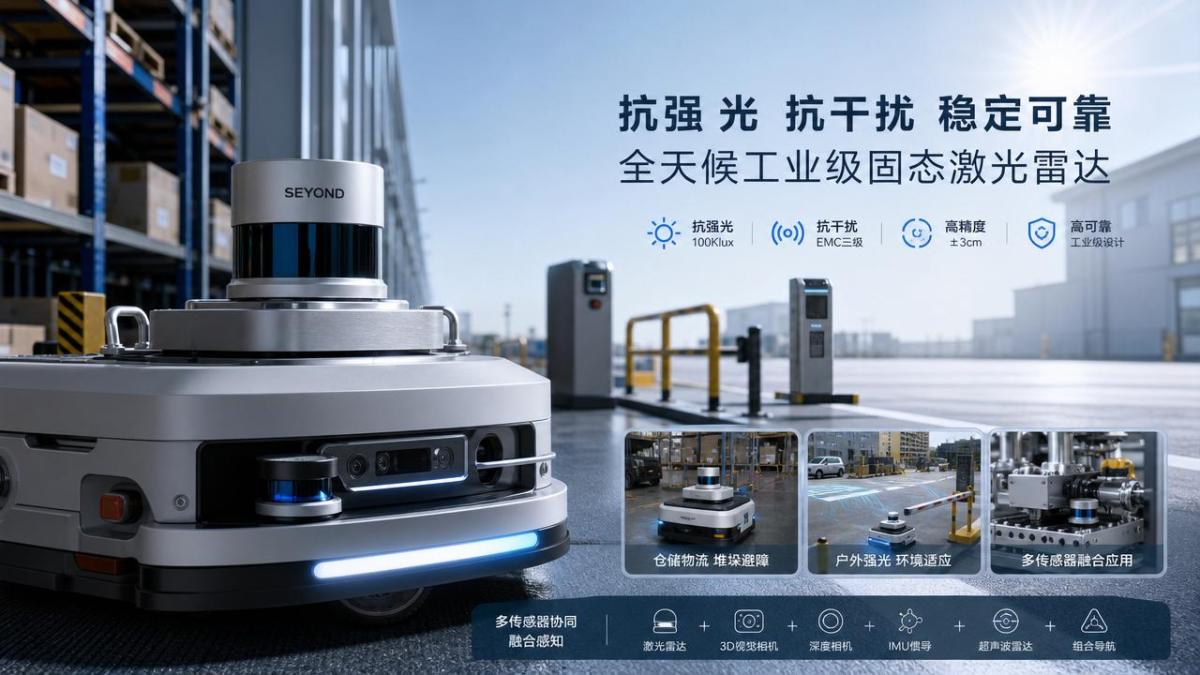
For technical evaluation teams, the hardest part of selecting a perception sensor is not reading a datasheet. It is predicting whether the sensor will still perform when the lab disappears and the real world begins. In factories, ports, mines, smart intersections, and UAV corridors, interference comes from everywhere: direct sunlight, reflective metals, fog-like particulates, dense sensor traffic, switching power supplies, high-current motors, and neighboring LiDAR units operating at similar wavelengths.
That is why solid-state LiDAR anti-interference parameters should be treated as procurement-critical specifications rather than secondary notes. A unit with attractive range and resolution on a clean test bench may still create unstable point clouds, false positives, missed returns, or timing drift in deployment. For AGV navigation, autonomous inspection, perimeter monitoring, and low-altitude UAV mapping, that gap translates directly into rework cost, delayed commissioning, and higher supplier qualification cycles.
At TechStat Vanguard, the guiding principle is simple: parameters do not lie. For evaluation professionals, the goal is not to find the sensor with the loudest performance claim. It is to identify which anti-interference metrics are actually linked to operational reliability, then request evidence, test conditions, and threshold behavior under defined stress scenarios.
- In robotics and automation, anti-interference affects route stability, obstacle confidence, and safety margin in mixed-light facilities.
- In UAV and aerospace-related applications, it influences altitude consistency, terrain reconstruction, and mission continuity under strong solar loading.
- In edge AI systems, it determines whether downstream perception algorithms receive clean spatial data or noisy, unstable inputs that inflate compute burden.
Which solid-state LiDAR anti-interference parameters should technical evaluators rank first?
Many vendors list “anti-interference” as a general capability, but evaluators need specification-level clarity. The table below organizes the most important solid-state LiDAR anti-interference parameters into practical review categories. It can be used directly when drafting a technical checklist or supplier questionnaire.
The key takeaway is that no single figure defines anti-interference performance. Technical evaluators should look for a combination of light immunity, cross-talk resistance, electromagnetic robustness, and low false-point behavior. If a vendor cannot explain the test conditions behind these solid-state LiDAR anti-interference parameters, the specification has limited decision value.
The five metrics that usually deserve the highest weighting
- Detection stability under strong ambient light, because outdoor and semi-outdoor deployments often fail here first.
- Cross-talk suppression in multi-sensor environments, because fleet growth quickly magnifies weak isolation design.
- False point density rather than headline range alone, because algorithm teams pay the price for noisy raw data.
- Signal discrimination latency, because anti-interference filtering that adds too much delay can degrade control performance.
- EMC-related operational stability, because industrial installations rarely provide a low-noise electrical environment.
How do application scenarios change the priority of anti-interference specs?
The most useful evaluation framework is scenario-first, not brochure-first. The same solid-state LiDAR anti-interference parameters do not carry the same weight in every use case. A mobile robot in a metallic warehouse and a UAV surveying open terrain face very different interference patterns. The table below helps align specification review with deployment context.
This scenario-based view prevents a common procurement mistake: weighting every specification equally. In practice, technical evaluators should assign environmental risk scores by scene, then rank solid-state LiDAR anti-interference parameters according to likely failure modes. That approach shortens testing cycles and produces more defensible supplier comparisons.
A simple way to translate deployment risk into spec weighting
- If the application is sun-exposed for long periods, raise the weighting of ambient light immunity and minimum effective range under glare.
- If many robots or roadside nodes operate together, prioritize cross-talk resistance and stable timing behavior.
- If the device sits near drives, converters, or high-current lines, request more detail on EMC-related performance under electrical stress.
- If downstream edge AI has limited compute headroom, low false-point output becomes more important than nominal maximum range.
What do suppliers often hide behind broad anti-interference claims?
The most common issue in LiDAR sourcing is not outright falsehood. It is insufficient test context. A supplier may state that a unit has “strong anti-interference performance,” yet omit lux level, target reflectivity, sensor spacing, incidence angle, airborne particle conditions, or whether filtering was applied before data output. Without those variables, the claim is difficult to compare or trust.
TSV’s engineering-first approach is useful here because it focuses on benchmark logic rather than promotional language. Evaluation teams should insist on threshold visibility: where performance starts to degrade, how quickly degradation occurs, and what recovery looks like after interference conditions change. That is far more actionable than a generic statement that the sensor is “adapted for complex environments.”
Red flags during supplier review
- No clear distinction between laboratory data and field data.
- No mention of reflectivity classes, despite claims about stable ranging.
- Cross-talk claims without defining the number of adjacent sensors or their distance.
- Anti-interference filtering is mentioned, but latency impact is not disclosed.
- Only maximum range is highlighted, while false alarm behavior is absent.
How should technical evaluators structure a procurement and test plan?
A strong procurement process converts solid-state LiDAR anti-interference parameters into measurable acceptance criteria. This is especially important in cross-functional buying teams where R&D, operations, procurement, and compliance may define value differently. A structured process reduces subjective debate and turns supplier comparison into evidence review.
Recommended evaluation workflow
- Define the real deployment scene, including light conditions, reflective materials, adjacent sensors, vibration, and electromagnetic noise sources.
- Translate that scene into a weighted specification matrix covering ambient light immunity, cross-talk suppression, false-point rate, latency under filtering, and electrical robustness.
- Request supplier evidence with test conditions, not just results. Ask for setup details, failure thresholds, and repeatability information.
- Run bench validation first, then limited field trials in the harshest expected interference window rather than the easiest operating period.
- Assess integration impact on compute, control loop timing, and false-alarm handling before final selection.
For organizations under delivery pressure, this workflow is also the fastest way to avoid expensive late-stage redesign. A sensor that appears affordable but forces extra shielding, algorithm tuning, or sensor fusion compensation can quickly become the more expensive option.
Procurement checklist for anti-interference review
- Ask whether anti-interference performance is maintained across the full field of view or only near the optical center.
- Confirm whether data output is raw, filtered, or conditionally filtered, and how that affects edge AI training consistency.
- Review housing, thermal behavior, and optical window contamination tolerance, because interference resilience is not purely algorithmic.
- Check integration interfaces and synchronization behavior if multiple sensors must coexist on one platform.
What standards, compliance topics, and engineering practices are relevant?
While anti-interference claims are often product-specific, technical evaluators should still frame their review within broader engineering and compliance expectations. In industrial and mobility-related projects, electromagnetic compatibility practices, functional safety considerations, environmental test routines, and optical safety classifications all influence whether a solid-state LiDAR can be deployed without hidden system risk.
The point is not to assume one universal standard proves anti-interference quality. It does not. Instead, compliance awareness helps teams verify whether the supplier has designed and tested the product within disciplined engineering boundaries. That supports more reliable supplier qualification, especially when operating across global manufacturing and advanced sensing supply chains.
- Review whether electromagnetic compatibility considerations are documented for the intended installation environment.
- Confirm environmental test coverage for temperature cycling, vibration, dust exposure, and moisture where relevant to the application.
- Check how the supplier defines detection reliability under degraded conditions, especially in safety-adjacent use cases.
FAQ: practical questions about solid-state LiDAR anti-interference parameters
How do I compare two LiDARs if both claim strong anti-interference performance?
Compare them by test context, not by adjectives. Request ambient light conditions, reflectivity assumptions, sensor spacing in cross-talk tests, false-point statistics, and any latency introduced by filtering. If one supplier provides threshold-based behavior and the other provides only narrative claims, the first usually offers a stronger basis for technical evaluation.
Which parameter matters most for outdoor deployment?
In many outdoor deployments, ambient light immunity becomes the first gate because sunlight can compress effective range and increase noise. That said, outdoor systems also face reflective clutter and weather-related signal confusion, so false-point rate and signal discrimination remain important. The right answer depends on whether the system is static infrastructure, mobile machinery, or an aerial platform.
Are cross-talk issues only relevant in large robot fleets?
No. Cross-talk can appear whenever multiple active optical sensors operate nearby, including test cells, roadside sensing clusters, and multi-sensor payloads. The risk rises with density, but even smaller deployments can experience unstable returns if timing coordination and signal discrimination are weak.
Can software filtering compensate for poor hardware anti-interference design?
Only to a limited extent. Software can suppress some noise and ghost points, but it often adds latency, compute load, and tuning complexity. If the optical path, receiver design, timing architecture, or EMC tolerance is weak, software becomes a patch rather than a solution. For most technical evaluation teams, it is better to start with stronger native sensor resilience.
Why work with a data-driven evaluation partner before final supplier selection?
Teams evaluating sensors across robotics, UAV, edge AI, and industrial automation often face the same bottleneck: too many claims, too little benchmark clarity. TechStat Vanguard addresses that gap by filtering hard-tech sourcing decisions through engineering evidence. Instead of asking which product sounds advanced, we help teams ask which parameters matter, what thresholds define success, and how to reduce trial-and-error in supplier qualification.
If you are reviewing solid-state LiDAR anti-interference parameters for a current project, you can consult TSV for practical support in spec clarification and comparison logic. Useful discussion topics include parameter confirmation, application-based spec weighting, product selection criteria, expected delivery constraints, integration risks, environmental test priorities, certification-related questions, sample evaluation planning, and quotation-stage technical alignment. For engineering-led procurement, better questions produce better sensors—and fewer surprises after deployment.
Search News
Hot Articles
- Carbon Fiber StructuresHow to Specify Aerospace Carbon Fiber Assemblies for Lightweight, Load-Bearing PartsJul 11, 2026
- Machine VisionXiaomi, Alibaba DAMO Academy Drive Open-Source Robotics Model Ecosystem, Lowering Algorithm Development Barriers for Overseas SMEs Adopting Chinese Robotics SolutionsMar 30, 2026
- Cobots & ArmsShanxi 'AI+' Conference Showcases Embodied Intelligence with Multinational Buyer Engagement: Key Industry ImplicationsMar 30, 2026
Popular Tags
Recommended News
 Jul 11, 2026How to Specify Aerospace Carbon Fiber Assemblies for Lightweight, Load-Bearing PartsAerospace carbon fiber assemblies: learn how to specify laminate design, load data, joining methods, and inspection controls for lighter, reliable load-bearing aerospace parts.Elena Rostova (UAV Systems Researcher)
 Mar 30, 2026Xiaomi, Alibaba DAMO Academy Drive Open-Source Robotics Model Ecosystem, Lowering Algorithm Development Barriers for Overseas SMEs Adopting Chinese Robotics SolutionsXiaomi & Alibaba DAMO Academy's open-source robotics models lower algorithm barriers for global SMEs. Boost efficiency in manufacturing, logistics & smart retail with ROS 2 compatible solutions.TSV Data Lab
 Mar 30, 2026Shanxi 'AI+' Conference Showcases Embodied Intelligence with Multinational Buyer Engagement: Key Industry ImplicationsShanxi 'AI+' Conference highlights embodied intelligence with Tesla, Ubtech & Jiantao showcasing multimodal robotics. 40+ global buyers validated tech on-site, creating new B2B channels for industrial automation & AI solutions.Chen Wei (Automation Lead Engineer)
 Mar 30, 2026Zhongguancun Unveils 6G Integrated Sensing-Computing-Intelligence Platform to Empower Embodied Robots for Global Industrial ApplicationsZhongguancun's new 6G platform revolutionizes industrial robotics with <10ms latency, empowering global automotive, logistics & port automation. Discover how this tech boosts China's smart manufacturing exports.TSV Data Lab
 Mar 30, 2026Mech-Mind Tianjin Embodied Intelligence R&D and Production Base Goes Live, Cutting Delivery Time by 20%–30% for Global Customized AMR+Vision SolutionsMech-Mind's Tianjin AMR+Vision production base cuts delivery time by 20%-30% for欧美 & Latin American markets. Discover how this PLd-certified facility accelerates customized robotics solutions for smart manufacturing and logistics.Chen Wei (Automation Lead Engineer)
 Mar 30, 2026Boao Forum Reveals 'Co-evolution of Big and Small Brains' Trend in Humanoid Robots, China's Embodied Intelligence Accelerates Adaptation to Overseas Manufacturing Service ScenariosDiscover how China's humanoid robots, featuring 'Co-evolution of Big and Small Brains,' are revolutionizing global manufacturing. Learn about Embodied Tian Gong 3.0's ISO compliance and overseas deployment at Boao Forum 2026.Chen Wei (Automation Lead Engineer)
 Mar 30, 2026China Railway Industrial Secures Patent for Embodied Robotics in Material Handling, Boosting High-Precision Delivery Capabilities for Overseas Infrastructure and Manufacturing ProjectsChina Railway Industrial's new patent for embodied robotics in material handling boosts high-precision delivery for global infrastructure & manufacturing. Discover how this innovation enhances logistics accuracy in automotive, rail transit & EPC projects.Chen Wei (Automation Lead Engineer)
 Sep 29, 2026ISO 9283 Repeatability: How to Evaluate Cobot Positioning PerformanceISO 9283 cobot repeatability explained: learn how payload, reach, approach direction, and test conditions affect positioning performance and cell capability.Chen Wei (Automation Lead Engineer)
 Sep 28, 2026Spindle Runout Measurement in Germany: DIN Standards, Methods, and Acceptance LimitsSpindle runout measurement Germany: explore DIN standards, proven methods, acceptance limits, and audit-ready practices for reliable machining quality.Dr. Marcus Vance
 Sep 27, 2026How to Select Wall-Mount Edge Devices for Space-Constrained Factory NetworksWall mount edge devices for space-constrained factories: evaluate workload, thermal design, power resilience, cable access, and network reliability for smarter deployments.TSV Data Lab
 Sep 26, 2026Machining Tolerance Analysis: How to Set Limits That Meet Function and Cost TargetsMachining tolerance analysis: learn how to set functional limits, control tolerance stacks, reduce inspection risk, and balance precision with production cost.Dr. Marcus Vance
 Sep 25, 2026How to Evaluate an Industrial Infrastructure Data Platform for Multi-Site OperationsIndustrial infrastructure data platform evaluation guide for multi-site operations: compare data quality, edge resilience, interoperability, governance, and scalable proof-of-value criteria.Victor Lin (Chief Software Architect)
 Sep 24, 2026How to Select Machine Vision Optics for Accurate Inspection at Different Working DistancesMachine vision optics selection guide for accurate inspection at every working distance. Compare FOV, pixel scale, DOF, distortion, lighting, and telecentric options.TSV Data Lab
 Sep 23, 2026How to Evaluate a Machine Vision System Integrator for High-Speed Inspection LinesChoose a machine vision system integrator with proven expertise in high-speed inspection, reliable reject timing, robust optics, and measurable acceptance criteria.TSV Data Lab
 Sep 28, 2026When is a SCADA API the right choice for connecting plant systems?SCADA API guide: learn when governed plant data integration improves traceability, security, and scalability—without compromising real-time control.Victor Lin (Chief Software Architect)
 Sep 27, 2026How SCADA data integration improves traceability across production linesSCADA data integration connects production-line data to improve traceability, accelerate quality investigations, and strengthen safety decisions.Victor Lin (Chief Software Architect)
 Sep 26, 2026What to define before starting SCADA integration planningSCADA integration planning starts with clear scope, control boundaries, data models, cybersecurity, and testing. Discover the definitions that reduce risk and costly rework.Victor Lin (Chief Software Architect)
 Sep 25, 2026How a smart factory with Industrial IoT reduces production blind spotsDiscover how a smart factory with Industrial IoT turns real-time machine, quality, and workflow data into actionable insights that reduce production blind spots and delivery risks.Victor Lin (Chief Software Architect)
 Sep 24, 2026When does Industrial IoT make smart manufacturing easier to scale?Smart manufacturing Industrial IoT scales when trusted data, interoperable systems, and secure workflows turn connected assets into measurable gains.TSV Data Lab
 Sep 23, 2026What drives ultra-precision machining cost at 1-micron tolerance?Ultra precision machining cost per part at 1 micron tolerance depends on process, material, metrology, and yield. Learn how to compare quotes confidently.Dr. Marcus Vance
 Sep 22, 2026Drone Engine-T550CC Applications: Build the UAV Power System Around the MissionAn application guide for Drone Engine-T550CC integration, covering payload planning, airframe matching, cooling, fuel, vibration, test procedures, documentation, and service preparation.Elena Rostova (UAV Systems Researcher)
 Sep 22, 2026How to Evaluate Industrial Edge Computing Vendors for Factory DeploymentIndustrial edge computing vendor evaluation guide for factories: compare latency, protocol fit, reliability, security, and lifecycle support before deployment.TSV Data Lab
 Sep 21, 2026Drone Payload Integration: Matching Power, Data, and Center of Gravity for Reliable FlightsDrone payload integration made practical: balance power, data, center of gravity, and endurance to build safer, more reliable mission-ready flights.Elena Rostova (UAV Systems Researcher)
 Sep 20, 2026Autonomous Navigation Pricing: Cost Drivers and Budget Benchmarks for AMR ProjectsAutonomous navigation price explained: compare AMR cost drivers, software, sensors, integration, safety, and lifecycle budgets to build a scalable project plan.Chen Wei (Automation Lead Engineer)