
Radar Sensors Range Explained: What Affects Detection Distance and Accuracy?
Publication Date
author
Radar performance is often reduced to a headline number, yet radar sensors range never comes from one specification alone. In practical use, detection distance and accuracy shift with target size, reflectivity, antenna design, operating band, processing quality, and the surrounding environment.
That matters across automation, UAV systems, smart infrastructure, security, and industrial vehicles. In a market crowded with inflated claims, a usable understanding of radar sensors range helps separate controlled lab results from field-ready engineering data.
Why range claims deserve closer reading
At system level, radar is asked to do more than see far. It must detect the right object, hold position confidence, and maintain performance when weather, vibration, clutter, or interference changes the scene.
That is why TechStat Vanguard emphasizes measurable parameters over broad marketing language. A published maximum range says little unless the test target, false alarm rate, angular resolution, and operating conditions are also defined.
The same sensor may look excellent on a bench, then lose consistency beside metallic structures, rotating machinery, roadside barriers, or dense drone traffic.
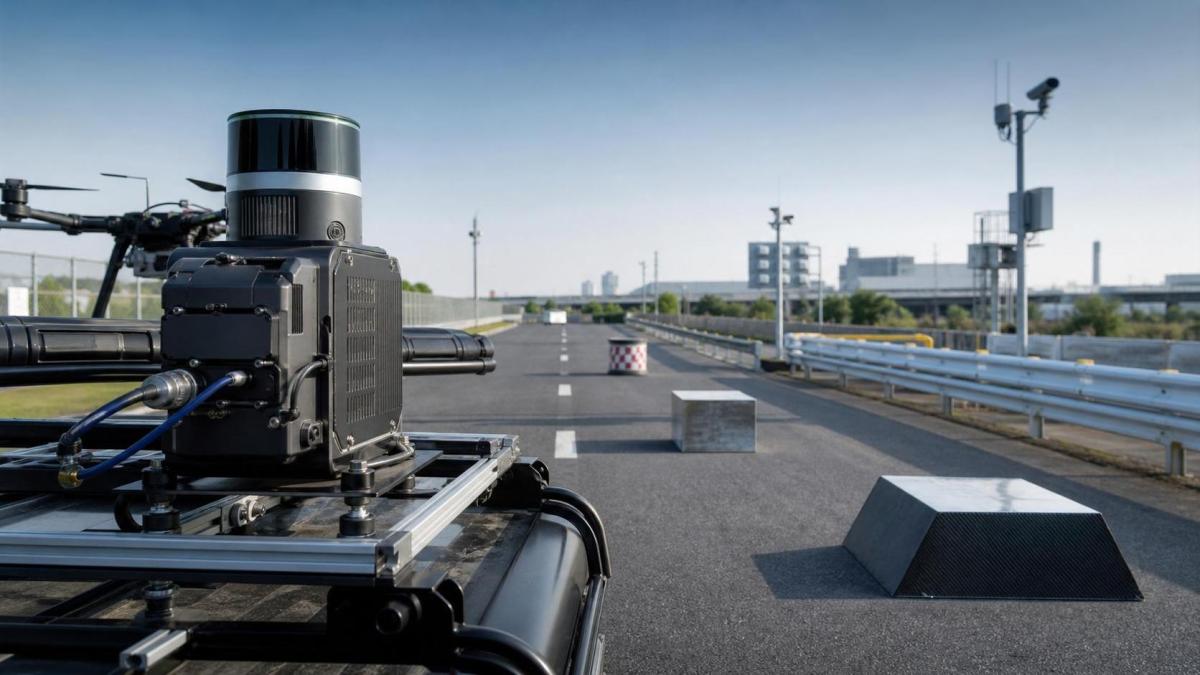
A range figure becomes meaningful only when it is tied to a real target and a real operating envelope.
What radar sensors range actually means
In simple terms, radar sensors range is the distance at which a sensor can detect, separate, and sometimes track an object with acceptable confidence.
That definition has layers. One distance may describe first detection. Another may describe reliable classification. A shorter distance may be required for stable velocity estimation or precise angle measurement.
This is where confusion begins. Vendors may promote the farthest detectable reflection, while the useful operational range for a system is much shorter.
Detection range and measurement quality are not the same
A radar can detect a large metal truck at long distance and still struggle to measure the edge of a small plastic obstacle with comparable confidence.
Likewise, a sensor can report returns at range while delivering weak angular definition. In navigation, collision avoidance, and industrial positioning, that difference is critical.
The variables that shape real-world performance
Several technical factors govern radar sensors range, and they interact rather than act independently. Looking at one parameter in isolation usually leads to poor comparison.
Target size and radar cross section
Larger objects usually return stronger echoes. Radar cross section, or RCS, expresses how detectable a target appears to radar, not simply how big it looks to the eye.
A flat metal surface can reflect strongly. A small composite component, thin cable, or angled body panel may return much less energy.
Material reflectivity and surface geometry
Material matters because radar waves interact differently with steel, aluminum, plastics, water, carbon composites, and coated surfaces.
Shape matters just as much. Curved, tilted, or irregular targets can scatter energy away from the sensor, cutting apparent range even when the object is physically large.
Frequency band and bandwidth
Lower frequencies can support longer propagation in some use cases, while higher bands often improve resolution and compact packaging.
Bandwidth affects range resolution. Wider bandwidth usually helps the sensor distinguish closely spaced objects, which improves scene interpretation even if maximum distance stays similar.
Antenna design and beam characteristics
Antenna gain, beamwidth, side lobes, and array layout all influence how energy is transmitted and received.
Narrow beams can extend useful range and improve angular separation. They may also reduce coverage if the application needs a wide field of view.
Signal processing and software logic
Modern radar performance is heavily shaped by processing. Noise filtering, Doppler extraction, clutter suppression, target tracking, and sensor fusion can all improve effective detection behavior.
This is one reason identical front-end hardware can perform differently across suppliers. The software stack changes what the hardware can reliably deliver.
Why the environment changes everything
Lab range values rarely capture full operational complexity. Outdoor weather, electromagnetic noise, reflective structures, and moving background objects can all alter results.
Rain, fog, dust, and snow often affect radar less than optical sensors, which is one reason radar remains attractive in safety-critical systems. Still, they can raise clutter and reduce certainty.
Multipath reflections are another problem. Warehouses, production cells, port terminals, and urban corridors create repeated reflections that may distort target position or generate ghost objects.
Mounting and system integration
Sensor height, tilt angle, enclosure material, vibration isolation, and cable routing can all change radar sensors range in practice.
A strong module can underperform if the radome attenuates signal energy or if the mounting location introduces blind spots and repeated reflections.
Where these differences matter most
Across hard-tech sectors, the meaning of acceptable range depends on the task. Long-distance awareness may matter in one system, while close-range precision matters more in another.
The broader lesson is clear. A sensor selected for one environment may not transfer cleanly into another, even when the advertised radar sensors range appears sufficient.
How to compare range data without falling for noise
In technical sourcing and benchmarking, the most useful questions are usually the least glamorous. They reveal whether a range claim is engineered evidence or polished positioning.
- Ask what target was used, including size, material, orientation, and RCS assumptions.
- Check whether the number describes first detection, tracking range, or reliable classification distance.
- Review false alarm rate, update rate, and angle accuracy beside range.
- Confirm environmental conditions, including rain, fog, dust, clutter, and interference sources.
- Inspect mounting constraints, radome losses, and thermal behavior in the final system.
- Look for repeatable field data rather than isolated demonstration cases.
This approach fits the TSV view of technical due diligence. Parameters only become useful when context is attached to them.
A practical way to frame the next evaluation
A better discussion of radar sensors range starts with the operating scene, not the brochure. Define the smallest target that must be detected, the worst environment expected, and the accuracy threshold the system cannot miss.
From there, compare suppliers on evidence quality. Range should be read beside resolution, tracking stability, interference resistance, and integration constraints.
For any shortlist, the next useful step is a structured benchmark matrix. Map target classes, test distances, clutter conditions, and confidence thresholds before committing to a design path.
That process does more than improve selection. It reduces trial cycles, sharpens specification writing, and turns radar sensors range from a vague promise into a decision-grade engineering metric.
Search News
Hot Articles
- Carbon Fiber StructuresHow to Specify Aerospace Carbon Fiber Assemblies for Lightweight, Load-Bearing PartsJul 11, 2026
- Machine VisionXiaomi, Alibaba DAMO Academy Drive Open-Source Robotics Model Ecosystem, Lowering Algorithm Development Barriers for Overseas SMEs Adopting Chinese Robotics SolutionsMar 30, 2026
- Cobots & ArmsShanxi 'AI+' Conference Showcases Embodied Intelligence with Multinational Buyer Engagement: Key Industry ImplicationsMar 30, 2026
Popular Tags
Recommended News
 Jul 11, 2026How to Specify Aerospace Carbon Fiber Assemblies for Lightweight, Load-Bearing PartsAerospace carbon fiber assemblies: learn how to specify laminate design, load data, joining methods, and inspection controls for lighter, reliable load-bearing aerospace parts.Elena Rostova (UAV Systems Researcher)
 Mar 30, 2026Xiaomi, Alibaba DAMO Academy Drive Open-Source Robotics Model Ecosystem, Lowering Algorithm Development Barriers for Overseas SMEs Adopting Chinese Robotics SolutionsXiaomi & Alibaba DAMO Academy's open-source robotics models lower algorithm barriers for global SMEs. Boost efficiency in manufacturing, logistics & smart retail with ROS 2 compatible solutions.TSV Data Lab
 Mar 30, 2026Shanxi 'AI+' Conference Showcases Embodied Intelligence with Multinational Buyer Engagement: Key Industry ImplicationsShanxi 'AI+' Conference highlights embodied intelligence with Tesla, Ubtech & Jiantao showcasing multimodal robotics. 40+ global buyers validated tech on-site, creating new B2B channels for industrial automation & AI solutions.Chen Wei (Automation Lead Engineer)
 Mar 30, 2026Zhongguancun Unveils 6G Integrated Sensing-Computing-Intelligence Platform to Empower Embodied Robots for Global Industrial ApplicationsZhongguancun's new 6G platform revolutionizes industrial robotics with <10ms latency, empowering global automotive, logistics & port automation. Discover how this tech boosts China's smart manufacturing exports.TSV Data Lab
 Mar 30, 2026Mech-Mind Tianjin Embodied Intelligence R&D and Production Base Goes Live, Cutting Delivery Time by 20%–30% for Global Customized AMR+Vision SolutionsMech-Mind's Tianjin AMR+Vision production base cuts delivery time by 20%-30% for欧美 & Latin American markets. Discover how this PLd-certified facility accelerates customized robotics solutions for smart manufacturing and logistics.Chen Wei (Automation Lead Engineer)
 Mar 30, 2026Boao Forum Reveals 'Co-evolution of Big and Small Brains' Trend in Humanoid Robots, China's Embodied Intelligence Accelerates Adaptation to Overseas Manufacturing Service ScenariosDiscover how China's humanoid robots, featuring 'Co-evolution of Big and Small Brains,' are revolutionizing global manufacturing. Learn about Embodied Tian Gong 3.0's ISO compliance and overseas deployment at Boao Forum 2026.Chen Wei (Automation Lead Engineer)
 Mar 30, 2026China Railway Industrial Secures Patent for Embodied Robotics in Material Handling, Boosting High-Precision Delivery Capabilities for Overseas Infrastructure and Manufacturing ProjectsChina Railway Industrial's new patent for embodied robotics in material handling boosts high-precision delivery for global infrastructure & manufacturing. Discover how this innovation enhances logistics accuracy in automotive, rail transit & EPC projects.Chen Wei (Automation Lead Engineer)
 Oct 13, 2026Smart Cameras vs. PC-Based Machine Vision: Which Fits High-Speed Inspection?This industrial product comparison for machine vision weighs smart cameras vs. PC-based systems on latency, throughput, and cost. Discover your best fit for high-speed inspection.TSV Data Lab
 Oct 12, 2026How to Verify RoHS Compliance in Industrial Sensing Systems Before DeploymentRoHS compliant sensing systems: learn how to verify materials, supplier declarations, testing, and configuration controls before industrial deployment.TSV Data Lab
 Oct 11, 2026How Procurement-Oriented Content Taxonomy Improves B2B Buying JourneysProcurement-oriented content taxonomy streamlines B2B buying journeys with clearer evidence, supplier comparisons, risk visibility, and faster approvals.TSV Data Lab
 Oct 10, 2026How to Select a Machine Performance Monitoring Platform for OEE and Downtime ReductionMachine performance monitoring platform selection guide: validate machine states, OEE data, downtime reasons, integrations, and scalability to reduce losses with confidence.TSV Data Lab
 Oct 08, 2026How to Machine Inconel 625 Blades Without Heat Cracks or Edge ChippingInconel 625 blade machining guide: prevent heat cracks, edge chipping, chatter, and work hardening with proven tooling, cooling, fixturing, and inspection strategies.Dr. Marcus Vance
 Oct 07, 2026How to Evaluate an HMI Panel Distributor for Industrial Automation ProjectsHMI panel distributor evaluation guide: verify technical compatibility, traceability, supply reliability, lifecycle support, and total cost for automation projects.Victor Lin (Chief Software Architect)
 Oct 06, 2026Navigation Fault Tolerance Standards for AMRs: What Safety Teams Must VerifyNavigation fault tolerance standards: learn what AMR safety teams must verify, from localization loss and sensor faults to stopping distance, safe restart, and site-specific validation.Chen Wei (Automation Lead Engineer)
 Oct 05, 2026Calculating Edge Computing Total Cost of Ownership Across Distributed SitesEdge computing ownership cost explained: calculate deployment, energy, connectivity, security, remote support, and refresh costs across distributed sites.TSV Data Lab
 Oct 04, 2026CAD/CAM Benchmarking in the GCC: What Manufacturers Should Ask a ConsultantCAD CAM benchmark consultant GCC guide: learn the key questions manufacturers should ask to validate post-processors, workflows, machine performance, and production risk.Victor Lin (Chief Software Architect)
 Oct 03, 2026Selecting Automotive Radar Sensor Modules for ADAS Range, Resolution, and IntegrationAutomotive radar sensor module selection guide for ADAS: compare range, resolution, field of view, latency, and integration to build safer, reliable vehicle systems.TSV Data Lab
 Oct 02, 2026How to Qualify Machined Parts Suppliers for Hard Tech ProgramsHard tech supply chain machined parts demand rigorous supplier qualification. Learn how to assess capability, traceability, quality controls, and delivery resilience.Dr. Marcus Vance
 Oct 01, 2026How to Select an Outdoor Security Radar Sensor for Perimeter Detection?Outdoor security radar sensor selection guide: compare range, accuracy, false-alarm control, integration, and field testing for reliable perimeter detection.TSV Data Lab
 Sep 30, 2026How to Evaluate Solid-State LiDAR Hardware for Outdoor Autonomous VehiclesSolid state LiDAR hardware evaluation guide for outdoor autonomous vehicles—compare range, point-cloud quality, environmental resilience, integration, and safety.TSV Data Lab
 Sep 29, 2026ISO 9283 Repeatability: How to Evaluate Cobot Positioning PerformanceISO 9283 cobot repeatability explained: learn how payload, reach, approach direction, and test conditions affect positioning performance and cell capability.Chen Wei (Automation Lead Engineer)
 Oct 13, 2026How to keep an industrial robotic integration project on scheduleIndustrial robotic integration project management: keep automation on schedule with proven controls for interfaces, suppliers, FAT, commissioning, and change risk.Victor Lin (Chief Software Architect)
 Oct 12, 2026What should be included in predictive maintenance pricing for factories?Predictive maintenance pricing for factories: compare sensors, software, integration, support, and total cost to secure measurable uptime gains and avoid hidden expenses.TSV Data Lab
 Oct 11, 2026How payload and reach change the cost of an industrial robotCost of industrial robot systems depends heavily on payload and reach. Learn how sizing, torque, tooling, safety, and lifecycle factors shape smarter automation investments.Chen Wei (Automation Lead Engineer)























