New VDI 2510 Raises AGV Obstacle Avoidance Bar to 99.997%
Publication Date
author
Lead
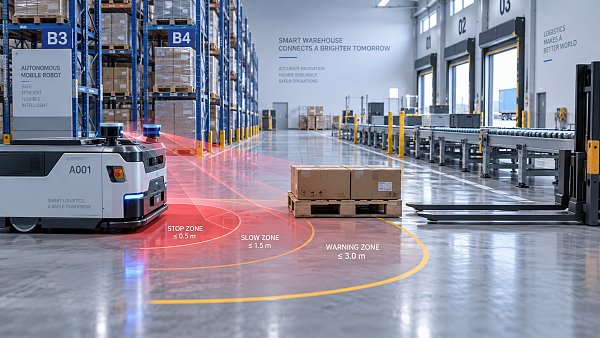
On May 22, 2026, the German Association of Engineers (VDI) officially implemented VDI 2510-2026, Requirements for Safety of Automated Guided Vehicle Systems. The revision mandates a dynamic obstacle detection success rate of ≥99.997%—equivalent to a mean time between failures (MTBF) of at least 100,000 interaction cycles. As this standard is now embedded in TÜV Rheinland’s certification framework, it directly affects global AGV suppliers seeking qualification with German OEMs and Tier 1 automotive manufacturers.
Event Overview
The VDI 2510-2026 edition entered into force on May 22, 2026. It explicitly requires AGV systems deployed in industrial and logistics environments subject to German regulatory or contractual oversight to achieve a verified dynamic obstacle recognition success rate of no less than 99.997%. This threshold is formally tied to an MTBF metric of ≥100,000 consecutive safe interactions. The standard is now integrated into TÜV Rheinland’s functional safety assessment protocol for AGV system certification. Non-compliant perception architectures—including standalone LiDAR-only or monocular machine vision (MV)-only solutions—are excluded from approval under German OEM secondary supplier audits.
Industries Affected
Direct Export Enterprises
Chinese AGV system integrators and OEMs exporting to Germany—or supplying Tier 1 suppliers headquartered there—are immediately impacted. Compliance is no longer optional for market access: failure to demonstrate fusion-based perception (LiDAR + machine vision) validated against VDI 2510-2026 will result in disqualification from tender processes and audit rejection. Impact manifests in delayed project timelines, increased validation costs, and potential contract renegotiation or loss.
Raw Material Procurement Firms
Suppliers of core perception components—including 1550 nm LiDAR modules, global-shutter CMOS sensors, and real-time FPGA processing units—face revised demand signals. Orders are shifting toward components certified for synchronized multi-sensor timestamp alignment and deterministic latency ≤15 ms. Firms sourcing unqualified or legacy-grade optics or timing ICs may encounter upstream pushback from integrators needing traceable compliance evidence.
Contract Manufacturing & System Integration Firms
EMS and JDM providers building AGV control units or perception subassemblies must now validate not only hardware functionality but also sensor fusion logic robustness across edge cases (e.g., low-contrast moving objects, occlusion recovery, rain-smeared lens simulation). Firmware versioning, calibration traceability, and runtime diagnostic logging become auditable deliverables—not just engineering best practices.
Supply Chain Certification & Testing Service Providers
Laboratories offering functional safety testing (e.g., ISO 13849, IEC 61508) must extend scope to include dynamic obstacle scenario libraries aligned with VDI 2510 Annex C. Third-party validators lacking test tracks with programmable pedestrian dummies, variable lighting, and mixed-reflectivity surfaces will struggle to support clients’ pre-certification verification cycles.
Key Focus Areas and Recommended Actions
Validate Fusion Architecture Against VDI 2510 Test Scenarios
Integrators should commission third-party validation using the standardized dynamic test suite defined in VDI 2510-2026 Annex C—not internal benchmarks. Emphasis must be placed on worst-case sequences: consecutive low-velocity obstacles (<0.3 m/s), partial occlusions lasting >2.5 s, and simultaneous multi-directional intrusion events.
Document Sensor Synchronization and Latency Budgets
Certification auditors now require end-to-end timing analysis: from photon arrival at LiDAR receiver to fused decision output. Documentation must include hardware timestamp resolution, software pipeline jitter measurements, and worst-case latency under full CPU/GPU load—validated across ≥1,000 operational hours.
Update Supplier Qualification Protocols
Procurement teams must revise component qualification checklists to mandate evidence of synchronization-ready interfaces (e.g., PTPv2 over Ethernet, hardware trigger lines with <100 ns skew), not just data sheet specs. Suppliers unable to provide traceable calibration certificates for co-aligned extrinsic parameters will no longer meet baseline requirements.
Prepare for Tiered Audit Evidence Packages
German OEMs now expect three-tier documentation: (1) design-level fusion algorithm white papers, (2) integration-level test reports with raw sensor logs, and (3) field-deployment telemetry summaries covering ≥10,000 km of operational exposure. Pre-submission gap assessments are strongly advised.
Editorial Perspective / Industry Observation
Observably, VDI 2510-2026 does not merely raise a technical bar—it redefines the boundary between ‘perception’ and ‘safety-critical control’. Analysis shows that the 99.997% threshold effectively eliminates statistical tolerance for single-sensor failure modes, making architectural redundancy non-negotiable. From an industry perspective, this signals a structural shift: perception is no longer a subsystem but a foundational safety layer. Current more relevant interpretation is that fusion is not about improving accuracy—it’s about enabling verifiable fault containment. That distinction reshapes R&D investment priorities, especially among mid-tier Chinese vendors previously optimizing for cost-per-point rather than failure-mode coverage.
Conclusion
This update marks a pivotal maturation point for AGV safety governance—not as a localized German requirement, but as a de facto benchmark influencing UL 3100, GB/T 38659, and upcoming ISO/IEC AWI 50881 drafts. Rational observation suggests the standard accelerates consolidation among perception solution providers while raising the barrier to entry for new entrants lacking deep functional safety expertise. For the broader logistics automation sector, it underscores that reliability is increasingly measured not in uptime percentages—but in statistically bounded behavioral guarantees.
Source Attribution
Official text: VDI 2510-2026, published by Verein Deutscher Ingenieure (VDI), May 2026.
Certification integration: TÜV Rheinland Functional Safety Bulletin No. FS-AGV-2026-05, issued May 22, 2026.
OEM implementation guidance: Volkswagen Group Supplier Requirement Document SRD-AGV-2026 Rev. 2 (effective Q3 2026).
Note: Pending clarification on cross-recognition status with UKAS and CNAS accreditation bodies—subject to ongoing monitoring.
Search News
Hot Articles
- Carbon Fiber StructuresHow to Specify Aerospace Carbon Fiber Assemblies for Lightweight, Load-Bearing PartsJul 11, 2026
- Machine VisionXiaomi, Alibaba DAMO Academy Drive Open-Source Robotics Model Ecosystem, Lowering Algorithm Development Barriers for Overseas SMEs Adopting Chinese Robotics SolutionsMar 30, 2026
- Cobots & ArmsShanxi 'AI+' Conference Showcases Embodied Intelligence with Multinational Buyer Engagement: Key Industry ImplicationsMar 30, 2026
Popular Tags
Recommended News
 Jul 11, 2026How to Specify Aerospace Carbon Fiber Assemblies for Lightweight, Load-Bearing PartsAerospace carbon fiber assemblies: learn how to specify laminate design, load data, joining methods, and inspection controls for lighter, reliable load-bearing aerospace parts.Elena Rostova (UAV Systems Researcher)
 Mar 30, 2026Xiaomi, Alibaba DAMO Academy Drive Open-Source Robotics Model Ecosystem, Lowering Algorithm Development Barriers for Overseas SMEs Adopting Chinese Robotics SolutionsXiaomi & Alibaba DAMO Academy's open-source robotics models lower algorithm barriers for global SMEs. Boost efficiency in manufacturing, logistics & smart retail with ROS 2 compatible solutions.TSV Data Lab
 Mar 30, 2026Shanxi 'AI+' Conference Showcases Embodied Intelligence with Multinational Buyer Engagement: Key Industry ImplicationsShanxi 'AI+' Conference highlights embodied intelligence with Tesla, Ubtech & Jiantao showcasing multimodal robotics. 40+ global buyers validated tech on-site, creating new B2B channels for industrial automation & AI solutions.Chen Wei (Automation Lead Engineer)
 Mar 30, 2026Zhongguancun Unveils 6G Integrated Sensing-Computing-Intelligence Platform to Empower Embodied Robots for Global Industrial ApplicationsZhongguancun's new 6G platform revolutionizes industrial robotics with <10ms latency, empowering global automotive, logistics & port automation. Discover how this tech boosts China's smart manufacturing exports.TSV Data Lab
 Mar 30, 2026Mech-Mind Tianjin Embodied Intelligence R&D and Production Base Goes Live, Cutting Delivery Time by 20%–30% for Global Customized AMR+Vision SolutionsMech-Mind's Tianjin AMR+Vision production base cuts delivery time by 20%-30% for欧美 & Latin American markets. Discover how this PLd-certified facility accelerates customized robotics solutions for smart manufacturing and logistics.Chen Wei (Automation Lead Engineer)
 Mar 30, 2026Boao Forum Reveals 'Co-evolution of Big and Small Brains' Trend in Humanoid Robots, China's Embodied Intelligence Accelerates Adaptation to Overseas Manufacturing Service ScenariosDiscover how China's humanoid robots, featuring 'Co-evolution of Big and Small Brains,' are revolutionizing global manufacturing. Learn about Embodied Tian Gong 3.0's ISO compliance and overseas deployment at Boao Forum 2026.Chen Wei (Automation Lead Engineer)
 Mar 30, 2026China Railway Industrial Secures Patent for Embodied Robotics in Material Handling, Boosting High-Precision Delivery Capabilities for Overseas Infrastructure and Manufacturing ProjectsChina Railway Industrial's new patent for embodied robotics in material handling boosts high-precision delivery for global infrastructure & manufacturing. Discover how this innovation enhances logistics accuracy in automotive, rail transit & EPC projects.Chen Wei (Automation Lead Engineer)
 Oct 07, 2026How to Evaluate an HMI Panel Distributor for Industrial Automation ProjectsHMI panel distributor evaluation guide: verify technical compatibility, traceability, supply reliability, lifecycle support, and total cost for automation projects.Victor Lin (Chief Software Architect)
 Oct 06, 2026Navigation Fault Tolerance Standards for AMRs: What Safety Teams Must VerifyNavigation fault tolerance standards: learn what AMR safety teams must verify, from localization loss and sensor faults to stopping distance, safe restart, and site-specific validation.Chen Wei (Automation Lead Engineer)
 Oct 05, 2026Calculating Edge Computing Total Cost of Ownership Across Distributed SitesEdge computing ownership cost explained: calculate deployment, energy, connectivity, security, remote support, and refresh costs across distributed sites.TSV Data Lab
 Oct 04, 2026CAD/CAM Benchmarking in the GCC: What Manufacturers Should Ask a ConsultantCAD CAM benchmark consultant GCC guide: learn the key questions manufacturers should ask to validate post-processors, workflows, machine performance, and production risk.Victor Lin (Chief Software Architect)
 Oct 03, 2026Selecting Automotive Radar Sensor Modules for ADAS Range, Resolution, and IntegrationAutomotive radar sensor module selection guide for ADAS: compare range, resolution, field of view, latency, and integration to build safer, reliable vehicle systems.TSV Data Lab
 Oct 02, 2026How to Qualify Machined Parts Suppliers for Hard Tech ProgramsHard tech supply chain machined parts demand rigorous supplier qualification. Learn how to assess capability, traceability, quality controls, and delivery resilience.Dr. Marcus Vance
 Oct 01, 2026How to Select an Outdoor Security Radar Sensor for Perimeter Detection?Outdoor security radar sensor selection guide: compare range, accuracy, false-alarm control, integration, and field testing for reliable perimeter detection.TSV Data Lab
 Sep 30, 2026How to Evaluate Solid-State LiDAR Hardware for Outdoor Autonomous VehiclesSolid state LiDAR hardware evaluation guide for outdoor autonomous vehicles—compare range, point-cloud quality, environmental resilience, integration, and safety.TSV Data Lab
 Sep 29, 2026ISO 9283 Repeatability: How to Evaluate Cobot Positioning PerformanceISO 9283 cobot repeatability explained: learn how payload, reach, approach direction, and test conditions affect positioning performance and cell capability.Chen Wei (Automation Lead Engineer)
 Oct 06, 2026Are Collaborative Robots Safe Enough to Operate Without Fencing?Are collaborative robots safe enough to work without fencing? Explore risk assessment, safeguarding options, and practical guidance for safer, productive cobot cells.Chen Wei (Automation Lead Engineer)
 Oct 05, 2026What Causes Machine Vision Systems to Miss Small Defects?What causes machine vision systems to miss small defects? Discover how lighting, optics, motion, and AI thresholds affect detection—and prevent costly escapes.TSV Data Lab
 Oct 04, 2026How Should You Compare 5-Axis CNC Machine Accuracy Claims?How do I compare 5-axis CNC machine accuracy claims? Learn how to assess standards, thermal stability, TCP accuracy, and real-world test evidence.Dr. Marcus Vance
 Oct 03, 2026Is Edge Computing Necessary for Real-Time Quality Inspection?Is industrial edge computing necessary for real-time quality inspection? Explore how latency, data volume, reliability, and control integration shape the right architecture.TSV Data Lab
 Oct 02, 2026What Documents Prove a Precision Machining Supplier Can Hold Tolerance?What documents prove a precision machining supplier can hold tolerance? Explore certificates, FAI reports, calibration, SPC, and traceability evidence to qualify suppliers with confidence.Dr. Marcus Vance
 Oct 01, 2026Can a Machining Supplier Meet Aerospace Fatigue Testing Requirements?Can a machining supplier meet aerospace fatigue testing requirements? Learn the traceability, process control, and test evidence needed for reliable aerospace parts.Dr. Marcus Vance
 Sep 30, 2026Which Industrial Robot Specifications Matter for High-Precision Assembly?Which industrial robot specifications matter most for high-precision assembly? Explore repeatability, accuracy, stiffness, vibration, calibration, and force control for reliable yields.Chen Wei (Automation Lead Engineer)
 Sep 29, 2026How Do You Verify Servo Motor Torque Under Continuous Load?How do I verify servo motor torque under continuous load? Learn RMS torque checks, torque-speed limits, thermal derating, and real-machine testing.Chen Wei (Automation Lead Engineer)