How Much LiDAR Range Accuracy Is Enough for Indoor Robots?
Publication Date
author
How Much LiDAR Range Accuracy Is Enough for Indoor Robots?
For indoor robots, the real target is not maximum distance. It is dependable measurement quality inside constrained, reflective, and constantly changing environments.
That is why solid-state LiDAR range accuracy matters more than headline range. Indoor systems need stable localization, safe stopping distance, and trustworthy obstacle contours.
A practical accuracy threshold reduces navigation drift, false obstacles, and unnecessary system cost. The right number depends on map resolution, speed, aisle width, and sensor fusion design.
Why a structured accuracy decision is necessary

Indoor robots operate in short to medium sensing ranges. Small range errors can create large effects when repeated across localization, tracking, and path planning cycles.
Marketing often highlights detection distance. Yet indoor performance usually depends on near-field consistency, edge definition, and repeatability across lighting, surfaces, and motion states.
A checklist-based review keeps evaluation tied to engineering outcomes. It links solid-state LiDAR range accuracy to stopping safety, docking precision, map quality, and integration burden.
Core points to verify before setting an accuracy target
- Define the robot’s actual operating distance band first, because solid-state LiDAR range accuracy at 1 to 8 meters matters more than performance at rarely used maximum range.
- Match accuracy to stopping distance and control latency, ensuring measurement error does not consume too much of the safety buffer during braking or obstacle avoidance.
- Check repeatability, not only nominal accuracy, because indoor localization degrades quickly when consecutive frames shift even if average error appears acceptable on paper.
- Review performance on reflective floors, glass, black plastics, and metal racks, since these surfaces often expose real weaknesses in solid-state LiDAR range accuracy.
- Compare angular resolution with range accuracy together, because precise distance alone cannot define pallet edges, chair legs, or narrow aisle corners correctly.
- Verify drift across temperature changes and vibration, especially for robots working near charging stations, doors, or industrial machinery with varying thermal conditions.
- Confirm how filtering, SLAM, and sensor fusion alter raw measurements, because downstream software can either stabilize or distort the value of solid-state LiDAR range accuracy.
- Assess data rate and latency together with precision, since delayed but accurate points may still fail fast indoor navigation where humans and carts move unpredictably.
- Set map resolution and docking tolerance before procurement, so the selected sensor is measured against application thresholds rather than generic vendor claims.
- Use benchmark tests at several distances and target materials, because a single accuracy number rarely represents the real indoor operating envelope.
What “enough” often means in real indoor applications
1. General AMR navigation in warehouses and factories
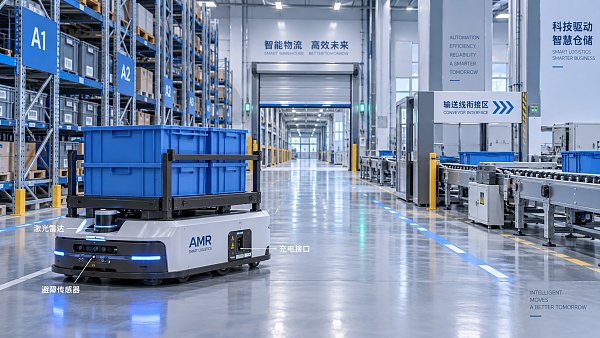
For mobile robots moving through aisles, near-field reliability usually matters most. In many cases, ±20 to ±50 mm at common operating distances is workable.
However, that only holds if repeatability is strong and software is tuned well. Poor consistency can break SLAM stability even when nominal accuracy seems acceptable.
2. Tight docking and charging alignment
Docking tasks often demand a tighter threshold. If the final alignment window is narrow, solid-state LiDAR range accuracy may need to stay near ±10 to ±20 mm.
Even then, many systems still add markers, bump sensors, or vision. LiDAR handles approach guidance, while secondary sensors secure final positional certainty.
3. Service robots in offices, hospitals, and public interiors
These spaces add glass walls, polished floors, furniture legs, and unpredictable human movement. Accuracy must be paired with reliable small-object detection and low false positives.
A moderate accuracy number is often enough if latency stays low and tracking remains stable around moving people, carts, and partially occluded obstacles.
4. Indoor mapping and inventory scanning
When map fidelity supports inventory verification or digital twins, the threshold becomes stricter. Small range deviations can distort rack geometry and corridor boundaries over time.
In such cases, solid-state LiDAR range accuracy should be judged alongside calibration stability, angular precision, and frame-to-frame registration quality.
A practical benchmark for selecting solid-state LiDAR range accuracy
A useful rule is to keep sensor error well below the robot’s required positional tolerance. Many teams use one-third to one-fifth of the final tolerance as a guide.
If docking tolerance is 30 mm, the ranging contribution should be significantly smaller. If aisle obstacle clearance is 150 mm, a larger sensor error may still be acceptable.
This approach prevents overbuying. It also avoids selecting a cheap sensor whose weak solid-state LiDAR range accuracy creates hidden software and safety costs later.
For many indoor robots, the question is less about achieving the smallest possible error and more about preserving consistent error across the full usable range.
Frequently missed issues that distort accuracy decisions
Ignoring target material behavior
A sensor can test well on calibrated boards but fail around glass, wrapped pallets, dark rubber, or shiny steel. Indoor validation must include real surfaces.
Treating average error as the whole story
Average error can hide dangerous outliers. Tail behavior, dropouts, and sudden jumps often matter more than one attractive specification line in a datasheet.
Separating accuracy from system timing
Accurate but delayed data may still cause collision risk. Indoor robots need timely point clouds that match motion speed, controller update rate, and planner frequency.
Forgetting mechanical integration effects
Mounting angle, vibration, housing windows, and contamination can reduce effective solid-state LiDAR range accuracy after installation, even if lab performance was strong.
Assuming one sensor solves every precision task
LiDAR may guide navigation well but still need support from vision, IMU, encoders, or contact sensors. Accuracy targets should reflect the complete perception stack.
How to evaluate the right threshold in practice
- List the three most critical indoor tasks, such as navigation, docking, and obstacle avoidance, then assign a measurable tolerance to each one.
- Test candidate sensors across the real distance band, not only at ideal reference points, and include representative materials from the deployment environment.
- Record repeatability, outlier rate, latency, and thermal stability, because these factors often determine whether solid-state LiDAR range accuracy remains usable over time.
- Run the sensor inside the actual software stack, including SLAM and fusion, to see whether errors are damped, amplified, or transformed into path instability.
- Choose the lowest-cost sensor that clears validated thresholds with margin, rather than the sensor with the most aggressive standalone specification.
Final takeaway
Enough solid-state LiDAR range accuracy for indoor robots is the level that safely supports the task, not the smallest number available on a brochure.
For many indoor navigation jobs, moderate accuracy with excellent consistency is the winning balance. For docking and mapping, tighter thresholds become more important.
Start with task tolerance, verify performance on real materials, and measure repeatability inside the full system. That is the fastest path to engineering truth through data.
Search News
Hot Articles
- Carbon Fiber StructuresHow to Specify Aerospace Carbon Fiber Assemblies for Lightweight, Load-Bearing PartsJul 11, 2026
- Machine VisionXiaomi, Alibaba DAMO Academy Drive Open-Source Robotics Model Ecosystem, Lowering Algorithm Development Barriers for Overseas SMEs Adopting Chinese Robotics SolutionsMar 30, 2026
- Cobots & ArmsShanxi 'AI+' Conference Showcases Embodied Intelligence with Multinational Buyer Engagement: Key Industry ImplicationsMar 30, 2026
Popular Tags
Recommended News
 Jul 11, 2026How to Specify Aerospace Carbon Fiber Assemblies for Lightweight, Load-Bearing PartsAerospace carbon fiber assemblies: learn how to specify laminate design, load data, joining methods, and inspection controls for lighter, reliable load-bearing aerospace parts.Elena Rostova (UAV Systems Researcher)
 Mar 30, 2026Xiaomi, Alibaba DAMO Academy Drive Open-Source Robotics Model Ecosystem, Lowering Algorithm Development Barriers for Overseas SMEs Adopting Chinese Robotics SolutionsXiaomi & Alibaba DAMO Academy's open-source robotics models lower algorithm barriers for global SMEs. Boost efficiency in manufacturing, logistics & smart retail with ROS 2 compatible solutions.TSV Data Lab
 Mar 30, 2026Shanxi 'AI+' Conference Showcases Embodied Intelligence with Multinational Buyer Engagement: Key Industry ImplicationsShanxi 'AI+' Conference highlights embodied intelligence with Tesla, Ubtech & Jiantao showcasing multimodal robotics. 40+ global buyers validated tech on-site, creating new B2B channels for industrial automation & AI solutions.Chen Wei (Automation Lead Engineer)
 Mar 30, 2026Zhongguancun Unveils 6G Integrated Sensing-Computing-Intelligence Platform to Empower Embodied Robots for Global Industrial ApplicationsZhongguancun's new 6G platform revolutionizes industrial robotics with <10ms latency, empowering global automotive, logistics & port automation. Discover how this tech boosts China's smart manufacturing exports.TSV Data Lab
 Mar 30, 2026Mech-Mind Tianjin Embodied Intelligence R&D and Production Base Goes Live, Cutting Delivery Time by 20%–30% for Global Customized AMR+Vision SolutionsMech-Mind's Tianjin AMR+Vision production base cuts delivery time by 20%-30% for欧美 & Latin American markets. Discover how this PLd-certified facility accelerates customized robotics solutions for smart manufacturing and logistics.Chen Wei (Automation Lead Engineer)
 Mar 30, 2026Boao Forum Reveals 'Co-evolution of Big and Small Brains' Trend in Humanoid Robots, China's Embodied Intelligence Accelerates Adaptation to Overseas Manufacturing Service ScenariosDiscover how China's humanoid robots, featuring 'Co-evolution of Big and Small Brains,' are revolutionizing global manufacturing. Learn about Embodied Tian Gong 3.0's ISO compliance and overseas deployment at Boao Forum 2026.Chen Wei (Automation Lead Engineer)
 Mar 30, 2026China Railway Industrial Secures Patent for Embodied Robotics in Material Handling, Boosting High-Precision Delivery Capabilities for Overseas Infrastructure and Manufacturing ProjectsChina Railway Industrial's new patent for embodied robotics in material handling boosts high-precision delivery for global infrastructure & manufacturing. Discover how this innovation enhances logistics accuracy in automotive, rail transit & EPC projects.Chen Wei (Automation Lead Engineer)
 Sep 28, 2026Spindle Runout Measurement in Germany: DIN Standards, Methods, and Acceptance LimitsSpindle runout measurement Germany: explore DIN standards, proven methods, acceptance limits, and audit-ready practices for reliable machining quality.Dr. Marcus Vance
 Sep 27, 2026How to Select Wall-Mount Edge Devices for Space-Constrained Factory NetworksWall mount edge devices for space-constrained factories: evaluate workload, thermal design, power resilience, cable access, and network reliability for smarter deployments.TSV Data Lab
 Sep 26, 2026Machining Tolerance Analysis: How to Set Limits That Meet Function and Cost TargetsMachining tolerance analysis: learn how to set functional limits, control tolerance stacks, reduce inspection risk, and balance precision with production cost.Dr. Marcus Vance
 Sep 25, 2026How to Evaluate an Industrial Infrastructure Data Platform for Multi-Site OperationsIndustrial infrastructure data platform evaluation guide for multi-site operations: compare data quality, edge resilience, interoperability, governance, and scalable proof-of-value criteria.Victor Lin (Chief Software Architect)
 Sep 24, 2026How to Select Machine Vision Optics for Accurate Inspection at Different Working DistancesMachine vision optics selection guide for accurate inspection at every working distance. Compare FOV, pixel scale, DOF, distortion, lighting, and telecentric options.TSV Data Lab
 Sep 23, 2026How to Evaluate a Machine Vision System Integrator for High-Speed Inspection LinesChoose a machine vision system integrator with proven expertise in high-speed inspection, reliable reject timing, robust optics, and measurable acceptance criteria.TSV Data Lab
 Sep 28, 2026When is a SCADA API the right choice for connecting plant systems?SCADA API guide: learn when governed plant data integration improves traceability, security, and scalability—without compromising real-time control.Victor Lin (Chief Software Architect)
 Sep 27, 2026How SCADA data integration improves traceability across production linesSCADA data integration connects production-line data to improve traceability, accelerate quality investigations, and strengthen safety decisions.Victor Lin (Chief Software Architect)
 Sep 26, 2026What to define before starting SCADA integration planningSCADA integration planning starts with clear scope, control boundaries, data models, cybersecurity, and testing. Discover the definitions that reduce risk and costly rework.Victor Lin (Chief Software Architect)
 Sep 25, 2026How a smart factory with Industrial IoT reduces production blind spotsDiscover how a smart factory with Industrial IoT turns real-time machine, quality, and workflow data into actionable insights that reduce production blind spots and delivery risks.Victor Lin (Chief Software Architect)
 Sep 24, 2026When does Industrial IoT make smart manufacturing easier to scale?Smart manufacturing Industrial IoT scales when trusted data, interoperable systems, and secure workflows turn connected assets into measurable gains.TSV Data Lab
 Sep 23, 2026What drives ultra-precision machining cost at 1-micron tolerance?Ultra precision machining cost per part at 1 micron tolerance depends on process, material, metrology, and yield. Learn how to compare quotes confidently.Dr. Marcus Vance
 Sep 22, 2026Drone Engine-T550CC Applications: Build the UAV Power System Around the MissionAn application guide for Drone Engine-T550CC integration, covering payload planning, airframe matching, cooling, fuel, vibration, test procedures, documentation, and service preparation.Elena Rostova (UAV Systems Researcher)
 Sep 22, 2026How to Evaluate Industrial Edge Computing Vendors for Factory DeploymentIndustrial edge computing vendor evaluation guide for factories: compare latency, protocol fit, reliability, security, and lifecycle support before deployment.TSV Data Lab
 Sep 21, 2026Drone Payload Integration: Matching Power, Data, and Center of Gravity for Reliable FlightsDrone payload integration made practical: balance power, data, center of gravity, and endurance to build safer, more reliable mission-ready flights.Elena Rostova (UAV Systems Researcher)
 Sep 20, 2026Autonomous Navigation Pricing: Cost Drivers and Budget Benchmarks for AMR ProjectsAutonomous navigation price explained: compare AMR cost drivers, software, sensors, integration, safety, and lifecycle budgets to build a scalable project plan.Chen Wei (Automation Lead Engineer)
 Sep 19, 2026How to Scope Automation Integration Services for Multi-System Factory ProjectsAutomation integration services: learn how to scope multi-system factory projects with clear workflows, interface contracts, safety boundaries, and acceptance criteria.Victor Lin (Chief Software Architect)