
IoT gateway for CNC machine monitoring often breaks at protocol mapping
Publication Date
author
When an IoT gateway for CNC machine monitoring fails at protocol mapping, the result is fragmented machine data, unreliable alarms, and costly blind spots on the shop floor. For teams evaluating industrial iot data collection architecture and industrial iot for predictive maintenance, this issue is not just technical—it directly affects uptime, traceability, and procurement decisions. This article examines why mapping breaks, how to diagnose it, and what engineering-grade fixes actually work.
In modern machining environments, a gateway is expected to translate machine-level signals into usable operational data across MTConnect, Modbus TCP, OPC UA, MQTT, proprietary CNC protocols, and MES or SCADA layers. The practical challenge is that many breakdowns do not happen at the physical network layer. They happen in the mapping logic between source registers, machine tags, event states, and business-level meanings such as cycle complete, spindle overload, tool life warning, or idle time classification.
For operators, that means dashboards that look healthy while alarms are missing. For maintenance teams, it means predictive models trained on distorted runtime data. For procurement managers and CTOs, it means buying an industrial IoT gateway that appears compatible on paper but fails in real production after 2 to 6 weeks of deployment. The key is to treat protocol mapping as an engineering validation issue, not a checkbox feature.
Why protocol mapping breaks in CNC machine monitoring projects
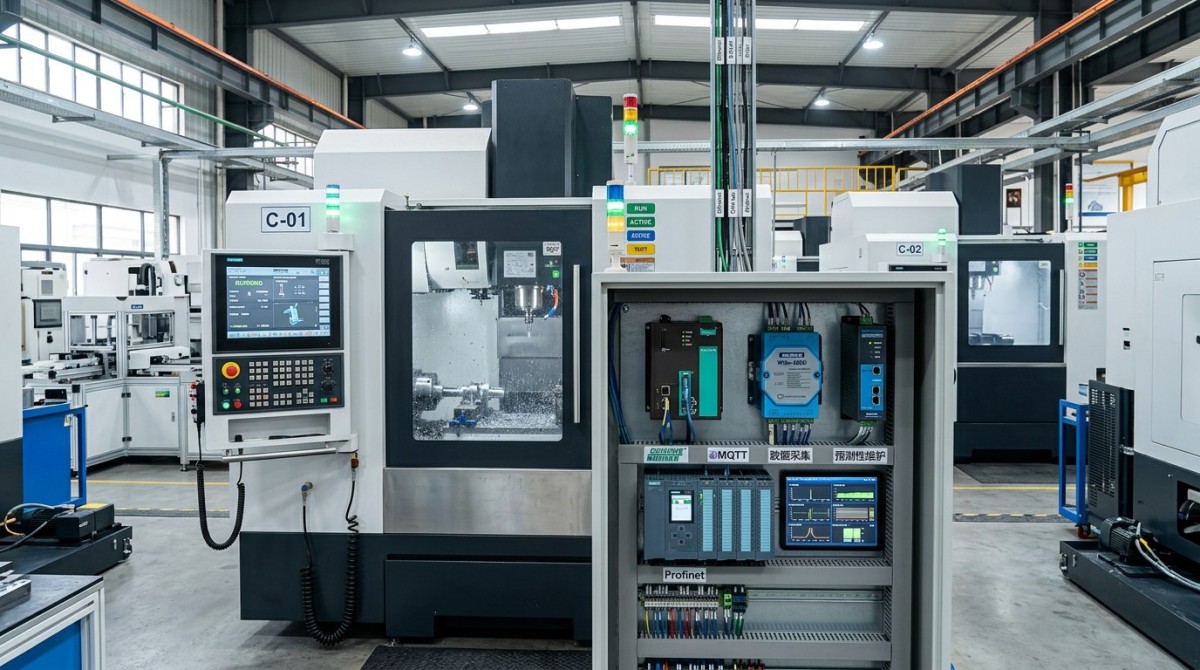
Protocol mapping failures usually begin with a mismatch between how CNC controllers expose data and how the gateway expects to consume it. A FANUC, Siemens, Mitsubishi, or legacy controller may publish status in different structures: some expose fixed registers, some expose hierarchical objects, and some only reveal selected parameters through vendor-specific drivers. A gateway may support the protocol family, yet still fail to normalize 30% to 50% of the critical machine states required for monitoring.
Another common issue is semantic ambiguity. A tag labeled “run” may mean spindle rotation on one machine, automatic cycle execution on another, and merely controller readiness on a third. If the mapping layer does not define event semantics clearly, overall equipment effectiveness, downtime classification, and alarm logic become unreliable. In mixed-brand workshops with 10 to 80 CNC assets, this inconsistency multiplies quickly.
Timing also matters. CNC machine monitoring often requires polling intervals between 200 ms and 2 seconds, depending on whether the goal is predictive maintenance, utilization tracking, or alarm escalation. If the gateway maps high-frequency signals into low-priority topics, timestamp drift and event ordering errors can occur. A missed 800 ms overload event may not matter for a monthly report, but it can undermine root-cause analysis for spindle or servo faults.
The fourth failure mode is data type conflict. A machine may output signed integers, bit fields, floating-point values, or encoded text. If a vibration threshold is treated as an integer when the source is scaled by 0.1, maintenance rules will trigger too early or too late. In precision machining, a bad mapping of only 3 to 5 parameters can create false alerts, poor traceability, and costly service calls.
Typical root causes engineers should verify first
- Controller protocol support is nominal, but the exact firmware revision is not fully covered by the gateway driver.
- Machine tag definitions are copied from one CNC model to another without validating actual register behavior.
- Polling rate, buffer size, and timestamp rules are configured for office IT traffic rather than shop-floor event density.
- Alarm and state dictionaries are not normalized across brands, plants, or shift practices.
The table below shows where protocol mapping typically fails and how those failures appear in production environments.
The critical takeaway is that gateway compatibility is not binary. A device can connect successfully yet still deliver low-integrity data. For CNC machine monitoring, usable interoperability depends on signal quality, event meaning, and repeatable mapping validation across all required machine states.
How to diagnose mapping failure before it disrupts uptime
Diagnosis should start with a three-layer audit: transport, data structure, and semantics. Transport checks confirm whether packets arrive consistently over Ethernet, serial-to-IP bridges, or edge connections. Data structure checks verify field names, scaling, polling intervals, and timestamp quality. Semantic checks compare the gateway’s interpreted machine state against what operators actually see on the CNC HMI during at least 20 to 30 real production cycles.
A common mistake is relying only on a bench test. A gateway may look stable during 1 hour of simulated traffic, then fail during actual shift changes, tool changes, or machine warm-up states. Effective validation usually requires 3 operating windows: normal production, transient events, and exception events. In many plants, that means a minimum observation period of 24 to 72 hours per representative machine type.
Maintenance and controls engineers should also create a signal priority matrix. Not every tag matters equally. For predictive maintenance, spindle load, axis current, servo alarms, vibration trend, cycle time deviation, and temperature drift typically outrank cosmetic HMI values. If only 15 to 25 signals can be validated first, those should be the ones tied directly to failure prediction, machine availability, and quality escape risk.
Another useful method is dual logging. Capture the controller-native values and the mapped gateway outputs side by side for the same time window. If the difference rate exceeds 1% to 2% for critical tags, the issue is not just communication. It signals mapping distortion, scaling loss, or incorrect event logic. This is especially important where the industrial IoT data collection architecture feeds MES, CMMS, or cloud analytics.
A practical 5-step diagnostic workflow
- Identify 10 to 20 mission-critical tags per machine, not all available tags.
- Record native controller values and gateway values over at least one full production shift.
- Trigger known states manually, such as feed hold, tool change, spindle start, alarm reset, and cycle end.
- Compare event order, scaling, and timestamp drift with a tolerance target, often under 500 ms for alarms.
- Freeze the mapping template only after cross-functional signoff from operations, maintenance, and OT teams.
What should count as a failed mapping test
A failed test is not limited to total communication loss. It includes false positives, false negatives, delayed alarms, duplicate events, wrong engineering units, and state labels that operators cannot trust. If a gateway reports uptime at 92% while shift supervisors manually log 84%, procurement teams should treat that as a technical nonconformance, not a minor tuning issue.
The table below provides a practical acceptance framework for diagnostic teams evaluating industrial IoT for predictive maintenance on CNC assets.
These targets are not universal certification thresholds, but they are practical engineering benchmarks. They help teams decide whether the gateway is ready for plant-wide deployment or still needs protocol adapter revision, data dictionary cleanup, or edge software tuning.
Engineering-grade fixes that actually improve protocol mapping reliability
The most effective fix is to separate connectivity from normalization. A robust IoT gateway for CNC machine monitoring should first acquire raw machine data with minimal transformation, then process mapping through a version-controlled data model. This two-stage design reduces the risk of hiding source-level errors and makes troubleshooting much faster. In multi-site programs, it also allows a central engineering team to maintain one normalized machine-state dictionary instead of editing each gateway separately.
Another fix is to implement tag tiering. Divide signals into Tier 1 operational tags, Tier 2 maintenance tags, and Tier 3 contextual tags. Tier 1 may include cycle start, cycle end, run, idle, alarm active, spindle load, and feed override. Tier 2 may include servo current, bearing temperature, vibration trend, and lubrication status. Tier 3 may include operator mode, part program number, or setup comments. This structure limits mapping complexity while preserving what matters most for decision-making.
Edge filtering is equally important. Not every raw signal should be sent upstream at full resolution. For example, 100 ms polling may be useful for local anomaly detection, but cloud transmission can often be aggregated into 1-second or 5-second intervals for non-critical trends. The goal is to preserve event fidelity without creating a data storm that overloads brokers, historians, or dashboards. Plants scaling from 12 to 120 machines often discover that bandwidth planning and message design are as important as protocol support.
Finally, create a formal mapping change-control process. Machine upgrades, controller firmware changes, new tooling logic, or macro edits can silently break previously stable mappings. A small revision on one CNC can alter the meaning of status bits or offsets. Good governance requires version numbers, rollback plans, and post-change validation within 24 hours after modifications.
Recommended design controls for higher reliability
- Use a canonical tag model so “cycle active” means the same thing across every machine family.
- Keep raw data logs for at least 30 to 90 days to support forensic checks after anomalies.
- Assign engineering units explicitly, such as °C, mm/s, A, %, or kW, instead of relying on assumptions.
- Apply role-based approval for mapping edits, especially in regulated or traceability-heavy production lines.
Where buyers should be skeptical of vendor claims
Buyers should look beyond statements like “supports 100+ protocols” or “plug-and-play CNC integration.” In practice, protocol count does not guarantee usable machine semantics. A stronger procurement question is whether the vendor can demonstrate cross-brand state normalization, timestamp integrity, and validation workflows for real machine events. If those details are vague, the gateway may be strong in connectivity but weak in operational truth.
For data-driven organizations, the best solution is the one that minimizes R&D trial-and-error and shortens supplier qualification. That aligns with TSV’s broader hard-tech philosophy: parameters matter more than slogans, and tolerance in data engineering is as important as tolerance in machining.
Procurement criteria for selecting an industrial IoT gateway for CNC environments
Procurement teams should evaluate gateways against four dimensions: controller compatibility depth, mapping tool maturity, edge performance, and lifecycle support. Compatibility depth asks whether the gateway handles only generic protocol transport or also machine-specific objects and alarm semantics. Mapping tool maturity covers template management, versioning, simulation, and diagnostics. Edge performance includes CPU headroom, local buffering, cybersecurity controls, and recovery after network loss. Lifecycle support includes documentation, engineering services, and update policies.
In many RFQ processes, the biggest hidden cost is not the hardware price. It is the engineering time required to stabilize the data model after deployment. A gateway that costs 15% less but needs 3 extra weeks of controls engineering support may be the more expensive option overall. This is especially relevant for enterprise decision-makers rolling out predictive maintenance across multiple plants.
Security and resilience should not be an afterthought. Industrial IoT gateways frequently sit between legacy CNC controllers and modern IT or cloud layers. Buyers should ask about local data buffering during outages, encrypted outbound communication, user-role separation, and the ability to isolate machine traffic from broader office networks. In facilities with 24/7 production, even a 30-minute data blackout can damage traceability and maintenance planning.
A disciplined purchasing team should also request a proof-of-mapping, not just a proof-of-connection. The supplier should validate at least 1 representative machine per major controller family before award, with a defined tag list, acceptance criteria, and exception log.
Buyer checklist for RFQ and technical review
The comparison table below helps procurement, operations, and CTO stakeholders evaluate gateway options using measurable criteria rather than marketing language.
The best buying decision is usually the one with the clearest validation path. In industrial IoT data collection architecture, a gateway is valuable only when the mapped outputs are stable enough to support maintenance decisions, KPI reporting, and cross-site comparability.
Implementation roadmap, common mistakes, and FAQ for decision-makers
A practical rollout usually follows 4 phases: scoping, pilot validation, controlled expansion, and governance. Scoping takes 1 to 2 weeks and defines machine families, critical tags, target systems, and acceptance rules. Pilot validation often takes 2 to 4 weeks for 1 to 3 machine types. Controlled expansion scales the template to additional machines after acceptance thresholds are met. Governance then maintains mapping integrity as the plant evolves.
The most expensive mistake is rolling out too broadly before semantic validation is complete. Another is assigning the project only to IT without enough involvement from maintenance and controls teams. CNC machine monitoring sits at the intersection of OT, equipment behavior, and enterprise reporting. If one of those groups is absent, the mapping can look technically correct while remaining operationally misleading.
A third mistake is underestimating legacy machines. Older CNC assets can still deliver useful signals for predictive maintenance, but integration often requires more selective scope. Instead of expecting full digital twins, teams should prioritize a smaller data set with high decision value. In many retrofit cases, 8 to 15 validated signals deliver better ROI than 50 poorly mapped ones.
For organizations following data-driven sourcing principles, the target is not “more data.” It is defensible data. That is the difference between a dashboard that looks modern and a monitoring architecture that genuinely reduces downtime, qualification cycles, and maintenance guesswork.
FAQ: How do I know if a gateway is suitable for predictive maintenance?
It is suitable when it can capture high-value condition signals with reliable timestamps and consistent engineering units, not merely machine utilization tags. Ask whether the system can preserve alarm timing within about 0.5 to 2 seconds, maintain critical tag accuracy above 98%, and export data cleanly to your analytics stack.
FAQ: How long does deployment usually take?
For a small pilot, 2 to 6 weeks is common, depending on controller diversity and internal approval speed. Multi-plant programs take longer because mapping libraries, security reviews, and acceptance standards must be standardized across sites.
FAQ: What should operators and maintenance teams verify after commissioning?
They should verify whether the dashboard matches actual machine behavior during cycle starts, tool changes, alarms, warm-up, and idle periods. At least 5 to 10 real exception events should be reviewed manually in the first week to ensure the mapped logic reflects reality on the shop floor.
FAQ: What is the safest scaling strategy?
Scale by controller family, not by plant count alone. Validate one template on representative machines first, then extend only after the machine-state dictionary, buffering policy, and diagnostic workflow are proven stable.
When protocol mapping breaks, the consequences extend far beyond missing tags. It affects downtime response, predictive maintenance quality, KPI trust, and supplier selection. The most reliable path is to validate semantics, timestamps, scaling, and change control with the same discipline used in machining quality assurance.
For engineering teams, plant operators, buyers, and executives, the right industrial IoT gateway is the one that turns raw machine signals into dependable operational truth. If you are assessing industrial IoT for predictive maintenance or redesigning your industrial IoT data collection architecture, now is the time to review your mapping assumptions, tighten your acceptance criteria, and build a more trustworthy edge data layer. Contact us to discuss a tailored evaluation framework, compare solution options, or explore a more rigorous CNC monitoring strategy.
Search News
Hot Articles
- Carbon Fiber StructuresHow to Specify Aerospace Carbon Fiber Assemblies for Lightweight, Load-Bearing PartsJul 11, 2026
- Machine VisionXiaomi, Alibaba DAMO Academy Drive Open-Source Robotics Model Ecosystem, Lowering Algorithm Development Barriers for Overseas SMEs Adopting Chinese Robotics SolutionsMar 30, 2026
- Cobots & ArmsShanxi 'AI+' Conference Showcases Embodied Intelligence with Multinational Buyer Engagement: Key Industry ImplicationsMar 30, 2026
Popular Tags
Recommended News
 Jul 11, 2026How to Specify Aerospace Carbon Fiber Assemblies for Lightweight, Load-Bearing PartsAerospace carbon fiber assemblies: learn how to specify laminate design, load data, joining methods, and inspection controls for lighter, reliable load-bearing aerospace parts.Elena Rostova (UAV Systems Researcher)
 Mar 30, 2026Xiaomi, Alibaba DAMO Academy Drive Open-Source Robotics Model Ecosystem, Lowering Algorithm Development Barriers for Overseas SMEs Adopting Chinese Robotics SolutionsXiaomi & Alibaba DAMO Academy's open-source robotics models lower algorithm barriers for global SMEs. Boost efficiency in manufacturing, logistics & smart retail with ROS 2 compatible solutions.TSV Data Lab
 Mar 30, 2026Shanxi 'AI+' Conference Showcases Embodied Intelligence with Multinational Buyer Engagement: Key Industry ImplicationsShanxi 'AI+' Conference highlights embodied intelligence with Tesla, Ubtech & Jiantao showcasing multimodal robotics. 40+ global buyers validated tech on-site, creating new B2B channels for industrial automation & AI solutions.Chen Wei (Automation Lead Engineer)
 Mar 30, 2026Zhongguancun Unveils 6G Integrated Sensing-Computing-Intelligence Platform to Empower Embodied Robots for Global Industrial ApplicationsZhongguancun's new 6G platform revolutionizes industrial robotics with <10ms latency, empowering global automotive, logistics & port automation. Discover how this tech boosts China's smart manufacturing exports.TSV Data Lab
 Mar 30, 2026Mech-Mind Tianjin Embodied Intelligence R&D and Production Base Goes Live, Cutting Delivery Time by 20%–30% for Global Customized AMR+Vision SolutionsMech-Mind's Tianjin AMR+Vision production base cuts delivery time by 20%-30% for欧美 & Latin American markets. Discover how this PLd-certified facility accelerates customized robotics solutions for smart manufacturing and logistics.Chen Wei (Automation Lead Engineer)
 Mar 30, 2026Boao Forum Reveals 'Co-evolution of Big and Small Brains' Trend in Humanoid Robots, China's Embodied Intelligence Accelerates Adaptation to Overseas Manufacturing Service ScenariosDiscover how China's humanoid robots, featuring 'Co-evolution of Big and Small Brains,' are revolutionizing global manufacturing. Learn about Embodied Tian Gong 3.0's ISO compliance and overseas deployment at Boao Forum 2026.Chen Wei (Automation Lead Engineer)
 Mar 30, 2026China Railway Industrial Secures Patent for Embodied Robotics in Material Handling, Boosting High-Precision Delivery Capabilities for Overseas Infrastructure and Manufacturing ProjectsChina Railway Industrial's new patent for embodied robotics in material handling boosts high-precision delivery for global infrastructure & manufacturing. Discover how this innovation enhances logistics accuracy in automotive, rail transit & EPC projects.Chen Wei (Automation Lead Engineer)
 Oct 27, 2026GXO and Agility Robotics Expand Partnership to Accelerate US Humanoid Robot DeploymentGXO and Agility Robotics plan to expand US humanoid robot deployment with Digit 4 in early 2027. Explore warehouse automation plans, service terms and future Digit 5 upgrades.Chen Wei (Automation Lead Engineer)
 Oct 27, 2026Robotic Automation Costs: Budgeting for Equipment, Integration, and MaintenancePlan your robotics automation cost with confidence. Explore equipment, integration, and maintenance expenses, compare quotes, and build a realistic budget for better ROI.Chen Wei (Automation Lead Engineer)
 Oct 26, 2026AMAXiMAL Releases Open-Source TopMod 3D v3 With Claude AIExplore AMAXiMAL’s free, open-source TopMod 3D v3 with Claude AI assistance, topology-based modeling and plywood fabrication tools that connect complex designs to physical builds.Dr. Marcus Vance
 Oct 26, 2026Choosing a SCADA System Integrator Company: PLC Compatibility and Long-Term SupportChoose a scada system integrator company with proven PLC compatibility and reliable long-term support. Discover what to test, compare, and require before investing.Victor Lin (Chief Software Architect)
 Oct 25, 2026Hesai Leads Global ADAS Main Lidar Shipments in Yole’s 2026 ReportHesai led global ADAS main lidar shipments with a 43% share in 2025, according to Yole’s 2026 report. Explore what this ranking reveals about its automotive market position.TSV Data Lab
 Oct 25, 2026Choosing an Aerospace Materials Manufacturer: Quality and Traceability ChecksChoosing an aerospace materials manufacturer? Learn how to verify certifications, test reports, and lot traceability to qualify suppliers confidently and reduce costly sourcing risks.Dr. Marcus Vance
 Oct 24, 2026Guotai Haitong: Global Entry-Level 3D Printer Shipments Rose 39% in Q1 2026Entry-level 3D printer shipments rose 39% in Q1 2026, Guotai Haitong reports. Explore how AI, multicolor printing and print farms are shaping market growth.Dr. Marcus Vance
 Oct 24, 2026Choosing an Industrial Vision Inspection Supplier: Acceptance Tests That MatterChoose an industrial vision inspection supplier with confidence. Discover acceptance tests for defect detection, false rejects, production speed, and reliable part rejection before you buy.TSV Data Lab
 Oct 23, 2026US Navy Raises Gecko Robotics Contract Ceiling to $300M for Robotic Fleet MaintenanceUS Navy raises Gecko Robotics’ contract ceiling to $300M for Pacific Fleet robotic inspections. Explore potential opportunities for maintenance suppliers and key procurement considerations.Chen Wei (Automation Lead Engineer)
 Oct 23, 2026Choosing Industrial Sensing Systems for Global Plants: Protocol CompatibilityCompare industrial sensing systems international buyers can trust. Explore protocol compatibility, reduce integration risks, and select proven configurations for reliable global plant deployments.TSV Data Lab
 Oct 22, 2026KUKA Showcases Physical AI and iiQKA.AI Vision at NVIDIA GTC BerlinExplore KUKA’s Physical AI showcase at NVIDIA GTC Berlin and discover how iiQKA.AI Vision aims to simplify robotic vision integration and improve 2D and 3D scene recognition.TSV Data Lab
 Oct 22, 2026Robotic Machining of Advanced Composites: What Tolerances Are Achievable?Explore advanced materials machining robotics: discover what drives achievable composite tolerances and how to validate accuracy before investing in your next machining system.Dr. Marcus Vance
 Oct 21, 2026China’s Industrial Robot Exports Near RMB 10 Billion in First Nine Months of 2026China’s industrial robot exports neared RMB 10 billion in January–September 2026, with value rising faster than volume. Explore the data and what it could mean for suppliers.Chen Wei (Automation Lead Engineer)
 Oct 21, 2026Low-Latency Industrial Data Processing: Pricing and Key Cost DriversExplore industrial data latency price drivers, from edge hardware to integration and support. Learn how to compare quotes, verify performance, and avoid unnecessary costs.TSV Data Lab
 Oct 20, 2026KUKA Launches iiQKA.AI Vision to Simplify Industrial Image ProcessingKUKA iiQKA.AI Vision simplifies industrial image processing with controller-based 2D and 3D vision. Explore drag-and-drop setup for vision-guided automation.TSV Data Lab
 Oct 20, 2026Smart Industrial Edge Devices: Key Criteria for Legacy PLC IntegrationChoose smart industrial edge devices for legacy PLC integration. Discover key criteria for compatibility, data quality, security, and reliable collection without disrupting control.TSV Data Lab
 Oct 19, 2026Choosing a Radar Sensor by Application: Range, Resolution, and Field of ViewSimplify radar sensor application based product selection. Compare range, resolution, and field of view to avoid blind spots and choose with confidence. Explore the guide.TSV Data Lab























